Not long ago, Metaverse development sounded like something out of a paperback sci-fi novel. Now it sits near the top of the agenda for tech and entertainment companies alike. This piece is about the hard part: what actually goes wrong when teams try to build Metaverse Game Worlds, and why those problems are tougher than they look from the outside.
What Do You Mean by Metaverse?
Think of the “metaverse” as one big, linked-up digital space where people hang out, talk, work, and play. It isn’t a single game. It’s many virtual environments stitched together so they feel like one place. That linking is the whole point, and it’s what separates the metaverse from a standalone virtual world you log into and leave. Platforms like Meta’s Horizon Workrooms, Decentraland, and Roblox all chase the same idea: a shared world that keeps running when you’re gone, where the line between online and offline life gets fuzzy.
The Rise of Metaverse Game Worlds
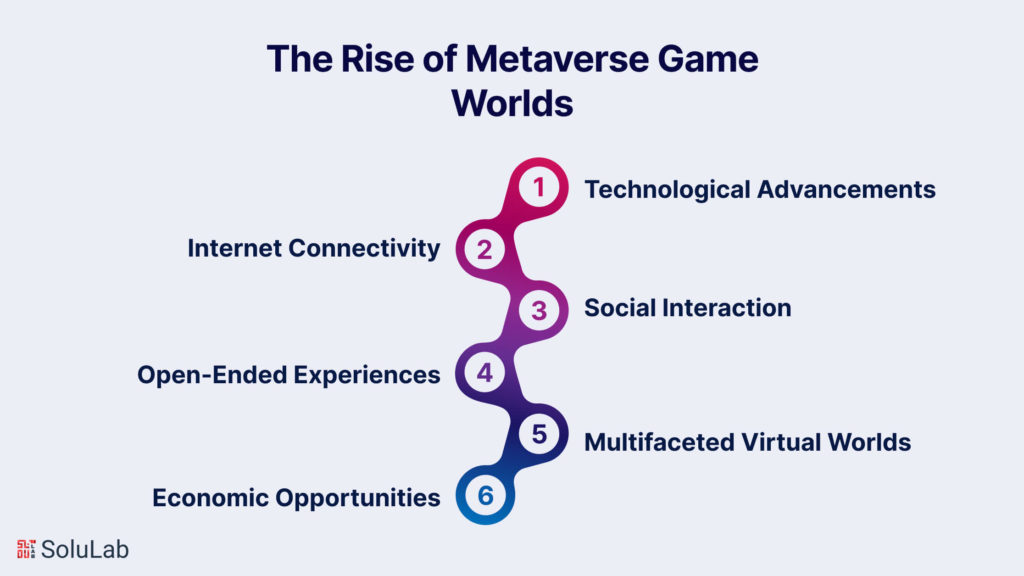
Why did metaverse game worlds take off so fast? No single reason. Several things matured at roughly the same moment, and together they made this kind of project possible for the first time.
- Technological Advancements: Graphics rendering got better. Networks got faster. Chips got more powerful. Put those together and you can finally ship the kind of rich, immersive experience that used to live only in concept art, running on hardware people already own.
- Internet Connectivity: Fast internet is now common in most places. That means a player in one country can team up, fight, or just chat with someone on the other side of the planet without much friction. A single shared digital universe used to be a pitch-deck fantasy. Now people log into versions of it every day.
- Social Interaction: Metaverse game worlds are not only about the gameplay. Much of the draw is social: meeting people, talking, building a group, making friends in ways that feel close to how it works offline. That mix of gaming and hanging out pulls in a much wider crowd than a pure game would.
- Open-Ended Experiences: Traditional games hand you a story and a goal. Metaverse games mostly don’t. You wander, you build, you invent your own reasons to be there, so no two sessions play out the same way. That freedom is the signature feature, and players love having the steering wheel.
- Multifaceted Virtual Worlds: These worlds do more than host games. They tend to be persistent, changing spaces where a concert can happen on Friday, a business meeting on Monday, and an art show or a class later in the week. At that point you’re not looking at a game anymore. You’re looking at a general-purpose digital place.
- Economic Opportunities: Metaverse game worlds create money-making room for builders and players both. Inside them, people make, sell, and trade virtual goods and currencies. And real-world brands keep showing up, some to invest, others to use the space for marketing or selling products.
So the rise of metaverse game worlds comes down to three forces meeting: better tech, social connection, and open-ended play. Developers and players have both bought in, because the canvas is far bigger than a traditional game. Keep that upside in mind as we get into the problems. The problems are real, but so is the reason people keep trying.
The Importance of Addressing Challenges
Building metaverse game worlds is hard, and not in just one way. The obstacles are technical, social, legal, and ethical, often all at once. Ignore them and the project may launch, but it won’t last. At this scale you can’t wing it. You need to understand what can break before it breaks. As top metaverse platforms keep attracting attention and money, anyone hoping to build something serious in metaverse development needs a clear view of these problems. The sections below go through them one by one, with practical ways to handle each stage of metaverse game world creation.
Technical Challenges in the Metaverse Game World
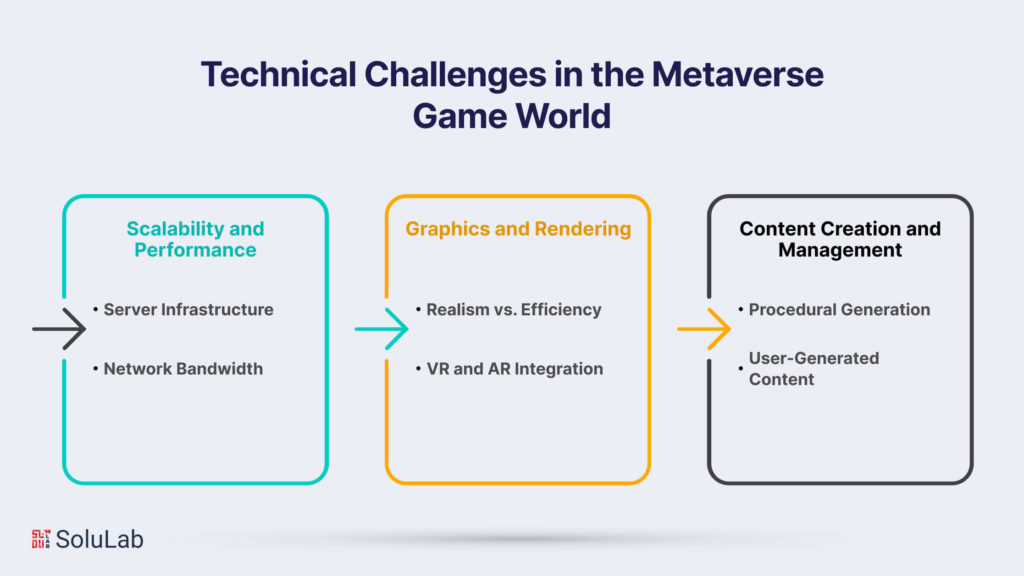
Start with the engineering. Building a huge digital world is one job. Keeping it running smoothly for thousands of people at once is a different and nastier job. If the tech stumbles, immersion goes first, and players notice right away. Here are the technical hurdles that come up again and again.
Scalability and Performance
- Server Infrastructure: Everything rests on the servers. They take the load from every user, every message, every interaction. For metaverse game development companies, spending on server infrastructure that can scale up and survive traffic spikes is not optional. The Virtual Reality Metaverse matters a lot here, since VR falls apart without fast, low-latency servers behind it. A few hundred milliseconds of lag and the headset stops feeling like a world.
- Network Bandwidth: The bigger the world gets, the more bandwidth it eats, and the growth is steep, not gentle. Data has to move in real time or interactions start to stutter. Augmented reality (AR) and Virtual Reality (VR) inside the metaverse depend heavily on a well-tuned network. Even in a mostly VR setting, Augmented reality comes into play too, because AR environments need data moved efficiently just as badly.
Graphics and Rendering
- Realism vs. Efficiency: Gorgeous visuals cut both ways. Push realism too far and frame rates crash on ordinary machines. Pull back too much and the world looks cheap. Teams handle this with techniques like Metaverse AI Integration, which scale rendering quality up or down depending on what the player’s hardware can take, so the experience stays smooth.
- VR and AR Integration: Most metaverse game worlds want to support both Virtual Reality (VR) and Augmented Reality (AR). That doubles the rendering headache. Each needs its own techniques to stay immersive and, in AR’s case, to interact with the physical room around the player. Keeping the experience consistent across headsets, phones, and PCs is one of the hardest parts, which is why Virtual Reality Metaverse work leans so hard on optimizing for VR.

Content Creation and Management
- Procedural Generation: A giant world with nothing in it is boring. Filling it by hand is slow and expensive. So many metaverse game development companies use procedural generation, where algorithms produce terrain, objects, and layouts on the fly. It saves a huge amount of manual work. The catch? Variety is easy to get. Quality is not. Algorithms happily spit out endless forgettable content. Metaverse AI Integration can help by tuning what gets generated to what players actually like and what their devices can handle.
- User-Generated Content: Letting players build and share their own stuff is central to many metaverse game worlds. It’s also a moderation nightmare. Someone has to check that uploads follow the rules and catch the offensive material before it spreads. Metaverse AI Integration is useful here as well, since AI-powered moderation and filtering can screen content at a volume no human team could keep up with, and that’s a big part of keeping the space safe and fun.
That’s the technical picture: lots of moving parts, each one able to ruin the experience on its own. Developers juggle all of them at once. The tools will keep improving, and the fixes will change with them, but the goal stays fixed: worlds that feel more creative and more alive every year.
User Engagement and Social Challenges
Across the metaverse gaming landscape, one rule holds: no community, no world. People come for the tech and stay for each other. Getting them to engage and keep engaging brings its own set of problems.
Community Building
- Building a Positive Community: Successful metaverse development depends on a community that’s welcoming and inclusive. Metaverse development companies put real effort into making people feel welcome, respected, and like they belong. That means rewarding good behavior, encouraging players to help each other, and making collaboration easy. People come to connect, learn, and have a good time. Let the mood turn sour and they leave.
- Moderation and Safety: Put huge numbers of strangers from every background in one space and trouble follows. Moderation and safety become core features, not add-ons. Metaverse development companies need solid moderation systems that deal with bad behavior and harmful content quickly. User safety has to come first, or nobody has a good time. And this ties straight back to the wider “Metaverse gaming landscape,” since it covers many platforms and communities, and each one has different moderation needs.
Monetization
- In-Game Purchases: Somebody has to pay for all this. Making money from metaverse game worlds is what keeps them running and growing. In-game purchases, whether virtual items, skins, or tickets to exclusive events, are the usual way metaverse development companies bring in revenue. The trick is not squeezing players. Get the balance right and spending feels like it adds to the fun. Get it wrong and it feels like a toll booth.
- Virtual Economies: Plenty of metaverse game worlds run full economies where players trade, buy, and sell virtual items or currencies. These look a lot like real financial systems, which means real financial problems: supply and demand swings, inflation, people trying to rig the market. Keeping that economy fair and stable is delicate, ongoing work for metaverse development companies. The metaverse gaming landscape keeps shifting, and handling engagement and social problems well is what lets people actually connect, work together, and enjoy themselves there. Manage the community and the money carefully, and you get worlds people care about today and still visit years from now.
Legal and Ethical Considerations
Then there’s the legal side, which catches a lot of teams off guard. Building metaverse game worlds raises plenty of legal and ethical questions for developers and players. Two stand out: staying on the right side of intellectual property law, and protecting user privacy and data.
Intellectual Property
- Copyright and Trademark Issues: Metaverse development companies have to watch closely for copyright and trademark problems. Drop a real brand, a hit song, or some other protected material into a world without the right permissions or licenses and you may end up in a legal fight. Both the people creating in the world and the original rights holders deserve protection.
- Licensing and Fair Use: Licensing is how creators get the rights to use content they didn’t make. In metaverse game development you need to actually read those agreements and understand where fair use begins and ends. The goal is simple to say and hard to do: respect other people’s IP while still leaving room for creativity inside the world.
Privacy and Data Security - Data Collection and User Privacy: Metaverse development companies tend to gather a lot of user data, both to improve the experience and to support different metaverse use cases and benefits. But privacy still matters, and so do data protection laws. Be upfront about what you collect, lock that data down, and ask for consent properly. That’s how you keep users’ information safe and earn their trust.
- Cybersecurity Concerns: As these worlds get bigger and more popular, they become juicier targets for attackers. Data breaches, hacks, and other attacks are a constant worry, and the threats keep changing. Metaverse development companies need serious security and the discipline to keep updating it as new threats show up.
The metaverse keeps expanding into more metaverse use cases and benefits, so these legal and ethical questions will only grow. Developers and users have to work on them together. Get it right and metaverse game worlds can grow inside a framework that respects IP and protects privacy and data, which is what makes people trust the place enough to stay.
The Role of AI and Automation
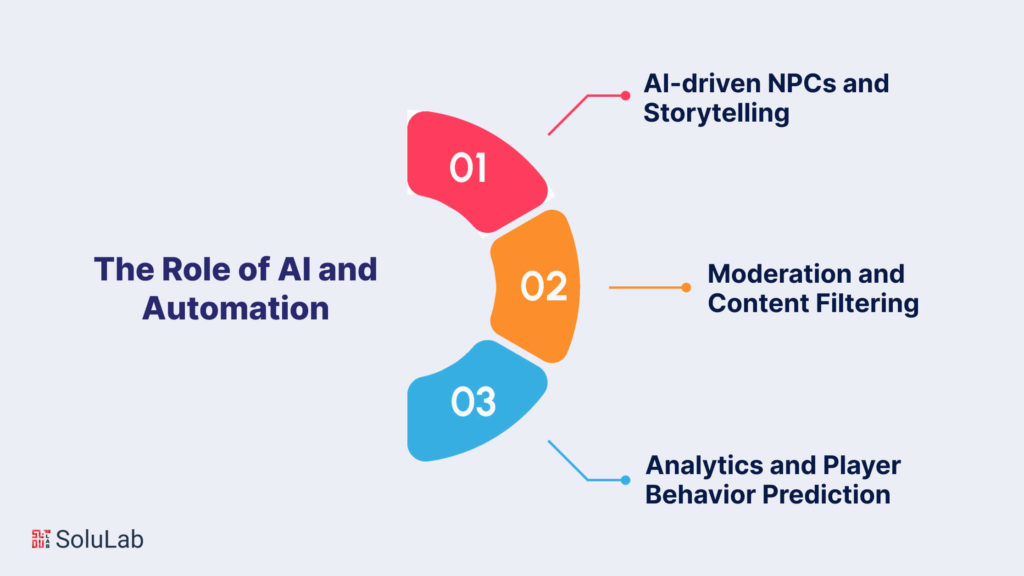
In metaverse development, AI (Artificial Intelligence) and automation now do a lot of the heavy lifting. They change how the experience feels, cut down on manual work, and take the edge off several of the problems above. Three areas matter most.
AI-driven NPCs and Storytelling
Non-Playable Characters (NPCs) run by AI hold a lot of these worlds together. They shape how the experience feels, push stories forward, and give players someone to actually interact with. A good AI-driven NPC reacts to what you do. It can bend the story around your choices, so you feel like your actions count. That’s where Metaverse AI Integration earns its keep: believable, responsive characters and stories that go well past what a scripted game can offer.
Moderation and Content Filtering
A safe world needs good moderation. Simple as that. AI now does much of the grunt work. Metaverse development companies run AI models that scan uploads, flag problems, and filter out content that breaks community rules. Players get a friendlier, safer space, and human moderators stop drowning in reports. Here, Metaverse AI Integration is less a nice extra and more a basic requirement for running a responsible, user-friendly world.
Analytics and Player Behavior Prediction
AI analytics can turn mountains of player data into something useful: what people like, how they play, where trends are heading. Teams use that to shape in-game content and to spot trouble early. AI can flag likely harassment or cheating, so metaverse development companies can step in before it spreads. Once again, Metaverse AI Integration is what makes this possible, reading behavior, predicting what comes next, and improving the experience overall.
Across metaverse development, AI and automation push things forward, making worlds more personal, safer, and more alive. As the metaverse matures, smart NPCs, stronger moderation, and predictive analytics working together will do a lot to produce game worlds that center the player and are fun without being reckless.
Strategies for Overcoming Challenges of Building Metaverse Game World
The metaverse gaming industry throws a lot of tangled problems at anyone building in it. So how do you get through them? For metaverse development companies and their partners, it comes down to three habits: work with others, be open with users, and never stop improving. Here’s what each looks like in practice.
Cross-Industry Collaboration
No single company has every skill the metaverse demands. That’s why partnering across industries works so well. The problems span too many fields for one team to solve alone. Metaverse development companies should work with technology specialists on the hard engineering: server infrastructure, rendering, network efficiency. Partnering with entertainment companies can bring in content nobody else has, the kind of experience that pulls people in and grows a community. Legal experts cover the rest, guiding teams through the thorny legal and ethical ground around intellectual property and data privacy. The challenges in metaverse gaming are exactly why this mix of disciplines matters, because the problems themselves keep changing shape.
Transparency and User Education
Trust in the metaverse gaming industry starts with honesty. Tell people plainly how their data is used, what your privacy policy says, and what the community rules are. Metaverse development companies should spell out how user data is collected, stored, and used. That kind of openness speaks directly to privacy and security worries, and it makes the whole space feel safer. User education belongs right alongside it. Players who understand how things work make better choices. They behave more responsibly, follow the rules more often, and have a realistic picture of both the risks and the rewards of metaverse gaming. Look closely at the challenges in metaverse gaming and you’ll see how much a responsible, trusting community depends on these two habits.
Continuous Innovation and Adaptation
Standing still is how you lose in the metaverse gaming industry. The problems keep moving: new security threats, new moderation headaches, new technology arriving every few months. Metaverse development companies have to stay close to the cutting edge so they can get ahead of issues instead of reacting to them. Sometimes innovation means adopting Metaverse AI Integration to improve moderation, sharpen the user experience, and smooth out gameplay. Adaptation keeps worlds flexible, quick to respond to what players want, and ready for whatever trend comes next. The challenges in metaverse gaming make this habit mandatory for any metaverse development company that wants to survive in a fast, crowded market.
Put these habits to work and metaverse development companies can take on the full spread of problems in the metaverse gaming industry. Partnerships, openness, user education, and steady improvement reinforce each other. Together they help the community get past obstacles, build trust, and grab new opportunities as the field keeps changing.

Final Words
Building metaverse game worlds is a mix of huge opportunity and genuinely hard problems. The metaverse keeps gaining ground in gaming and tech, and the teams that do well treat it as a strategic project, not a side experiment. They partner across disciplines, stay honest with users, and keep improving. This is more than a new kind of game. It’s a living digital world full of ways to interact, and that’s exactly why the technical, social, legal, and ethical details matter so much.
Metaverse development companies and creators are right at the front of this shift. AI and automation already do a lot of the work behind immersion, moderation, and understanding how players behave. If builders keep up with the technology, partner beyond their own industry, and put users’ well-being first, these worlds can keep growing and changing for a long time. Solve the hard problems and the payoff is real: interactive spaces where creativity and community grow together.
SoluLab, as a Metaverse game development company, helps shape the metaverse with solutions built for immersive digital experiences. The team knows where these projects get complicated, and brings experience across software development, artificial intelligence, and blockchain to build modern applications and platforms. Its metaverse work covers environments that scale, stay secure, and feel easy to use, with AI, automation, and data analytics built in so game worlds run smoothly and stay fun. That includes AI-driven NPCs, advanced content moderation, and predictive analytics that lift engagement and keep players safe. SoluLab looks at metaverse development end to end, helping businesses and creators build dynamic, inclusive game worlds that change how people interact and play online.
FAQs
Shipra Garg is a tech-focused content strategist and copywriter specializing in Web3, blockchain, and artificial intelligence. She has worked with startups and enterprise teams to craft high-conversion content that bridges deep tech with business impact. Her work translates complex innovations into clear, credible, and engaging narratives that drive growth and build trust in emerging tech markets.