Look, if you’re running a fintech or Web3 company right now and you’re not seriously considering a white-label crypto wallet launch in Singapore, you’re honestly leaving serious money on the table. Here’s why this matters to you immediately
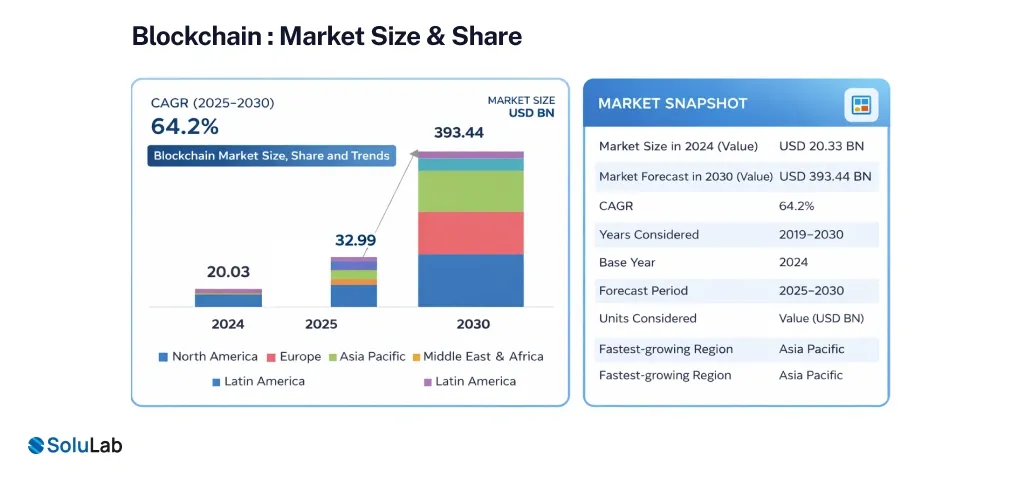
| The global blockchain market just hit $67.4 billion in 2026, and it’s growing at 85.9% year-over-year. More importantly, enterprises, actual Fortune 500 companies, are deploying blockchain infrastructure faster than ever before. JPMorgan alone processes $1.5 trillion annually through its blockchain network. That number keeps growing. |
Singapore isn’t just another jurisdiction. It’s become the financial tech capital of Asia-Pacific, and the Monetary Authority of Singapore (MAS) has built one of the world’s clearest, most investor-friendly regulatory frameworks for crypto wallet development in Singapore. And it means you can launch a fully regulated, enterprise-grade wallet solution in weeks, not years. Just as you read, your competitors are already moving. The question is whether you will too.
Key Takeaways
- Singapore’s robust regulatory clarity, progressive licensing, and strong financial ecosystem make it ideal for white-label crypto wallets.
- Wallets launched in Singapore benefit from broader market access, seamless fiat on/off ramps, and higher institutional trust, eventually boosting user growth and monetization.
- SoluLab builds Singapore-ready white-label crypto wallets with licensing support, secure architecture, and revenue-driven features, helping businesses launch faster and scale profitably.
Why Singapore Is a Prime Market for White-Label Crypto Wallet Businesses?
The timing is honestly critical. Singapore established itself as a crypto-friendly hub back in 2019, but 2026 is different. The regulatory environment has matured, and the technology is battle-tested. Most importantly, enterprise demand has shifted from should we do this? How do we do this quickly?
1. Regulatory Maturity Has Replaced Uncertainty
- The Monetary Authority of Singapore finalized the Payment Services Act (PSA) in 2019 and the Financial Services (Markets) Act (FSMA) framework in 2022.
- By June 2025, all legacy compliance deadlines passed.
2. Singapore Offers What the US and EU Still Don’t: Clarity
Compare this to the EU’s MiCA framework, which keeps companies guessing. Or the US, which still doesn’t have a unified federal crypto banking framework. Singapore? Clear rules. Licensed Payment Institutions (PIs) can operate legally, hold customer assets, and scale. That regulatory clarity is worth millions in risk mitigation to your potential clients.
3. First-Mover Advantage Is Still Available
The second reason to move now: launch white label crypto wallet in Singapore while your competitors are still evaluating, where the regulatory framework attracts serious money. Institutions that would never touch crypto infrastructure in sketchy jurisdictions are actively looking to Singapore. Your first-mover advantage in your vertical or geography could define the next 3-5 years of your revenue.
4. Tokenization Is Moving from Theory to Infrastructure
- Real-world assets (RWA) are projected to hit $18.9 trillion by 2033.
- Enterprises need wallets that can hold, trade, and settle tokenized securities, commodities, and even real estate.
- Singapore’s clarity on stablecoin regulation (over SGD 5 million in circulation requires a Major Payment Institution license) means you can build that infrastructure here without regulatory backlash.
And let’s be honest: client trust matters. When a Fortune 500 company evaluates wallet providers, they look at jurisdiction, regulatory status, and compliance rigor. Singapore ranks in the top 3 globally for crypto regulatory excellence. That’s a competitive fact, and your Singapore license becomes your sales tool.
Why Choose a Regulated Crypto Wallet Solution Singapore for Fast Market Entry?
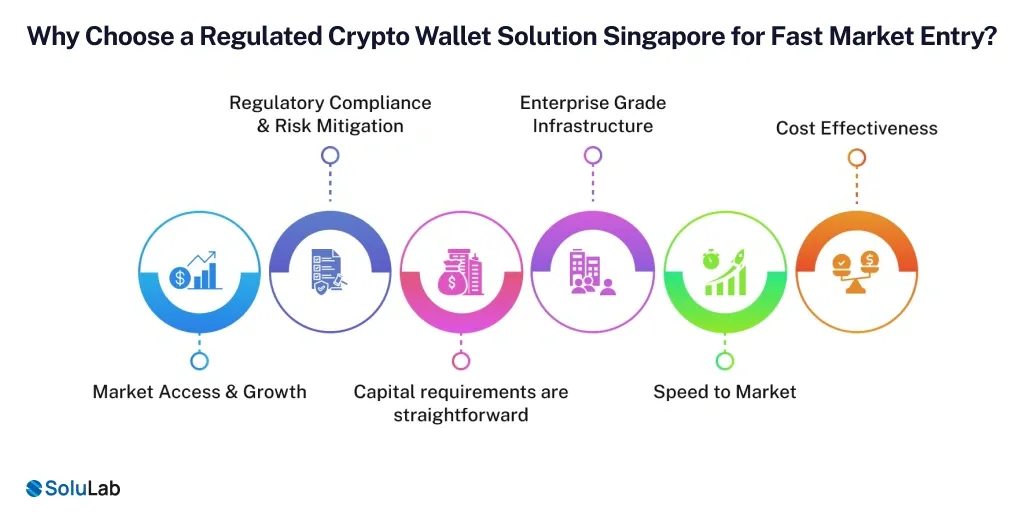
1. Market Access & Growth
When you have a white-label cryptocurrency wallet app licensed by MAS, you don’t just get Singapore. You get the entire ASEAN region – 650 million people, a rapidly growing digital economy, a massive unbanked population, and a desperately underdeveloped payment infrastructure. Singapore licenses don’t restrict geographic reach; they provide regulatory credibility that extends across borders. Your wallet can serve customers in Thailand, Malaysia, Indonesia, Philippines, and Vietnam from a Singapore base.
The enterprise appetite is real. Singapore processes over $2.2 trillion in annual cross-border transactions. Companies here move money across five continents daily. They need fast, cheap, compliant settlement infrastructure. That’s exactly what a regulated crypto wallet does.
2. Regulatory Compliance & Risk Mitigation
This is the unsexy-but-absolutely-critical benefit. MAS compliance isn’t just a checkbox—it’s your liability insurance, your customer trust signal, and your competitive moat. When you build a crypto wallet solutions platform with built-in MAS-compliance architecture, you solve the biggest headache your enterprise clients face: regulatory risk.
Here’s what MAS requires, and why it matters: AML/CFT screening (Anti-Money Laundering, Counter-Terrorism Financing), KYC/CDD protocols (Know Your Customer, Customer Due Diligence), cybersecurity frameworks, business continuity planning, and capital adequacy requirements.
Sounds heavy, right? But here’s the thing, these aren’t obstacles, they’re features. They mean your platform can operate in any jurisdiction that respects FATF standards. That’s 200+ countries, and if you build for Singapore’s standard, you can scale globally with minimal additional compliance work.
3. Capital requirements are straightforward:
- Money-Changing License: SGD 100,000 (~$74,000 USD)
- Standard Payment Institution: SGD 250,000 (~$185,000 USD)
- Major Payment Institution (full custody): SGD 5 million (~$3.7 million USD)
That’s transparent. Manageable. No hidden costs. Compare that to the US, where fintech licensing varies by state and can cost 5-10x more.
4. Enterprise-Grade Infrastructure
When you launch a MAS-compliant white-label crypto wallet platform, you’re not building consumer apps. You’re building for institutions. That changes everything about architecture, security, and feature requirements.
Enterprise clients need:
- Multi-signature authorization for all transactions
- Hardware wallet integration (Ledger, Trezor, Thaïs, etc.)
- Real-time settlement and instant liquidity
- Treasury management dashboards (profit/loss, exposure analysis, hedging)
- API-first architecture for seamless ERP integration
- Audit trails that satisfy SOC 2 Type II requirements
- 99.99% uptime SLAs
Singapore’s white-label providers have refined this over the years. You get battle-tested architecture that’s already integrated with major stablecoin networks (USDC, USDT, SGDₑ, etc.), DeFi protocols, and traditional settlement rails. You’re not starting from scratch, but you’re deploying proven infrastructure.
5. Speed to Market
Building a white label wallet solutions platform from scratch takes 18-24 months. Launching a white-label crypto wallet development solution through an established provider takes 8-16 weeks. That’s not a small difference; that’s the difference between your competitor capturing market share and you entering the market competitively.
Why is Singapore-based white-label deployment so fast? Because the infrastructure exists. The regulatory pathway is proven, and the KYC/AML integrations are pre-built. You’re not pioneering, you’re deploying. That speed translates directly to revenue: every month you’re living faster than competitors is a month of customer acquisition advantage.
6. Cost-Effectiveness
Here’s the financial reality: building crypto wallet software in Singapore in-house costs $2-5 million for an MVP. Hiring security auditors, hiring blockchain engineers, hiring compliance specialists, it compounds fast. Regulatory consulting alone can run $500K-$1M.
White-label deployment? $150K-$500K for licensing, infrastructure setup, and compliance integration. You’re looking at 80-90% cost savings versus native development. That’s capital you can redeploy into sales, marketing, or product differentiation.
And the ongoing operational costs are lower, too. You’re not hiring a full blockchain engineering team. You’re not managing security patches across the entire stack. The provider handles that. You focus on what matters – client success and revenue growth.
How Does a Regulated Crypto Wallet Solution in Singapore Boost Client Trust and Adoption?
Let me walk you through Singapore’s regulatory framework because this is genuinely what separates Singapore from every other jurisdiction in Asia, and most jurisdictions globally.
The MAS doesn’t treat crypto as a gambling game or a speculative commodity. It treats it as financial infrastructure. That matters profoundly for enterprise clients.
The Three License Types
| License Type | Capital Requirement | What You Can Do | What You Can’t Do | Best Fit / Use Case |
| Money-Changing License | SGD 100,000 | Buy and sell cryptocurrency, operate trading or exchange services, and support remittance flows | Cannot custody customer funds | Best if you want to offer spot trading or exchange services without holding user assets. Fastest approval and lowest operational overhead. |
| Standard Payment Institution (SPI) | SGD 250,000 | Money transfer services, limited custody for payment purposes, stablecoin settlement, and payment processing | Not suitable for full custody or large-scale wallet platforms | Ideal for cross-border payments and settlement use cases without becoming a full custodian. |
| Major Payment Institution (MPI) | SGD 5,000,000 | Full custody of customer funds, all digital asset services, stablecoin issuance (over SGD 5M circulation), enterprise-grade wallet infrastructure | Higher capital and compliance obligations | Built for enterprises aiming to launch complete financial platforms with custody, wallets, and regulated scale. |
Here’s what enterprise clients care about: all three license types carry the same regulatory credibility. There’s no license tier stigma. An MAS-licensed Standard Payment Institution is just as legally defensible as a Major PI, and you choose based on your business model, not regulatory hierarchy. That’s excellent design.
Compliance Architecture That Actually Works
| Compliance Area | What MAS Requires | How It Works in Practice | Why It Matters for You |
| AML / CFT | Real-time monitoring, suspicious activity reporting, and beneficial ownership checks | Automated transaction screening across OFAC lists, sanctions databases, and behavioral analytics. Compliance AI handles false positives instead of manual queues | Continuous compliance without slowing operations, lower regulatory risk, and faster scale |
| KYC / CDD | Identity verification, source-of-funds checks, ongoing risk assessment | Clear documentation standards remove ambiguity around “reasonable diligence.” Everything is predefined and auditable | Faster onboarding, fewer compliance surprises, and predictable audits |
| Cybersecurity | MFA, encryption, penetration testing, incident response plans | Security is designed into the platform from day one instead of being added later | Real protection, not security theater, reduces breach risk and client trust issues |
| Capital & Reserves | Minimum capital held as cash, government securities, or MAS deposits | Reserves are ring-fenced, so customer funds remain protected during operational or market stress | This is why insurers, pension funds, and institutions trust Singapore platforms over unregulated ones |
What Are the Key Technical Must-Haves for a MAS-Compliant White-Label Crypto Wallet Platform?
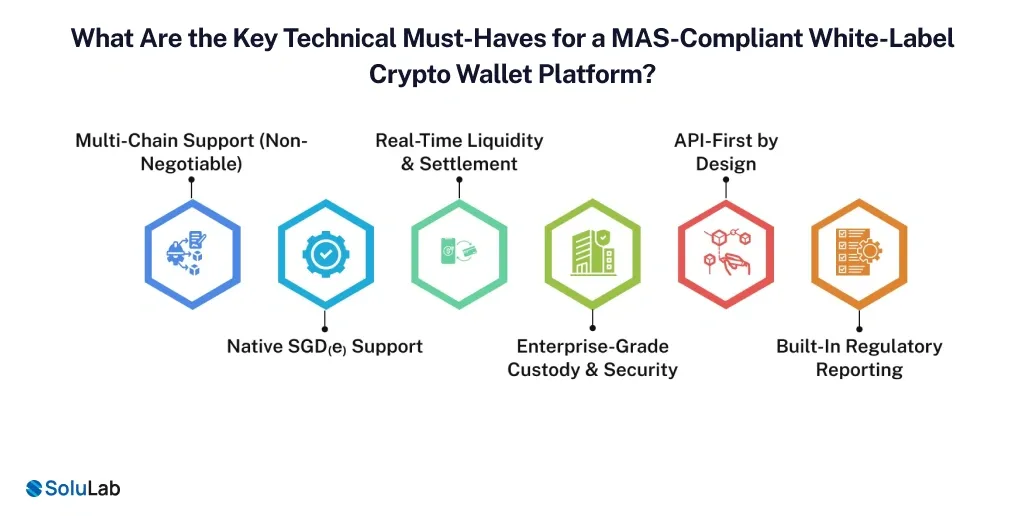
Let’s keep this practical. When you’re choosing a white-label provider or building for Singapore, these are the technical things enterprises actually care about.
1. Multi-Chain Support (Non-Negotiable)
Your wallet must support Ethereum, Polygon, Solana, and Bitcoin. Enterprises hold assets across chains – USDC on Ethereum, USDT on Polygon, SOL on Solana, BTC on Bitcoin. Single-chain wallets don’t survive enterprise conversations.
2. Native SGD₍e₎ Support
Singapore-focused wallets increasingly support SGD₍e₎, the on-chain Singapore Dollar issued under MAS oversight. This lets enterprises settle in local currency without forex friction, which is operationally cleaner and surprisingly powerful as a sales advantage.
3. Real-Time Liquidity & Settlement
Enterprises expect instant settlement. That means:
- Direct DEX liquidity (Uniswap, Curve, Balancer)
- Cross-chain bridge integrations
- Stablecoin on-ramps connected to banking rails
Moving $10M across borders should take minutes, not days. That’s table-stakes now.
4. Enterprise-Grade Custody & Security
Institutions expect this by default:
- Multi-sig approvals (2-of-3, 3-of-5)
- Cold storage for most assets
- Hardware custody (Fireblocks, Ledger Vault)
- Asset segregation, audit trails, and insurance coverage
Anything less feels retail, and enterprises won’t engage.
5. API-First by Design
Enterprises don’t want your UI; they want integration. REST APIs, WebSockets, webhooks, and SDKs are mandatory. Strong versioning and backward compatibility matter more than new features.
6. Built-In Regulatory Reporting
MAS requires 5+ years of transaction records, identity-linked trails, and automated compliance reporting. When this is built into the data layer early, audits stop being painful.
Where This Actually Gets Used
| Use Case | What Changes with Crypto Wallets | Business Impact |
| Cross-Border Payments | Stablecoins replace slow wire transfers | Fees drop from 0.5–2% to ~0.1–0.3%, and settlement moves from days to minutes |
| Treasury & Liquidity Management | Regulated access to on-chain yield | Even 1% extra yield on $100M in reserves creates meaningful annual returns |
| Tokenized Assets (RWA) | Custody and settlement of tokenized assets | Institutions can participate in tokenized real estate, bonds, and commodities without regulatory risk |
How Can You Build White Label Crypto Wallet in Singapore Within 90 Days?
Let’s be concrete about the timeline. Here’s what a realistic 90-day build white label crypto wallet in Singapore deployment looks like:
| Timeline | Phase | Key Activities |
| Week 1–2 | Foundations | Finalize business requirements and use cases, prepare MAS licensing application, sign white-label agreements, set up development environment, review compliance framework |
| Week 3–4 | Integration & Architecture | API integration testing, KYC/AML setup (Veriff, Jumio, or equivalent), wallet infrastructure deployment, security audit planning, initial UI/UX customization |
| Week 5–6 | Regulatory Compliance | Submit MAS application, complete AML/CFT policies, document business continuity plans, define incident response protocols, conduct staff compliance training |
| Week 7–8 | Testing & Hardening | End-to-end transaction testing, security penetration testing, performance and load testing, pilot user acceptance testing, compliance checklist validation |
| Week 9–10 | MAS Approval & Go-Live Prep | Receive MAS approval (assuming no material issues), finalize compliance verification, prepare production infrastructure, create onboarding materials, train support teams |
| Week 11–12 | Go-Live & Optimization | Launch platform, onboard customers, enable real-time monitoring, optimize performance, set up regulatory reporting, conduct initial operational review |
This timeline assumes you’re using an established white-label provider and not building from scratch. If you’re building native infrastructure, add 12-18 months and multiply costs by 8-10x. The math is straightforward: white-label is faster, cheaper, and lower-risk.
Conclusion
Singapore in 2026 presents a rare convergence of factors – mature regulatory clarity, enterprise demand for infrastructure, established technical solutions, and first-mover advantages in regional deployment. This isn’t going to stay this way forever. The question for decision-makers reading this is straightforward: do you move now, or do you wait and compete on price later?
If you’re a fintech founder, a wealth management firm, a payment processor, or any financial services company, a white-label wallet provided like SoluLab in Singapore is becoming table-stakes. The question is, who moves first to work on Wallet?
FAQs
With over 3 years of experience, I specialize in breaking down complex Web3 and crypto concepts into clear, actionable content. From deep-dive technical explainers to project documentation, I help brands educate and engage their audience through well-researched, developer-friendly writing.