Key Takeaways
- The Status Quo: Many financial institutions are interested in DeFi but hesitate due to regulatory uncertainty, security concerns, fragmented infrastructure, and compliance risks.
- Growing Institutional Interest: Regulated DeFi is gaining momentum as banks, fintech firms, and asset managers explore tokenized assets, on-chain settlements, and programmable finance models.
- What We Do: Modern blockchain development and AI development solutions help institutions launch regulated DeFi pilots with automated compliance workflows, risk monitoring, and scalable digital asset systems.
- Why Speed Matters: Launching DeFi pilots within 6 to 8 weeks allows enterprises to validate business models, test user adoption, and evaluate operational efficiency without long development cycles.
- Enterprise Benefits: Regulated DeFi pilots can improve transparency, reduce settlement time, automate financial operations, and unlock new revenue opportunities through tokenized ecosystems.
- Why SoluLab: SoluLab helps enterprises build compliance-ready DeFi platforms with blockchain development, tokenization solutions, AI integration, smart contract development, and enterprise-grade security infrastructure.
Every technology wave starts the same way. A small group gets curious. A few prototypes get built. Then suddenly, the question stops being “Is this interesting” and becomes “Why are we not moving?”
For institutional teams exploring DeFi development, that pressure usually lands in one sentence:
We understand the upside. Instant settlement. Programmable collateral. New yield mechanics. But we cannot ship anything that Compliance cannot sign off on.
That tension is not a blocker. It is the whole point.
Innovation wants motion. Risk wants certainty. Institutions live in the space between them, where every “yes” needs a control, an owner, an audit trail, and a way to unwind. That is why most DeFi initiatives stall when real stakeholders enter the room: Compliance, Legal, Security, Risk, Treasury, and sometimes Procurement.
Here is the good news. You do not need to jump from DeFi curious to a production platform.
A regulated, compliance-ready DeFi proof of concept can be built in 6 to 8 weeks if you treat it like a pilot-grade system with real controls, scoped risk, and evidence you can hand to reviewers. Not a demo dressed up in institutional vocabulary. A small system that behaves like the real thing in the ways that matter most.
This guide lays out a practical blueprint your CTO, Compliance, and Product teams can use to align quickly on scope, architecture, roles, and budget. The goal is not to prove DeFi is exciting. The goal is to prove a compliant DeFi flow can run inside your risk constraints, with observable controls, and with clear operational ownership.
What Does Compliance-Ready Mean in a DeFi Pilot?
In institutional contexts, compliance rarely means “we read some regulations.” It means three non-negotiables are demonstrably true.
Who is allowed to use this is enforceable?
Institutions cannot rely on social agreements or loose onboarding. Access must be enforceable, testable, and revocable. In practice, this often includes:
- KYC or KYB checks for every participating entity
- Eligibility rules for who can interact with the pools or contracts
- Allowlisting of wallets, institutions, or specific counterparties
- Sanctions screening and ongoing monitoring hooks
- Accreditation constraints were relevant
- Role-based access for internal operators, approvers, and auditors
The key shift is this: you are not just verifying identity. You are enforcing participation rules at runtime.
What happened is provable?
Institutions do not approve narratives. They approve evidence.
A pilot must produce artifacts that survive internal review and can be reconstructed after the fact what DeFi trends say. That means:
- Immutable event trails for user actions and admin actions
- Audit logs that capture who did what, when, and why
- Risk signals that can be monitored and thresholded
- Alerts that trigger when limits are crossed or anomalies appear
- Reporting outputs that map activity to internal control language
If an incident occurs, your reviewers will ask two questions immediately:
- What exactly happened
- How do we know
Your system needs to answer both without improvisation.

What are the rules enforced at the edges?
A compliance-ready pilot is not only about the smart contracts. It is about the control points around them.
Institutions typically require enforceable rules such as:
- Custody constraints and approval policies for signing transactions
- Transfer limits, caps, and velocity rules
- Travel Rule obligations where applicable to the flow
- Incident response readiness, including pause and unwind controls
- Clear ownership of control points across teams
This is where many pilots become unreviewable. They build a decent chain flow, but the boundaries are soft. Nobody can confidently say who can stop it, who can approve it, and what happens if something goes wrong.
The reality
Regulators globally are pushing for transparency from day one. Institutions respond by demanding the same internally. That leads to a simple truth:
Institutions do not approve concepts. They approve observable systems.
If your pilot cannot demonstrate controls with evidence, it will stall regardless of performance, yield, or technical elegance.
Before You Build Anything, Answer This: What Are We Proving?
The most common failure mode is building to “show DeFi” instead of building to prove institutional viability.
A strong institutional pilot has one job:
Prove a compliant, observable DeFi flow can run inside your risk constraints. That sounds obvious, but it changes everything about how you scope.
Define success in one sentence
If you cannot explain the success criteria in 30 seconds, you are not ready to build. Examples of 30 second success criteria that institutional teams actually approve:
A whitelisted set of counterparties can deposit stablecoins into an allowlisted pool, accrue returns, and withdraw, with full audit logs and enforceable caps.
A permissioned borrow flow can be executed end to end with policy approvals, on chain access gating, monitoring alerts, and a tested unwind path.
A treasury team can run a capped, controlled allocation via stablecoin rails with dashboards that show every material action and every exception.
Notice what is missing. None of these lead with yield. They lead with controls and observability.
What a defensible pilot scope usually looks like?
Institutions move faster when the pilot is intentionally narrow and boring in the right ways.
A defensible first pilot often includes:
- Whitelisted counterparties only
- Stablecoin-only rails such as USDC
- Caps per wallet and per institution
- No retail UX, internal console only
- Monitoring, alerts, and reportable activity from day one
- A clear unwind path and an emergency pause mechanism
You are proving that the machine can be governed. Not that the machine can run fast.
The pilot is not the product
This is a critical alignment point for stakeholder management.
A pilot exists to answer a bounded set of institutional questions:
- Can we enforce who is allowed to participate
- Can we prove what happened with credible logs and artifacts
- Can we enforce operational rules at the boundaries
- Can we stop and unwind safely
If the pilot answers those questions, you win the right to expand scope. If it does not, the program becomes a permanent discussion.
Turn assumptions into a review checklist
A practical move that de risks the entire build is to convert assumptions into a checklist that Compliance can react to early.
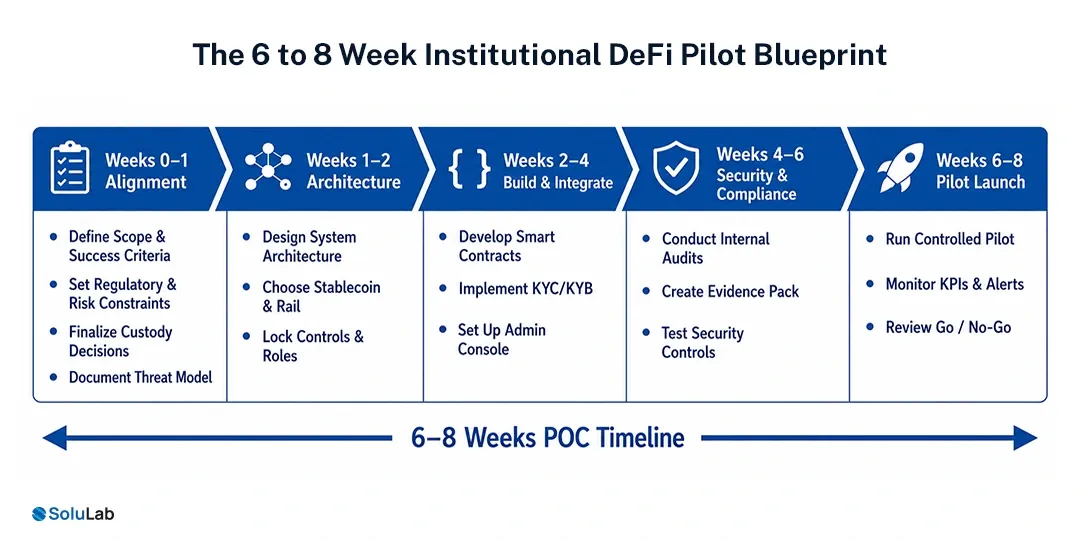
The 6 to 8 Week Institutional DeFi Pilot Blueprint
The reason institutional DeFi pilots stretch into 9 month “explorations” is rarely technology. It is ambiguous.
- Ambiguity around custody.
- Ambiguity around who signs.
- Ambiguity around what is in scope.
- Ambiguity around who owns risk.
A structured 6 to 8 week blueprint works because it compresses uncertainty early. It forces architectural decisions before code is written. It produces review artifacts alongside features, not after them.
Here is what a realistic institutional pilot timeline looks like when executed with discipline.
Weeks 0 to 1: Alignment Before Code
Most pilots quietly fail here.
Not because the idea is wrong.
But because different stakeholders are solving different problems.
- Engineering wants to prove the contracts work.
- The product wants to prove user value.
- Compliance wants to prove exposure is bounded.
- Security wants to prove nothing is leaking.
- The Treasury wants to prove funds are safe.
If those objectives are not reconciled in Week 1, they will collide in Week 5.
The real objective of Week 1
Week 1 is not about excitement. It is about removing ambiguity before it becomes expensive.
By the end of Week 1, you should have:
- A clearly defined POC scope
- Success criteria written in plain language
- Regulatory assumptions documented
- A high level threat model
- Named owners for every control surface
- A decision log covering custody model, participation model, and stablecoin rail
This decision log becomes one of the most important artifacts in the entire pilot. It shows reviewers that architecture was intentional, not accidental.
Custody and access control decisions harden early
One scar tissue insight from institutional pilots: custody and access control decisions made casually in Week 1 often become long term constraints.
Examples:
- Choosing a basic multisig without policy enforcement may limit future operational scaling
- Allowing flexible participation models may complicate regulatory classification
- Deferring decisions on wallet ownership may create legal ambiguity
Alignment means confronting these tradeoffs early.
Who must be in the room?
This is not an engineering workshop. It is an institutional design session.
Core participants should include:
- Product lead
- Compliance advisor
- Security lead
- Blockchain architect
- Representative from Risk or Treasury
The goal is not to reach a consensus on every detail. It is explicit agreement on boundaries. If someone says, “We assumed that would be decided later,” you are not ready to leave Week 1.
Weeks 1 to 2: Architecture That Compliance Can Review
This is where requirements stop appearing mid build.
Once alignment is locked, architecture decisions must be formalized in diagrams and flows that Compliance and Security can review. This is the difference between a demo and a compliance ready institutional DeFi architecture.
Lock these structural decisions
Institutional pilots typically require early resolution of:
- Permissioned versus permissionless participation
- Custody model and signing authority
- Stablecoin and settlement rails
- Allowlists, transaction caps, and velocity controls
- Role based access for operators, approvers, and auditors
- Monitoring and reporting design
If these remain abstract, developers will fill in gaps with assumptions. Those assumptions often contradict regulatory intent.
Deliverables that prevent rework
By the end of Week 2, you should have artifacts that make the system reviewable.
These usually include:
- A high level architecture diagram showing custody, contracts, policy engines, and monitoring
- Two to three sequence flows such as onboard to deposit to earn, or borrow to unwind
- A data and logging schema mapping events to control objectives
- An evidence checklist aligned with compliance requirements
These deliverables serve two purposes.
First, they clarify design for blockchain engineers.
Second, they allow Compliance and Security to react before build effort compounds.
Architecture as a trust signal
Institutional reviewers are not evaluating Solidity syntax. They are evaluating control posture.
An architecture diagram that clearly shows:
- Access gating before contract interaction
- Policy engines authorizing transactions before signing
- Segregation of operator and approver roles
- Monitoring hooks and reporting layers signals maturity.
It tells stakeholders this is not a crypto experiment. It is a controlled financial system implemented on new rails.
Weeks 2 to 4: Build the Thin Slice That Proves Controls
Now code begins. But it begins with restraint.
The objective of Weeks 2 to 4 is not feature richness. It is building the smallest end to end workflow that demonstrates enforceable controls.
Think of it as a thin slice through the system.
What a thin slice usually includes?
For most institutional DeFi pilots, this includes:
- Smart contracts with access gating and pausability
- On chain allowlists or attestation layers
- KYC or KYB integrations that write permissions to wallets
- Admin tooling for managing institutions and transaction limits
- Event indexing to support monitoring and alerting
Each of these components must be implemented with reviewability in mind.
Patterns regulated teams consistently prefer
Across banks, fintechs, and asset managers, certain design patterns appear repeatedly in institutional DeFi pilots:
- Whitelisted pools instead of open liquidity
- Off chain policy engines that authorize transactions before signing
- MPC or HSM backed wallets with approval workflows
- Clear role separation between operator, approver, and auditor
- Caps enforced both at the contract layer and at the policy layer
Redundancy in controls is not inefficiency. It is defense in depth.
Build for explainability
One of the most underestimated design criteria is explainability.
If you cannot walk a Compliance officer through:
- Who can initiate a transaction
- Who must approve it
- What checks run before execution
- What logs are produced after execution
- How the system can be paused
In a whiteboard session, the pilot will struggle during review. In institutional contexts, elegance matters less than clarity.
By the end of Week 4, you should have a working, minimal flow that:
- Enforces participation rules
- Processes a controlled transaction
- Produces audit artifacts
- Supports pause and unwind
At this stage, the system is not ready for capital scale. But it is ready for scrutiny.
Weeks 4 to 6: Security and the Compliance Evidence Pack
At this point, most of the technical pieces exist. Smart contract development and deployment is done in a controlled environment. Allowlisting works. Policy checks trigger. Logs are being generated.
But here is where many pilots quietly collapse. Because what was built is functional.
But it is not yet reviewable.
Weeks 4 to 6 are about converting a working system into an approvable system.
Security: Assumptions Are the Real Risk
Institutional security reviews rarely fail because of broken cryptography. They fail because of undocumented assumptions.
Examples that trigger red flags:
- Unclear ownership of admin keys
- No documented process for rotating signing authority
- Implicit trust in an off chain service without fallback logic
- Monitoring that exists but has no defined response workflow
- Emergency pause that is technically possible but operationally undefined
A structured security phase typically includes:
- Static analysis of smart contracts
- Unit tests and invariant tests
- Role based access validation
- Key management review
- Internal security checklist walkthrough
- Optional targeted external review for critical contracts
The goal is not to achieve theoretical perfection. The goal is to remove ambiguity.
- If something breaks, can we explain the blast radius?
- If a key is compromised, what happens next?
- If a policy engine fails, does the system fail safe or fail open?
Institutions care deeply about fail modes.

The Compliance Evidence Pack
This is one of the most important but least discussed artifacts in institutional DeFi development.
You are not just delivering code. You are delivering evidence.
A strong Compliance Evidence Pack usually contains:
- A control matrix mapping regulatory or internal requirements to specific technical implementations
- Architecture diagrams with clearly marked control boundaries
- Sample smart contract audit logs showing transaction flows
- Monitoring samples such as triggered alerts or velocity cap breaches
- Defined data retention policy
- An incident response mini playbook
- A custody model description with signing flows
Think of this pack as your internal regulator facing narrative.
When Compliance reviews the pilot, they are not only asking whether it works. They are asking:
Can we defend this design if challenged internally or externally?
If your pilot cannot produce artifacts, screenshots, logs, and mappings, it will feel conceptual. And conceptual systems do not get a budget for expansion.
Converting Skepticism Into Structured Feedback
A well prepared evidence pack changes the tone of review meetings.
Instead of abstract questions like:
“Is this compliant?”
You get specific ones:
“Can we add a dual approval here?”
“Should we log this field as well?”
“Do we need a tighter cap for phase one?”
That shift is critical. It moves the conversation from existential risk to structured iteration.
By the end of Week 6, you should have:
A technically stable thin slice
Documented security posture
A formalized evidence pack
Stakeholder feedback incorporated
At this point, the pilot is not just running. It is defensible.
Weeks 6 to 8: Controlled Pilot Launch
Now the system faces something more important than engineering review. It faces operational reality. This is where Treasury, Risk, and Compliance see live flows.
And this is where institutional confidence is either built or broken.
What a controlled launch actually means?
A controlled launch is not a marketing event. It is a governance exercise.
It typically includes:
- Strict caps on capital allocation
- Whitelisted internal or known counterparties only
- Clear go live checklist sign off
- Named operational owners for monitoring
- Defined escalation paths
- Daily or weekly reporting cadence
You are not trying to prove scale. You are trying to prove discipline.
Operational Runbooks
Institutional pilots must transition from code to operations.
That requires runbooks covering:
- How to onboard a new participant
- How to adjust caps
- How to rotate keys
- How to pause contracts
- How to respond to alerts
- How to unwind positions
If this knowledge lives only in engineers’ heads, the pilot is fragile. Runbooks turn architecture into repeatable operations.
KPI Dashboards That Matter
Yield alone does not convince institutional stakeholders.
More meaningful KPIs in early pilots often include:
- Number of transactions processed within defined risk limits
- Time to approve and execute transactions
- Number of alerts triggered and resolved
- Policy exceptions detected
- Uptime of monitoring infrastructure
These metrics show control maturity.
The Go or No Go Memo
Before expanding scope, many institutions require a formal decision memo.
This typically summarizes:
- Original pilot objectives
- What was tested
- What evidence was produced
- Risk observations
- Required changes before expansion
- Recommended next phase
Success at this stage is not about returns. It is about demonstrating that:
A compliant, observable DeFi ecosystem can run inside defined risk boundaries. That is what unlocks Phase Two.

Conclusion
Institutional DeFi rarely fails because of weak technology. It fails when governance is unclear, scope expands without discipline, and compliance enters too late.
A regulated DeFi pilot can move from concept to launch in six to eight weeks when it is treated as an institutional system from the start, with defined objectives, locked architectural decisions, and enforceable controls. Solulab, is an expert DeFi development service provider, backed by a team of 250+ developers and finance experts to ensure the best solutions delivered.
The goal is to build the thinnest compliant slice, produce evidence rather than promises, and operate within clearly bounded risk. In this model, success is not yield but observability, enforceability, and operational discipline. With that foundation, expansion becomes a strategic progression, not a leap of faith.
Having a unique business requirement? Lets connect!
FAQs
Shipra Garg is a tech-focused content strategist and copywriter specializing in Web3, blockchain, and artificial intelligence. She has worked with startups and enterprise teams to craft high-conversion content that bridges deep tech with business impact. Her work translates complex innovations into clear, credible, and engaging narratives that drive growth and build trust in emerging tech markets.