
The UAE’s blockchain ecosystem has crossed a critical inflection point, and by 2026, 67% of Fortune 1000 companies operate blockchain initiatives in production, which is a massive jump from just 23% in 2023. For enterprises and startups looking to launch their next cryptocurrency development services, the question isn’t whether to build on blockchain anymore; it’s which crypto development company in the UAE has the depth, regulatory clarity, and track record to actually deliver.
Here’s the real tension– you need a partner who speaks both Silicon Valley and VARA rulebooks. Someone who understands that your smart contracts need to pass security audits, but your business model also needs to survive Dubai’s increasingly sophisticated compliance landscape. That’s what separates a functional MVP from a profitable, defensible product.
Key Takeaways
- The problem: Many crypto projects in the UAE fail due to regulatory misalignment, poor architecture, and a lack of a market-ready strategy.
- The solution: A UAE-focused crypto development partner ensures compliance with VARA/ADGM, robust smart contracts, and scalable token ecosystems.
- SoluLab delivers end-to-end crypto solutions in the UAE, from wallets to tokenization platforms, combining regulatory expertise, security, and growth-driven features to maximize launch success and long-term returns.
Why the UAE Demands a Specialized Crypto Development Company?
You can’t build a Dubai-compliant DeFi platform the same way you’d build one for Singapore or the Cayman Islands. The regulatory texture is different, the investor base is different, and the talent pool speaks the local language of governance, capital markets, and sharia-aligned finance.
Here’s what makes the UAE unique: VARA licensing has created clarity where chaos once lived. Before 2023, you had legal ambiguity about whether a stablecoin fell under VARA, CBUAE, or some hybrid framework. Today? The rules are published. The license categories are modular, and the supervision fees are transparent. But that clarity only matters if your development partner actually understands the implications for your architecture.
Take DeFi staking platforms, for example. A generic cryptocurrency development services team might build a permissionless smart contract and call it done. A UAE-native firm like SoluLab knows that institutional DeFi in Abu Dhabi Global Market (ADGM) requires Accepted Virtual Assets (AVAs) compliance, real-time KYC integrations, and custody frameworks that most Web2 developers have never even heard of. That’s not a feature. That’s the difference between launching and launching legally.
The numbers reflect this urgency, as the global cryptocurrency exchange market reached USD 41.41 billion in 2025 and is expected to reach USD 211.57 billion by 2033, but not all of that value flows to poorly built platforms. It flows to the ones, that got the compliance foundation right the first time.
Why Is SoluLab a Leading Cryptocurrency Development Company for UAE Startups?
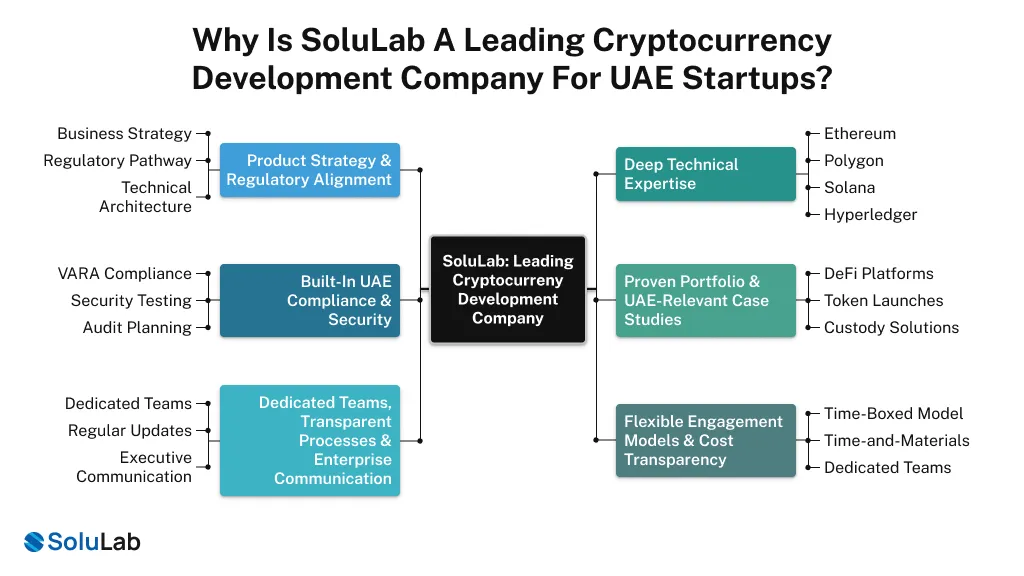
SoluLab operates with a foundational principle – you’re not just hiring developers. You’re contracting a partner who understands that blockchain is infrastructure, and infrastructure must align with three simultaneous demands – technical rigor, regulatory compliance, and business sustainability.
The firm has been explicitly recognized as a top-tier blockchain development company in UAE for its customer-centric methodology across DeFi, token creation, and enterprise systems. But recognition alone doesn’t win enterprise mandates. Execution does.
What sets SoluLab apart in a crowded marketplace of best cryptocurrency development company contenders is a deliberate process that maps your business model first, then selects the optimal blockchain architecture, not the other way around. That sequencing matters because it prevents the expensive trap of we built on Ethereum L1 but we needed Polygon scalability or we chose Hyperledger, but our stakeholders demanded public blockchain transparency. Here is the 6 that would let you know why SoluLab is the right choice.
6 Major Factors That Make SoluLab A Trusted Crypto Dev Partner
1. Product Strategy & Regulatory Alignment
Before a single line of code is written, SoluLab’s engagement begins with what we call the three-lens discovery. This means understanding your product from three vantage points simultaneously:
- The business strategy (what you’re trying to accomplish)
- The regulatory pathway (which license type and jurisdiction makes sense)
- The technical architecture (which blockchain and consensus model best support your constraints).
When we work with startups launching a crypto token development services offering, this discovery phase literally determines whether you need VARA-regulated activity licensing, CBUAE payment token standards, or an innovation-sandbox approach.
Get this wrong, and you can be 12 months into development before discovering you need to rebuild for a different regulatory rail.
For enterprise clients, the stakes are even higher. A bank building a tokenized trade finance platform has different regulatory requirements than a gaming studio launching NFTs. The best cryptocurrency development companies don’t force-fit one playbook; they flex.
SoluLab’s approach here includes:
- Regulatory mapping sessions with your executive team and legal counsel to identify the optimal license type (VARA Category 1 or 2? ADGM? CBUAE for payment tokens? Or Innovation City sandbox?).
- Tokenomics design workshops that model your economic model, burn mechanics, staking incentives, and sustainability across different market cycles, because a poorly designed token economics breaks even the best engineering.
- Competitive use-case analysis to identify whether blockchain actually solves your problem better than traditional databases or permissioned networks, and if not, to save you millions by saying so.
- Go-to-market & compliance timeline planning, which coordinates product development sprints with licensing applications, audit schedules, and exchange listing requirements.
This upfront discipline is what transforms a crypto development company from a coding vendor into a strategic partner.
2. Deep Technical Expertise Across Web3 Stacks
Enterprise decision-makers ask one revealing question: What blockchains do you actually know?
The honest answer separates credible partners from pretenders. SoluLab’s technical architecture spans Ethereum (L1 and L2 solutions like Arbitrum, Optimism), Polygon, BNB Chain, Solana, Hyperledger, and Polkadot, as actively maintained domains with real project deployments.
And this matters because every blockchain has a different security model, throughput profile, and compliance posture.
- Ethereum offers the deepest DeFi liquidity and institutional credibility but higher gas costs.
- Polygon excels at retail-friendly dApps with sub-cent transactions.
- Solana delivers raw speed for high-frequency applications but carries centralization tradeoffs.
- BNB Chain bridges crypto-native users and traditional fintech.
In the UAE, this depth isn’t optional. Many teams end up running hybrid setups – retail contracts on Polygon, settlement on Ethereum, and private Hyperledger or Corda systems behind the scenes for audit and compliance. Regulations also shape architecture. ADGM, VARA, custody rules, KYC flows, these choices affect which rails you can and can’t use.
If your development partner only knows one chain, that limitation eventually becomes your problem.
3. Built-In UAE Compliance & Security Frameworks
This is where most crypto development partners quietly fail. They treat compliance like something you can tape on at the end. We’ll add KYC later. Audits can happen after launch. Your legal team can handle regulators.
In the UAE, that thinking is expensive. Sometimes fatal. When security gaps show up after launch, fixes don’t just take longer; they cost five to ten times more. When VARA flags architectural issues during review, licensing can stall for months. And when an audit forces contract redesigns, you’re burning runway, momentum, and trust.
SoluLab works differently. Compliance and security are part of how things are built, not something added when the product already exists.
From the first week, the team sits down and stress-tests the actual business logic, asking where things can break, be exploited, or misunderstood, not generic checklists, but threats tied to how your system really works. Code goes through mandatory reviews, automated checks run continuously, and testing mirrors real attack scenarios, not theory.
Architectures are designed with VARA in mind from day one – clear audit trails, custody separation, governance controls, so nothing needs to be ripped apart later. Audits with firms like CertiK or Hacken are planned mid-build, which is often when the most dangerous issues are cheapest to fix.
In Dubai, this isn’t overengineering. It’s the cost of operating legally, and done right, it can shave months off your compliance timeline.
4. Proven Portfolio & UAE-Relevant Case Studies
When you are evaluating the best crypto development company in the UAE, the portfolio matters, but not in the way most people think. A shiny token launch or a GitHub repo looks impressive on the surface, but it does not tell you how a team performs once real users, real money, and real pressure enter the system.
What actually counts are live products that have been running for a year or more. Systems that process transactions daily, handle spikes in usage, stay secure, and are still being actively maintained.
That is where you see whether a team understands production, not just development. Context matters just as much.
- If you are building DeFi, you want to see DeFi platforms that are already live.
- If it is NFTs, custody, or tokenization, then those exact use cases should exist in their track record.
Broad blockchain experience often means nothing unless it maps directly to what you are building. In the UAE, regulatory exposure is another layer you cannot ignore; that’s why a credible partner should be able to talk through VARA or ADGM realities as naturally as they talk about code.
SoluLab’s portfolio spans regulated custody solutions, DeFi infrastructure, token launches, and enterprise blockchain platforms with complex financial logic. That reference-ability becomes especially important when you are sitting in front of boards or institutional investors who need proof that your crypto development partner has delivered at scale.
5. Dedicated Teams, Transparent Processes & Enterprise Communication
Enterprise development isn’t freelance coding. Once you’re building something that touches real money, real users, and real regulators, you need more than speed; you need structure that doesn’t slow you down.
At SoluLab, projects run with dedicated blockchain teams, not a rotating bench of contractors. You know who your architect is, who owns QA, and who’s accountable when something breaks or needs to scale. That stability matters in blockchain, where even a single architectural shortcut or overlooked edge case can later become a security or compliance issue. Churn kills momentum, and ownership protects it.
Communication is where this really shows.
- Regular updates that tell you what’s moving, what’s blocked, and what’s changed.
- Technical discussions happen early, before decisions harden into code.
- And at the executive level, conversations stay grounded in budgets, timelines, and business outcomes, not just features shipped.
- When issues surface, and they always do, they’re raised immediately, not buried.
- Security findings, audit flags, and performance concerns all come with clear next steps, not excuses.
Yes, this can feel heavier than the startup chaos some founders are used to. But for CXOs and boards evaluating serious blockchain initiatives, this is trust. This is how you justify investing in a market that’s seeing billions flow into blockchain, by working with a crypto development company in the UAE that operates with enterprise discipline, not guesswork.
6. Flexible Engagement Models & Cost Transparency
In crypto development, it is unavoidable. The real problem isn’t that it depends — it’s when no one tells you what it depends on until the invoice arrives. That’s usually where things go wrong. SoluLab tries to be very clear about this upfront, before any contract is signed.
If the scope is tight and well defined, a time-boxed model works best. You know the budget, the timeline is clear, and there are no moving goalposts. But when the product is still evolving, a time-and-materials setup makes more sense. You get flexibility, but with monthly caps and clear checkpoints, so it never turns into an open-ended spend.
For founders building something long-term, dedicated teams, sometimes even equity-aligned, tend to work better. It lowers early burn and keeps everyone focused on outcomes, not hours.
| Project Type | Complexity | Cost Range (AED) | Timeline |
| MVP / Proof of Concept | Basic | 25,000 – 100,000+ | 6–10 weeks |
| Token Launch | Moderate | 30,000 – 150,000+ | 8–12 weeks |
| DeFi Protocol | High | 50,000 – 200,000+ | 12–18 weeks |
| Enterprise/Regulated Platform | Very High | 50,000 – 200,000+ | 18–36 weeks |
In the UAE, crypto development costs usually range from AED 25k for a basic MVP to AED 200k+ for regulated, enterprise-grade platforms. That typically covers development, audits, and VARA-compliant architecture, but not licensing or ongoing regulatory fees, which are separate and unavoidable.
A trustworthy partner isn’t the cheapest one. It’s the one that explains the costs clearly, sets boundaries early, and then delivers exactly what was agreed.
Common Mistakes When Choosing a Crypto Development Company in United Arab Emirates
After looking at dozens of blockchain projects across Dubai, Abu Dhabi, and the free zones, some mistakes just keep coming up, and they cost time and money.
Mistake 1: Chasing the Cheapest Option
Cutting AED 30,000 on development feels smart, but if your smart contracts don’t meet VARA standards, you could end up rebuilding for AED 80,000 and lose months of first-mover advantage.
Mistake 2: Overlooking Post-Launch Support
Blockchain isn’t built and forget. Without ongoing monitoring, protocol updates, and security patching, you’re exposed. Support should be part of your plan, not a surprise cost later.
Mistake 3: Thinking One Blockchain Solves Everything
Solana might be fast, but if your partners need Ethereum rails or VARA requires private nodes, you get a messy, fragmented setup and a team learning on the fly.
Mistake 4: Underestimating Audit Timelines
Security audits take 2–4 weeks minimum. Planning a Q2 launch without scheduling audits early is a sure way to miss deadlines.
Mistake 5: Treating Compliance Like Legal’s Job
Lawyers handle paperwork, but they can’t design smart contracts or custody solutions to meet VARA’s rules. This needs tech and legal to work together from the start.
Mistake 6: Not Asking for Proof
Claims of 50 DeFi projects mean little without live links, audit reports, or references. If a partner hesitates, consider it a red flag.
Why Founders Trust SoluLab More Than Other Crypto Development Partners in the UAE?
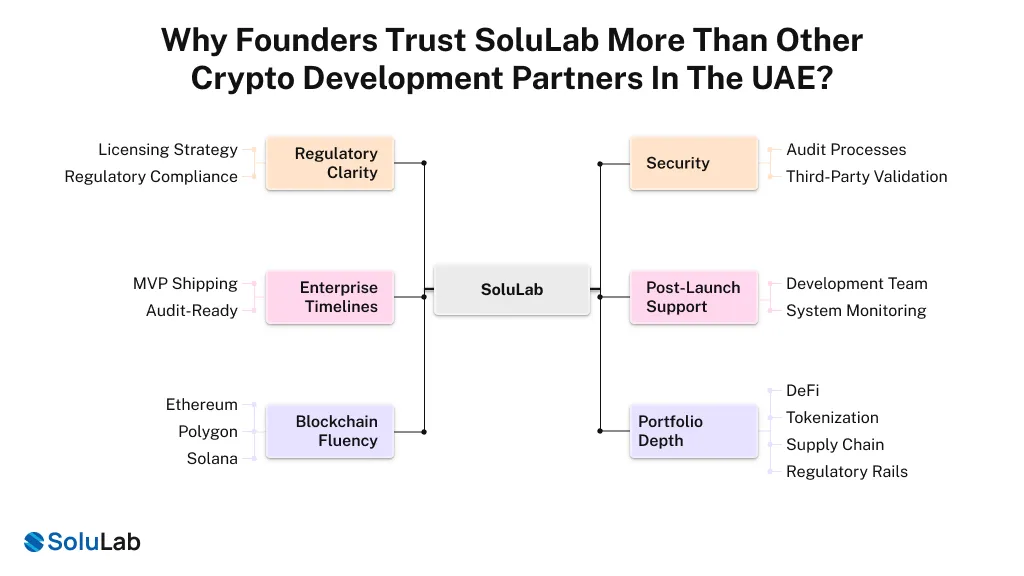
After conversations with dozens of startup founders and enterprise CTOs, a few patterns emerge about why SoluLab consistently becomes the first choice rather than the third option:
1. Regulatory Clarity from Day One
Founders tell us: Most firms ask about your product features. SoluLab asked about our licensing strategy. That question, alone, saved us from building the wrong thing for the wrong regulator.
2. Security Isn’t Negotiable
In Web3, one vulnerability becomes public within hours. A partner who treats security as a sprint-end task is not a partner – they’re liability. SoluLab’s embedded audit processes and third-party validation workflows reflect an assumption that security failures are existential. Founders recognize this immediately.
3. They Actually Understand Enterprise Timelines
Startups need fast iteration, but they also need credibility with institutional investors. A partner who can ship an MVP in 12 weeks and have it audit-ready for enterprise customers gets the economics of the market.
4. Post-Launch Support Isn’t a Revenue Grab
Many firms use the transition from development to maintenance as an upsell moment. SoluLab frames support as continuity – the development team you hired for building is the same team monitoring and optimizing your system post-launch. That alignment reduces churn and improves outcomes.
5. They Speak Multiple Blockchains Fluently
Founders building DeFi or multi-chain applications need partners who can justify architectural choices, not sell them on a single-chain bias. Having developers who know Ethereum, Polygon, and Solana isn’t a nice-to-have; it’s how you future-proof your product.
6. Portfolio Depth Across Verticals
If you’re the first founder in your vertical that a firm is working with, you’re the experiment. SoluLab’s portfolio spans DeFi, tokenization, NFTs, supply chain, and enterprise regulatory rails, meaning most founders are walking into a structured process, not a learning curve.
Conclusion
Choosing a cryptocurrency development company in the UAE isn’t like hiring a software agency; you’re hiring a strategic partner who must navigate simultaneous demands – technical rigor, regulatory compliance, business scalability, and security resilience. Get any one of those wrong, and your entire product suffers.
And SoluLab position itselfs as the option that gets you to market legally, securely, and sustainably, without breaking your bank. That’s why enterprise founders and CXOs consistently choose SoluLab as their best crypto development company in the UAE.
Your blockchain initiative isn’t just a technology project; it’s a business transformation. The partner you choose will either accelerate that transformation or constrain it. Choose wisely.
FAQs
With over 3 years of experience, I specialize in breaking down complex Web3 and crypto concepts into clear, actionable content. From deep-dive technical explainers to project documentation, I help brands educate and engage their audience through well-researched, developer-friendly writing.
![How to Successfully Launch a Crypto Token in the UAE [2026]?](https://www.solulab.com/wp-content/uploads/2026/02/Launch-a-Crypto-Token-in-the-UAE-1.webp)