Key Takeaways
- Robinhood Chain is a public Ethereum Layer 2 built on Arbitrum Orbit’s Nitro stack, and contract deployment is permissionless. You don’t need Robinhood’s sign-off to launch on it.
- The chain settles to Ethereum, runs roughly 100ms block times, and pays gas in ETH. There’s no native protocol token.
- A deployed contract isn’t a finished token. Liquidity, an audit, and a compliance review carry as much weight as the code.
- Whether a token counts as a security comes down to facts and circumstances, not the chain it launches on. Robinhood structured its own Stock Tokens as debt securities to get ahead of exactly this question.
- Post-launch, three buckets of metrics matter for different reasons: token metrics, product metrics, and community metrics.
Robinhood didn’t build a chain just to have one. Robinhood Chain went live on mainnet on July 1, 2026, running on Arbitrum’s Orbit framework, and its main purpose is to host tokenized real-world assets at scale, starting with Robinhood’s own Stock Tokens.
The brokerage backstory isn’t really what matters here, though. What matters is that this is a permissionless, EVM-compatible chain anyone can deploy to, and it’s sitting inside an ecosystem that already has real trading volume and real users on day one.
Gartner’s forecast puts blockchain’s new business value at $3.1 trillion worldwide by 2030. Token launch platforms are one of the categories actually dragging that figure forward right now.
Here’s what the chain actually is, how to build and deploy a token on it, and what happens after launch that most guides never get to.
What Is Robinhood Chain?
Robinhood Chain is a public Ethereum Layer 2 blockchain, built using Arbitrum Orbit, the same Nitro-based chains-as-a-service framework that powers Arbitrum One. It settles transaction data back to Ethereum for security, runs on roughly 100-millisecond block times, and pays gas in ETH instead of shipping its own token.
That last part is a deliberate choice. Keeping a native gas token out of the picture keeps speculation out of the base layer, at least in theory. Deloitte’s CFO survey found 23% of North American CFOs expect their treasury teams to hold or transact in crypto within two years. That jumps to 39% among companies over $10 billion in revenue.
The chain is fully EVM-compatible. Existing Ethereum tooling, Solidity contracts, and wallets work without modification, and any developer can deploy a contract without Robinhood reviewing or approving it first. Robinhood’s flagship product on the chain is Stock Tokens, tokenized exposure to US equities and ETFs, live in 120+ countries through Robinhood Wallet.
The US itself is currently excluded from that particular rollout. Chainlink handles oracle pricing. A DEX ecosystem including Uniswap and newer entrants like Arcus was live from day one, not bolted on later.
Why Does It Matter for Token Launches?
A chain backed by an established retail brokerage brings something most new Layer 2s simply don’t have on launch day: a real user base already sitting inside the wallet. Deploying here starts from a fundamentally different place than launching on a chain with zero distribution and hoping a community shows up on its own.
There’s a bigger pattern behind it too. Robinhood Chain sits at the center of the broader shift toward real-world asset tokenization, a category that’s grown fast enough that industry trackers reported tokenized stock spot trading volume topping $15 billion in Q1 2026 alone. For scale, Statista’s crypto research puts global cryptocurrency users at roughly 861 million as of 2025. That’s the pool a well-distributed chain can actually tap, something a brand-new, unknown chain has no shot at on launch day.
Regulatory attention has followed the money, predictably. The SEC flagged Robinhood’s Stock Token structure for scrutiny in January 2026 guidance. The takeaway for anyone building here isn’t “avoid this chain.” It’s that the chain’s technical openness doesn’t make the securities law question go away. It just moves that question earlier in the process, where it belongs.

How Do You Build a Token for Robinhood Chain?
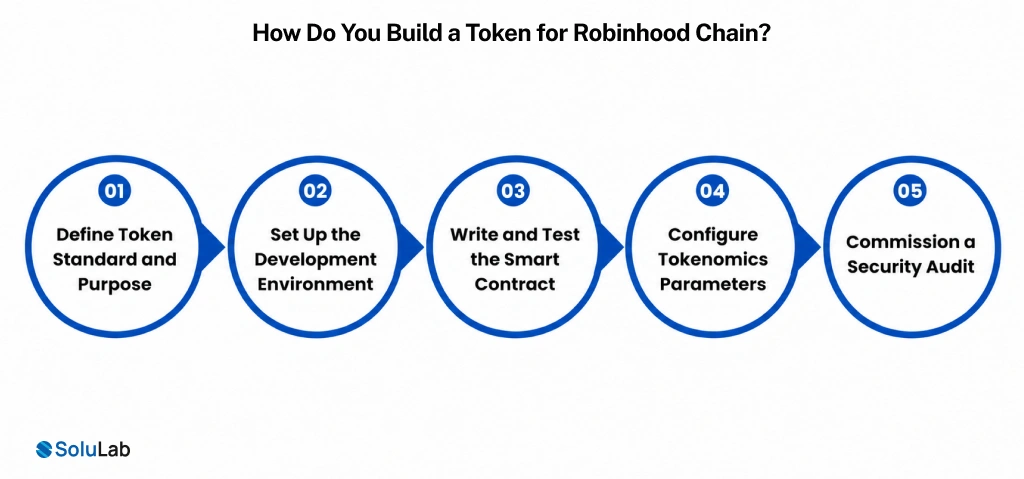
Building on Robinhood Chain runs through standard Ethereum tooling from start to finish, just applied to a chain tuned for real-world asset use cases instead of general speculation.
1. Define Token Standard and Purpose
What is this token actually for? Answer that before touching code. Most tokens on the chain use ERC-20 or a compliant variant when the token represents a regulated asset.
- Choose ERC-20 or a compliant variant
- Define the token’s real utility
- Decide whether it represents an asset
2. Set Up the Development Environment
Robinhood Chain’s EVM compatibility means Hardhat, Foundry, and standard Solidity tooling work without any special adaptation.
- Install Hardhat or Foundry
- Add the Robinhood Chain RPC endpoint
- Fund a wallet with testnet ETH
3. Write and Test the Smart Contract
Contract logic should cover supply, transfer rules, and any compliance restrictions well before it ever touches mainnet. Bringing in a smart contract development company with actual Arbitrum Orbit experience beats learning the chain’s quirks in production, and it usually costs less in the long run than the alternative.
- Write core ERC-20 contract logic
- Add transfer or eligibility restrictions
- Run local unit tests
4. Configure Tokenomics Parameters
Supply, distribution, and vesting decisions get baked in hard here. Get them wrong and you’re not fixing a bug later, you’re renegotiating trust with your own holders.
- Set total and circulating supply
- Define vesting and unlock schedules
- Model allocation across stakeholders
5. Commission a Security Audit
Independent review catches what a team stops noticing after months staring at the same codebase. That’s not a knock on the team, it’s just how attention works.
- Engage an independent audit firm
- Fix flagged vulnerabilities before launch
- Publish the audit report
How Do You Deploy a Token on Robinhood Chain?
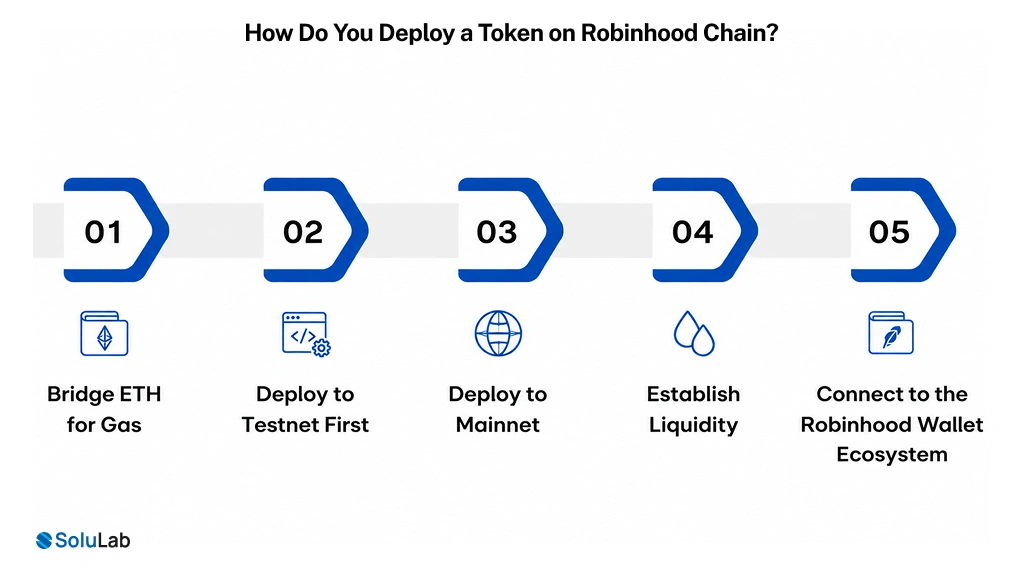
The deployment transaction itself is mechanically simple on an EVM chain. Everything around it is where the real planning happens.
1. Bridge ETH for Gas
The chain runs on ETH for gas, so funding a deployer wallet comes first.
- Bridge ETH from Ethereum mainnet
- Confirm funds arrived on-chain
- Verify RPC connection stability
2. Deploy to Testnet First
Testnet is where integration issues get caught cheap, before they cost real gas and real reputation.
- Deploy the contract to testnet
- Run a full transaction test suite
- Confirm behavior against audit expectations
3. Deploy to Mainnet
Mainnet deployment happens only once testnet results are clean and the audit sign-off is actually final, not “mostly done.”
- Deploy the verified contract to mainnet
- Confirm deployment via block explorer
- Lock or renounce contract ownership
4. Establish Liquidity
A token with no trading venue is a spreadsheet entry. It isn’t a market yet.
- List on Uniswap or Arcus
- Seed meaningful liquidity pool depth
- Consider a liquidity lock period
5. Connect to the Robinhood Wallet Ecosystem
Visibility inside a wallet that already has real distribution does more for a launch than most marketing budgets ever will.
- Confirm wallet compatibility and display
- Submit for relevant listings
- Test the full user transaction flow
Common Mistakes to Avoid When Launching a Token
A lot of failed token launches trace back to the same handful of avoidable errors, over and over.
- Launching without clear utility tops the list. A token that doesn’t solve a specific problem for a specific user ends up trading purely on speculation, and speculation-only tokens rarely survive their first bear cycle.
- Right behind it: treating tokenomics as an afterthought, deciding supply schedules and unlocks in the final week before launch, which usually creates sell pressure nobody actually planned for.
- Skipping the security audit belongs on this list too, obviously, but it’s worth saying anyway. The cost of an audit is a rounding error next to the cost of an exploit, and exploits are what erode trust fastest in a brand-new token.
- So does launching with thin liquidity. A small sell order shouldn’t be able to crater the price and become the headline instead of the product.
- Heavy insider or team ownership concentration reads as a red flag to anyone running basic diligence, and it should. Ignoring regulatory requirements is another one that seems to catch teams off guard even though it shouldn’t; Robinhood’s own flagship product got flagged by regulators for its structure, which is less a reason to panic than a reason to get the legal review done early.
- And overpromising token value in marketing copy invites regulatory attention and investor lawsuits in roughly equal measure. Neither is a great outcome.
What Metrics Should You Track After Launch?
Launch day numbers tell you almost nothing on their own. What matters is the trend over the weeks after.
1. Token Metrics
- Circulating supply versus total supply
- Trading volume across listed venues
- Liquidity pool depth over time
- Holder count and distribution concentration
2. Product Metrics
- Active wallet addresses interacting weekly
- Smart contract transaction volume trends
- Integration count with other protocols
3. Community Metrics
- Community growth rate month over month
- Developer activity on public repositories
- Sentiment and engagement across channels
What Legal and Compliance Issues Should You Consider?
Here are the legal and compliance issues you should consider before launching a token on Robinhood:
1. Is the Token a Security?
Every other compliance decision flows from this one, and it depends on the token’s structure and marketing rather than which chain it launches on. Robinhood built its own Stock Tokens as debt securities to navigate exactly this, since they track equity performance without conferring actual shareholder rights.
2. KYC/AML Requirements
Any token sale involving fundraising, not just secondary trading, typically triggers know-your-customer and anti-money-laundering obligations, and the specifics shift depending on jurisdiction and how the sale is structured.
3. Token Sale Compliance
Public sales, private placements, and airdrops each carry different regulatory treatment. The line between a “reward” and a “sale” matters a lot more to regulators than it usually does to marketing teams. Skip legal review at this stage, and most teams end up rediscovering it later, at a worse time. Working with a specialized token development services provider from the earliest planning stage tends to save far more than it costs.
4. Tax and Reporting Considerations
Token issuance, distribution, and secondary trading can all trigger reporting obligations for the issuing entity and, in plenty of jurisdictions, for recipients too.

Conclusion
Launching a token on Robinhood Chain is technically simple, given the EVM compatibility and permissionless deployment. What actually separates a token that survives from one that doesn’t live outside the smart contract: real tokenomics planning, a genuine audit, real liquidity, and a compliance review done before launch instead of after a regulator comes asking.
SoluLab, a blockchain development company, can help your business handle the architecture, audits, and compliance strategy this kind of launch actually needs.
Talk to a SoluLab blockchain architect about tokenomics and compliance strategy.
FAQs
Neha is a curious content writer with a knack for breaking down complex technologies into meaningful, reader-friendly insights. With experience in blockchain, digital assets, and enterprise tech, she focuses on creating content that informs, connects, and supports strategic decision-making.