Key Takeaways
- The Problem: Startups have many challenges when it comes to deciding what to do with the development of AI: hire an in-house team or outsource. This decision is critical due to limited funds, short deadlines, and the lack of talented AI specialists.
- The Solution: A practical model assists startups in considering aspects such as the scope of the project, budget, availability of talent, time-to-market, and sensitivity of the data. Outsourcing is often more effective with smaller or smaller-scale projects, whereas mission-critical and long-term projects are sometimes more economical to keep within the company. The trick is to balance between cost, control, and expertise.
- How SoluLab helps: SoluLab provides complete AI development services to startups. Regardless of whether you wish to scale your own staff or simply outsource AI projects, SoluLab offers premier talent, safe infrastructure, and flexible contracting models to provide high-quality and cost-effective AI solutions within timeframes.
Ever wondered if building an AI team in-house is worth it, or if outsourcing could actually save your startup more? Which route gives faster results without burning a hole in your budget? And how do you balance control, expertise, and cost at the same time?
Startups are facing this dilemma more often than ever. Hiring AI engineers isn’t cheap, and training them takes months. On the other hand, outsourcing promises speed and access to global talent, but can you really trust an external team with your sensitive data and long-term strategy?
In fact, studies show that around 59% of companies outsource primarily to reduce development costs, and outsourcing often results in faster access to specialized skills. In this blog, we’ll break down the numbers, pros, cons, and real-world factors so you can decide smartly.
Understanding In-House AI Development vs Outsourcing
In-House AI Development
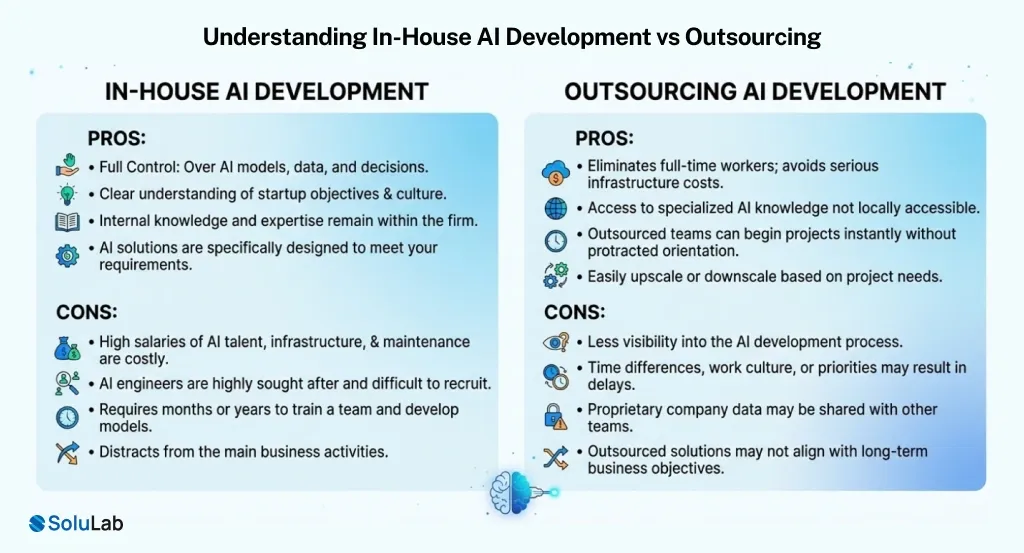
In-house AI development refers to a situation in which a startup or a company has created its AI team and operates it internally. This team not only deals with data collection, model training, and deployment but also with monitoring and updating AI systems.
Pros:
- Full Control:l You have every AI model, data, and decision-making process.
- The team has a clear idea of youstartupup objectives and culture.
- Acquisitions of internal knowledge and expertise remain with the firm. Cano can develop AI solutions that are specifically designed to meet your requirements.
Cons:
- The salaries of AI talent, infrastructure, and maintenance are costly.
- AI engineers are highly sought after and difficult to recruit.
- It requires months or even years to train a team and come up with models.
- Distracts from the main business activities.
Outsourcing AI Development
The process of outsourcing the development of AI is where a firm contracts another vendor or a specialist AI firm to manage its AI projects. The vendor is a supplier of the team, infrastructure, and expertise required to develop and deploy the models.
Pros:
- Eliminates full-time workers and does not incur serious costs in terms of infrastructure.
- Can access specialized AI knowledge that is not locally accessible.
- Outsourced teams can begin projects instantly without protracted orientation.
- Scalability can be upscaled or downscaled easily depending on the needs of the project.
Cons:
- You are less likely to see what is going on in the development of AI.
- Time differences, work culture, or priorities may result in delays.
- Proprietary company data can be given to other teams.
- The outsourced solutions may not be entirely in line with long-term business objectives.
When to Choose Building an In-House AI Team?
The startup and organizations must focus on creating an in-house AI team when they require complete control, solutions that are tailor-made, and long-term knowledge that best meets their business requirements and objectives.
- Complete Control of AI Projects: With an internal team, a firm can have complete control of model development, data processing, and deployment, and thus startups can make strategic changes without having to depend on outside vendors.
- Organization-Specific Solutions: It is possible to design AI models to perfectly fit the workflows, products of the startup, and the needs of customers that are often impossible with outsourced solutions.
- Long-term experience and expertise: The creation of AI skills within a company leads to the cultivation of a specific talent and institutional memory, which offers a competitive edge and minimizes the reliance on external advisors in the long run.
- Coherence with Company Vision: An internal team is more familiar with the strategy of the business over time, so AI efforts are effective in meeting the core business objectives and promoting cultural values.
- Control of Data Security and Privacy: The development of AI within a company minimizes the risk of information leakage to a third party and allows it to stay in line with privacy policies and preserve customer loyalty.
Read more: AI Development Cost
When Does Outsourcing AI Development Make More Sense?
It is not always necessary to develop an in-house AI team in startups. When speed, low-cost, and availability of specialized expertise are more important than internal control and ownership, outsourcing can be smarter.
- Budget-constrained: It eliminates the initial expenses associated with full-time hiring, infrastructure, and training costs, which is optimal for start-ups in need of AI solutions that do not require a substantial financial investment.
- Time-to-Market Pressure: External AI teams can launch models in shorter timeframes, assisting startups in launching products or other features in less time than it would take them months to develop internal expertise.
- Niche Expertise Required: AI outsourcer companies tend to possess specialized expertise and experience with complicated models that would be challenging or costly to acquire within the company.
- Scalability of Projects: Outsourcing projects enables the up and downscaling of teams depending on the demand of the project, without any long-term commitments of employment, and the ability to be flexible with fluctuating workload.
- Focus on Core Business: When AI development is delegated, startups will be able to focus on strategy, marketing, and growth, and have the technical heavy lifting done by experts.
Practical Framework to Decide In-House vs Outsourcing AI Development
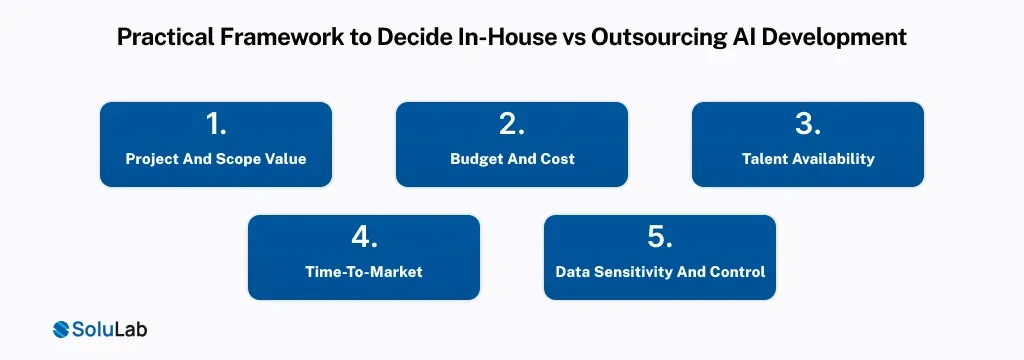
The decision between in-house and outsourced AI development might either make or break the growth of a startup. An effective framework assists in considering both costs, experience, and the needs of the project to make the most strategic decision.
1. Project and Scope Value
Evaluate the scale, complexity, and future implications of your AI project. An in-house team could be useful in large, mission-critical projects, whereas smaller, clearly defined projects can be effectively outsourced.
2. Budget and Cost
Compare the total cost, including salaries, infrastructure, and maintenance costs in in-house teams with the amount of money incurred in outsourcing through the fees of the vendor and the cost per project. Include hidden costs such as training or delay in integration.
3. Talent Availability
Test the ability of your startup to attract and retain competent AI engineers. In case ofa deficit of special skills in the locality, outsourcing provides access to international talent without having to go through lengthy hiring processes.
4. Time-to-Market
Take into account the rapidity of the AI solution implementation. Outsourcing can be faster than in-house teams, whereas in-house teams can be slower, but offer better long-term vision.
5. Data Sensitivity and Control.
In-house development would provide greater security and control in the case of projects that involve sensitive information or those that are strictly controlled. Outsourcing can be a risk, but it can be performed through solid NDAs and secure operations.
A Head-to-Head Comparison: In-House vs Outsourcing AI Development
| Parameter | In-House AI Development | Outsourcing AI Development |
| Cost | High upfront and ongoing costs (salaries, infrastructure). | Lower initial cost, pay per project or retainer. |
| Control & Alignment | Full control over projects; fully aligned with company goals. | Limited control; alignment depends on vendor communication. |
| Talent & Expertise | Requires hiring skilled engineers, may face talent scarcity. | Access to global experts without long recruitment. |
| Time-to-Market | Slower due to team setup and ramp-up. | Faster deployment as the vendor starts immediately. |
Factors That Influence Cost-Effectiveness
There are several considerations that startups should make when deciding whether to develop AI internally or outsource. The effectiveness of cost is not only based on salaries or contracts but also based on the project scope, project timelines, the goals, and the compliance requirements.
1. Project Size and Complexity: Costs are directly influenced by the size and the level of an AI project. Major projects that involve cutting-edge AI demands and take up more sophisticated infrastructure demand more skilled resources, longer development times, and complex infrastructures that make in-house development more costly than outsourcing.
2. Time-to-Market Urgency: In case speed is a key factor, outsourcing can help to make development faster, as external teams might have solutions and experience that are ready to deploy. Teams within the company might take longer to ramp up, and this could slow down the product launch and affect the competitive edge.
3. Long-Term vs Short-Term Goals: Some of the startups that intend to achieve long-term AI capabilities might find it beneficial to invest in internal knowledge that is ultimately rewarding in the long run. Considerable cost savings are usually achieved by means of outsourcing or ready-made AI services in short-term ventures of limited scope.
4. Regulatory and Compliance Requirements: Strict compliance industries (finance, healthcare) might require internal teams to guarantee the privacy of data and compliance with regulations. To achieve these standards, outsourced projects may require additional costs due to audit or legal control.

Conclusion
The choice betweenan in-house AI Development team and outsourcing should be made based on the priorities, budget, and long-term objectives of a startup. Internal teams offer complete control, company vision fit, and expertise, but are more expensive and require more time to be fully operational.
Outsourcing has quicker implementation, access to competent talent, and reduced initial costs, but can be associated with communication difficulties and reduced control. When deciding on a startup, it is advisable to consider project complexity,y time-to-market, data sensitivity, and available resources.
Finally, the most appropriate decision will be cost-efficient and strategically oriented towards growth that will see AI investments generate as much value to the business as possible.
SoluLab, an AI development company, can help your business automate workflows and increase ROI and productivity. Book a free discovery call today!
FAQs
Neha is a curious content writer with a knack for breaking down complex technologies into meaningful, reader-friendly insights. With experience in blockchain, digital assets, and enterprise tech, she focuses on creating content that informs, connects, and supports strategic decision-making.