Generative AI stopped being a lab curiosity a while ago. It now shows up in marketing teams, product roadmaps and back offices across very different industries, and the companies building with it all want the same scarce thing: people who actually know how to make it work.
As generative artificial intelligence (AI) keeps reshaping how industries operate, demand for specialists in it has shot up. Startup, enterprise, research lab? Doesn’t matter much. If you want real value out of AI, you need the right people building it, and they are hard to find. This guide covers how to spot them, how to test them, and how to get them to say yes.
There’s a second story here too. AI isn’t only the thing you’re hiring for. It’s also changing how hiring gets done, with companies using generative models to surface strong candidates faster than a human screener could. So we’ll look at both sides: what the job of a hiring manager looks like now, and how generative AI is rewriting it.
Fair warning. Hiring well in this field takes time. The work is technical, the talent pool is thin, and a polished resume tells you surprisingly little. What follows are the strategies and habits that help you separate the genuinely skilled from the merely fluent.
How Will Generative AI Affect Work in the Future?
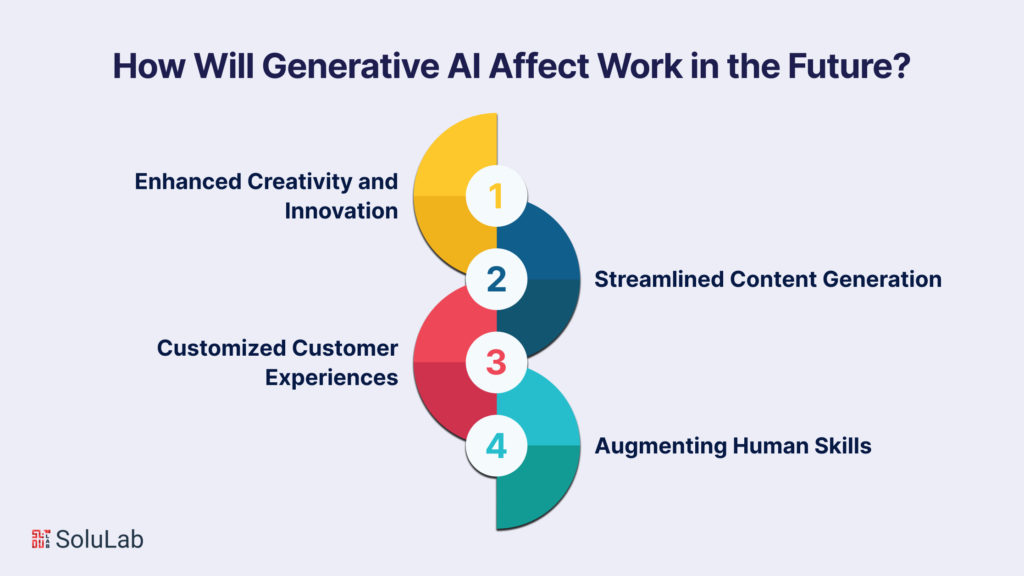
Work keeps changing shape as technology moves, and generative AI is one of the bigger forces pushing it right now. The term covers machines that produce new material on their own: text, photos, video, music, even whole virtual worlds. As the models get better, their fingerprints show up in more and more businesses. Here’s how that’s changing day-to-day work, and where it could take things next.
Enhanced Creativity and Innovation
Good generative AI developers make a team more inventive. Built on algorithms and neural networks, generative AI models can throw up ideas, designs and directions nobody in the room would have reached alone. That pushes people past the usual boundaries of their craft. A graphic designer gets a fresh angle. So does an architect. The tool doesn’t have the taste, but it widens the pile of options to pick from.
Streamlined Content Generation
Plenty of businesses run on content, and generative AI is helping to streamline hiring process. It can draft text, graphics and video, which hands people back time for strategy and judgment calls. A copywriter might ask a language model for a first draft or a batch of product descriptions. A designer might generate starting visuals and refine from there. Put simply, Human-generative AI collaboration is lifting both speed and output.
Customized Customer Experiences
Personalization used to be expensive. Skilled generative AI developers make it scale. Their models can produce tailored recommendations, one-off product designs and marketing campaigns cut for a single customer segment. Customers notice. They stay longer, engage more, and buy more. That’s a real change in how a company talks to the people it sells to.
Augmenting Human Skills
The fear is replacement. The more likely outcome is augmentation, and frankly a more satisfying job. Once the repetitive tasks are automated, people get to spend their hours on the stuff machines are bad at: invention, critical thinking, reading a room. They take on harder problems and add more strategic value. Used well, generative AI makes human workers stronger rather than redundant.
How to Choose the Best Generative AI Professionals in the Hiring Process?
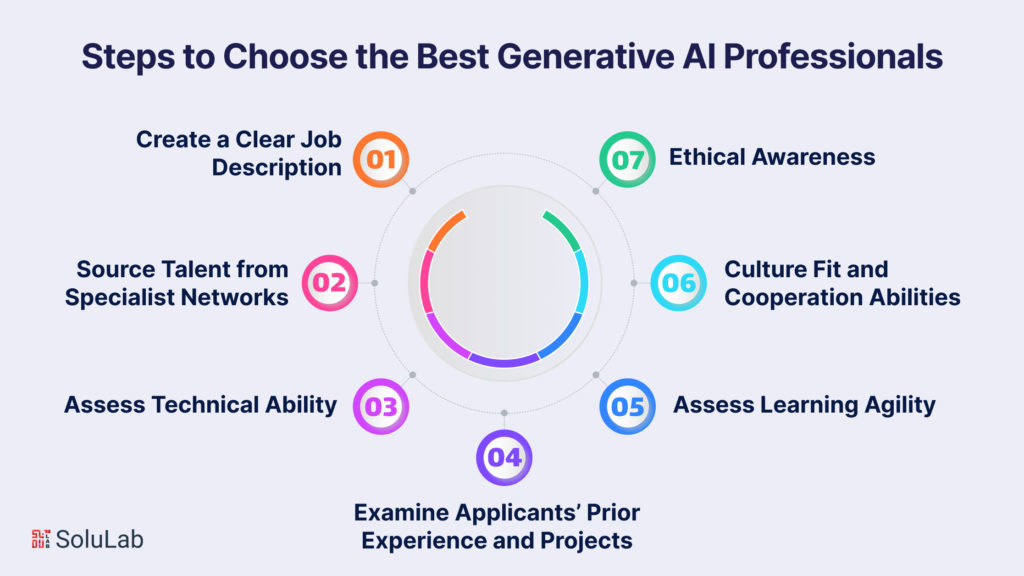
If you want AI to change how your business runs, the hire matters more than the tool. The right developer brings ideas, builds things nobody else has, and drags the whole company forward. The wrong one burns a quarter. Below is a practical walk through the recruiting process, step by step, so you stay ahead in a field that moves very fast.
Create a Clear Job Description
Start with the job description. Vague ones attract vague candidates. Spell out the credentials, skills and experience you need, what the person will own day to day, and which generative AI methods, frameworks and tools they should already know. Be specific. A sharp description does half your filtering before a single call is booked.
Source Talent from Specialist Networks
General job boards won’t get you far here. This is a specialist field, so go where the specialists already are. Build ties with universities. Show up at industry conferences. Spend time in online AI and machine learning communities and forums, where researchers and practitioners actually talk shop. You’ll meet people you’d never find through an ad, and you’ll pick up on what’s new in the field along the way.
Assess Technical ability
Test the skills directly. Mix practical assessments with interviews. Ask for a portfolio or work samples that show hands-on use of generative models such as Generative Adversarial Networks (GANs) or Variational Autoencoders (VAEs). Then run a technical interview or a coding challenge on the algorithms, languages and frameworks the role needs. The real question is simple: can they take theory and make it work on a messy, real problem?
Read Our Blog: Top 10 Generative AI Development Companies
Examine Applicants’ Prior Experience and Projects
Past work is the best predictor you have. Look for people who’ve used generative AI to fix actual problems, not just toy demos. Creative projects, published papers and generative AI competitions all count. When you review them, ask three things. How much did it matter? How hard was the problem? What came out the other end? The answers tell you a lot about how someone thinks when things get difficult.
Assess Learning Agility
What someone knows today will be dated soon. This field shifts constantly, so the habit of learning counts for more than any single skill. Ask candidates how they keep up. Do they read research papers? Go to conferences or workshops? Contribute to open-source projects? The people who keep adapting are the ones still useful to you two years from now.
Culture Fit and Cooperation Abilities
Technical chops come first, sure. But they aren’t enough. Generative AI projects almost always cut across teams, pulling in product, design, data and business people, so check how well a candidate works in that kind of mixed group. Can they explain a hard idea to someone outside their field? Do they listen? In practice, this is where brilliant hires most often stall. Look for people who adjust to different settings, pull their weight, and help build a team that includes everyone.
Ethical Awareness
Generative AI raises real ethical questions, and your hires need to take them seriously. In the interview, ask about bias, fairness and privacy. Put a hypothetical dilemma in front of them and see how they reason through it. A candidate who shrugs at these questions is a risk. One who has thought about them is far more likely to build and ship systems responsibly.
How Generative AI is Helping to Streamline Recruiting Operations?
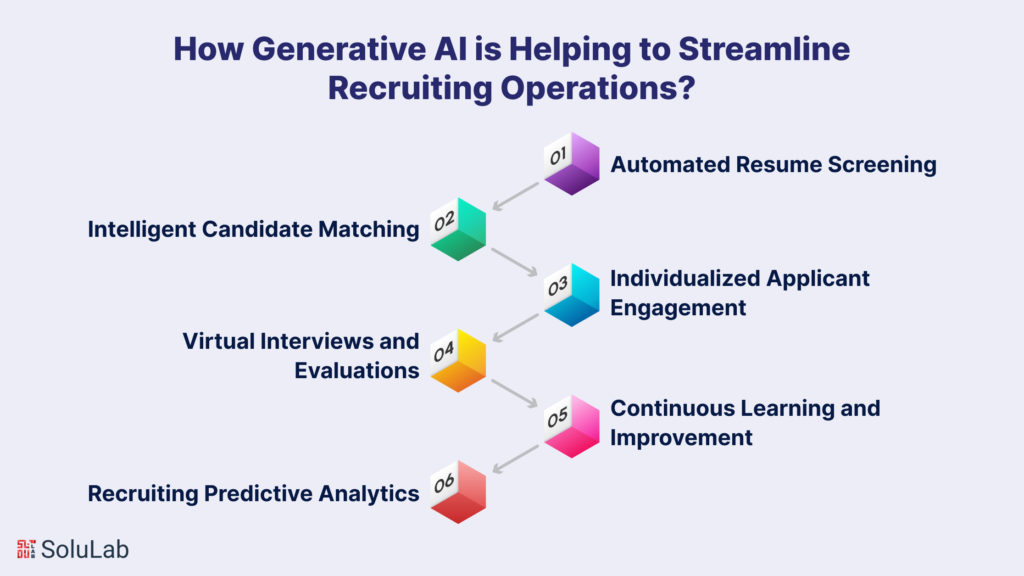
Strong teams start with recruiting, and recruiting has always been a grind. Someone reads every resume by hand. Someone books and runs every interview. Someone makes the call on fit. Generative AI is changing that picture in a big way. Here’s how it’s reshaping recruiting workflows, candidate selection and the overall speed of hiring.
Automated Resume Screening
Wading through a mountain of resumes eats more recruiter hours than almost anything else. Generative AI tools can take that on: reading resumes, pulling out the relevant details, and sizing up each candidate.
Using natural language processing (NLP), these tools quickly pick out keywords, skills and experience, then rank applicants against the job criteria. Recruiters get their afternoons back. They can spend them on the conversations that actually need a person.
It cuts the other way, too. Job seekers can use AI to tighten their resumes, with suggestions on layout and keywords. Examples of ATS-friendly resumes show how a clean structure and well-chosen keywords help a resume get noticed by automated screeners.
Intelligent Candidate Matching
Pattern recognition is what these systems do best. Recruiting platforms put that to work by lining up job requirements against candidate profiles.
Feed the model candidate data (skills, experience, education, preferences) and it can suggest the strongest fits for a given role. Shortlisting gets simpler. Recruiters spend their energy on the handful of people most worth talking to.
Individualized Applicant Engagement
Candidates hate silence. Generative AI can keep them in the loop with personal, responsive contact at every stage. Chatbots driven by AI can screen applicants, answer the usual questions, and send status updates as things happen.
These assistants hold conversations that feel close to human, which improves the experience and cuts waiting time. The result is a process that moves faster and actually feels built around the candidate.
Virtual Interviews and Evaluations
Interviews are changing as well. Some virtual interview platforms now use generative AI to analyze what candidates say, along with facial expressions and body language, and hand recruiters the findings.
Working from set criteria, they flag patterns, rate communication skills and judge how well someone fits. The pitch is that automated review cuts bias and makes evaluations consistent, so assessments come out more accurate and fairer. That holds only if the criteria themselves are sound, which is a human job.
Recruiting Predictive Analytics
Your old hiring data has stories in it. Generative AI can dig through it, find the patterns, and estimate who is likely to succeed. By weighing things like education, work history and performance markers, Generative AI use cases can indicate how well a candidate might do in a particular role.
With those predictions, recruiters decide on firmer ground and bring in stronger hires. Grounding choices in data also makes gut-feel bias less likely, and overall results tend to improve.
Continuous Learning and Improvement
These systems don’t stand still. They take in feedback, user behaviour and hiring outcomes, and keep tuning their models as they go.
Each cycle sharpens selection, evaluation and matching a little more. For recruiters, that means the tool gets more useful the longer it runs, and so do the hires it helps produce.
What are the Recruitment Challenges Raised by Generative AI?
Generative AI gets a lot of attention because it creates new material on its own. That power is useful in recruiting. It also brings its own set of headaches, and companies have to deal with them head on. Here are the main ones, and what can be done about each.
Bias in Training Data
A model is only as fair as the data it learned from. Skewed training data produces skewed output, and in hiring that means old inequalities get baked in and repeated. Say your past hiring decisions leaned one way. The generative AI model can pick up that lean and copy it, quietly filtering out candidates who deserved a shot.
Lack of Transparency
Models such as generative adversarial networks (GANs) are complicated and often hard to interpret. It isn’t easy to see how they produce what they produce, or what’s driving a given decision. In hiring, that opacity is a problem. When a candidate asks why they were rejected, “the model said so” is not an answer anyone can defend, and fairness and accountability both suffer.
Data Security and Privacy
Training these models well takes a lot of data. Much of it, in recruiting, is personal information about applicants. That raises obvious questions about how it’s kept private and secure. Mishandle it, or let the wrong person in, and you’re looking at misuse, identity theft and privacy breaches.
What are the Best Practices for Using Artificial Intelligence (AI) in Recruitment?
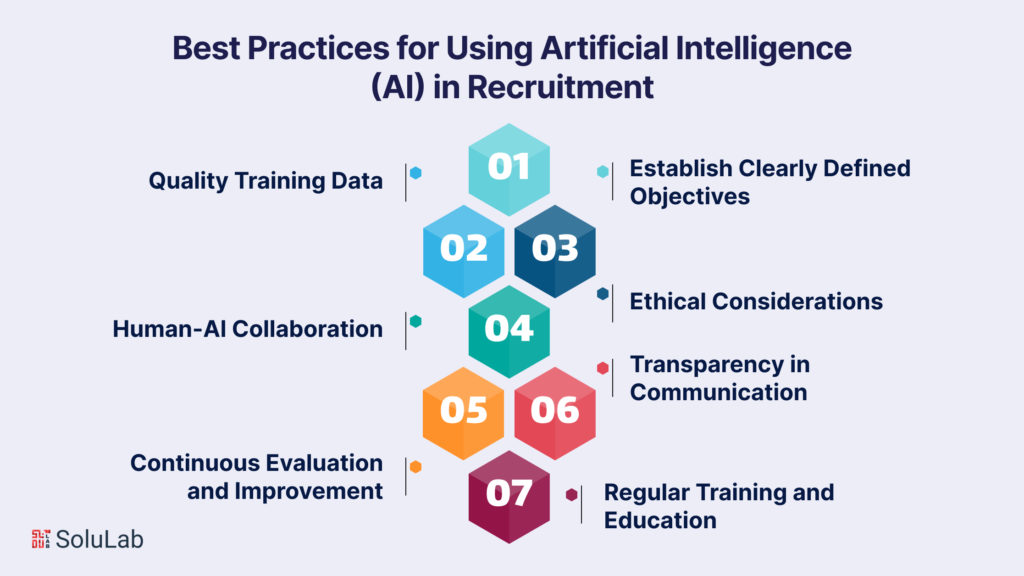
Generative AI is speeding up hiring workflows, sharpening candidate selection and lifting productivity. Getting those gains without the pitfalls takes some discipline, though. These are the practices that separate a smooth rollout from an expensive mess.
Establish Clearly Defined Objectives
Decide what you want before you plug anything in. Which specific problems in your hiring process should generative AI fix?
Maybe it’s faster hiring. Maybe it’s better candidates, or a more diverse and inclusive pipeline. Whatever the goal is, writing it down keeps the tool pointed at what your organization actually cares about, instead of being used just because it’s there.
Quality Training Data
Garbage in, garbage out. Generative AI models lean hard on their training data for accuracy, so make sure yours is good and reflects the range of candidates you want to attract.
Use broad, representative datasets to keep outcomes from tilting. And don’t treat the data as finished. Refresh and extend it regularly so the model keeps pace as your hiring needs shift.
Ethical Considerations
Build ethics and responsible AI practice into how you use these tools, not as an afterthought. Tell candidates plainly when AI is part of the selection process.
Watch for bias by monitoring and auditing what the system outputs, on a schedule. Keep testing and adjusting the algorithm so it doesn’t slowly start favouring certain groups without anyone meaning it to. Fairness takes ongoing maintenance.
Human-Al Collaboration
AI should sit next to your recruiters, not in their chairs. Set things up so each side does what it’s good at.
Hand the repetitive work, like resume screening and first-round assessments, to the machine. Let recruiters spend their time on big decisions, talking to candidates and building relationships. And keep a feedback loop running between recruiters and the system, because that’s how it gets better at the job.
Continuous Evaluation and Improvement
Check regularly whether the thing is actually working. Track KPIs such as time-to-hire, candidate quality and diversity figures to see how the system performs and where it falls short. Gather feedback from recruiters, candidates and anyone else involved, then feed it into steady improvements to the AI model. One practical example: a QR code for Google Form used during interviews makes it much easier to collect input on candidate experience, technical assessments or what the hiring panel thought.
Transparency in Communication
Be upfront with applicants. Tell them what the AI does in your process, how their data gets used, and how it might affect their chances. Then answer their questions honestly. Candidates who understand the process trust it more, and trust is worth a lot when you’re competing for the same small pool of people.
Regular Training and Education
Your recruiters and hiring managers need to understand the tools they’re using. Train them regularly on how generative AI works and where it fits in recruiting. Make sure they know its limits, its strengths, and the biases that can creep into systems built by even leading generative AI developers. Informed recruiters work better alongside AI, make smarter calls, and keep hiring a human process.
Conclusion
Generative AI moves fast, and the only way to get its full value is to hire people who can keep up. A deliberate process helps you find candidates with the right skills, knowledge and experience who also fit how your team works. The pieces that matter most: know what you need, test technical ability, dig into portfolios and projects, stay current on research, probe problem-solving, and weigh teamwork and communication properly.
Keep in mind that the best generative AI developers should bring a strong educational base, relevant experience and deep familiarity with machine learning and deep learning frameworks.
Look hard at one thing in particular: can they produce realistic, original output across different domains? After that, problem-solving, culture fit and communication decide whether they’ll actually work well with the rest of your team.
The field will keep moving. The companies that stay ahead will be the ones that hired well early, and those people are the ones who’ll turn generative AI into new products, solve the ugly problems and hit the goals that matter to your business.
SoluLab’s AI team works across a wide range of AI technologies and builds capable Generative AI models and solutions. If you’re a person or a business looking for advanced generative AI development services shaped around your exact needs, SoluLab is a strong fit. Get in touch with SoluLab today to see what its Generative AI solutions could do for your digital products.
FAQs
Shipra Garg is a tech-focused content strategist and copywriter specializing in Web3, blockchain, and artificial intelligence. She has worked with startups and enterprise teams to craft high-conversion content that bridges deep tech with business impact. Her work translates complex innovations into clear, credible, and engaging narratives that drive growth and build trust in emerging tech markets.