Owning something digital used to mean very little. Anyone could right-click and save. Non-fungible tokens, NFTs for short, changed that, and NFT art is where the change has been loudest. An NFT uses a blockchain to create a one-of-a-kind digital asset that proves who owns a virtual item, whether that is a painting, a collectible, or a sword in a video game. The effect? A brand-new market built on digital scarcity, and a fresh way for artists and creators to get paid for what they make.
In this guide we cover what NFTs are and why they differ from ordinary digital files. We look at the main types, and at the problems nobody should ignore. Then we get practical: how to create NFT art without coding.
By the end, you will know what makes an NFT special, how to put together your own no-code NFT, and which trade-offs deserve a hard look before you step into a market that is still changing fast. Let’s start with the basics.
What is an NFT Art?
A non-fungible token (NFT) is a record that identifies a specific digital asset, one that cannot be swapped for another. That record lives on a blockchain, a shared electronic ledger. NFTs can stand for all sorts of media, video and music included, and they can also point to physical things like artwork or land. Each one is distinct from every other token of its kind, and you cannot merge them. That is where the scarcity, and the value, comes from. Cryptocurrencies work the other way: one coin is as good as the next, and they exist to be spent or traded. NFTs exist to be collected and kept. What one is worth depends on things like how novel it is, how much demand there is, and whether it connects to something in the real world.
NFTs rely on blockchain technology to assign ownership and keep a secure, public history of every transaction. And because creators can sell straight to buyers, the usual gatekeepers get cut out.
Types of NFTs
NFTs caught on quickly, and today they cover a surprisingly wide range of digital assets. These are the main categories you will run into:
1. Art
Think digital paintings, illustrations, and 3D renders. Artists mint their pieces as NFTs to prove they are authentic and to collect royalties later. Well-known examples include Beeple’s “Everyday: The First 5000 Days” and the work sold by creators on platforms such as SuperRare and Foundation.
2. Collectibles
Picture trading cards, only digital. Collectibles are unique items that usually belong to a bigger set. CryptoPunks and Bored Ape Yacht Club sold limited editions that collectors now chase hard, and many pieces carry special traits that make them rarer, and pricier, than the rest.
3. Gaming
NFTs in gaming stand for things you use inside a game: characters, weapons, plots of virtual land. Players can trade or sell them, sometimes across different games and platforms. Axie Infinity and Decentraland are the obvious examples, with players buying, selling, and swapping assets freely.
4. Virtual Real Estate
Yes, people buy land that does not physically exist. Virtual real estate means owning digital plots or buildings inside virtual worlds, then using them for experiences, shops, or places to hang out. Decentraland, The Sandbox, and Cryptovoxels all let you invest in and build on virtual property.
5. Music
Musicians sell songs, full albums, or exclusive extras to fans as NFTs, with no label in the middle. It gives them another income stream and a closer line to their listeners. Kings of Leon did it with their album “When You See Yourself,” and platforms like Audius host exclusive drops of the same kind.
6. Sports Memorabilia
Sports collectibles are going digital too: trading cards, highlight clips, and other exclusive content. The standout is NBA Top Shot, which sells officially licensed NBA highlights as NFTs. Fans get to own a small piece of the game’s history.
7. Domain Names
Some domain names now live on a blockchain as NFTs, which takes control of registration away from a central authority. With Unstoppable Domains or the Ethereum Name Service (ENS), you can buy, sell, and manage a domain securely, no intermediary required.
8. Fashion
Digital clothes. Accessories. Whole outfits for your avatar. Fashion NFTs can be worn in virtual worlds or simply collected, and big names such as Gucci and Nike have already launched their own pieces and experiences.
9. Utility NFTs
These are less about looking at something and more about what the token unlocks for whoever holds it. Membership passes, event tickets, and other digital keys all fit here. A membership NFT, for instance, might get you into a private online community or an in-person event.
10. Photography
Photographers mint their shots as NFTs to prove the work is theirs and to find buyers they would never reach otherwise. Photography-focused platforms such as Quantum Art and Sloika let them sell straight to collectors.
The NFT marketplace platform keeps shifting. New types and uses show up as the technology matures and creators test what is possible, and each type brings its own mix of benefits for different interests and industries.
New Types of Ownership for Art
Before NFTs, owning a digital artwork in any meaningful sense was close to impossible. The file could be copied and passed around endlessly. Tokenizing the work fixes that by creating scarcity and clear ownership rights. Artists can now use the blockchain to prove a digital piece is genuine and show who holds it. Every NFT art for beginners carries a history of its owners that nobody can dispute.
There is more. Artists can write smart contracts that pay them royalties on future resales of their NFT work. Think of it as a “resale rights clause” baked into the token, sending the artist a cut every time the piece changes hands, something digital art simply never had before. NFTs have also opened the door to collaborative work, where several artists hold partial ownership of one piece through shared tokens. Step back and the picture is clear: NFTs gave digital art the traits physical art always had, namely authenticity, exclusivity, proven ownership, and resale value. Plenty of digital artists have done very well out of that shift.
Reasons Behind No-Code NFT Art Creation
Say your work already sells for great prices. Why bother with NFTs or digital assets at all? It is a fair question. But not seeing the upside right now is not the same as there being none. A few examples:
- Lifelong Royalties
Historically, artists have earned surprisingly little across their careers, because the value of a piece tends to climb after they sell it. The people who cash in are the resellers, who buy from the artist and sell on to someone else. Some artists died poor while their earlier work was changing hands for millions. Musicians and other creators may have better options today, but for painters and illustrators, not much has changed. NFTs take some of that risk away. Instead of one lump sum at the first sale, you can keep collecting royalties for the rest of your life.
Setting it up is simple: build royalties into the artwork itself. NFT royalties usually fall somewhere between 2.5% and 10%. So if your work gains value down the line, for whatever reason, that could mean several healthy payouts.
- More Reasonable to Begin
Selling art the traditional way costs money up front. You might rent a gallery, pay an auction house, even cover shipping to the buyer’s door. NFTs make most of that disappear.
They sell on peer-to-peer online marketplaces that anyone in the world can reach. More potential buyers, and you keep most of what the sale brings in.
- Genuine and Verifiable
Proving a piece is real has dogged art sales for centuries. With an NFT, that worry mostly goes away: your work is authenticated, even when other people download it or link to it.
The certificate of authenticity records the artist, every previous owner, and what each paid. That kind of openness means you and your buyers can always see where the money went and who holds the piece now.
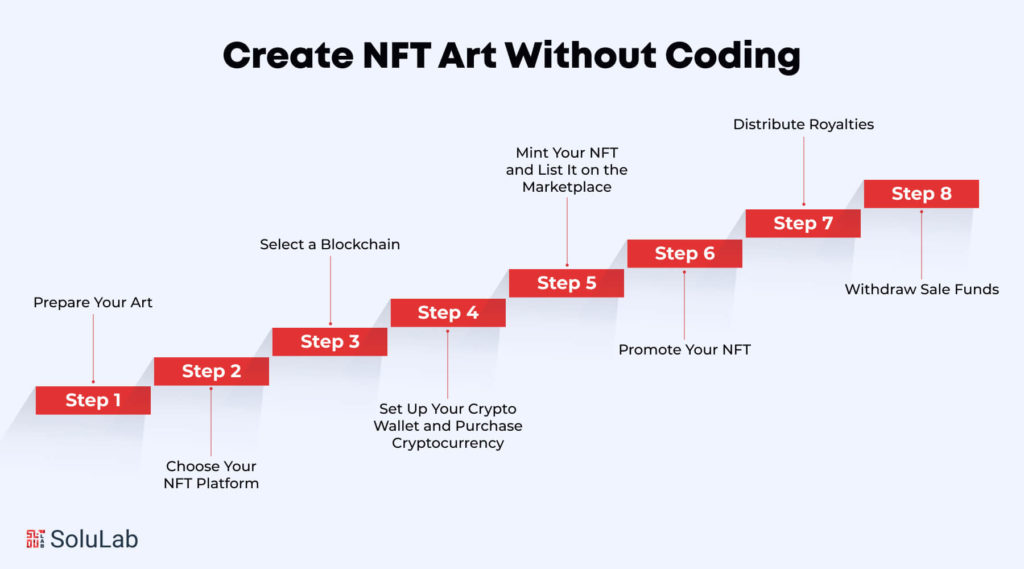
How to Create NFT Art Without Coding: Step-by-Step Guide
Making an NFT for free is easier than most people expect, and you will not write a line of code. A few basic tools and a handful of steps are enough to mint your digital art and put it up for sale. Here is how to create NFT art without coding, start to finish.
Step 1: Prepare Your Art
Everything starts with the artwork. For a no-code NFT, that could be an image, a video, an audio file, or any other digital piece. Make it good and make it yours. Buyers notice originality and quality before anything else.
Step 2: Choose Your NFT Platform
Now pick the marketplace where your NFT will live. Foundation, Rarible, SuperRare, OpenSea, and Nifty Gateway are the usual picks. Features and fees differ from one to the next, so compare them against what you actually need.
Step 3: Select a Blockchain
Which chain will you mint on? Ethereum is the default for most people, simply because it is so widely adopted and supported. It is not the only option, though. Binance Smart Chain and Flow work too, depending on your preferences and the platform you settled on.
Step 4: Set Up Your Crypto Wallet and Purchase Cryptocurrency
You need a crypto wallet for two jobs: holding the funds to pay for minting, and receiving the money when something sells. MetaMask and Coinbase Wallet are common choices. With the wallet ready, buy some Ethereum (ETH), or whatever the native currency of your chosen chain is, to cover minting fees.
Step 5: Mint Your NFT and List It on the Marketplace
Each platform walks you through minting. Typically you upload the file, fill in the name, description, and how many copies you want, then pay the minting fee in ETH. Once that is done, your NFT shows up on the marketplace, ready to sell.
Step 6: Promote Your NFT
Listing it is only half the job. Nobody buys what they never see, so get it in front of people on Twitter, Instagram, and NFT-focused communities. In practice, this is the step most first-time creators underestimate.
Related: Twitter NFT; First Social Media Platform to Support NFT Technology
Step 7: Distribute Royalties
Did you add a royalty scheme to your NFT’s smart contract? Then each resale sends a percentage back to you, and you keep earning from the piece long after the first sale.
Step 8: Withdraw Sale Funds
When sales come in, you can move the proceeds from your crypto wallet to your bank account. If you need local currency, a crypto exchange will convert the ETH for you.
Creating NFT Art Without Coding
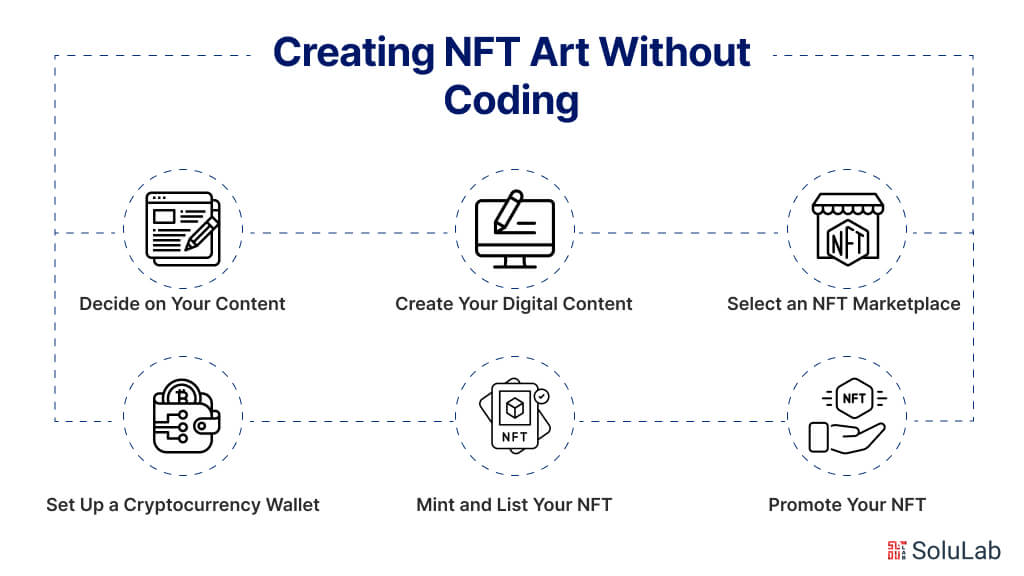
Honestly, the no-code route is not hard. Here is the short version of the steps that matter:
- Decide on Your Content
First, what are you turning into an NFT? A photo, a video clip, a song, any original piece works. Just be certain you own it outright and have the right to sell it.
- Create Your Digital Content
Everyday editing tools are enough. For photos, Photoshop, Picsart’s photo editor or Canva do the job well. For video, try iMovie or Adobe Premiere Pro. For audio, Audacity handles recording and editing nicely. Whatever you use, quality is what pulls buyers in.
- Select an NFT Marketplace
Sign up with a marketplace like OpenSea, Rarible, Foundation, or Nifty Gateway. Accounts are free; verify your identity and you can start listing.
- Set Up a Cryptocurrency Wallet
Get a cryptocurrency wallet such as MetaMask or Coinbase Wallet. Open an account, then load it with some Ethereum (ETH), or the right currency for your chain, so the minting fees are covered.
- Mint and List Your NFT
Upload your file to the marketplace you picked. Add a name and a description, and set a price in ETH. The platform creates a unique token tied to your work and puts it up for sale.
- Promote Your NFT
Share your NFT on social media platforms and inside NFT communities to build interest and sales. Not moving? Try a different price, or push harder on promotion.
That is really the whole process: get your content ready, pick the right tools and platforms, and promote the work properly. Stick with it, and a global audience is within reach of anyone who can make good digital art, code or no code.
Impacts and Challenges While Creating NFT Art Without Coding
NFTs are not all upside. Here is the good and the bad, side by side:
Positive Impacts:
- Direct monetization: Musicians, artists, collectors, and other creators can now earn from their work without a middleman taking a slice, all thanks to NFTs.
- Democratizing wealth: Up-and-coming musicians have done well in the NFT market, which means a wider range of voices is finally getting heard.
- Encouraging innovation: The NFT space has sparked new business models, new financial products, and entirely new artistic mediums.
- Provenance: The blockchain keeps a permanent record of ownership and origin, which helps prove an NFT is legitimate and backs up its value.
Challenges:
- Environmental Impact: Minting and trading NFTs on Ethereum eats a lot of energy, and that raises real sustainability questions.
- Speculative Bubble: Some worry the current NFT rush looks a lot like a bubble, with hype rather than substance setting prices.
- Fraud and Theft: Like any new technology without consumer safeguards, NFTs have seen their share of fraud, scams, and outright theft.
- Volatility: An NFT’s value is tied directly to swings in crypto prices, which makes it a risky thing to invest in.
- Unregulated Market: The NFT sector is still young and largely unregulated. No one is watching over it, and buyers get no formal protection.
Top NFT Marketplaces for Beginners
With so many NFT marketplaces out there, a beginner can easily get lost. So let’s look at a few, and at who each one suits best.
1. OpenSea: OpenSea is one of the most popular NFT marketplaces, and it earned that spot. It is easy to use, and you can buy and sell with several different cryptocurrencies. The catalogue of digital art is huge, so there really is something for everyone. New to NFTs? This is a sensible first stop.
2. SuperRare: SuperRare is curated. It focuses on distinctive, high-end digital art, and while its user base is smaller than some rivals, it has a name for quality and uniqueness. For an artist who wants to show off serious work as NFTs, it is a strong venue.
3. Foundation: Foundation runs a well-known market for digital art and items. A big user base and a simple layout make it an easy place to start selling. It also has an active community of artists and collectors who can help get eyes on your work.
4. Rarible: Rarible is a decentralized NFT marketplace where users create and trade their own NFTs. The layout is friendly and the prices are low, which makes it a good fit for newcomers. Its creator and collector community is lively too, and that can help your work get noticed.
5. Nifty Gateway: Nifty Gateway is easy to get around and specializes in limited-edition drops from well-known, well-loved musicians. Its reputation for premium, unique work makes it a good home for artists selling NFTs. Collectors can even pay by credit card. On top of that, it runs events and has an active network of artists and collectors.
Conclusion
No-code NFT tools have given artists and creators a real way to earn from digital work on the blockchain. The path is short: prepare the art, pick a platform, set up a wallet, mint, and promote. That is enough to get into the NFT market, and it means far more people can profit from the growing interest in non-fungible tokens than ever could before.
Simple does not mean easy, though. Creators still hit walls: making sense of how blockchains work, finding their way around different NFT platforms, and marketing well enough to reach buyers. That is where SoluLab, a leading NFT development company, can step in. SoluLab offers end-to-end NFT marketplace development services, helping artists get past the technical hurdles and get more out of the NFT space. Our team knows blockchain development and knows this market, and we can take you from minting through to marketing. Want to take your NFT work further? Contact SoluLab today and turn your digital art into assets that hold real value.
FAQs
Shipra Garg is a tech-focused content strategist and copywriter specializing in Web3, blockchain, and artificial intelligence. She has worked with startups and enterprise teams to craft high-conversion content that bridges deep tech with business impact. Her work translates complex innovations into clear, credible, and engaging narratives that drive growth and build trust in emerging tech markets.