Think of Web 3.0 as the internet’s next draft. It runs on public blockchains, the same kind of shared record-keeping that powers most crypto transactions. What makes it different? No single giant like Google or Facebook sits in the middle calling the shots. People own and run pieces of the network themselves.
There are now over 23,000 active monthly Web3 developers globally, and that count has kept climbing even through several brutal crypto downturns. What these teams are building isn’t a bet at a casino table. It’s a real change in how the internet is wired. Businesses that figure out how to Build A Decentralized Web3 Ecosystem now will hold a structural edge over the next ten years of the web.
On Web 3.0, you don’t ask anyone for permission to use a service. No gatekeeper decides who gets access. And you don’t have to trust a middleman to move money or sign an agreement online. That does something useful for privacy: fewer agencies and intermediaries sit between you and your data, so less of it gets scooped up. This guide walks through how to build a decentralized Web3 ecosystem, how the pieces fit, and what you actually gain from it.
Enough preamble. Let’s get into it.
Key Takeaways
- The Problem: Most companies treat Web3 like a project with a finish line. Ship it, done. But skip the ecosystem architecture, the governance design, and the infrastructure layer underneath, and even a well-funded product stalls after launch, because nobody built the community or the developer experience around it.
- The Solution: A Web3 ecosystem that actually works gets built in layers. Start with blockchain infrastructure. Move up through developer experience and application mapping. Scale community and growth only after that. Get the order right on day one, and you end up with a live product instead of a permanent beta.
- How SoluLab Can Help: SoluLab is a full-service Web3 Development Company, and it covers every layer of the stack: architecture, smart contracts, developer tooling, dApp development, and the community infrastructure that keeps things alive after launch. The result is a working ecosystem, not just a working product.
What is Web3 Technology?
Is Web3’s decentralized architecture a real break from the internet we use today, or just a fresh coat of paint? Line the two up side by side and the structural gap is hard to miss:
| Dimension | Web2 (Current Internet) | Web3 (Decentralised Internet) |
|---|---|---|
| Data ownership | Controlled by platforms (Google, Meta) | Owned by the user |
| Identity | Platform-issued login (SSO) | Self-sovereign decentralised identity |
| Payments | Bank/card intermediaries required | Peer-to-peer, borderless crypto rails |
| App governance | Controlled by founding company | Community/token holder governance |
| Data storage | Centralised cloud servers | Distributed (IPFS, Arweave, Filecoin) |
| Censorship resistance | Low, platform can remove content | High, immutable on-chain records |
| Developer access | API access subject to platform terms | Open, permissionless protocols |
| Value capture | Accrues to platform shareholders | Accrues to network participants/token holders |
Significance of Decentralization in Web3
Decentralization sits at the heart of Web3. It answers a handful of problems that the old centralized web could never quite fix.
- Increased Security: Data spreads across many nodes instead of sitting in one place. So there’s no single box an attacker can knock over to bring the whole thing down. That spread makes the system tougher to break.
- Enhanced Privacy: You get real control over your own data. No central authority stands between you and your accounts, so you can transact and interact with more privacy and more say over what happens to your information.
- Reduced Intermediary Dependency: Web3 cuts out the middlemen. Smart contracts, for instance, run and settle agreements on their own, no third party required. That trims costs and removes a lot of the friction points where deals usually snag.
- Censorship Resistance: No single entity can easily silence or filter what flows through the network. That matters. It protects free expression and keeps information reachable for everyone, not just whoever a platform decides to let in.
- Ownership and Control: Your tokens, your data, genuinely yours. Decentralized identity and blockchain-based systems hand you real ownership over your digital assets and your presence online.
Why does decentralization in Web3 matter so much? Because it’s the base layer for dedicated developers and users alike, and everything more resilient, more secure, and more user-centric gets built on top of it. Take these principles seriously and the way we deal with the digital world starts to look genuinely different.
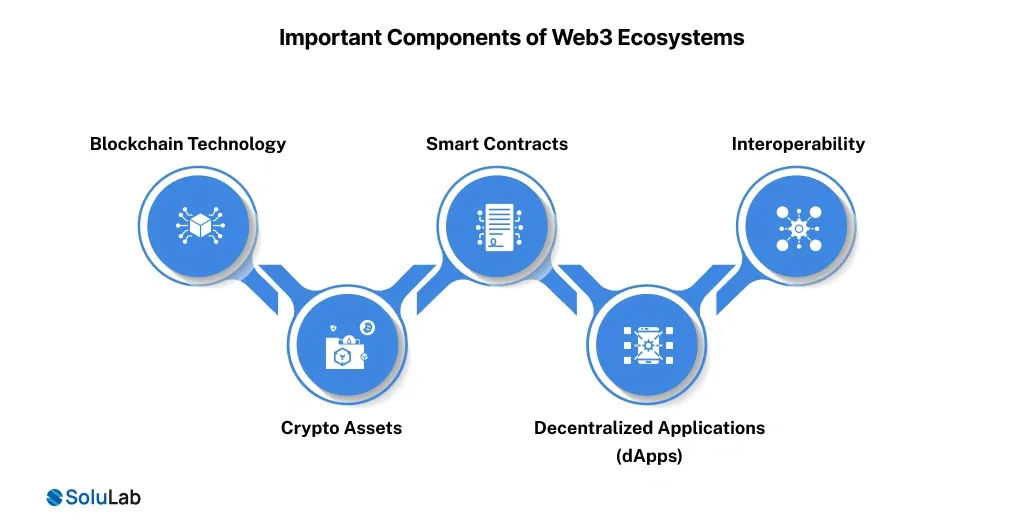
Important Components of Web3 Ecosystems
Decentralization is the pillar the whole thing stands on. It opens room for new ideas while cutting through the bureaucratic drag that slows most systems down. It also makes a Web3 network more accountable, more autonomous, and quicker to respond to what users and markets actually want. That’s why it counts as a defining feature.
1. Blockchain Technology
Blockchain is the bedrock. It gives Web3 a decentralized network for storing and moving data, and its distributed ledger keeps things secure enough to build, ship, and trade digital assets without a central authority stepping in.
2. Crypto Assets
Tokens and cryptocurrencies lean on blockchain’s decentralized design to settle transactions securely. They do double duty. They act as the native currency inside decentralized applications (dApps), and they give holders a real voice in how Web3 projects are governed.
3. Smart Contracts
A smart contract is a program that runs itself once its conditions are met. That simple idea is what makes clever dApps possible, and it’s one of the building blocks the rest of Web3 rests on.
4. Decentralized Applications (dApps)
dApps blend the interactive feel of a normal app with the decentralization underneath. They let you buy or sell non-fungible tokens (NFTs), trade crypto, and reach decentralized finance (DeFi) solutions, all while keeping more control in your hands than a Web2 app ever would.
5. Interoperability
Interoperability is what lets your assets move and talk across different platforms without getting stuck. On Web3, you hold full control over your data. That’s the opposite of Web2, where a handful of companies keep it locked behind their own walls.
Put simply, these components are what you need to get right to build a Web3 ecosystem that holds up, one that leaves room for creativity and pushes the digital world toward something more decentralized and more centered on the people using it.
Web3 Application Development Across Diverse Sectors
Web3 apps are already reshaping how whole industries operate, bringing decentralized applications (dApp) solutions that rewrite the old rules. Here’s a quick tour of where the impact is landing:
1. Finance: In finance, Web3 apps make transactions transparent and trustless, smooth out cross-border payments, and open the door to decentralized finance (DeFi). A DeFi Explorer earns its keep here by letting users pull up, dig into, and verify on-chain data for themselves, which spreads financial access through open, transparent rails.
2. Healthcare: In healthcare, Web3 keeps data sharing both secure and interoperable, puts patients in charge of their own records, and tightens things like drug traceability on-chain. The payoff: better data security and care that actually revolves around the patient.
3. Supply Chain: Supply chains get a real upgrade. Web3 apps add transparency and traceability, so both companies and shoppers can confirm a product is the real thing at every step, all tracked on decentralized ledgers.
4. Real Estate: Property deals change shape too. Web3 applications bring in smart contracts for smoother transactions, allow fractional ownership, and keep a clear property history on-chain, which means fewer intermediaries taking a cut.
5. Gaming: Gaming is a natural fit. Tokenizing in-game items gives players true ownership, reward systems get transparent, and assets can carry across titles, building a decentralized gaming world instead of a walled garden.
6. Identity Management: Web3 rethinks identity entirely. You control your digital ID across platforms yourself, which cuts the risk of theft through decentralized, user-first systems.
7. Education: Education gets more trustworthy records. Web3 apps make credential checks secure and transparent, support tokenized certifications, and run decentralized learning platforms, which keeps academic records both honest and easy to reach.
8. Energy: On the energy side, Web3 apps set up transparent trading platforms, let neighbors buy and sell power directly, and tune grid efficiency through decentralized solutions. The result is a cleaner, more efficient energy market.
9. Social Media: Social platforms flip the model. Web3 apps put data ownership back with users, strip out centralized control, and often reward creators and users with tokens, which changes how people connect online.
10. Governance: Governance goes decentralized. Communities weigh in on decisions directly through consensus mechanisms, which makes the whole process more open and more inclusive.
The pattern repeats across every sector: a push toward decentralization, transparency, and putting users in charge. Old industries get rebuilt, and what comes next looks more open and more efficient than what it replaced.
How to Build a Decentralized Web3 Ecosystem?
A decentralized Web3 ecosystem rests on three things: careful architecture, clear governance, and systems that don’t ask you to trust anyone blindly. Pull it off, and you’ve lined up technology, user experience, and staying power right from the start.
1. Create a Compelling Developer Experience
This comes first. Before users, before growth, before a single marketing dollar.
Why it matters: Web3 ecosystems live or die on developer adoption. No builders, no apps. No apps, no users. It really is that linear.
What your Developer Experience team should own:
- Developer portal documentation, template code, and quickstart guides in one place
- Support channels high-availability Telegram/Discord with trained community moderators
- FAQs + code reviews track recurring questions and offer reviews for large-scale projects
- Feedback loops regularly update the DX roadmap based on real developer pain points
Here’s the shortcut. Hire Web3 developers with real ecosystem-building experience, and you can shave months off your early timeline instead of piecing together DX infrastructure from scratch.
2. Build the Infrastructure Ecosystem
No other decision hits your cost and scalability harder than the infrastructure you pick. Choose carefully.
The 4 Layers of Web3 Infrastructure:
| L1 | Blockchain network | Ethereum, Solana, Avalanche | Chain selection |
| L2 | Node providers | Alchemy, Infura, QuickNode | Reliability + cost |
| L3 | APIs + SDKs | Web3.js, Ethers.js, Moralis | Developer ergonomics |
| L4 | Dev tools | Hardhat, Truffle, OpenZeppelin | Speed to ship |
As of 2026, Ethereum L2s like Arbitrum, Base, and Optimism carry most of the daily transaction load, and fees have dropped more than 90% compared to mainnet. Solana has grown up too, stable and steady with its Anchor framework.
Look over the Top Web3 platforms comparison before you lock in a stack.
3. Map the Application Ecosystem
Find the right gaps. Then leave the crowded corners alone.
The goal: Spot which application categories are starved for attention in your ecosystem, and put those ahead of the ones already packed with competitors.
Application types to map across your ecosystem:
- DeFi + trading protocols
- NFT infrastructure
- Metaverse + gaming (Play-to-Earn)
- Decentralised identity + authentication
- Governance + DAO tooling
- Predictive markets
- Enterprise use cases + supply chain
- Social + creator platforms
How to find the gaps: Open up ‘Request for Proposal’ submissions from your community, the way the Ethereum Foundation runs its RFP process. Hand out grants for useful tools that don’t yet have a business model behind them. And run governance forums with a clean, readable UI so people can raise and vote on what the ecosystem needs most.
Our AI and Web3 Execution playbook digs into the application mapping process in full, including how to rank which gaps to fill first based on user demand and how many developers are actually available to build.
What to Build First based on 2026 Priority Framework?
This is where most teams trip up.
| 1st | Core infrastructure + smart contracts | The on-chain logic everything else depends on. Audit before anything is built on top. |
| 2nd | Developer tooling + documentation | Third-party devs are your primary growth engine. They won’t build on an undocumented platform. |
| 3rd | One flagship dApp | A single well-designed application that proves your ecosystem’s value. Your trust anchor. |
| 4th | Governance layer | Converts users into advocates by enabling transparent, auditable, and trust-driven agent behavior |
| 5th | Web3 wallet integration | The UX gateway. For enterprise clients, a dedicated web3 wallet for businesses is often required before institutional engagement begins. |
4. Define and Execute the Growth Strategy
Community, then marketing, then commercial development. Keep them in that order.
The three growth levers:
| Community | Marketing | Commercial Dev |
| Hackathons, Discord, grants for early builders | Developer-first content, case studies, ecosystem maps | Onboard enterprises once critical mass is reached |
You want methodical people who really get Web3’s value proposition, not generalist marketers passing through. They need the tactical chops and a genuine feel for what developers are up against.
Once you hit critical mass, big players in gaming, e-commerce, and social become obvious partners. Use the Web3 Custom AI Agent Builder to take the pain out of integration for enterprise clients who want automated workflows but not a full custom build.
5. Long-Term Company Strategy
Protect what you’ve built by staying a step ahead of where the ecosystem is heading.
The three strategic pillars at this stage:
- Value proposition clarity – keep sharpening what makes your platform uniquely worth building on
- Developer roadmap alignment – your next priorities have to match what your most active builders actually need
- Internal team strengthening – put money into dedicated support functions as the ecosystem grows
As Web3 Development Services companies rake in more profit and grab more market share, the pressure to hold onto that lead only climbs. The ones who stay on top treat strategy as something they revisit constantly, not a document they wrote once at launch and filed away.
Benefits of Developing a Web3 App
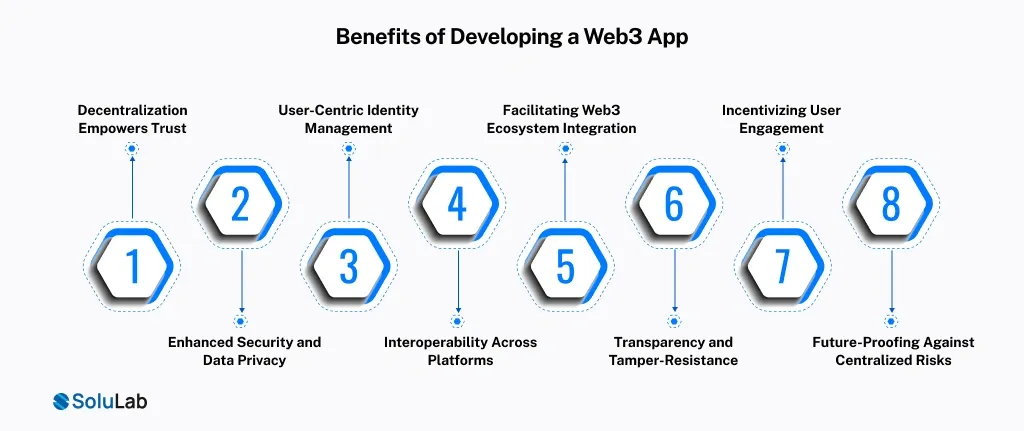
Building a Web3 app pays off in a lot of ways, most of them tracing back to decentralization and secure identity management. Here are the advantages worth paying attention to:
- Decentralization Empowers Trust
Web3’s decentralized architecture builds trust into digital interactions. There’s no central authority to rely on. Transactions, data exchanges, and smart contracts all run on a transparent, tamper-resistant blockchain, which creates an environment where you don’t have to take anyone’s word for it.
- Enhanced Security and Data Privacy
Web3 apps take user security and privacy seriously. With decentralized identity management, you hold more control over your personal information and dodge the risks that come with piling everything into one central data store. Fewer honeypots means less chance of identity theft or unauthorized access.
- User-Centric Identity Management
Web3 puts the user at the center of their own identity, which is a real change from how things used to work. With decentralized identity solutions, you manage your online personas securely across platforms and lean far less on centralized entities to vouch for you.
- Interoperability Across Platforms
Web3 apps play well together, so you can move and use your assets across platforms without friction. Compare that to Web2, where your data usually sits under one company’s control. In a Web3 setup, you get more autonomy over your digital presence.
- Facilitating Web3 Ecosystem Integration
Build a Web3 app and you plug straight into the wider decentralized network. That opens up decentralized finance (DeFi), tokenized ecosystems, and other new decentralized applications, which sets up a more collaborative, more active digital environment.
- Transparency and Tamper-Resistance
Blockchain bakes transparency and tamper-resistance right into the app. Once a transaction or action lands on-chain, it stays put, which gives you a verifiable, open history. That kind of permanence is what makes users and stakeholders trust the system.
- Incentivizing User Engagement
Plenty of Web3 apps hand out token-based rewards, so users and creators get something real for showing up. That nudges people to stay active, and an active crowd is what keeps an ecosystem lively.
- Future-Proofing Against Centralized Risks
Going decentralized shields you from the failure modes that haunt centralized systems. As more people wise up to data breaches and privacy worries, a decentralized approach holds up better against the weak spots central systems tend to carry.
So the upside of building a Web3 app goes well past the tech itself. It touches trust, security, privacy, and putting users in charge. Lean into those advantages and you’re not just following the decentralization ethos, you’re planting your app right at the front of a fast-moving digital shift.
Conclusion
Building a Web3 ecosystem has less to do with which tools you pick and more to do with a shift in how you think, toward decentralization, transparency, and users owning their own stuff. Blockchain, smart contracts, and dApps are changing how digital systems get built and trusted, and that opens real room to rethink products, platforms, even whole industries. It’s already making digital experiences more secure, more inclusive, and more centered on the person using them.
That’s where SoluLab comes in, taking businesses from an idea to something running. With deep hands-on work across blockchain protocols, smart contracts, and decentralized apps, the team cuts through the messy parts of Web3 and turns them into solutions you can actually ship and scale. If you’re serious about building in Web3, SoluLab is a partner worth having for the road ahead.
FAQs
Shipra Garg is a tech-focused content strategist and copywriter specializing in Web3, blockchain, and artificial intelligence. She has worked with startups and enterprise teams to craft high-conversion content that bridges deep tech with business impact. Her work translates complex innovations into clear, credible, and engaging narratives that drive growth and build trust in emerging tech markets.