Gen AI showed up on almost every industry’s work desk over the past year. That trend is not slowing down: 83% of organizations now treat AI as a high business priority. In 2023, financial services poured roughly $35 billion to AI into AI investment, with around $21 billion of that coming from banking alone.
Generative AI produces content and data by running algorithms that mimic human-generated output. And in accounting, the impact has been real. Tasks that used to eat whole afternoons are now done in seconds. Decisions that once relied on gut feel now have actual data behind them.
The shift runs deeper than automation. AI is now catching fraud earlier, surfacing patterns inside financial data that humans would miss, and flagging compliance gaps before they become problems. These are not edge features. They are becoming table stakes.
This article covers the real benefits of generative AI in accounting, where teams typically hit walls during implementation, and how to work through them.
What is Generative AI?
Generative AI learns from existing information and then produces something new from it: text, images, synthetic data, structured reports. It is not the same as traditional AI, which mostly interprets or classifies what it is given. Generative AI creates. It does this using machine learning architectures, particularly neural networks, that have been trained on large volumes of examples until they can produce outputs that read or behave like the originals.
In finance, that capability gets applied to things like tax code analysis, financial forecasting, and document drafting. A GenAI system can sift through transaction records, identify likely deductions, draft a compliance report, and flag anything it’s not sure about. The accountant reviews and decides. The hours-per-report drops significantly.
The real appeal for data-heavy organizations is that generative AI does not get tired or skip steps. It applies the same logic to the thousandth record as it did to the first. That consistency is genuinely hard to replicate with a human team at scale.
The Role of Generative AI in Accounting
GenAI has changed how financial data gets processed, analyzed, and reported. The technology uses generative AI in payments and applies high-end machine learning models for better efficiency and accuracy. Financial reporting and audit compliance are two places where that shows up most clearly.
1. GenAI Accounting for Streamlined Financial Reporting
Month-end used to mean late nights and spreadsheet archaeology. Generative AI changes that. It pulls data from across an organization, identifies the relevant trends, and builds out reports tailored to whoever is reading them. The accounting team gets a draft. They verify, adjust, and publish. What previously took days can close in hours.
Generative AI in accounting and AI agents for finance examples include systems that pull data from external databases, CRM platforms, and ERP systems into one standardized report. These systems can also be configured to align with GAAP or IFRS, so regulatory compliance is built into the output, not bolted on afterward.
2. Improved Audit and Compliance Processes
Generative AI in sales and accounting is also changing in the audit space. Traditional audits rely on sampling because reviewing every transaction is not feasible by hand. Generative AI can analyze 100% of transactions, flagging anomalies and patterns that suggest errors or fraud. The audit becomes more thorough, not just faster.
It also generates audit trails with plain-language summaries of flagged transactions. That matters both for internal review and for external regulators who want a clear record, not a spreadsheet they have to decode themselves.
3. Predictive Analytics and Personalized Insights
Beyond compliance, GenAI gives analysts and accountants a look forward, not just backward. By working through historical data and market trends, these systems can project financial outcomes and suggest adjustments. For smaller businesses, that kind of forward-looking analysis was previously out of reach unless they hired a dedicated financial consultant.
Generative AI in accounting can build personalized accounting dashboard templates that track real-time metrics: revenue, expenses, financial health across different business units. When something shifts, the system shows it immediately. Teams react faster because they are not waiting for a weekly report to tell them what already happened.
4. Enhanced Accuracy and Reduction of Human Mistakes
One accounting error in the wrong place can mean a restatement, a fine, or worse. GenAI reduces that risk by taking over the tasks where humans are most likely to slip: data entry, reconciliation, repetitive calculations. The same process runs the same way every time. Consistency is the point.
5. Future Implications of Generative AI in Accountancy
The integration is still deepening. Real-time tax optimization, automated budgeting, and AI-powered financial assistants that can handle complex queries are already appearing in early-stage deployments. The shift here is not just operational. It is structural. Accountants are moving away from transaction processing and toward strategy. That is a different job, and for many, a better one.
GenAI accounting has produced real improvements across the financial sector. Generative AI in payments is changing the field: it makes financial reporting more credible, compliance easier to manage, and gives teams information they can actually act on. Businesses that put this technology to work well will handle their financial operations with more precision and better foresight.
Generative AI in Accounting Pros and Cons
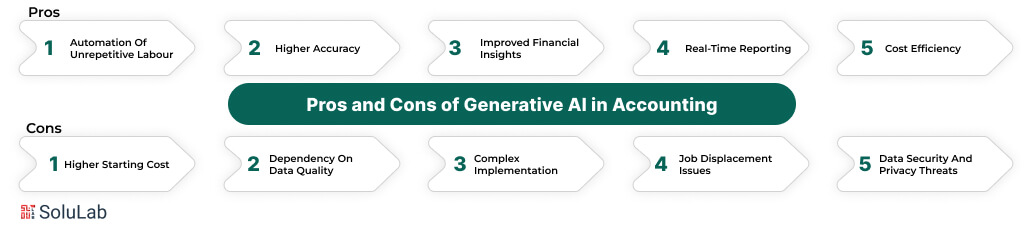
GenAI has changed real things in accounting. Speed, accuracy, compliance overhead: all measurably better. But it is not a clean win. There are genuine tradeoffs, and ignoring them tends to make the problems worse. Here is a straightforward look at both sides.
Pros of Generative AI in Accounting
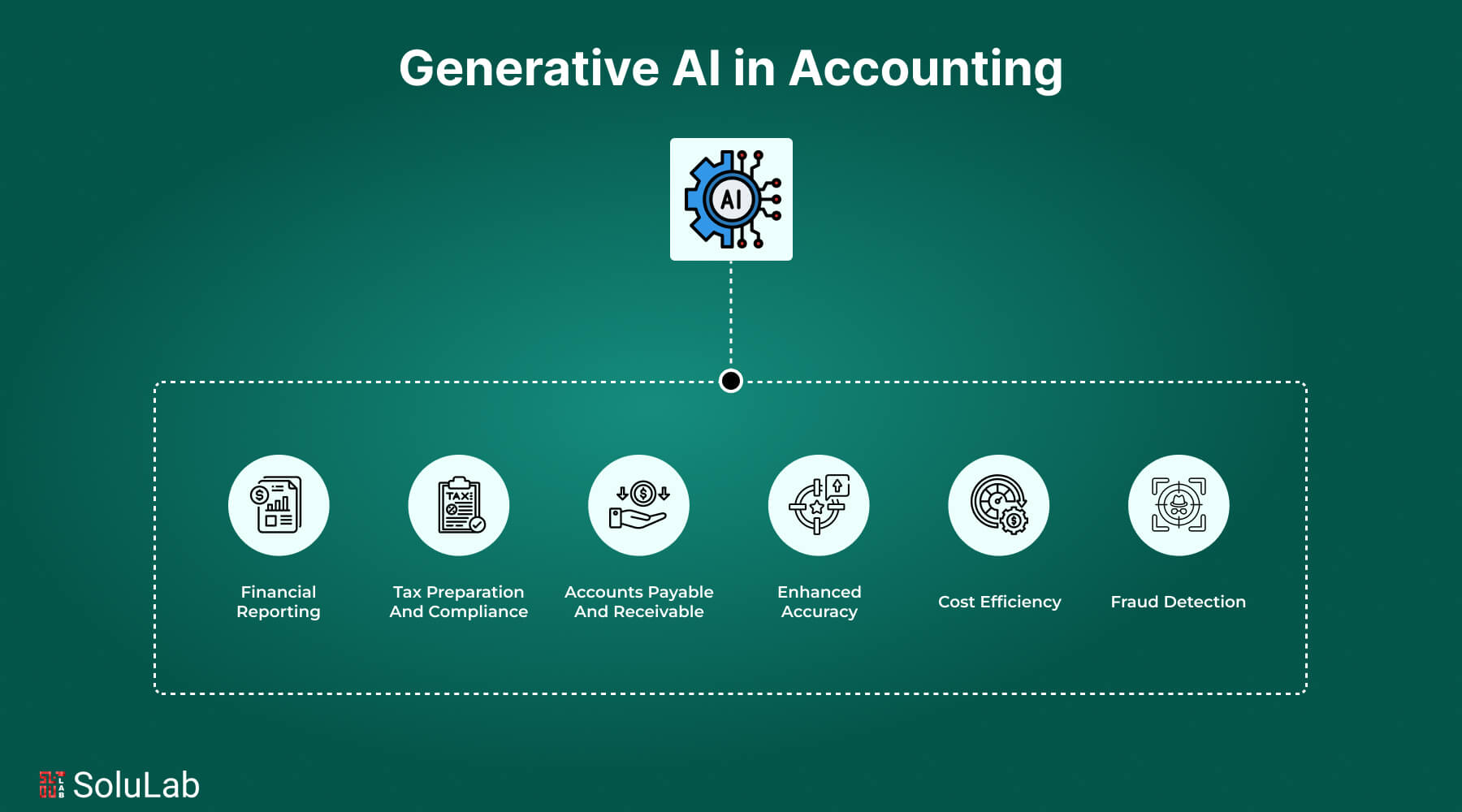
- Automation of Repetitive Work: GenAI handles data entry, reconciliation, and report generation. With those tasks off their plate, accountants can spend time on financial planning and analysis instead of moving numbers between columns.
- Higher Accuracy: Human error in ledger maintenance or tax processing drops substantially when GenAI handles the calculations. Cleaner data means cleaner audit trails and more dependable financial reports.
- Improved Financial Insights: Generative AI agents sift through large datasets to find patterns, trends, and anomalies that would routinely get missed. That gives companies real information to act on, not summaries that arrived a week too late.
- Real-time Reporting: GenAI can produce financial reports as conditions change. Decision-makers get current numbers, not last month’s picture.
- Cost Efficiency: Automating manual tasks lowers operating costs. Fewer errors also means fewer expensive corrections and a reduced risk of compliance penalties.
- Customizable Solutions: Generative AI systems can be built around specific regulatory requirements or internal workflows, not just generic accounting logic.
Cons of Generative AI in Accounting
- Higher Starting Cost: Software, hardware, and training all cost money upfront. For smaller businesses, the initial investment is real, and ROI is not always immediate.
- Dependency on Data Quality: Garbage in, garbage out. GenAI is only as good as the data it processes. Messy, incomplete, or outdated datasets produce outputs that look credible but are wrong.
- Complex Implementation: Integrating generative AI into existing accounting systems is not a weekend project. It takes technical expertise and time to get it working alongside what is already there.
- Job Displacement Concerns: Automating routine work creates anxiety about job losses. GenAI does open up more strategic roles, but that transition is not always straightforward for everyone on the team.
- Data Security and Privacy Risks: Accounting involves sensitive financial data. Without proper security controls, GenAI systems can become a target for data breaches, putting compliance and confidentiality at risk.
- Limited Contextual Understanding: GenAI is strong at processing structured data, but nuanced financial situations still require human judgment. Edge cases, unusual transactions, and ambiguous policy changes often need a person to interpret them.
Use Cases of Generative AI in Accounting
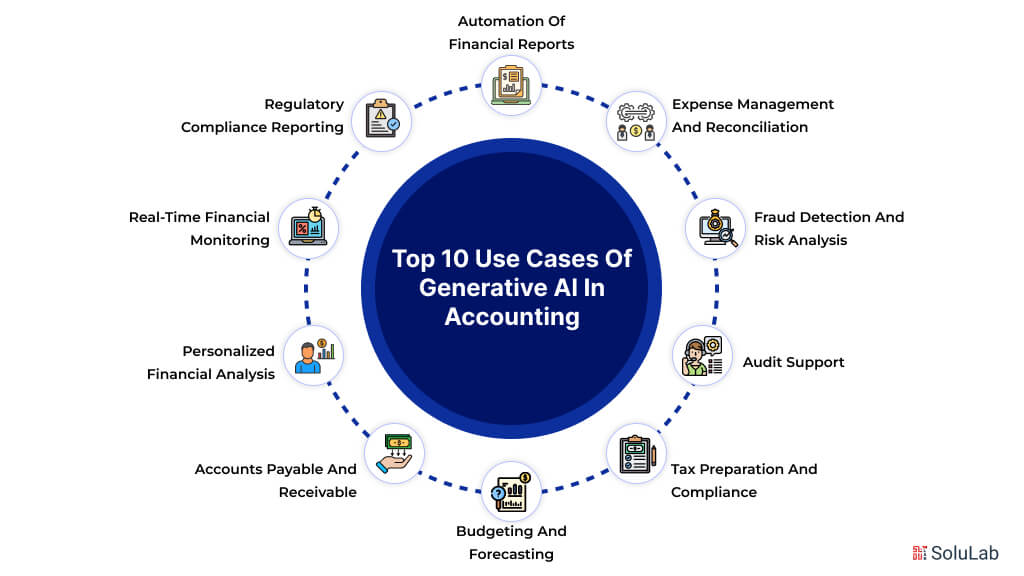
Generative AI is being applied across nearly every layer of accounting work. Among the most significant use cases of GenAI making a difference in accounting today:
1. Automation of Financial Reports
One of the most well-established applications of GenAI in accounting is automated report generation. Given large volumes of financial data, GenAI can produce accurate income statements, balance sheets, and cash flow statements. Time drops, errors drop, and the output still meets accounting standards.
2. Expense Management and Reconciliation
Generative AI categorizes expenses automatically, flags anything that looks off, and reconciles bank statements against accounting records without someone doing it manually. Accountants still review the results, but they are not starting from scratch each time.
3. Fraud Detection and Risk Analysis
GenAI identifies unusual patterns across large transaction sets, spotting things like unauthorized payments or invoice discrepancies before they compound. It also supports risk assessment by working through financial trends and flagging potential vulnerabilities in how money is moving.
4. Audit Support
Where traditional audits depend on sampling, GenAI can examine every transaction. The audit becomes more thorough by default. It also produces audit trails and plain-language summaries that make the review process faster for both internal teams and external regulators.
5. Tax Preparation and Compliance
Tax rules change constantly. In the UK, generative AI for tax preparation and Making Tax Digital software helps businesses stay current by tracking eligible deductions, calculating tax liability, and filing without errors. In the US, comparable AI-driven platforms handle IRS compliance requirements, automate filings, and prepare documentation that holds up under audit. Less manual work, fewer penalties.
6. Budgeting and Forecasting
Generative AI builds dynamic budgets and forecasts by working through historical data and current market conditions. Businesses get projections they can actually use for resource allocation, spending decisions, and planning. Static annual budgets are becoming less relevant as real-time forecasting becomes feasible.
7. Accounts Payable and Receivable
GenAI processes invoices automatically, sends payment reminders, and kicks off collection workflows without someone managing each step. Cash flow stays healthier because nothing falls through the cracks because someone forgot to follow up.
8. Personalized Financial Analysis
GenAI can build financial analysis that matches the specific situation of a business or individual. Based on spending patterns and stated goals, it puts together strategies for cutting costs, identifying where to allocate resources, and finding investment opportunities worth considering.
9. Real-Time Financial Monitoring
With generative AI, companies can watch their financial performance as it happens. Dashboards and analytics tools give decision-makers a live view of revenue, expenses, and key performance indicators. When something shifts, they see it and can respond, rather than discovering the problem weeks later in a report.
10. Regulatory Compliance Reporting
Compliance is not optional, and generative AI in compliance makes it more manageable by generating error-free compliance reports that match current industry standards. Deadlines get met, documentation is audit-ready, and the risk of missing a regulatory update drops significantly.
Steps to Integrate Generative AI in Accounting
Bringing generative AI into accounting can reshape how your financial operations run: less manual effort, better decisions, compliance that does not require a heroic push at quarter-end. But the implementation has to be deliberate. Here is what that looks like in practice.
- Assess Business Needs and Objectives: Start by identifying the specific problems you want GenAI to solve. Automating financial reporting? Improving fraud detection? Reducing tax compliance overhead? Clear objectives keep the implementation from sprawling into something unmanageable.
- Evaluate Data Readiness: Generative AI is sensitive to the quality of its inputs. Before you do anything else, check your financial datasets: are they accurate, complete, and current? Clean and preprocess the data where needed. This step is easy to skip and painful to fix later.
- Choose the Right GenAI Tools: Select tools that match your accounting requirements. Look at features like report generation, anomaly detection, and forecasting capabilities. Check whether they meet industry standards and whether they can connect with your existing accounting systems.
- Develop a Pilot Program: Do not roll GenAI out everywhere at once. Pick a single area, accounts payable, financial reporting, and run a pilot. Watch how the tool performs, identify issues early, and collect feedback from the team before expanding.
- Train Your Team: Introducing generative AI requires people to work differently. Show the team how to use the tools with real examples. They need to understand both how to operate the system and how to apply AI outputs to actual decisions, not just accept whatever the model produces.
- Integrate GenAI with Existing Systems: Getting GenAI to work cleanly alongside your current accounting software, ERP, and financial management platforms takes real technical effort. Work with your IT team to make sure data flows correctly between systems without downtime or data loss.
- Monitor Performance and Outputs: After launch, watch the system closely. Review the reliability of generated reports, check the quality of automated workflows, and assess the usefulness of the insights it surfaces. Use that feedback to tune the system and address problems as they come up.
- Ensure Compliance and Security: Financial data is regulated. Put strong security controls in place to protect data integrity and confidentiality. Verify that your GenAI tools meet the relevant standards, whether that is GDPR, SOX, or other applicable regulations, before going live.
- Scale and Optimize: Once you have proven results in the pilot area, expand to other accounting functions. Keep improving by updating algorithms, bringing in new datasets, and adding features as your needs change.
- Measure ROI and Impact: Track the return on investment and the actual effect on your accounting operations. Measure efficiency gains, cost savings, and decision-making quality. Those numbers make the case for continued investment in AI tools.
Knowing how to use generative AI in accounting well means treating the rollout as a deliberate process, not a one-time deployment. Assess your needs, prepare your data, train your people, and keep compliance central throughout. Done that way, the technology delivers. Rushed or poorly scoped, it creates more problems than it solves.
Benefits of Generative AI in Accounting
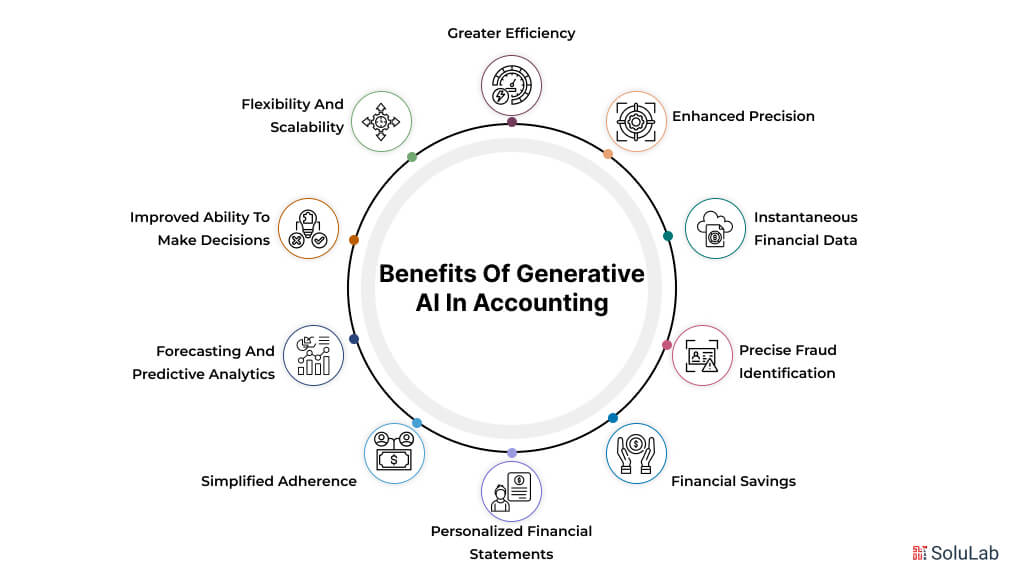
GenAI has changed accounting in ways that are measurable. Speed, accuracy, the ability to handle more work without proportionally more staff: these are real outcomes. The benefits below reflect what teams are actually seeing when they put this technology to work.
Greater Efficiency
Data entry, reconciliation, report drafting: these tasks get done faster with generative AI. Accountants get time back for work that actually requires judgment. Things that used to take hours can now be finished in minutes.
Enhanced Precision
Errors in accounting are expensive. GenAI reduces them by applying the same logic consistently across every calculation, every reconciliation, every report. Whether you are generating financial statements or running tax figures, the outputs are more reliable than what manual processes produce at scale.
Instantaneous Financial Data
GenAI assesses data as it arrives, giving decision-makers current figures rather than a snapshot from last week. That matters most for cash flow management, investment evaluation, and risk assessment, where acting on stale information has a real cost.
Precise Fraud Identification
GenAI spots patterns that manual review misses. By cross-referencing transaction histories and financial records, it catches anomalies early, before they grow into something harder to address. That protects both the business and its reputation.
Financial Savings
Fewer manual hours, fewer errors, and fewer compliance failures all reduce cost. GenAI also helps prevent financial losses from fraud that might otherwise go undetected for months.
Personalized Financial Statements
Generative AI can produce reports shaped for specific audiences: executive summaries for the board, detailed breakdowns for finance teams, visualizations that make complex data accessible for stakeholders who do not live in spreadsheets.
Simplified Adherence
Keeping up with regulatory requirements is genuinely hard. GenAI makes it more manageable by building compliance into reporting, generating audit-ready documentation, and reducing the chance of a missed requirement turning into a penalty.
Forecasting and Predictive Analytics
Generative AI builds financial projections from historical data and market patterns. Those projections inform budgeting, resource allocation, and strategic planning. Businesses that use them make decisions based on evidence rather than intuition.
Improved Ability to Make Decisions
GenAI processes large volumes of financial data and surfaces what matters. Finance teams and executives get insights they can act on, not raw data dumps they have to spend hours interpreting.
Flexibility and Scalability
As a business grows, so does the complexity of its financial data. Generative AI scales with that growth. It handles larger datasets and more intricate processes without requiring a proportional increase in headcount.
Challenges of Using Generative AI in Accounting
GenAI has real advantages in accounting. But it also comes with a set of challenges that are worth understanding before you commit. Here are the ones that matter most.
- High Costs of Implementation: Infrastructure, software licensing, and staff training all require upfront investment. For smaller businesses, those costs can be substantial, and the return is not always quick to materialize.
- Dependency on Data Quality: The system is only as reliable as the data it works from. Inaccurate, incomplete, or outdated records produce outputs that look credible and are wrong. Data quality is not a one-time fix. It is an ongoing commitment.
- Limited Knowledge of Context: GenAI handles structured tasks well, but it struggles with situations that require nuance. Unusual transactions, ambiguous regulations, edge cases in financial reporting: these still need a human who understands the context.
- Issues with Privacy and Security: Accounting involves sensitive financial data. Without proper security controls in place, AI systems become a target. A breach does not just mean financial loss. It means regulatory exposure and reputational damage.
- Difficulties in Regulatory Compliance: Generative AI systems must comply with data protection and financial regulations like SOX and GDPR. As those rules change, keeping the system aligned is a continuous effort, not a setup-once task.
- Worries About Job Displacement: When routine tasks get automated, people worry about their jobs. That concern is real. GenAI opens up more strategic accounting work, but the transition requires active investment in training and role redesign. It does not happen automatically.
- A Lack of Transparency: Many generative AI models function as black boxes. The output arrives without a clear explanation of how it was reached. In accounting, where you need to defend your numbers to auditors or regulators, that lack of visibility is a real problem.
- Integration Difficulties: Connecting GenAI with existing accounting software and workflows is technically demanding. Compatibility issues and customization requirements can delay deployment and push up costs beyond the initial estimate.
- Excessive Automation Dependence: Automation is one of the technology’s core strengths. But over-relying on it can erode the human oversight that catches what the system misses. Critical errors or anomalies that need a judgment call can go unnoticed if no one is looking.
- Issues of Ethics and Bias: When trained on biased datasets, generative AI models can carry those biases into financial operations. That can produce unfair outcomes or distorted analysis in ways that are hard to detect without deliberate testing.
Future of Accounting With Generative AI
Accounting is changing, and generative AI is driving a significant part of that change. Repetitive transaction processing, the kind of work that used to consume the majority of an accountant’s week, is increasingly handled by AI systems. That frees up practitioners for financial planning, strategic analysis, and advisory work: the parts of the job that actually require expertise.
Fraud detection and risk management will get stronger as AI capabilities improve. By examining transaction patterns and spotting irregularities across entire datasets rather than samples, these systems can catch problems earlier. And when combined with technologies like blockchain, financial records become more traceable and harder to manipulate, which strengthens the foundation that accounting rests on.
Compliance management will also look different. Generative AI can track regulatory changes in real time and update systems accordingly, reducing the scramble that typically happens when rules shift. AI-driven predictive analytics will give businesses sharper forecasts: revenue patterns, budget scenarios, expenditure planning with a level of accuracy that was not practical before.
The accountant’s role is shifting, not disappearing. As AI absorbs routine work, the people who succeed will be those who can interpret AI-generated analysis, challenge it when something looks off, and translate it into advice that actually moves a business forward. That is a more interesting job than reconciling spreadsheets, but it requires a different skill set.
And smaller businesses will not be left out. As AI tools become more accessible and affordable, the sophisticated financial management that used to require a full in-house finance team will be within reach for SMEs too. That is a meaningful shift in what is possible for businesses that previously lacked the resources to compete on financial sophistication.

The Bottom Line
Generative AI is making accounting faster, more accurate, and less dependent on manual effort. The technology handles the repetitive work well: data entry, reconciliation, report generation, compliance documentation. What gets freed up is the judgment, the analysis, the strategic thinking that actually moves businesses forward.
We at SoluLab, as a Generative AI development company have worked directly with AI’s possibilities. Our project Gradient shows what generative AI can do when applied seriously: combining stable diffusion with GPT-3 to produce detailed images alongside rich text descriptions. It is a concrete example of how these technologies, including in accounting contexts, can be applied in ways that go beyond the obvious.
If you want to see how generative AI could improve your accounting systems, talk to SoluLab. We can help you figure out where it fits and build something that actually works for your situation.
FAQs
Shipra Garg is a tech-focused content strategist and copywriter specializing in Web3, blockchain, and artificial intelligence. She has worked with startups and enterprise teams to craft high-conversion content that bridges deep tech with business impact. Her work translates complex innovations into clear, credible, and engaging narratives that drive growth and build trust in emerging tech markets.