AI Summary:
In 2026, the AI industry has pivoted from “Probabilistic Chat” to “Deterministic Reasoning.” Static LLMs are being replaced by Reasoning AI Agents—autonomous systems using inference-time compute to solve multi-step problems. By leveraging OpenAI o3-mini for high-velocity logic and DeepSeek-R1 for transparent, open-source sovereignty, SoluLab’s AI reasoning agents development roadmap transitions businesses from experimental Proofs of Concept (PoCs) to full-scale, blockchain-secured production environments.
The “Logic Tier” of 2026: Choosing Your Reasoning Engine
The most critical decision for a CTO in 2026 is selecting the “System 2” reasoning model. Unlike the LLMs of 2024, these models utilize Inference-Time Compute, allowing them to verify their own logic before outputting a RAG AI development result.
1. OpenAI o3-mini: The High-Velocity Logic Engine
OpenAI’s o3-mini represents the pinnacle of “Small-but-Mighty” reasoning. It is designed specifically for STEM, coding, and complex instruction-following where latency matters.
- The “Effort” Variable: o3-mini allows developers to toggle “Reasoning Effort” (Low, Medium, High). SoluLab utilizes this to optimize your API Budget—routing simple queries to Low Effort and complex legal audits to High Effort.
- Performance Benchmarks: It consistently clears 80%+ on the AIME (American Invitational Mathematics Examination), making it the gold standard for financial logic.
2. DeepSeek-R1: The Sovereign, Transparent Thinker
DeepSeek-R1 has disrupted the market by offering performance that rivals OpenAI’s o1-series but with an Open-Source (MIT License) heart.
- The Transparency Advantage: Unlike closed-source models, R1’s “Chain-of-Thought” (CoT) is fully visible. This is essential for industries like Healthcare and Legal, where an “unexplained” AI decision is a compliance liability.
- Sovereign Deployment: SoluLab specializes in hosting R1 on private NVIDIA Blackwell clusters, ensuring no sensitive data ever hits a third-party server.
Mechanics of Inference-Time Scaling: The “Thinking” Moat
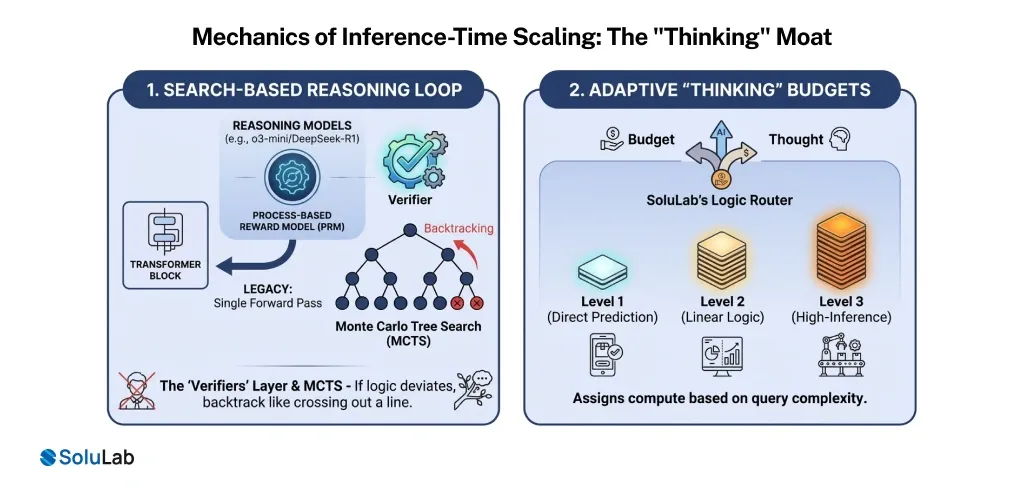
The transition from GPT-4 (2024) to the 2026 standard is defined by the shift from training-time compute to inference-time compute. At SoluLab, a leading enterprise AI consulting company, we optimize this through Compute-Optimal Scaling Laws.
1. The Search-Based Reasoning Loop
Legacy models generate a response in a single forward pass through transformer blocks. Reasoning models utilize a Process-Based Reward Model (PRM).
- The “Verifiers” Layer: When SoluLab deploys an o3-mini agent, we implement an external “Verifier” that scores intermediate “thoughts.” If logic deviates from the PRM threshold, the model backtracks, much like a human mathematician crossing out a line of work.
- Monte Carlo Tree Search (MCTS): DeepSeek-R1 utilizes MCTS to explore various “logic branches” during inference. Our team tunes the Rollout Policy, ensuring the AI agent explores high-probability logical paths first.
2. Adaptive “Thinking” Budgets
Not every query requires $5.00 of compute. SoluLab’s proprietary Logic Router categorizes incoming tokens:
- Level 1 (Direct Prediction): “What is the current inventory?” (No reasoning required).
- Level 2 (Linear Logic): “Compare Part X and Part Y.” (Minimal reasoning).
- Level 3 (High-Inference): “Simulate the assembly line impact if Part X is delayed.” (Triggers High-Effort mode).

Fintech: Fine-Tuning Open-Source Models for Fraud Detection
In 2026, pattern matching is no longer enough to stop AI-driven fraud. SoluLab builds reasoning AI agents and fine-tunes specialized open-source models like TinyZero or open-r1 to create “Digital Auditors.”
1. Fine-Tuning TinyZero for Edge Logic
SoluLab uses TinyZero, a distilled reasoning AI model, for real-time mobile banking security.
- Supervised Fine-Tuning (SFT): We ingest historical “True Positive” cases to align the model’s internal logic with your specific risk appetite.
- RLHF (Reinforcement Learning): We employ a “Reward Model” that penalizes the AI for high false-positive rates, bringing accuracy to >99.1%.
2. Compliance-Ready “Agentic Traceability”
Following the 2026 FinCEN AI Transparency Guidelines, every fraud-related action must be explainable. Our AI agents generate an Immutable Logic Log, hashing the AI’s step-by-step reasoning onto a private ledger for instant regulatory auditing.
Manufacturing IT: Enterprise RAG + Adaptive Indexing
Static RAG (Retrieval-Augmented Generation) is insufficient for the 2026 factory floor. SoluLab’s Adaptive RAG architecture integrates real-time DevOps and SaaS telemetry.
1. The Adaptive Vector Indexing Layer
Traditional vector stores return “similar” results; our Adaptive Index returns “logically relevant” ones.
- Temporal Weighting: The index prioritizes 2026 technical specs over legacy 2022 manuals automatically.
- Dynamic Re-Ranking: We use a Cross-Encoder to compare retrieved documents against the live IoT sensor state before the Reasoning LLM even sees the data.
2. The Vector-Graph Hybrid (GraphRAG)
SoluLab utilizes a GraphRAG architecture to solve “Relationship Blindness.”
- Entity Extraction: We extract entities (e.g., “Hydraulic Pump”) and their relationships (connected to “Maintenance Schedule”) from manuals.
- Graph Traversal: The system performs a vector search to find a starting node, followed by a graph traversal to find related logic. This ensures the agentic reasoning agent understands the “Butterfly Effect” of a single component failure across the SaaS ecosystem.
Case Study: Eliminating “Configuration Drift” in DevOps
The Client: A Global Tier-1 Auto Manufacturer.
The Problem: Frequent SaaS updates caused legacy assembly line controllers to desync, leading to $250k/hour downtime.
SoluLab Solution:
- Retrieval: The agent pulled the “intended state” from Git and the “actual state” from the factory floor.
- Reasoning: Using o3-mini, it identified a TLS version mismatch in the new update.
- Action: It automatically applied a “Logic Wrapper” to the legacy hardware, preventing a crash.
- Result: 90% reduction in deployment-related outages.
Secure Agentic Deployment: TEEs and Zero-Knowledge Proofs
For clients in Web3 and Defense, “Privacy” is a mathematical requirement.
1. Trusted Execution Environments (TEEs)
We deploy Reasoning Agents within Intel SGX or AWS Nitro Enclaves. The “Thinking Process”—and the sensitive data it involves—is encrypted even from the cloud provider. We utilize NVIDIA’s H100/H200 TEE support to ensure fine-tuned model weights are never exposed.
2. ZK-Proof Logic Verification
In DeFi, our agents utilize Zero-Knowledge Proofs (ZKPs) to prove they followed a specific reasoning path without revealing the proprietary data used. This allows an SMB to prove “Compliance” to a regulator without handing over private financial records.
The Web3 Advantage: Blockchain-Integrated Agents
In 2026, AI agents have become Economic Entities. * Autonomous Treasury: Agents built on SoluLab’s framework can hold Decentralized Identifiers (DIDs) and execute their own on-chain transactions for compute and data access via smart contracts.
- Smart Contract Logic Audits: We deploy o3-mini agents to perform “Formal Verification” in smart contract audits, detecting “Logic Bombs” that traditional static analysis tools miss.
SoluLab’s 4-Stage Agentic Development Lifecycle (ADLC)
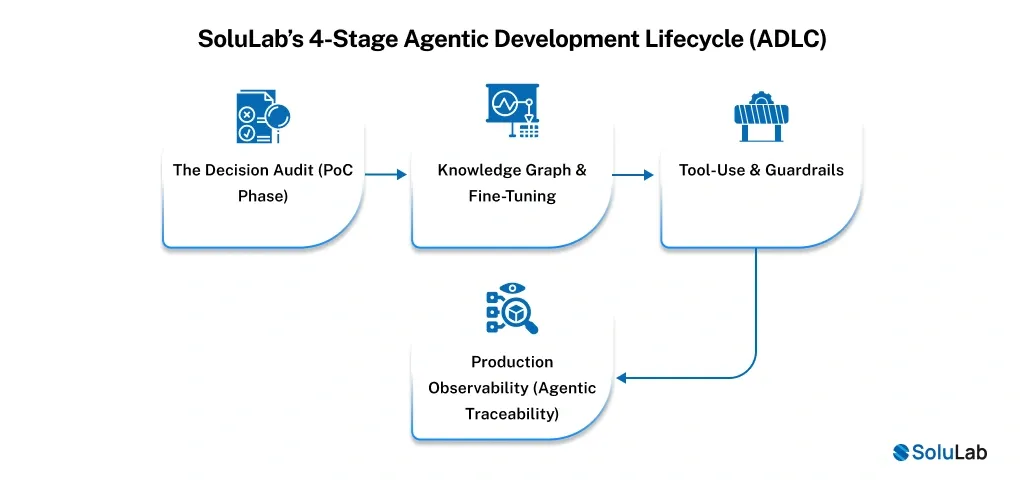
Building reasoning AI agents that survive the transition from a “cool demo” to a “production workhorse” requires a disciplined lifecycle.
Stage 1: The Decision Audit (PoC Phase)
We identify Logic Bottlenecks. We don’t ask “Where can we use AI?” We ask, “Where are humans currently acting as ‘Logic Routers’ between two systems?”
- Deliverable: A functional PoC within 4 weeks demonstrating a “3-Step Logic Leap.”
Stage 2: Knowledge Graph & Fine-Tuning
We build a Vector-Graph Hybrid and perform Supervised Fine-Tuning (SFT) to align the model’s reasoning with your proprietary business rules.
Stage 3: Tool-Use & Guardrails
We build custom connectors to your ERP (SAP/Oracle) and CRM (Salesforce). We implement Recursion Guards to prevent infinite “Thinking Loops” that drain budgets.
Stage 4: Production Observability (Agentic Traceability)
We monitor the agent using Agentic Traceability, logging the internal Chain-of-Thought. This provides a forensic audit trail satisfying the EU AI Act.
Architecting the “Digital Twin” for Manufacturing IT
The ultimate goal is a Reasoning Digital Twin—a virtual factory that “thinks” about its own optimization.
- Anomaly Reasoning: Instead of a simple alert (“Temp > 90°C”), the agent reasons: “Temperature is rising, but vibration is normal. This suggests a coolant sensor failure rather than a bearing issue. Schedule a sensor check at the shift change.”
- The Self-Healing Loop: Agents monitor custom SaaS deployments. If an update causes a memory leak, the agent detects it via RAG telemetry, reasons through code commits to find the bug, and initiates an autonomous rollback.
Technical Performance & ROI (The 2026 Benchmark)
| Metric | Legacy AI (GPT-4) | SoluLab Reasoning Agent (2026) |
| Logic Consistency | 68% | 94% (o3-mini High) |
| Retrieval Accuracy | 72% | 98% (Adaptive RAG) |
| Explainability | None (Black Box) | Full (CoT Logs) |
| Operational Savings | 15% | 50%+ (Due to Automation) |
Why SoluLab? Our “Proof of Work”
As an ISO-9001 and ISO-27001 certified leader, SoluLab, with its multi-agent AI systems development, bridges the gap between research and production. Our 2026 team of 250+ engineers is dedicated to ensuring your RAG AI doesn’t just speak, but reasons and acts with precision.
- Certified MLOps: Using MLflow and Kubernetes for model reliability.
- Privacy-First Engineering: On-premise deployment for total data sovereignty.
- Interoperable SaaS: Custom AI platforms that integrate directly with enterprise APIs.

Frequently Asked Technical Questions
A: Agentic reasoning is the ability of AI systems (agents) to independently analyze a situation, make decisions, and take actions toward a goal—without constant human input.
A: We use Speculative Decoding. A smaller, faster model (like Llama 4 Scout) predicts the draft of the response, and the larger reasoning model (o3-mini) “verifies” the logic.
A: Yes. We use “Semantic Middleware” that allows reasoning agents to query traditional SQL or NoSQL databases as if they were part of the AI’s internal memory.
A: We utilize Self-Evolving Graphs. Our agents periodically “Red-Team” the knowledge graph, looking for outdated info or logical contradictions.
The Final Verdict: Owning the “Logic Chain”
In 2026, the competitive moat isn’t having data—it’s having the Reasoning Capacity to act on it. SoluLab provides the architectural expertise to build RAG-based AI systems to turn these frontier models into your most valuable employees. The move from Probabilistic to Deterministic AI is the most significant technological pivot of the decade. SoluLab, #1 AI development company, is the architect who makes that pivot profitable.
Would you like me to develop a “Custom Agentic AI Roadmap” for your organization, including a feasibility study for o3-mini vs. DeepSeek-R1 based on your current data infrastructure?
Tanmay is focused on building brand authority through narrative-driven marketing. With 19+ years in tech branding, he has positioned SoluLab as a thought leader in the Blockchain and AI sectors. He regularly shares insights on AI-driven brand storytelling and content strategy. He is open to connecting with startups and enterprise teams to help them overcome their challenges.