US President Donald Trump called it a “wake-up call.” He was talking about DeepSeek, the Chinese AI program that rattled financial markets and sent a jolt through the American tech sector. The trigger was one claim: that its R1 model had been built for a fraction of what rivals spend. That single assertion knocked value off some of the biggest companies on the planet and left whole industries asking what comes next. And within a week of launch, the app sat at the top of the US download charts.
So the field got crowded, fast. DeepSeek went from unknown to a credible alternative to ChatGPT almost overnight, pitching strong capability at a much lower price. Which raises the obvious question, the one you probably searched for: what actually separates DeepSeek Vs ChatGPT?
Below, we put DeepSeek next to ChatGPT, the better-known and reportedly pricier option, so you can pick the one that fits how your business really works.
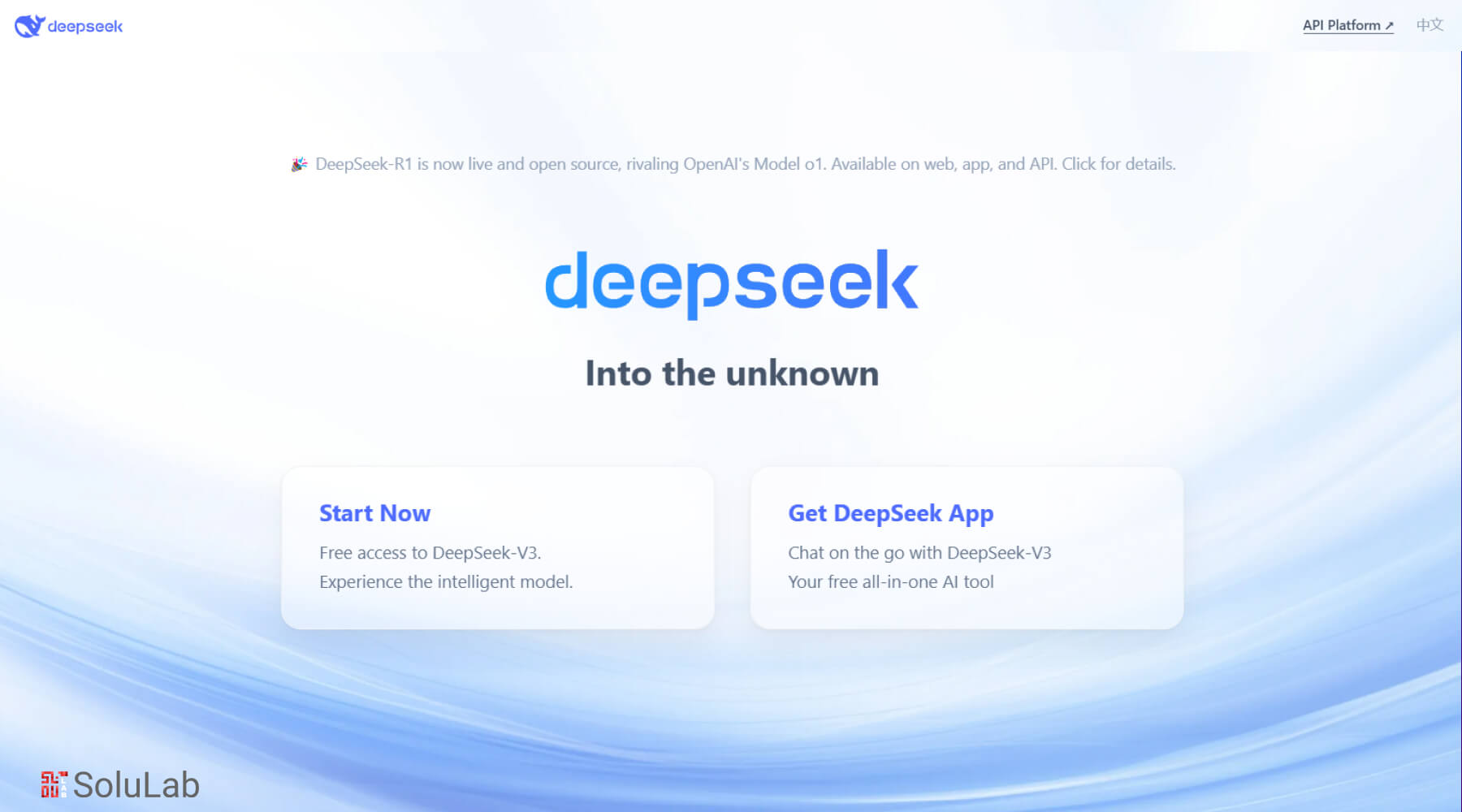
What is DeepSeek and How Does it Work?
Liang Wenfeng founded DeepSeek in May 2023. Its large language models, DeepSeek V3 and DeepSeek R1 above all, grabbed headlines in early 2025. Training DeepSeek took 2.788 million H800 hours. The pitch is efficiency: these models handle a wide spread of jobs while eating fewer resources than the competition. R1 goes a step further. It is built for the heavier stuff, the problems that need slow, careful reasoning.
Interest really took off after the company shipped a new model it said could match what American firms like OpenAI, the maker of ChatGPT, were putting out. The kicker? It claimed to need far less of Nvidia’s expensive chips to train on huge volumes of data. That is when DeepSeek AI became the name everyone in the industry was repeating. Once the chatbot landed on the Google and Apple app stores earlier this year, anyone with a phone could try it.
Working of DeepSeek
DeepSeek exists to build AI. Its gains in reasoning are the part people keep pointing to as a real step forward, and they come from a handful of techniques.
- Reinforcement Learning: The team trained for reasoning with reinforcement learning at large scale. Lots of trial, lots of feedback.
- Reward Engineering: Instead of a learned reward model, researchers wrote a rule-based reward system, and it beat the reward models most labs rely on.
- Distillation: Through careful knowledge transfer, DeepSeek packed its skills into much smaller models, some as small as 1.5 billion parameters.
- Emergent Activity Network: This is the surprising bit. Sophisticated reasoning patterns showed up on their own during reinforcement learning. Nobody programmed them in.
What is ChatGPT and How Does it Work?
ChatGPT is an intelligent AI chatbot that uses natural language processing to hold something close to a human conversation. Ask it a question and it answers. Ask for an email, an article, an essay or a chunk of code, and it writes one.
It belongs to the family of generative AI application: you type a prompt, and it hands back text, images or video that feel human-made. The name tells you how it works. GPT stands for “Generative Pre-trained Transformer,” which is the machinery it uses to read your query and build a reply. On top of that, OpenAI trained it with reinforcement learning from human feedback, using reward models to steer it toward the best answers.
Working of ChatGPT
Under the hood, it is pattern-spotting. Specialized algorithms inside the Generative Pre-trained Transformer pick out patterns in data.
At launch, ChatGPT ran on a GPT transformer neural network machine learning model along with the GPT-3 large language model.
Every response draws on a very broad training dataset.
Pay for ChatGPT Plus and you get GPT-4o alongside GPT-3.5 and GPT-4. The jump from 3.5 to 4 is noticeable. GPT-4 can describe pictures, write image captions, and produce long answers that run past 25,000 words.
How Are They Different?
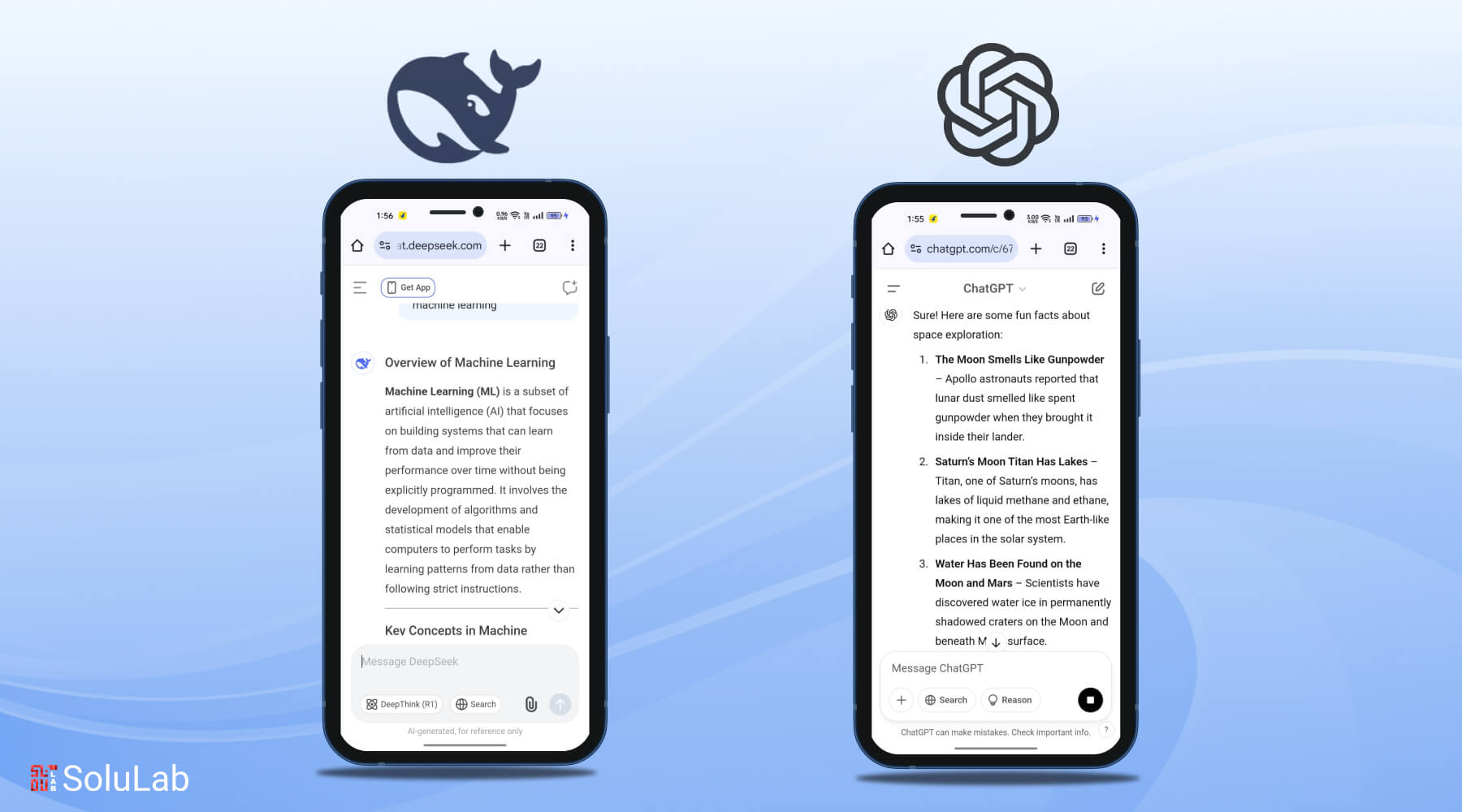
Line them up and the gaps are real.
Both are advanced AI models, but they were built differently, and that shapes where each one shines. Four things split them: how they are structured, how they perform, what they cost, and how they moderate content. Here is each one in turn.
Architecture and Design
Start with the plumbing. This is where they differ most.
DeepSeek uses a Mixture-of-Experts design. It has 671 billion parameters*, yet only the ones a request actually needs switch on. Because it wakes up just the relevant experts, it answers quickly and still holds its quality on specialized, technical work.
ChatGPT sticks with a more traditional transformer AI in the architecture. Every parameter fires on every request. That makes it a generalist by design, able to cover a huge range of tasks. The trade-off shows up in detailed programming and hard mathematical logic, where this approach tends to fall a little behind.
Performance and Capabilities
Give them the same job and they behave differently.
DeepSeek is the one you want for technical and analytical work. Hard coding problems, advanced math, structured problem-solving: that is its home turf. Syntax highlighting and error detection make it a daily tool for developers and data scientists, not a toy.
ChatGPT earned its reputation another way. Conversation flows. Replies feel creative. General knowledge is deep. Throw a broad trivia question, a casual chat or a storytelling prompt at it and it does very well. It can write code, sure. But on technical precision, it does not quite reach DeepSeek’s level.
Speed and Cost
Most buyers boil the decision down to two questions. How fast? How much?
Reports say DeepSeek answers faster when you are looking up programming information. Each tool, remember, comes with its own strengths, architecture and uses.
Both are powerful. What separates them is design, capability, price and moderation policy, and the comparison below walks through those one by one.
On price, DeepSeek wins easily. If you mainly need AI help with code, it is the budget pick, with subscription rates starting at $0.50 per month [SOURCE NEEDED].
ChatGPT charges $20 a month. For a solo developer or a small team counting every dollar, that adds up.
Content Moderation
Moderation is where the two take very different paths. DeepSeek was built in China, so Chinese government rules shape what it will and will not say.
In practice, that means it may block anything that breaks local law or touches politically sensitive topics. ChatGPT takes a more global view, though it has plenty of limits of its own. OpenAI runs strict content rules meant to stop harmful speech along with false or biased information.
Can They Work Together?
DeepSeek and ChatGPT are two big leaps in artificial intelligence, especially in natural language processing. And whenever a newcomer like DeepSeek shows up this fast, people get skeptical.
DeepSeek, the Chinese AI company, has picked up traction quickly with its open-source platform, and with DeepSeek R1 in particular. R1 is very good at writing code and cracking hard technical problems, which is exactly why developers and programmers like it. Cost is the other big draw. It runs at a fraction of what many competitors spend.
ChatGPT, built by OpenAI, is the established name. People know it for range: casual chat on one end, heavy content creation on the other. It also handles more than text, with image analysis and voice conversations that keep users engaged.
Potential for Integration
Why pick one? Wire them together and each covers the other’s weak spots:
- Technical Proficiency: DeepSeek handles the code and the technical questions. ChatGPT handles the talking. A developer might write precise code with DeepSeek, then hand it to ChatGPT to explain it in plain English or draft the software documentation.
- Cost Efficiency: Since DeepSeek is free and open source, it can sit in the backend as the cheap workhorse while ChatGPT’s conversational features face the user. For a startup or an indie developer trying to keep spending low without cutting features, that split makes a lot of sense.
- Enhanced User Experience: Connect both platforms through a tool like Pabbly Connect and you can automate a workflow that plays to each artificial intelligence. Say you kick off a coding task in DeepSeek. ChatGPT can then pick it up and write friendly documentation or support replies.
Challenge and Considerations of Integrating Them
It sounds tidy on paper. In practice, teams hit a couple of snags:
- Interoperability: Getting the two platforms to talk cleanly often needs custom integration work, and how messy that gets depends on your use case.
- Data Privacy: The two treat sensitive data annotation differently. DeepSeek is open source, while ChatGPT runs on a proprietary model, so you have to think hard about privacy before you connect them.
They fill different niches in AI. Put together, though, you get to use what each does best. DeepSeek brings the technical muscle, ChatGPT brings the conversational range, and the result can serve both your engineering needs and your creative ones.
Cost of Creating an App Like DeepSeek
Building an AI app like DeepSeek will run you somewhere from $50,000-$300,000, sometimes more. The real figure can swing a lot depending on a few variables. Here are the technical factors that move the budget most:
1. Model’s Size and Difficulty
Bigger model, bigger bill. That is the short version. Models with billions of parameters, the kind DeepSeek uses, need serious compute to train and to run, and that compute is where much of the money goes.
2. Data for Training
Training data varies wildly in price and in how easy it is to get. Good data, varied and clean, costs real money. Then it has to be preprocessed before it is any use for training a model that works.
3. Resources for Computation
GPUs and TPUs are expensive. You have two routes. Buy the hardware and you pay a lot upfront but may spend less over time. Rent in the cloud and you can scale easily, though long-running workloads get pricey.
4. Language and Translation Proficiency
Want it multilingual, like DeepSeek? Then you need advanced natural language processing techniques and models that can read and write across languages. That adds complexity. It adds cost too.
5. Processing in Real-Time
Add web crawling and live data processing and the stack gets heavier: more complex algorithms, more design work, more infrastructure. All of that pushes up the architectural complexity and the related costs of developing AI apps like DeepSeek R1.
| Project Complexity | Estimated Time | Price |
| Simple | Six to Twelve Months | $50,000-$150,000 |
| Moderate | Twelve to Eighteen Months | $150,000-$200,000 |
| Difficult | Eighteen to Twenty-Four Months | $180,000-$300,000 |
Which is Better For Your Needs?
Choosing between them for your business comes down to one thing: what each is genuinely good at, and whether that matches what you need.
1. ChatGPT Core Competencies
- General-Purpose Application: ChatGPT is strong across a wide range of conversational work, so it fits customer support, content creation and education well. Its answers sound human, and that keeps people talking to your business.
- Ease of Use: The interface is friendly enough that non-experts pick it up in minutes. If you want to roll something out quickly and you do not have a deep technical bench, that matters.
- Multimodal Capabilities: ChatGPT supports multimodal models text and image input, which widens what you can build when users want more than one way to interact.
Best For:
Businesses that want one flexible AI to juggle lots of different tasks, without needing deep domain expertise.
Teams focused on better customer engagement through chat-style interfaces.
2. DeepSeek Core Competencies
- Domain-Specific Solvent: DeepSeek is aimed at enterprise-grade, practical use, especially in specialized fields like finance, healthcare, and logistics. Because it leans on industry-specific datasets, its answers tend to be accurate and on point.
- High Performance in Technical Tasks: On complex queries, particularly in programming and data analysis, DeepSeek often beats ChatGPT on both speed and accuracy. If your business lives or dies on technical problem-solving, pay attention to that.
- Customization and Integration: You can build DeepSeek into AI and ML data integration existing enterprise systems and shape it around your exact business requirements.
Best For:
Companies in specialized fields where accuracy and domain knowledge are non-negotiable.
Organizations with the budget and people to invest in customizing it and fitting it into their workflows.
Related: Llama Vs. GPT
Which One is Offering More Control?
Which one actually puts you in the driver’s seat, DeepSeek or ChatGPT? You have to look at what each lets you change.
A. DeepSeek for Enhanced Control and Customization
DeepSeek hands you a lot of control, simply because it is open source. Businesses and developers can modify the model to fit their own needs and even run it on their own infrastructure. That means you decide what the AI does, you keep data privacy in your hands, and you run operations your way.
There is also the API bill. DeepSeek’s API pricing sits well below ChatGPT’s, which makes a real difference for high-volume users who would otherwise rack up hefty fees.
It is at its best on technical jobs, with precise answers and detailed settings built for specialized work. For developers who want a tool they can fine-tune for a specific purpose, coding or data analysis say, that is a big part of the appeal.
B. ChatGPT for Versatility with Limited Control
ChatGPT was built for a wider audience. Versatility and user engagement come first. You get memory and multimodal features, voice included, but you give up some of the customization you would have with
DeepSeek. Users can build custom versions of ChatGPT for particular tasks. Still, the model underneath stays proprietary, and that caps how much say you have over how it is deployed and run.
Read Blog: Top ChatGPT Development Companies In 2025
How are They Changing the Dynamics?
Together, these two are rewriting the rules of the artificial intelligence industry. Each brings its own innovations and competitive edge, and both are poking holes in the old way of doing things.
1. Market Disruption
DeepSeek showed up as a serious rival and shook the incumbents, OpenAI and Nvidia among them. Its fast rise lined up with a notable drop in Nvidia’s market cap, a clear sign of power shifting inside tech. Industry leaders are now rethinking their strategies and where they put their AI money.
2. Cost-Effectiveness
DeepSeek is open source, so you can use it without paying a subscription. That puts advanced AI within reach of developers and companies that could not afford it before, startups on thin budgets most of all. ChatGPT’s premium features, by contrast, usually sit behind a paywall. For some users, that is where they stop.
3. Customization and Flexibility
Because DeepSeek is open source, developers get far more say over how it is customized and plugged into live systems. Clients can bend it around specific needs, which makes it more useful in niche applications. ChatGPT is versatile, no argument. But it is closed source, and that blocks you from changing it directly.
4. Technical Advancements
DeepSeek’s architecture delivers competitive performance on fewer resources than traditional models like ChatGPT. Lower running costs are one payoff. A smaller environmental footprint is another, and that could change how data centers are planned around the world.
5. Geopolitical Implications
There is a bigger story here too. DeepSeek shows how far Chinese AI has come, even with US export restrictions on high-end chips. That raises hard questions about global competitiveness and who leads in AI, and about how US policymakers will respond as they try to keep America ahead in AI innovation.
The Bottom Line
DeepSeek arriving next to platforms like ChatGPT has changed artificial intelligence in a basic way. The two are not interchangeable. Each has clear advantages, and each suits a different kind of business.
DeepSeek gives you a cheap, open-source option that is excellent at expert-level technical work and lets you customize heavily. Its architecture means faster processing and top performance on specialized jobs. If your industry demands precision and advanced reasoning, it deserves a serious look.
ChatGPT is still the stronger general-purpose tool, great at engaging users and producing creative content. Multimodal features and a friendly interface put it in reach of almost anyone, from casual users to large companies trying to improve how they talk to customers.
Progress in AI technology is not slowing down. Organizations that put these tools to work can run more efficiently, ship new ideas faster and hold their edge in their markets, which you can see for yourself with help from a ChatGPT development company. So which should you choose? Match each tool’s strengths to your own strategic goals, and the answer usually becomes obvious.
FAQs
Shipra Garg is a tech-focused content strategist and copywriter specializing in Web3, blockchain, and artificial intelligence. She has worked with startups and enterprise teams to craft high-conversion content that bridges deep tech with business impact. Her work translates complex innovations into clear, credible, and engaging narratives that drive growth and build trust in emerging tech markets.