Key Takeaways
- The problem: Teams struggle to extract insights from large volumes of documents, leading to wasted time, scattered knowledge, and inefficient decision-making without context-aware AI support.
- The solution: Build an AI-powered app like NotebookLM using LLMs, embeddings, and retrieval systems to enable document-based Q&A, summarization, and intelligent knowledge interaction in real time.
- How SoluLab helps: SoluLab is an AI-native company, using AI within our workflows to deliver faster development at lower costs while building scalable, production-ready AI apps tailored to your business needs
AI has changed how people go through information in documents. They don’t rely on search anymore; they go to ChatGPT or similar tools for direct answers. People don’t want to read long files; they want quick, reliable insights.
And this is what NotebookLM does perfectly. It organizes and summarizes documents like PDFs, Google Docs, and web URLs, then lets users ask questions based on their own data with contextual answers. It lets users upload multiple sources and then chat with them, almost like having a personal research assistant who has read everything, so you don’t have to.
| The global note-taking app market is valued at $13.3 billion in 2026 and is projected to reach $28.05 billion by 2030 (20.5% CAGR) |
The demand for tools like this is exploding. So, if you’re wondering how to build an AI app like NotebookLM, this guide walks you through everything from core features to the tech stack you’ll need.
What Is NotebookLM?
NotebookLM is an AI-powered research and note-taking tool developed by Google that helps users understand, summarize, and interact with their own documents using large language models.
It allows you to upload sources like PDFs, Google Docs, or notes, and then ask questions, generate summaries, extract insights, and even create structured content based on that material. Unlike general AI chat tools, NotebookLM focuses on your specific data, giving answers grounded in your documents with source references.
Why Invest In Building An App Like NotebookLM?
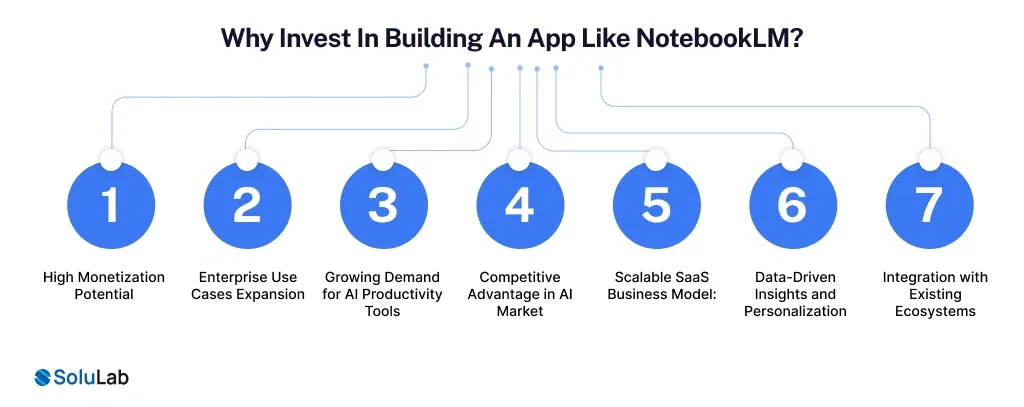
The demand for AI-powered productivity tools is rapidly increasing, making apps like NotebookLM a strong investment opportunity for businesses looking to build scalable, intelligent, and high-engagement digital products.
- High Monetization Potential: Apps like NotebookLM can generate recurring revenue through subscriptions, enterprise licensing, and API access, making them sustainable business models across individual users, teams, and large-scale organizations.
- Enterprise Use Cases Expansion: Businesses are adopting AI tools for research, knowledge management, compliance, and internal documentation, creating strong demand for customized NotebookLM-like solutions across industries such as finance, healthcare, and legal.
- Growing Demand for AI Productivity Tools: Professionals and students increasingly rely on AI to summarize, analyze, and extract insights from large datasets, driving rapid adoption of intelligent note-taking and research assistant applications.
- Competitive Advantage in AI Market: Building an app like NotebookLM positions companies at the forefront of generative AI innovation, helping them differentiate their offerings and capture early market share in a fast-growing space.
- Scalable SaaS Business Model: Such applications can be easily scaled across geographies and industries with cloud infrastructure, enabling businesses to expand user base without significantly increasing operational costs.
- Data-Driven Insights and Personalization: These apps leverage user data to deliver personalized insights and recommendations, increasing engagement, retention, and long-term value for both users and businesses.
- Integration with Existing Ecosystems: NotebookLM-like apps can integrate with tools like CRMs, document platforms, and enterprise systems, enhancing workflows and becoming a core part of daily operations for organizations.

How Does NotebookLM Work?
NotebookLM works as an intelligent assistant that turns documents into interactive knowledge, helping users read, analyze, and extract insights faster using advanced AI models trained on contextual understanding.
- Create a Project: Users begin by setting up a workspace where all documents, notes, and queries are organized around a specific topic, making it easier to manage research and maintain contextual continuity.
- Upload Sources: You can upload PDFs, documents, or notes which the system processes and converts into structured knowledge, enabling powerful AI document analysis app capabilities for deeper understanding.
- Analyze and Chat: The system uses large language models to answer questions, summarize content, and generate insights, functioning as an AI summarization app and conversational AI note-taking app in one interface.
- Save and Organize: All generated responses, summaries, and notes are saved within the project, allowing users to revisit insights, refine outputs, and build structured knowledge over time efficiently.
Key Features Of Notebooklm
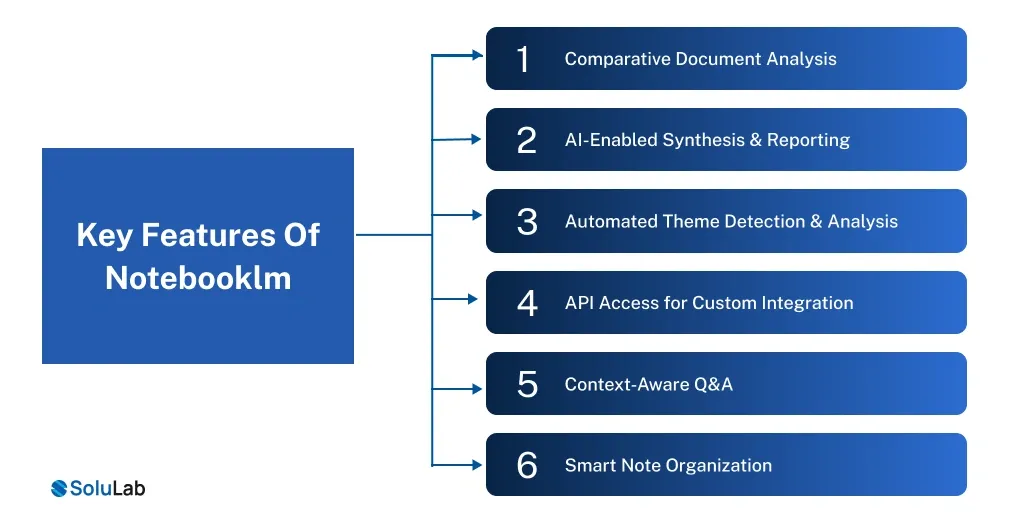
NotebookLM brings advanced AI capabilities into everyday research workflows, helping users analyze documents, generate insights, and create structured outputs faster using intelligent, context-aware automation across multiple data sources.
- Comparative Document Analysis: Compares multiple documents simultaneously, highlighting differences, similarities, and key insights across sources for faster decision-making.
- AI-Enabled Synthesis & Reporting: Generates concise summaries, reports, and insights by combining information from various documents into structured outputs.
- Automated Theme Detection & Analysis: Identifies recurring themes, patterns, and topics across documents to simplify complex research and analysis tasks.
- API Access for Custom Integration: Enables AI integration with enterprise systems, allowing businesses to build workflows using AI document analysis app capabilities.
- Context-Aware Q&A: Allows users to ask questions based on uploaded documents, delivering precise answers grounded in source material.
- Smart Note Organization: Automatically structures notes and insights, functioning as an intelligent AI research assistant software for ongoing knowledge management.
Step-by-Step Guide to Build An App Like Notebooklm
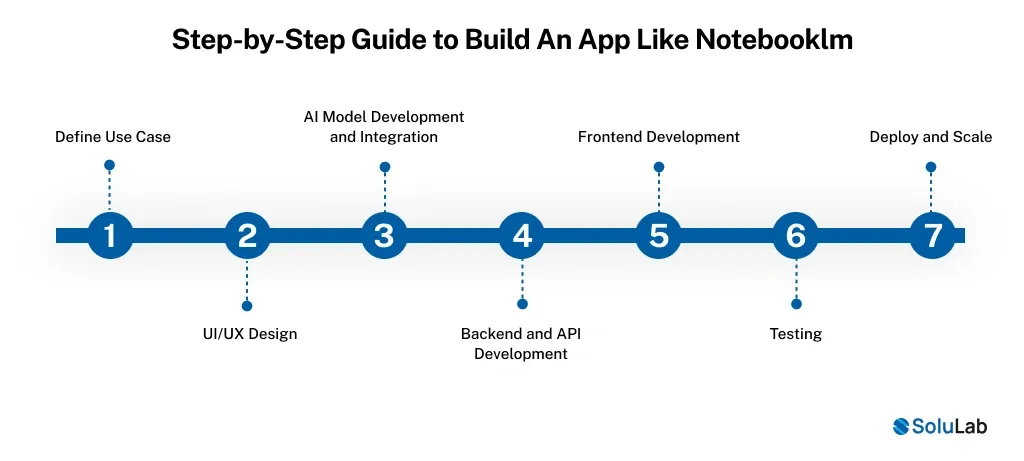
Building a powerful AI application requires a clear roadmap that aligns product vision, user experience, and scalable technology to deliver intelligent, reliable, and user-focused outcomes in real-world scenarios.
1. Define Use Case
Start with a strategic AI consultation to identify the exact problem your app will solve, whether it’s document summarization, research assistance, or enterprise knowledge management. A well-defined use case ensures focused development when you build an app like NotebookLM for real-world applications.
2. UI/UX Design
Design intuitive, clean, and user-friendly interfaces that make document interaction seamless. Focus on readability, easy navigation, and conversational flows so users can interact naturally with AI without confusion or friction.
3. AI Model Development and Integration
Select and integrate the right large language models, embedding systems, and retrieval mechanisms. This stage ensures your app can understand context, generate accurate responses, and deliver meaningful insights from user-uploaded data.
4. Backend and API Development
Build a strong backend to handle data processing, storage, and API integrations. Ensure secure data pipelines, scalable architecture, and smooth communication between AI models, databases, and frontend interfaces.
5. Frontend Development
Develop responsive and interactive interfaces where users can upload documents, ask questions, and view AI-generated responses. The frontend should support real-time interactions and provide a smooth, engaging user experience.
6. Testing
Conduct thorough testing across functionality, performance, and AI accuracy. Validate outputs, reduce hallucinations, and ensure the system behaves reliably under different scenarios and data inputs.
7. Deploy and Scale
Deploy the application on scalable cloud infrastructure and continuously optimize performance. With custom AI solution development, you can expand features, handle growing user demand, and improve system intelligence over time.
How Much Does it Cost to Build an App Like NotebookLM?
Building an app like NotebookLM involves multiple cost components, from design and development to
and infrastructure, each contributing to the overall investment required for a scalable, intelligent application.
| Component | Estimated Cost Range | What It Covers |
| UI/UX Design | $5,000 – $8,000 | User research, wireframes, interactive design, and intuitive interfaces for seamless document interaction and AI-driven workflows. |
| Frontend Development | $8,000 – $12,000 | Building responsive interfaces using frameworks like React or Next.js, ensuring a smooth user experience and real-time interaction with AI features. |
| Backend Development | $10,000 – $18,000 | Server-side logic, APIs, authentication, database management, and handling document processing and user requests efficiently. |
| AI/LLM Integration | $12,000 – $20,000 | Integration of LLMs, embeddings, RAG pipelines, and AI logic for summarization, Q&A, and contextual responses. |
| Vector Database & Storage | $4,000 – $7,000 | Setup of vector databases and cloud storage for managing embeddings and document data securely and efficiently. |
| Testing & QA | $3,000 – $6,000 | Functional, performance, and AI accuracy testing to ensure reliability across different user scenarios. |
| Deployment & DevOps | $3,000 – $5,000 | Cloud deployment, CI/CD pipelines, monitoring, and scalable infrastructure setup for production environments. |
| Total Estimated Cost | $50,000+ | End-to-end development of a scalable AI-powered application with core features, integrations, and production readiness. |
Monetization Techniques for NotebookLM
Monetizing an AI app like NotebookLM requires a mix of subscription models, usage-based pricing, and enterprise offerings that align with user value, scalability, and continuous engagement across different user segments.
- Subscription-based pricing: Offer tiered monthly or yearly plans based on features like document limits, AI queries, and collaboration tools, ensuring predictable revenue while catering to both individual users and professional teams with varying needs.
- Usage-based billing: Charge users based on the number of AI queries, tokens processed, or documents analyzed, making pricing flexible and directly aligned with actual usage, especially beneficial for power users and enterprise clients.
- Freemium model: Provide basic features for free, such as limited uploads and summaries, while gating advanced capabilities like multi-document reasoning, integrations, and higher usage limits behind paid plans to drive upgrades.
- Enterprise licensing: Offer custom pricing packages for enterprises with advanced security, compliance, dedicated infrastructure, and API access, enabling large organizations to integrate the solution into their workflows at scale.
- API monetization: Allow developers and businesses to access core AI functionalities like summarization and document querying through APIs, generating revenue by charging per request or via subscription-based API plans.
- Add-on services: Introduce premium features such as advanced analytics, team collaboration dashboards, custom AI agents, or domain-specific LLM models as paid add-ons to increase average revenue per user.
How SoluLab Can Help You Build an App like NotebookLM?
Building an AI-powered app like NotebookLM requires the right architecture, domain expertise, and scalable execution to turn complex AI capabilities into real-world, production-ready applications.
- AI-native development approach: SoluLab operates as an AI-native company, embedding intelligence into every stage of development. This ensures smarter workflows, faster iterations, and highly optimized solutions aligned with modern AI agent development services standards.
- Faster delivery, reduced cost: By leveraging pre-built frameworks, automation, and AI-assisted development cycles, SoluLab significantly reduces time-to-market and development costs while maintaining high-quality outputs for complex AI-powered applications.
- Custom LLM integration: SoluLab specializes in integrating leading LLMs like OpenAI, Claude, and open-source models, enabling tailored solutions through custom Large Language Model Development that align with specific business use cases and data requirements.
- Scalable architecture: From MVP to enterprise-grade platforms, SoluLab designs scalable systems using cloud infrastructure, vector databases, and modular architectures, ensuring your AI app grows seamlessly with increasing users, data, and workloads.

Conclusion
Building an app like NotebookLM requires more than just integrating an LLM. It involves designing a strong data pipeline, enabling context-aware retrieval, and creating a seamless user experience that makes complex information easy to interact with.
From choosing the right tech stack to ensuring scalability and accuracy, every step plays a critical role in delivering a reliable AI-powered application. Businesses that invest in well-structured AI systems can unlock faster decision-making, improved productivity, and smarter workflows.
If you’re planning to build a similar solution, SoluLab, an AI app development company, can help your business turn this vision into a scalable, production-ready reality.
FAQs
Neha is a curious content writer with a knack for breaking down complex technologies into meaningful, reader-friendly insights. With experience in blockchain, digital assets, and enterprise tech, she focuses on creating content that informs, connects, and supports strategic decision-making.