Key Takeaways
- The Problem: Most AI systems struggle with coordination, context sharing, and workflow management when multiple agents operate independently. This often leads to inconsistent outputs, slower execution, and limited scalability in real-world automation environments.
- The Solution: Building a multi-agent supervisor with CrewAI and AutoGen enables centralized orchestration, task delegation, memory handling, and agent collaboration for scalable and autonomous AI workflows.
- How SoluLab Helps: SoluLab is an AI-native company that uses AI across internal workflows to deliver faster development cycles, optimized automation, and cost-efficient solutions. Our team helps businesses design, integrate, and scale multi-agent AI systems tailored to real operational use cases.
Building reliable AI systems is no longer just about using one smart model; it is about coordinating multiple agents that can reason, act, and hand off tasks smoothly.
That’s where AI agent development services become essential. By combining the AutoGen multi-agent framework with CrewAI agent orchestration, businesses can create structured AI systems capable of intelligent collaboration, task delegation, and autonomous decision-making.
Instead of relying on isolated agents, organizations can build scalable architectures where supervisors manage communication, optimize workflows, and improve overall system efficiency.
In this guide, we’ll break down how to build a powerful multi-agent supervisor using CrewAI and AutoGen step by step.
What Is a Multi-Agent Supervisor in AI Systems?
A Multi-Agent Supervisor is a centralized control layer in an AI system that coordinates the actions, communication, and task delegation among multiple specialized autonomous AI agents.
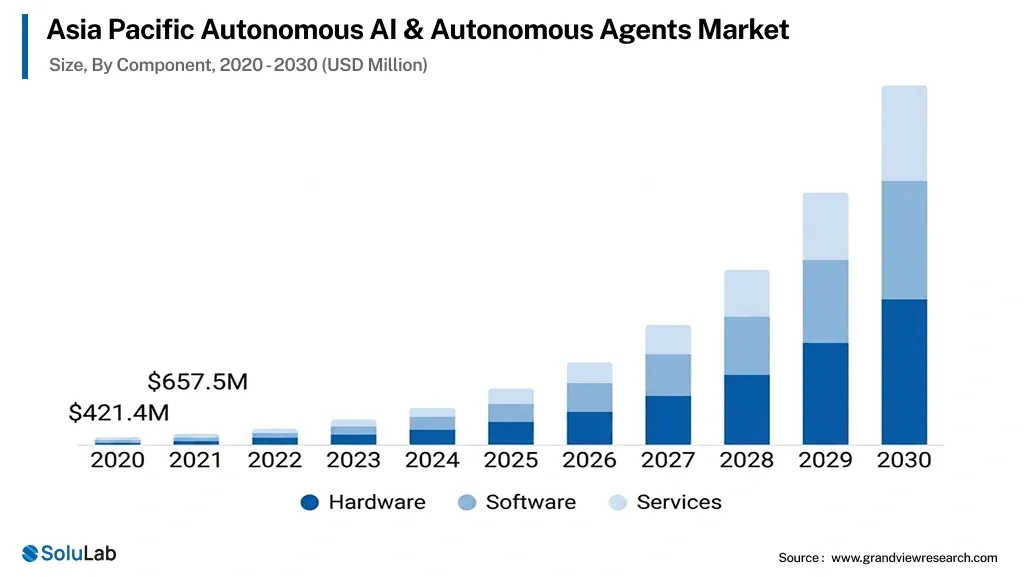
The global autonomous AI and autonomous agents market size was estimated at USD 3.93 billion in 2022 and is projected to reach USD 70.53 billion by 2030.
- Task Decomposition: It receives a complex objective and breaks it down into smaller, manageable sub-tasks for individual agents to execute.
- Routing: The supervisor identifies the most qualified agent for a specific job and routes the task to them based on their unique capabilities.
- Information Synthesis: It gathers outputs from various agents, resolves any conflicting data, and compiles a single, coherent final response for the user.
Why Are Multi-Agent Systems Gaining Traction in 2026?
Multi-agent systems are gaining attention in 2026 as businesses move beyond basic AI tools toward collaborative systems capable of handling complex workflows, automation, reasoning, and real-time decision-making at scale.
1. Rise of Agentic AI
AI is evolving from passive assistants into autonomous AI agents capable of planning, reasoning, and executing tasks independently, making multi-agent collaboration essential for advanced business operations.
2. Enterprise Automation Needs
Modern enterprises require AI systems that can automate large-scale workflows across departments, tools, and data environments without constant human supervision or manual coordination.
3. Limitations of Single LLM Agents
Single AI agents often struggle with context overload, task complexity, and long workflows, while multi-agent systems distribute responsibilities for better accuracy and scalability.
4. Demand for Real-Time Decision Making
Businesses increasingly need AI systems that can analyze changing data, coordinate responses instantly, and make decisions across multiple operational layers simultaneously.
5. Growth of AI Tool and API Ecosystems
The expansion of APIs, plugins, and external AI tools has created a strong need for multi-agent systems that can coordinate tools, workflows, and external services efficiently.
How to Build a Multi-Agent Supervisor with CrewAI and AutoGen?
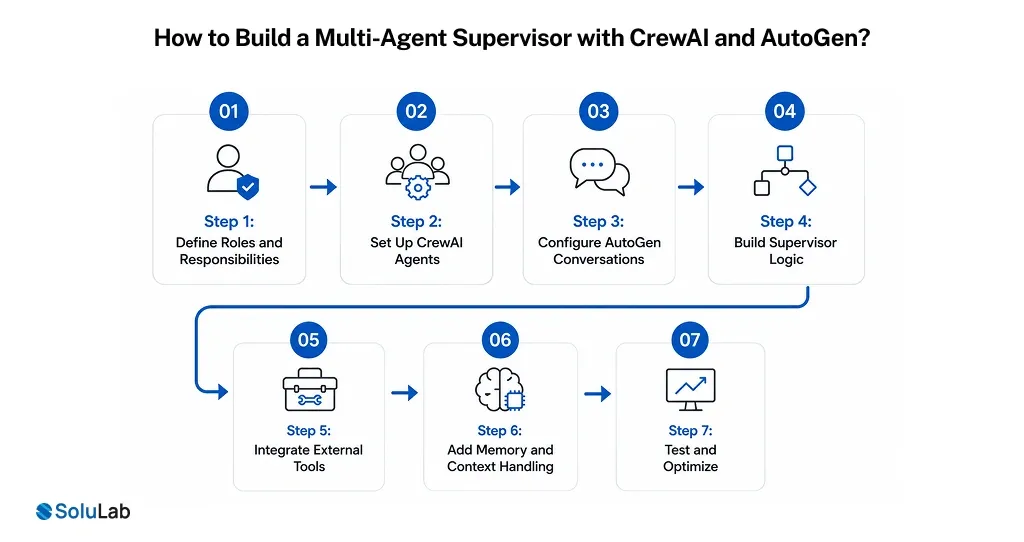
Building a multi-agent supervisor with CrewAI and AutoGen requires structured AI agent orchestration, clear agent coordination, memory handling, and intelligent workflow management to create scalable AI systems capable of autonomous task execution and collaboration.
Step 1: Define Roles and Responsibilities
Start by assigning clear responsibilities to each AI agent, such as planning, execution, validation, or monitoring. Well-defined roles reduce conflicts, improve coordination, and help the supervisor manage workflows efficiently across complex multi-agent environments.
Step 2: Set Up CrewAI Agents
Configure CrewAI agents with specific goals, tools, and operational behaviors. Each AI agent should specialize in a dedicated task while remaining connected to the broader workflow orchestrated by the supervisor layer.
Step 3: Configure AutoGen Conversations
Set up communication pipelines within AutoGen to enable structured agent-to-agent interactions. This allows agents to exchange context, collaborate on tasks, and respond to changing workflow requirements in real time.
Step 4: Build Supervisor Logic
Develop the AI agent with supervisor logic responsible for task routing, monitoring outputs, resolving conflicts, and aggregating responses. The supervisor acts as the central orchestration layer controlling the entire multi-agent system architecture.
Step 5: Integrate External Tools
Connect APIs, databases, search engines, CRMs, and third-party systems to expand agent capabilities. External integrations allow agents to retrieve live data, automate workflows, and perform actions beyond language-based interactions.
Step 6: Add Memory and Context Handling
Implement short-term and long-term memory systems so agents can retain context across workflows. Shared memory improves consistency, reduces repetitive processing, and enables more intelligent decision-making over time.
Step 7: Test and Optimize
Continuously test agent coordination, response accuracy, latency, and workflow stability. Optimization helps eliminate bottlenecks, improve collaboration efficiency, and ensure the supervisor performs reliably at scale.
Use Cases of AI Multi-Agent Supervisors
Multi-agent supervisors are transforming how businesses automate complex workflows by coordinating multiple AI agents simultaneously. It enables faster decision-making, task specialization, and scalable automation across enterprise operations.
1. Ecommerce Automation
Multi-agent supervisors improve ecommerce operations by assigning specialized agents for recommendations, pricing, inventory, and cart recovery, improving customer experience and operational efficiency across online retail platforms.
- Personalized product recommendations
- Automated pricing optimization
- Smart inventory coordination
2. Customer Support Orchestration
Using a CrewAI multi-agent system, businesses can coordinate multiple AI agents to manage tickets, route conversations, and deliver faster, more accurate customer support experiences at scale.
- Intelligent ticket routing
- Automated response generation
- Multi-channel support coordination
3. Data Analysis Pipelines
Multi-agent supervisors improve analytics workflows by distributing tasks like data collection, validation, processing, and reporting across multiple agents, reducing manual effort and increasing real-time business intelligence capabilities.
- Real-time data processing
- Automated insight generation
- Workflow monitoring and validation
4. Content Generation Workflows
The AutoGen multi-agent framework enables collaborative AI-driven content pipelines where multiple agents handle research, writing, editing, and optimization to accelerate large-scale content production workflows.
- AI-assisted research workflows
- Automated content optimization
- Multi-agent editing collaboration
Multi-Agent Supervisor vs Single Agent: What’s the Difference
Single-agent systems work well for simple automation tasks, while multi-agent supervisors are designed to coordinate specialized AI agents for faster, scalable, and more intelligent enterprise workflows.
| Aspect | Single Agent | Multi-Agent Supervisor |
| Structure | One AI system | Multiple coordinated agents |
| Task Execution | Handles all tasks alone | Delegates tasks across agents |
| Scalability | Limited scalability | Highly scalable workflows |
| Speed | Slower for complex tasks | Faster parallel processing |
| Collaboration | No agent collaboration | Real-time agent coordination |
| Best For | Simple automations | Enterprise AI orchestration |
| Flexibility | Limited adaptability | Modular and flexible systems |
| Failure Handling | Single failure risk | Supervisor-managed recovery |
How Much Does it Cost to Build a Multi-Agent Supervisor with CrewAI and Autogen?
The AI agent development cost of a multi-agent system architecture using CrewAI varies based on the number of agents, orchestration layers, integrations, and customization required.
Businesses investing in AutoGen multi-agent system development often prioritize scalability, workflow automation, and long-term operational efficiency.
| Development Component | Estimated Cost Range | What’s Included |
| Basic Multi-Agent MVP | $8,000 – $20,000 | Simple supervisor logic, 2–3 agents, basic workflow automation |
| Intermediate Multi-Agent System | $20,000 – $40,000 | Multiple coordinated agents, API integrations, memory handling |
| Enterprise-Grade Supervisor System | $50,000+ | Advanced orchestration, autonomous workflows, scalable infrastructure |
| CrewAI Agent Configuration | $5,000 – $15,000 | Agent roles, task delegation, workflow setup |
| AutoGen Communication Layer | $7,000 – $18,000 | Agent-to-agent communication and coordination pipelines |
| External API & Tool Integration | $5,000 – $25,000 | CRM, databases, search tools, third-party APIs |
| Memory & Context Management | $4,000 – $12,000 | Persistent memory, shared context, retrieval systems |
| Testing & Optimization | $3,000 – $10,000 | Workflow debugging, latency optimization, monitoring |
| Cloud Infrastructure & Deployment | $2,000 – $15,000+ | Hosting, GPUs, orchestration servers, scaling setup |
Future of Multi-Agent Systems with CrewAI and AutoGen
Multi-agent systems are becoming the next big leap in AI trends. Tools like CrewAI and AutoGen are shaping smarter, collaborative, and autonomous workflows.
- Autonomous Workflows: Multi-agent systems can independently handle complex tasks by assigning responsibilities across specialized agents. This reduces manual intervention, improves execution speed, and enables end-to-end workflow automation.
- Self-Improving Agents: Future AI agents will learn from past interactions, analyze mistakes, and refine decision-making processes. This continuous improvement will make systems more adaptive, efficient, and capable of solving evolving business challenges.
- Enterprise Adoption: Businesses are integrating multi-agent systems to improve operations, customer support, and automate decision-heavy tasks. Their scalability makes them highly valuable for modern enterprise environments.
- Enhanced Collaboration Between Agents: Different AI agents can work together like specialized team members, sharing context and insights. This collaboration enables better problem-solving and more accurate task execution.
- Industry-Specific Applications: From healthcare and finance to education and logistics, multi-agent systems will offer tailored AI-powered solutions, helping industries automate processes while maintaining precision and contextual understanding.
Conclusion
Building a multi-agent supervisor with CrewAI and AutoGen is not just about connecting AI agents; it’s about creating a smart system where agents can collaborate, share context, and complete tasks more efficiently together.
As businesses move toward autonomous workflows and agentic AI systems, supervised multi-agent architectures will become a key part of modern automation.
Whether you’re experimenting with AI or building enterprise-grade automation, having the right architecture matters. SoluLab, #1 AI development company, can help your business design and integrate scalable multi-agent AI systems tailored to your operational needs.
FAQs
Neha is a curious content writer with a knack for breaking down complex technologies into meaningful, reader-friendly insights. With experience in blockchain, digital assets, and enterprise tech, she focuses on creating content that informs, connects, and supports strategic decision-making.