Every missed call is a missed customer. Every long hold is a lost deal. And every overworked receptionist juggling phones, walk-ins, and scheduling is silently costing your business more than you realize.
The front desk is broken, and hiring your way out of the problem isn’t working anymore.
In 2026, smart business owners aren’t waiting for the perfect hire. They’re deploying AI voice receptionists that answer instantly, run 24/7, and cost a fraction of a full-time salary.
In fact, around 1 in 3 businesses already use some form of voice AI. This guide shows you exactly how to build an AI voice receptionist, the development cost, and more.
Why Are Businesses Adopting AI Voice Receptionists?
Businesses today are under pressure to respond faster, stay available around the clock, and deliver better customer experiences without constantly increasing operational costs or stretching internal teams too thin.

The global conversational AI market is expected to reach $41.39 billion by 2030,
- 24/7 availability: AI voice receptionists answer calls any time, ensuring businesses never miss leads, urgent requests, or after-hours customer inquiries.
- Faster response times: Customers get instant answers, call routing, or booking support without waiting on hold or depending on staff availability.
- Lower operational costs: They reduce the workload on front desk teams by handling repetitive calls, helping businesses optimize staffing and overhead.
- Improved lead capture: Every incoming call becomes an opportunity to qualify leads, collect details, and route prospects to the right team.
- Consistent customer experience: AI ensures every caller gets a professional, accurate, and brand-aligned interaction across all touchpoints.
- Scalable support: Businesses can manage higher call volumes during peak hours, campaigns, or seasonal spikes without service disruptions.
- Multilingual communication: AI voice systems can support multiple languages, helping businesses serve diverse customers more effectively.
- Better team productivity: Staff can focus on complex tasks and customer relationships instead of spending time on repetitive phone queries.

Tech Stack Used for AI Voice Receptionist Development
Building a reliable AI voice receptionist requires more than a voice bot. The right tech stack ensures smooth conversations, secure integrations, fast responses, and a customer experience that feels natural every time.
- Speech Recognition Engine: Converts customer voice input into accurate text in real time. This helps the AI-based call handling system understand caller intent clearly, even during long or complex conversations.
- Natural Language Processing (NLP): Helps the system interpret customer questions, tone, and context. It enables smarter responses and supports human-like interactions for better call resolution.
- Large Language Models (LLMs): Power dynamic conversations, contextual replies, and intelligent follow-ups. LLMs help the receptionist handle varied customer queries without sounding robotic or scripted.
- Text-to-Speech (TTS) Technology: Converts AI-generated responses into natural-sounding voice output. High-quality TTS improves customer comfort and makes AI-powered front desk automation feel more professional.
- Telephony APIs and VoIP Integration: Connect the receptionist with business phone lines, call routing systems, and cloud communication platforms. This ensures seamless incoming and outgoing call management.
- CRM and Calendar Integrations: Syncs appointments, customer records, and lead data automatically. This reduces manual work and helps businesses respond faster with accurate customer context.
- Workflow Automation Tools: Trigger actions like booking confirmations, reminders, follow-up calls, and escalation alerts. This makes business operations smoother and improves customer satisfaction.
- Security and Compliance Layer: Protects customer conversations, call recordings, and sensitive business data. Essential for businesses handling regulated information in healthcare, finance, or enterprise support.
- Analytics and Monitoring Dashboard: Tracks call volume, missed opportunities, response quality, and customer behavior. These insights help businesses continuously improve call experiences and conversions.
Read More: Advanced AI Voice Agent Development
Step-by-Step Guide to Build an AI Voice Receptionist
A well-built AI voice receptionist can help businesses answer calls faster, reduce missed leads, and improve customer experience without increasing front desk workload. Building one requires the right mix of AI, workflow design, and business context. Here’s how you can build AI receptionist:
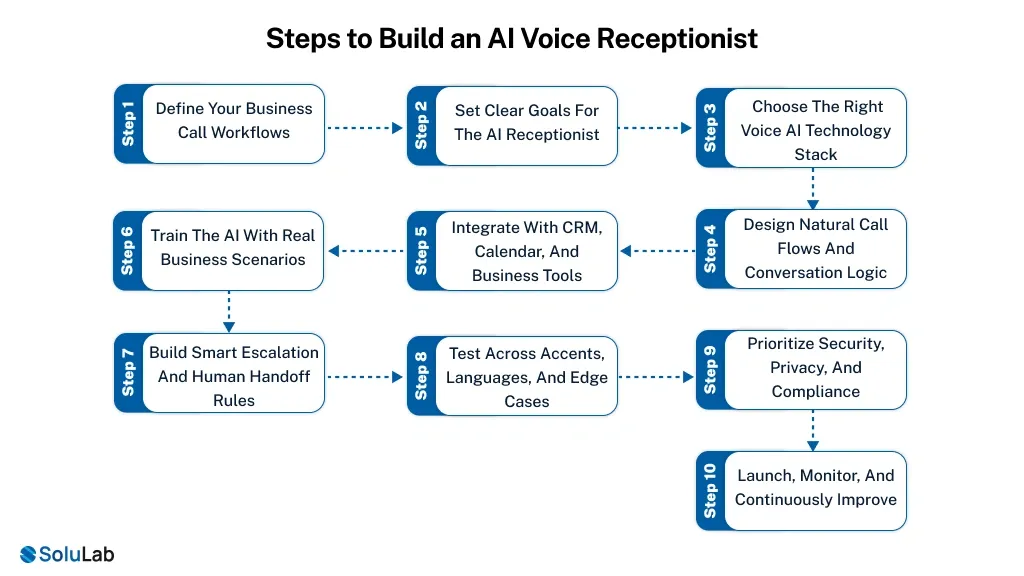
1. Define Your Business Call Workflows
Start by identifying the types of calls your business receives every day. Map common customer queries, booking requests, complaints, and escalation needs so the AI can handle repetitive tasks while routing complex conversations correctly.
2. Set Clear Goals for the AI Receptionist
Decide what success looks like before development begins. Your goals may include reducing missed calls, improving response times, lowering support costs, or increasing appointment bookings through smarter AI-based call handling system capabilities.
3. Choose the Right Voice AI Technology Stack
Select tools for speech recognition, natural language understanding, text-to-speech, and backend logic. The right stack should support natural conversations, fast response times, multilingual interactions, and secure integrations with business systems.
4. Design Natural Call Flows and Conversation Logic
Create clear conversation paths for greetings, FAQs, appointment scheduling, call transfers, and emergencies. Good call flow design ensures customers feel heard and guided instead of stuck in frustrating robotic loops.
5. Integrate With CRM, Calendar, and Business Tools
Your AI receptionist should connect with systems your team already uses. CRM, scheduling tools, help desks, and internal workflows help deliver real-time updates and ensure smooth customer handoffs.
6. Train the AI With Real Business Scenarios
Use real call transcripts, FAQs, customer objections, and industry-specific situations to train the system. This helps improve intent recognition, response accuracy, and the AI’s ability to handle varied customer needs.
7. Build Smart Escalation and Human Handoff Rules
Not every issue should stay with AI. Set clear triggers for live transfers, urgent escalation, or callback scheduling so customers can reach the right human quickly when needed.
8. Test Across Accents, Languages, and Edge Cases
Run extensive testing before launch. Check how the AI handles different accents, interruptions, unclear speech, and unexpected questions to ensure consistent performance across customer interactions.
9. Prioritize Security, Privacy, and Compliance
Voice systems often process sensitive customer data. Build with strong security measures, access controls, encryption, and compliance requirements relevant to your market or industry.
10. Launch, Monitor, and Continuously Improve
After deployment, track call quality, missed intents, conversion rates, and customer satisfaction. Continuous optimization helps your AI-powered front desk automation improve over time and deliver better business outcomes.
Custom AI Voice Receptionist vs Subscription-Based SaaS Tools
An AI voice receptionist can transform how businesses handle calls, but the right solution depends on flexibility, control, and long-term ROI. Here’s how custom development compares with subscription-based SaaS tools.
| Comparison Factor | Custom AI Voice Receptionist | Subscription-Based SaaS Tools |
|---|---|---|
| Customization | Built around your exact workflows, call flows, and business rules. | Limited to preset templates and standard workflows. |
| Integration | Can connect deeply with CRM, ERP, calendars, ticketing systems, and internal tools. | Usually supports only common third-party integrations. |
| Scalability | Designed to grow with call volume, locations, and evolving business needs. | Scaling often depends on pricing tiers and platform limits. |
| Branding | Voice tone, scripts, and customer journey can match your brand fully. | Limited branding and voice personalization options. |
| Data Ownership | Greater control over call data, recordings, and analytics. | Data is stored under vendor policies and restrictions. |
| Compliance | Easier to build for HIPAA, GDPR, UAE, or industry-specific compliance. | Compliance depends on vendor support and shared infrastructure. |
| Security | Security layers can be tailored to business and industry requirements. | Security is standardized and may not meet niche enterprise needs. |
| Best For | Growing businesses needing control, automation, and tailored CX. | Small teams needing quick deployment with basic features. |
AI Voice Receptionist Development Cost
An AI voice receptionist can improve response times and reduce front desk workload. Development cost depends on business needs, integrations, security, and how advanced the conversations need to be.
| Cost Component | What It Covers? | Estimated Cost Range |
|---|---|---|
| Basic MVP Development | Simple call answering, FAQs, call routing, basic voice workflows | $8,000 – $20,000 |
| Mid-Level Solution | CRM integration, appointment booking, multilingual support, analytics | $20,000 – $50,000 |
| Enterprise-Grade System | Custom workflows, advanced NLP, compliance, omnichannel support | $50,000+ |
| Voice Infrastructure | Telephony APIs, cloud hosting, call recording | $1,000 – $10,000+ annually |
| AI Model Training | Industry-specific responses, workflow optimization | $5,000 – $25,000 |
| Integrations | CRM, ERP, calendar, payment systems | $3,000 – $20,000 |
| Security & Compliance | HIPAA, GDPR, UAE data regulations | $5,000 – $30,000 |
| Ongoing Support | Monitoring, updates, performance tuning | 15%–25% of project cost annually |
Industry Use Cases for AI Voice Receptionists
An AI voice receptionist is no longer limited to answering calls. Today, it helps businesses manage inquiries, reduce response delays, and improve customer experience across industries without increasing front desk workload.
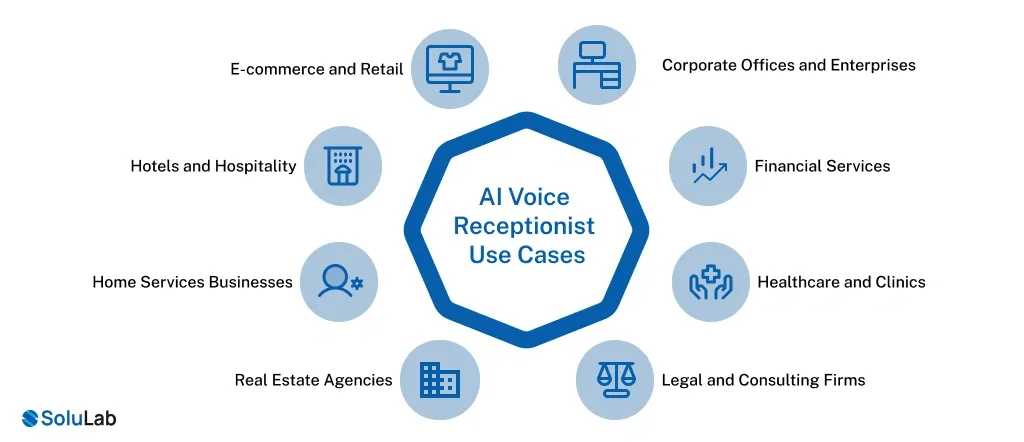
1. Healthcare and Clinics
An AI voice receptionist helps hospitals and clinics manage appointment bookings, patient follow-ups, prescription reminders, and basic inquiries, reducing pressure on staff while improving patient response times.
2. Real Estate Agencies
Real estate firms use AI voice systems to qualify leads, answer property questions, schedule site visits, and capture after-hours inquiries that would otherwise be missed.
3. Hotels and Hospitality
Hotels can automate reservation inquiries, room availability checks, guest requests, and booking confirmations, creating faster and more convenient guest communication experiences.
4. Legal and Consulting Firms
Law firms and consultants use voice AI to manage consultation requests, route urgent client calls, collect intake details, and improve first-response efficiency.
5. Home Services Businesses
Plumbers, electricians, HVAC providers, and repair companies can use AI voice receptionists to capture urgent service requests and schedule jobs without missing peak-hour calls.
6. E-commerce and Retail
Retail brands use AI voice agents for order updates, return requests, store inquiries, and customer support, improving service availability during busy periods.
7. Financial Services
Banks, insurance providers, and advisory firms use voice AI-agents for conversation and sales handling system solutions to manage routine customer queries, appointment scheduling, and service requests securely.
8. Corporate Offices and Enterprises
Large businesses use AI-powered front desk automation to handle internal call routing, visitor assistance, employee queries, and operational support more efficiently.
Future Trends of AI Voice Receptionist
As customer expectations shift toward instant, personalized communication, AI-powered call handling is evolving fast. Businesses adopting early will improve service quality, reduce response gaps, and create more efficient customer experiences.
- Smarter contextual conversations: Future AI receptionists will better understand caller intent, history, and urgency, making interactions feel more natural and less scripted.
- Deeper business system integrations: AI tools will connect seamlessly with CRMs, calendars, billing systems, and helpdesks to automate complete workflows without manual follow-up.
- Hyper-personalized caller experiences: Advanced systems will tailor responses based on customer profiles, past interactions, language preferences, and behavior patterns.
- Stronger multilingual support: Businesses serving global audiences will benefit from. AI receptionists that handle regional accents, dialects, and multiple languages more accurately.
- Emotion and sentiment recognition: AI will increasingly detect caller frustration, urgency, or satisfaction and adjust tone or escalate when needed.
- Voice cloning for brand consistency: Companies may use branded voice models to create consistent, recognizable customer interactions across locations.
- Better compliance and security: As AI Voice Receptionist development advances, future systems will offer stronger encryption, audit logs, and industry-specific compliance support.
- Industry-specific customization: Demand for Custom AI Voice Receptionist solutions will grow as businesses need workflows tailored for healthcare, real estate, legal, and hospitality needs.
Conclusion
Building an AI voice receptionist in 2026 is no longer just a way to reduce front desk workload. It is a practical step toward faster response times, better customer experiences, and more efficient operations.
The right solution can handle calls around the clock, qualify leads, book appointments, and route urgent requests without delays. Success depends on choosing the right workflows, integrations, and training approach for your business.
If you are exploring how voice AI can fit your operations, SoluLab, an AI development company, can help your business build a tailored solution that improves service and supports long-term growth.
FAQs
Neha is a curious content writer with a knack for breaking down complex technologies into meaningful, reader-friendly insights. With experience in blockchain, digital assets, and enterprise tech, she focuses on creating content that informs, connects, and supports strategic decision-making.