
Procurement sits at the middle of everything a company buys and every supplier it depends on. It is the function that goes out and gets the things the business cannot run without: raw materials for the factory floor, the daily services nobody notices until they stop. Get it right and it shows up in margin, in sustainability numbers, in how you stack up against competitors. Get it wrong and it shows up there too. Advanced analytics has moved the needle here. Sanofi, for example, cut spend by roughly 10% on average using should-cost modeling, and an advanced analytics platform cut tender evaluation time by two-thirds. And digitally enabled negotiations increased the savings achieved by 281%.
“RFx” is procurement shorthand. The X is a placeholder. Swap it out and you get Request for Proposal (RFP), Request for Quotation (RFQ), or Request for Information (RFI), each one a different way of asking vendors for something. These documents are what make bidding transparent, negotiations structured, vendor selection defensible, and communication traceable. They are also how a company proves it got value for money without cutting corners on compliance or quality.
The trouble starts with the responses. Keying in data by hand, reading through analysis line by line, chasing the same boilerplate across five documents: it eats hours and it invites both bias and plain human error. Bring AI into the RFx response and the shape of the work changes. Teams decide faster, on evidence, with fewer mistakes baked in. Costs drop. Risk drops. Supplier relationships get more attention because somebody finally has time for them. That is the competitive edge, and it comes from analytics doing the grinding.
So this piece covers the basics of AI for RFx response: what an RFx response actually is, where AI speeds it up, and how you would go about building an AI-powered RFP response system of your own.
What is RFx Response?
RFx stands for Request for X. The X changes depending on what you are asking for: a proposal (RFP), a quote (RFQ), or information (RFI). Those three are the workhorses of most business and procurement operations.
- Request for Proposal (RFP): You send one when you want to buy a product or service and you want qualified suppliers to pitch against your stated needs and criteria. The RFP spells out scope of work, requirements, how you will assess the bids, and whatever else matters. Plenty of tools exist for this, RFP automation software among them, where you can autofill responses, drop the manual import and export shuffle, and get through review cycles faster with fewer errors in the proposal.
- Request for Quote (RFQ): A buyer uses an RFQ to get comparable prices from vendors for specific items or services. It is a formal ask: here is what we need, tell us what it costs and on what terms.
- Request for Information (RFI): This one is for learning, not buying. You want to know more about a product, a service, or a provider, and you are not ready to commit. RFIs show up early in procurement, when you are still mapping what the market can do, what options exist, and what data you will need for the decision later.
These documents carry real weight in procurement. They are how buyers gather information, weigh options, and defend a supplier choice with something more than a hunch. They also work in the other direction: suppliers learn exactly what is expected of them and how their offer will be judged.
Read Also: AI Agents for Procurement
Traditional RFx Responses Structure Used by Industries
What follows is the classic layout, the one most industries default to for RFx responses and especially for RFPs. It breaks into these sections.
Here is how the pieces usually stack up:
1. Cover Letter/Introduction: Most responses open here. The supplier introduces itself, signals genuine interest in the opportunity, and pulls forward the two or three things about the company that matter most.
2. Compliance Matrix: Suppliers commonly include one. It maps every RFP requirement to the section or page of the response that answers it. Nothing gets missed, and the buyer’s evaluation turns into a checklist instead of a scavenger hunt.
3. Executive Summary: A condensed version of the proposal. Key features, the benefits, and the argument for why this supplier and not the other four.
4. Detailed Answer: After the summary comes the substance: a reply to every requirement or question raised in the RFx document. This is where suppliers describe their products and services, lay out how they plan to meet the buyer’s needs, walk through implementation, set out pricing structures, and cover whatever else the document asked for.
5. Technical Specs: In RFPs and RFQs, suppliers often attach technical specifications, product details, or service descriptions that show the offering actually matches what the buyer asked for.
6. Pricing: The part everyone flips to first, particularly in an RFQ. Suppliers give unit costs, volume discounts where they apply, terms and conditions, and any extra fees that would otherwise surface as a surprise.
7. References and Case Studies: References, testimonials, and case studies get attached here as evidence: proof that the supplier has done something comparable before and that past clients would say so.
The tail end of the response usually covers the proposed agreement itself. Payment terms, warranties, service level agreements, contract specifics. The whole structure exists for one reason: a buyer should be able to read it straight through, see every RFx criterion addressed, and compare it cleanly against the pile of other responses on the desk.
How Does AI-powered RFx Response Work?
Artificial intelligence reshapes the RFx response process by putting three things to work together: advanced analytics, machine learning, and natural language processing. Submissions get more accurate. Document creation stops being a slog. Output goes up. The mechanism is not mysterious: powerful Large Language Models (LLMs) are paired with your own organizational data, and what comes out is tuned to the specific RFx in front of you rather than the generic one.
Under the hood, an AI-powered RFx response system pulls together a fair number of parts. Here is the chain:
1. Sources of Data: The system is only as good as what you feed it, and it wants variety:
- Historical Response Data: Your archive of past RFx replies. It shows which tactics worked and which details get asked for again and again.
- Data From Competitor Submissions: Publicly granted contracts and industry benchmarks give away a surprising amount about rival pricing and strategy.
- Details About the Client: Everything you know about the customer: past exchanges, project history, and the specific requirements or preferences stated in the current RFx document
- Information on Regulations and Compliance: The industry rules and compliance requirements that have to make it into the answers.
- Project Details: Specifics from the RFx papers themselves: timetables, technical requirements, selection criteria, scope.
2. Data Pipelines: All of that arrives messy. Data pipelines handle ingestion, cleaning, and structuring so the material is actually usable downstream.
3. Embedding Model: The prepared data then hits an embedding model, which turns text into numerical vectors that AI models can read. OpenAI, Google, and Cohere all ship well-known embedding models.
4. Vector Database: Those vectors go into a vector database. Pinecone, Weaviate, PGvector. The point is fast, efficient search.
5. APIs and Plugins: Serp, Zapier, Wolfram and the rest are the connective tissue. They wire components together and add capability the core system does not have: pulling in extra data, talking to outside tools and platforms, running specific tasks.
6. Query Execution: Everything kicks off when a user asks the RFx response app something. Could be about a particular RFx requirement, could be a request for strategic guidance, could be “draft this section.”
7. LLM Processing: The app hands the query to an orchestration layer. That layer pulls what it needs from the vector database and the LLM cache, then routes the whole package to whichever LLM suits the question. Different questions, different models.
8. Output: The LLM produces something based on the query plus the retrieved data. That might be a suggested compliance check, or a strategic recommendation keyed to the RFx specifications.
9. RFx Response App: The layer your proposal team actually touches. It presents AI-generated drafts and insights in a form people can edit and finish without fighting the interface.
10. Feedback Loop: Users react to what the LLM produced, and that reaction goes back into the system. Relevance and accuracy improve over time because people keep telling it what was useful.
11. Agent: AI agents show up at this stage to handle the hard problems, interact with the outside world, and learn from what happens after deployment. They manage it through strategic tool use, multi-step reasoning and planning, memory, recursion, and self-reflection.
12. LLM Cache: Frequently used data gets cached with Redis, SQLite, or GPTCache so the system answers quickly instead of recomputing the same thing all day.
13. Logging/LLMOps: LLM operations (LLMOps) tools like Weights & Biases, MLflow, Helicone, and Prompt Layer record what happens and measure how it performs. Without them you are flying blind on whether the LLMs are running well or quietly degrading.
14. Validation: A validation layer checks that the LLM output is actually correct. Guardrails, Guidance, Rebuff, and LMQL all do this job, and they are what stands between a confident draft and a wrong one going out the door.
15. LLM APIs and Hosting: You need somewhere to run all this. Developers can pick open-source models or LLM APIs from providers such as Anthropic and OpenAI. For hosting there is the cloud provider menu: Databricks, Mosaic, Anyscale, AWS, GCP, Azure, Coreweave, or an opinionated cloud instead. What you choose comes down to project requirements and what your developers already know.
Follow that flow end to end and you can see where the gains come from in the RFx response process: preparation gets faster, quality goes up, and more responses land.
How Can AI Solve the Challenges Associated With RFx Response?
Answering an RFP, RFQ, or RFI is fiddly work that swallows days. Below are the problems that come up most often, and what AI does about each one.
- Deciphering and Comprehending RFP Questions
Challenge: RFP documents pile up dozens of questions across every angle of a project or product. Miss the nuance in one of them and your answer, however well written, is answering something nobody asked.
AI-RFX Procurement Solution: Natural Language Processing reads the RFP document and pulls out the questions and requirements that matter, so the team starts from a clear picture rather than a PDF.
- Recommending Pertinent Content From a Vast Content Library
Challenge: Most organizations are sitting on years of past proposals, case studies, white papers, and product sheets. Finding the right three paragraphs in all of that, by hand, is where proposal teams lose entire afternoons.
AI-Powered RFx Management Solution: Artificial intelligence (AI)-powered content management systems surface the relevant material out of large collections in seconds, which makes responses both faster and more consistent.
- Rapidly Generating Initial Drafts of Proposal Responses
Challenge: Writing a thorough, well-structured response on a short deadline is hard enough. Do it for a complex RFP that needs input from five different stakeholders and the deadline starts winning.
AI-RFX Procurement Solution: AI writes the first draft. Human experts then sharpen it, which is a far better use of their time than staring at a blank page.
- Customizing Content to Meet Specific RFP Requirements
Challenge: No two RFPs are alike. Each one wants a response shaped around that organization’s needs, goals, and quirks of preference.
AI-Powered RFx Management Solution: AI tools rework existing content against the specifics of each RFP, so the response reads as written for that buyer rather than pulled from a drawer.
- Submitting Information Into Online Portals and Uploading Necessary Documents
Challenge: A lot of RFPs have to go through an online portal, each with its own formatting rules and document upload requirements. It is tedious, and it is exactly the kind of tedium where a submission gets rejected on a technicality.
AI-RFX Procurement Solution: Automation takes over the form filling, the uploads, and the guideline compliance.
Across all of it, AI and analytics tighten the RFx process: better collaboration, evaluation criteria that are actually explicit, decisions grounded in data, cleaner communication, and response evaluation that runs itself.

AI Integration With the RFx Response
Folding AI into RFx response is one of the bigger shifts procurement has seen. Take an RFP response and walk it stage by stage, and you can see where AI-powered RFx management actually touches the work:
- Recognizing the Requirements of the RFP: AI systems pull the essential requirements and criteria out of the RFP document. Machine learning models then rank and group them by how significant and applicable they are to the project.
- Content Generation: Feed NLP algorithms your previous bids, related documents, and comparable RFPs, and they help produce the response. AI-driven content systems supply pre-written templates, boilerplate, and the sections worth carrying over.
- Personalization and Customization: AI algorithms adapt the answer to the customer’s particular requirements, interests, and priorities. NLG technology writes customized material section by section, against the RFP’s own specifications.
- Accuracy and Compliance: Compliance monitoring systems check the response against every rule, specification, and recommendation in the request. Machine learning models flag inconsistencies, mistakes, and gaps before a human reviewer ever sees them.
- Optimization and Improvement: AI analytics systems go back through historical RFP replies, performance indicators, and feedback data to find the weak spots. NLU algorithms pick out the patterns, trends, and practices that show up repeatedly in responses that won.
- Presentation and Formatting: Document formatting tools keep the response consistent, intact, and pleasant to look at. Natural language generation handles executive summaries, introductions, and closing sections so the reading experience holds up.
- Quality Assurance: Grammar, spelling, and style consistency get checked automatically across the whole answer. Machine learning models can also play the part of a human reviewer, spotting where the writing is unclear or where the argument could push harder.
Put AI into the response process and the whole thing gets tighter: better quality, better accuracy, fewer manual steps. Organizations that use AI-powered RFx get more output from the same team and send out proposals that are harder to say no to.
Applications of AI in RFx
RFPs, RFQs, and RFIs are all intricate and all slow. Here are some of the applications of AI in RFx processes:
- Automated Proposal Evaluation: AI reviews and scores the submissions that come in. NLP algorithms read through documents at speed, pull out what matters, and check each one against the stated requirements.
- Customized RFP Response Generation: AI-driven systems build tailored RFPs from historical data and project requirements, proposing the sections, requirements, and evaluation criteria that belong in this particular document.
- Predictive Analytics for Vendor Selection: AI algorithms weigh vendor data, past performance, and other relevant signals to predict which vendors will actually meet the buyer’s needs. Shortlists get shorter and better justified.
- Chatbot Assistance for RFP Queries: AI-powered chatbots field the routine questions from both buyers and vendors: how the process works, submission guidelines, deadlines, requirements. Fewer of those questions land in somebody’s inbox.
- Risk Assessment and Mitigation: AI can assess the risk a vendor carries, whether that is financial instability, compliance trouble, or a shaky performance history. Buyers go in knowing what they are taking on.
- Optimized Proposal Content: Run past winning proposals through AI and patterns emerge in what got them accepted. Those patterns feed the content and structure of the next one.
- Dynamic Pricing Optimization: AI reads market trends, competitor pricing, and other factors to tune the pricing strategy in a response. The goal is staying competitive without giving away the margin.
- Automated Compliance Checks: Formatting guidelines, legal requirements, and other specifications get verified automatically. That is hours of manual checking gone, and every submission comes out consistent.
- Natural Language Generation for Proposal Summaries: AI-powered NLG systems write executive summaries or highlight reels from the content of submitted proposals. Decision-makers get the gist fast and can compare proposals side by side without reading all of them front to back.
- Automated Follow-up Communications: Follow-ups with suppliers run on their own. Reminders, clarifications, and status updates go out by email, chatbot, or messaging platform, so nothing sits waiting for someone to remember it. Less manual effort, more transparency, and procurement teams and suppliers stay in step.
RFQ
- Automated Supplier Identification: AI algorithms read historical data, market trends, and vendor performance metrics to identify and recommend suppliers worth approaching for a given RFQ. You end up contacting the qualified ones instead of the whole list.
- Dynamic Pricing Analysis: Historical quotes, market movement, competitor pricing: AI pulls it together and tells you where your number should sit on an RFQ submission. Competitive, but not at the cost of profitability.
- Natural Language Processing (NLP) for Quote Analysis: NLP algorithms extract the key details from RFQ documents and vendor quotes, including pricing, terms, and conditions, so buyers can line up the quotes and compare them quickly.
- Supplier Performance Prediction: Delivery times, product and service quality, customer satisfaction ratings. AI reads the history and predicts how likely each supplier is to deliver what the buyer needs, which makes the RFQ decision far less of a gamble.
- Automated Quote Comparison: AI systems compare offers from multiple vendors against pre-set standards like cost, timeliness, and quality. Evaluation stops being a spreadsheet exercise and the cost-effective options rise to the top.
- Optimized RFQ Generation: AI-powered systems draft RFQs from historical data, past requirements, and the needs of the current project, recommending the parts, specifications, and assessment standards to include.
RFI
- Natural Language Processing (NLP) for Document Analysis: NLP algorithms chew through large volumes of RFI documents and extract what matters: product specifications, service offerings, supplier capabilities. Buyers find the relevant detail fast.
- Automated Supplier Research: AI reads company websites, industry reports, and social media to find and assess suppliers who fit the buyer’s requirements. Supplier discovery moves quicker and the picture you get is fuller.
- Predictive Analytics for Market Analysis: AI algorithms analyze market trends, customer preferences, and competitor strategies to show how the market is moving and where the openings are. That is useful precisely when you are using RFIs to explore what is possible.
- Chatbot Assistance for RFI Queries: AI-powered chatbots walk buyers through the RFI process, answering the common questions, explaining submission guidelines, and pointing out relevant market trends. Productivity goes up and the experience is simply less annoying.
- Supplier Capability Assessment: AI reads supplier websites, case studies, and customer reviews to judge what a potential supplier is actually good at, which tells buyers whether the fit is real.
- Personalized Recommendations: AI algorithms weigh buyer preferences, past interactions, and industry trends to suggest suppliers or solutions that fit. Less scrolling, more relevance.
- Automated Response Evaluation: AI-powered systems compare RFI responses against predefined criteria and benchmarks, calling out strengths, weaknesses, and the areas that deserve a second look. The assessment stays impartial.
- Continuous Improvement Through Feedback Analysis: Feedback from past RFI rounds, from buyers and suppliers both, goes back through AI to show what should change next time. The process gets sharper with every cycle.
- Personalized RFx Document Layouts: Using data analytics and natural language processing, AI generates documents with layouts built for readability. It studies past successful documents, market trends, and audience preferences, then adjusts the visual elements, charts, graphs, infographics, to carry complex information clearly. People understand more, stakeholders stay engaged, and the AI in RFx process works better for it.
How to Build an AI-Powered RFP Response System?
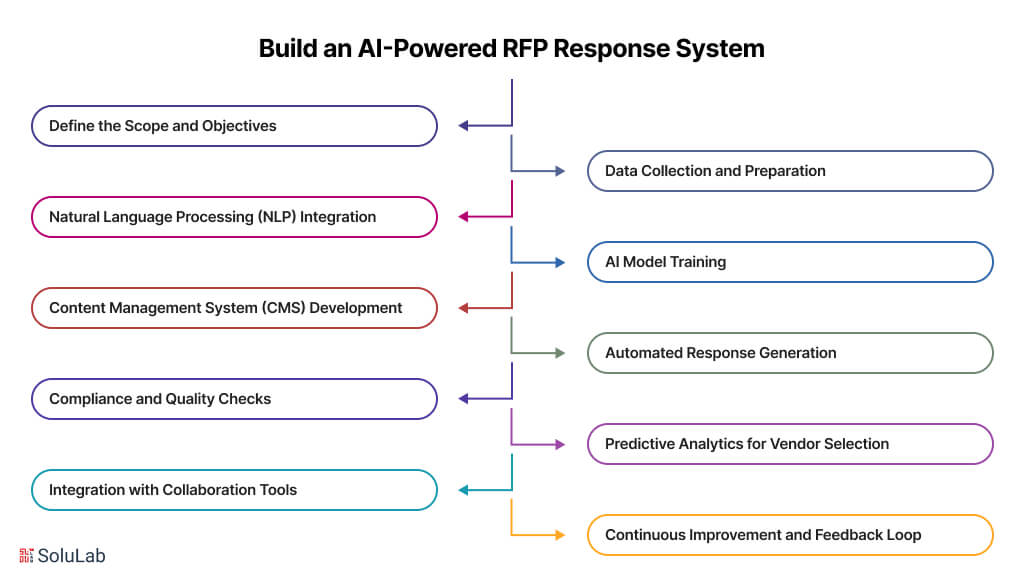
Building one of these is a sequence, not a single project. Several AI technologies have to work together before RFP management gets meaningfully easier. Here is how to put together an AI-powered RFx management system that earns its keep:
1. Define the Scope and Objectives
What do you actually want out of this? Faster responses? Better accuracy? A higher win rate? Name the problem first. Vague goals produce vague systems, and the whole build will drift unless you can say what success looks like before anyone writes code.
2. Data Collection and Preparation
Pull together every past RFP, RFQ, and RFI you have, plus the responses you sent, the proposals that won, and whatever supporting documents exist. Then clean it. Models trained on messy data produce messy output, and in practice this is where most projects stall. Anonymize anything sensitive so you stay on the right side of privacy law.
3. Natural Language Processing (NLP) Integration
Apply natural language processing (NLP) approaches so the system can read RFP materials rather than just store them. NLP algorithms lift out project requirements, deadlines, and evaluation criteria, and that extracted structure is what lets the system write a response that fits.
4. AI Model Training
Train on your historical RFP data. Machine learning will surface the trends hiding in the bids that won, and the models learn to predict strong responses and suggest content that has worked before. Retrain on a schedule. Requirements shift, and a model trained on two-year-old wins starts recommending yesterday’s answers.
5. Content Management System (CMS) Development
Build a solid CMS to hold everything: past proposals, case studies, product information. Then add AI-powered search on top so retrieving the right segment takes seconds. Without that layer, the repository is just a bigger haystack.
6. Automated Response Generation
Let AI produce the first drafts. Templates give you the skeleton, AI-driven customization shapes it to the specific RFP requirements, and your experts start from something real. The draft is a foundation, not a finished submission.
7. Compliance and Quality Checks
Wire in automated compliance checks for formatting guidelines, legal requirements, and the rest of the specifications. Have AI read the response back for consistency, accuracy, and completeness. Manual checking is slow and, past hour three, unreliable.
8. Predictive Analytics for Vendor Selection
Put predictive analytics to work on vendor selection. Performance data, market trends, and other signals feed models that estimate which vendors will meet the buyer’s needs. The decision stops being about who presents best and starts being about what the data says.
9. Integration with Collaboration Tools
Connect the system to whatever collaboration tools your team already lives in. If people have to leave their normal workflow to use it, they will not use it, and stakeholder input will keep arriving in scattered email threads.
10. Continuous Improvement and Feedback Loop
Set up a feedback loop and keep it alive. Ask users what is falling short, then fix it. Track how submitted proposals actually performed and feed that back into the models. A system nobody tunes gets worse, slowly, and you will not notice until you lose a bid you should have won.
Work through those ten steps and you have a working AI-powered RFx Management system: faster responses, better accuracy, and a real edge on the competition.

The Bottom Line
Automating procurement with AI-powered RFx Management changes how RFPs, RFQs, and RFIs get handled, and not marginally. Response processes get shorter, accuracy improves, and decisions rest on data instead of instinct. Automated proposal drafting, compliance checks, predictive analytics for vendor selection: each one takes time and effort out of procurement work. The productivity gain is the obvious part. The better part is winning more of the bids you enter.
None of which means it is easy. Data quality problems, integration with the systems you already run, models that need updating on a schedule nobody owns yet: these are the things that trip up an AI-RFx procurement rollout. That is where SoluLab, as a leading AI development company, comes in. We handle the integration, the data management, and the ongoing model training that keeps the system current, and we build around what your procurement process actually looks like rather than a generic version of it. Ready to change how your procurement runs? Contact us today and we will show you what AI can do for AI-powered RFx management.
FAQs
Shipra Garg is a tech-focused content strategist and copywriter specializing in Web3, blockchain, and artificial intelligence. She has worked with startups and enterprise teams to craft high-conversion content that bridges deep tech with business impact. Her work translates complex innovations into clear, credible, and engaging narratives that drive growth and build trust in emerging tech markets.