What if your crypto wallet did more than just hold your coins? That’s the idea behind AI crypto wallets. They’re built to help you make sharper decisions, catch suspicious activity before it turns into a problem, and give you recommendations based on how you actually use the app.
As crypto goes mainstream, the tools people rely on have to keep up. AI brings real utility here: automated suggestions, smart notifications, voice controls. Think of it as a co-pilot baked right into your wallet, one that pays attention so you don’t always have to.
This guide walks you through building your own AI-enabled crypto wallet. Whether you’re a developer or just curious how this works, we’ll break down the stages, the tools, and the decisions worth thinking about before you start.
The Journey of Crypto Wallets
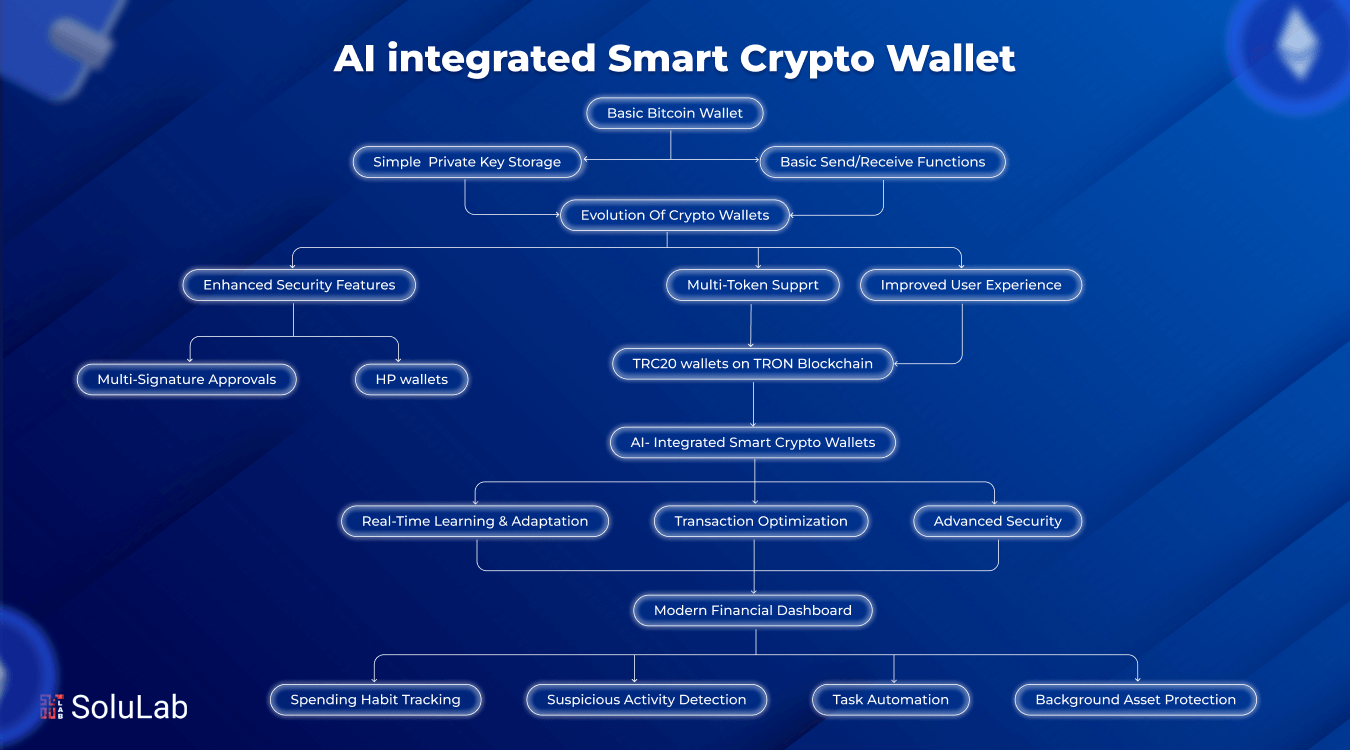
When Bitcoin launched in 2009, crypto wallets were barely more than key storage. Send, receive, stay safe. That was it. But as the user base expanded, wallets had to grow with it. Developers started adding multi-token support, better UX, and cross-chain compatibility.
TRC20 wallets brought TRON into the mix, and some have started using AI to make transactions faster and security tighter. These wallets don’t just react to inputs anymore; they learn, adjust, and respond in real time. That’s the shift that marks the beginning of the AI-integrated smart crypto wallet era. Multi-signature approvals and HD wallets also came along, giving users a much harder grip on their own funds.
Today, wallets have outgrown their original job. They’re becoming full financial dashboards. Track spending. Flag suspicious behavior. Automate repetitive tasks. All while keeping assets secure in the background. Not bad for something that started as a digital keychain.
Market Statistics for Smart Crypto Wallets in 2025
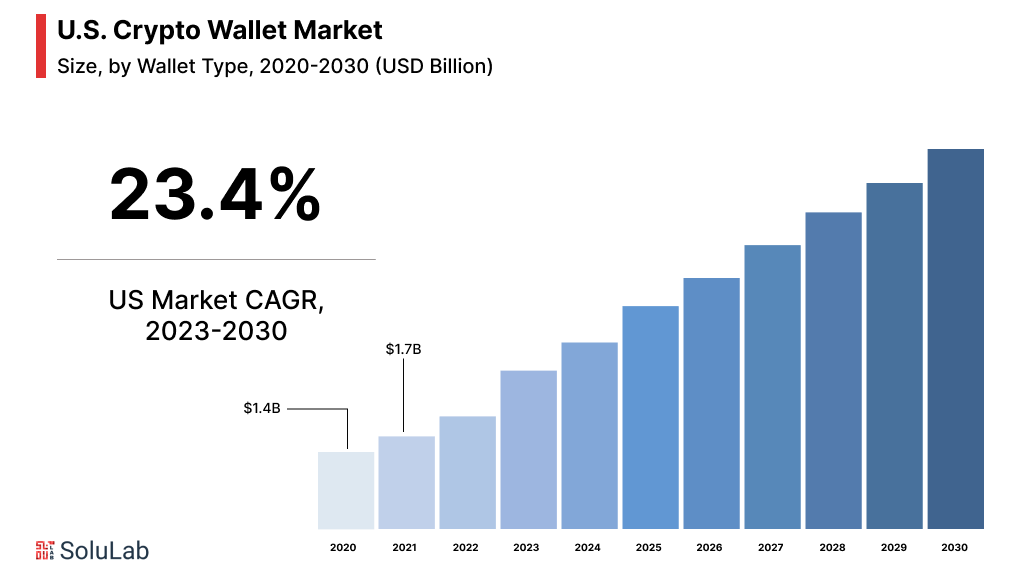
The AI-integrated smart cryptocurrency wallet market is growing quickly through 2025 and beyond. Broader adoption of blockchain technology across industries is driving a lot of this, alongside rising demand for secure crypto transactions and steady improvements in AI-powered functionality.
Key Statistics and Trends:
- According to a Grand View Research report, the worldwide AI crypto wallet market was valued at USD 8.42 billion in 2022 and is expected to grow at a compound annual growth rate (CAGR) of 24.8% from 2023 to 2030.
- The worldwide smart wallet market was estimated at USD 289.16 million in 2023. It is projected to reach USD 519.22 million by 2032, growing at a CAGR of 6.72% from 2024 to 2032. That growth is tied to the wider digital transformation push and rising e-commerce activity.
Key Features of a Next-Level Smart Crypto Wallet
A modern wallet has to do more than hold tokens. It needs to be secure, fast to use, and flexible enough to match how people actually handle crypto day to day. If you’re building one, here’s what belongs on your list.
1. Handles Different Coins in One Place
A solid wallet should support a wide range of cryptocurrencies, not just Bitcoin or Ethereum. Managing everything from established coins to newer tokens in one place, without bouncing between apps, is exactly what makes an AI-integrated smart crypto wallet worth using.
2. Works Across Devices
People switch between their phone, laptop, and tablet constantly. Your wallet should work across all of them and stay synced. Whether you’re on Android at work or on a Mac at home, the data should be current wherever you log in.
3. Security That Doesn’t Get in the Way
Biometric logins, 2FA, solid encryption: these all need to be built in. But they shouldn’t make the app feel slow or awkward. The best security is the kind users barely notice, doing its job in the background while the experience stays clean.
4. Stores Keys With the User
Your wallet shouldn’t be storing private keys on a central server. Keys stay on the user’s device. That way, control stays with the user, and a failure on someone else’s infrastructure doesn’t put funds at risk.
Related: Build an AI-Integrated Crypto Wallet on Aptos from Scratch
5. Multi-Sig for Shared Access
Teams and DAOs often need shared wallet access. Multi-signature support means no single person can move funds unilaterally. It adds accountability without creating bottlenecks, and cuts down the risk of unauthorized transfers.
6. Built-In Swap Feature
Swapping tokens without leaving the wallet saves time and cuts fees. It’s one of those features that sounds minor until you’ve had to leave an app three times to complete a basic trade. In practice, it’s a meaningful part of what separates a good experience from a frustrating one.
7. QR Code Transfers
Anyone who’s tried to type a wallet address by hand knows how painful that is. QR codes fix this problem. Scan to send, scan to receive. Especially useful for retail payments or any face-to-face transaction.

Why Integrating AI Can Transform Your Crypto Wallet?
There are already plenty of crypto wallets on the app stores. So why build your own AI-based one? The short answer: ownership and control.
When you build your own wallet, you’re not dependent on someone else’s infrastructure or hoping a third-party backend holds up. You write the security protocols yourself, shaped around your exact use case. And bringing in AI agents for finance adds a serious layer of protection. These agents watch real-time activity, catch red flags early, and help you get ahead of problems before they cost anything.
AI also makes the wallet work the way each user actually needs it. Handling transaction approvals, managing crypto portfolio more cleanly, running smart contracts automatically based on set triggers: these aren’t gimmicks. They’re real time-savers for anyone doing more than casual trading.
Here’s what makes a learning wallet different from a static one: it pulls live market data, checks past transaction history, and spots patterns. If you’re unsure when to act on a position, it can surface a suggestion grounded in what’s actually happening rather than intuition alone.
Building one from scratch is also a genuine learning opportunity. You get hands-on exposure to how blockchain systems connect, you work through AI applications directly, and you develop a real understanding of security practices that hold up under pressure. That kind of knowledge is hard to get any other way.
The role of AI in crypto wallets isn’t about adding features for the sake of it. It’s about building tools that respond to how people actually use crypto. And if you’re building the wallet yourself, it works the way you need it to.
Step-by-Step Breakdown to Build Your Own AI-Powered Crypto Wallet
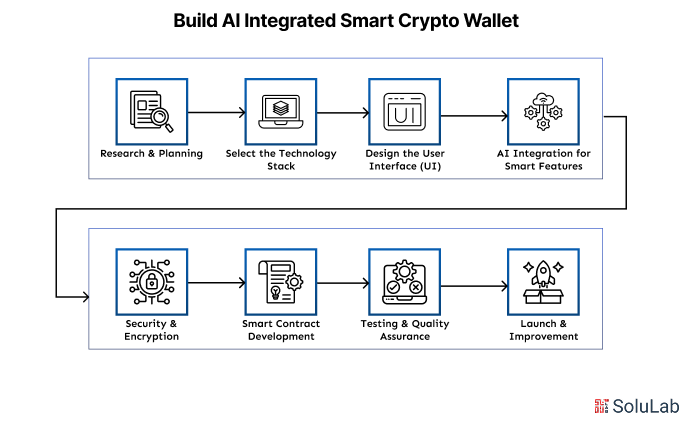
Building a crypto wallet that actually blends AI with blockchain isn’t just a coding exercise. Every stage, from concept to launch, has decisions that affect how the product performs and how much trust users place in it. Here’s a clear walkthrough.
1. Research and Planning
Don’t skip the research phase. Look hard at what existing wallets get right and where they fall short. Then figure out where AI can do something genuinely useful: better fraud alerts, timing suggestions, smarter notifications. Not buzzword AI. The kind that actually changes what a user does.
2. Select the Technology Stack
Your stack shapes both performance and how far you can scale. For the blockchain layer, most teams pick Ethereum, Solana, or Binance Smart Chain. On the AI side, PyTorch and TensorFlow are both well-supported for training and integration work. Which combination makes sense depends entirely on what your wallet is trying to do.
3. Design the User Interface
In crypto especially, design matters. If the interface isn’t clear, people won’t trust it with their money. Keep it simple enough for someone who isn’t deeply technical. Balances, token transfers, and AI-powered insights should all be one or two taps away, not buried in menus. Poor UI is one of the most common reasons adoption stalls.
4. AI Integration for Smart Features
Artificial intelligence has real potential here, but only if it’s applied to actual problems. A crypto wallet can offer personalized financial recommendations, automatic portfolio rebalancing, and warnings about suspicious-looking activity. Machine learning models can track user behavior and market data together to surface meaningful, real-time suggestions rather than generic alerts that get ignored.
5. Security and Encryption
Security isn’t optional here. Use strong encryption standards for private keys and sensitive data. Two-factor authentication for identity checks. AI contributes on this front too: it can monitor behavior patterns and flag unusual access attempts before any real damage happens.
6. Smart Contract Development
A wallet that supports decentralized finance needs to connect directly with smart contracts. These go beyond basic transactions: staking, swaps, lending protocols can all run through the wallet. With solid top AI cryptocurrency wallet development, you can build in automation that moves assets based on conditions, no manual steps or third-party middlemen needed.
Read More: How to Build a Crypto Wallet that Excels in 2026?
7. Testing and Quality Assurance
Bugs in production when real money is involved are a serious problem. Full testing means feature checks, security validation, stress tests for high-traffic conditions, edge cases, and verifying that your AI modules actually behave correctly. None of this is optional before you go live.
8. Launch and Improvement
Once everything holds up in testing, launch through mobile stores or web platforms. But the work doesn’t end there. Watch how users actually interact with the wallet. Gather feedback. Regular updates let you ship new AI features, sharpen the UX, and tighten security over time.
What Does It Cost to Build an AI-Powered Crypto Wallet?
If you’re planning to build an AI-integrated smart crypto wallet, cost is probably one of your first questions. There’s no fixed number. The budget shifts based on what features you’re building, how complex the AI layer is, and where your development team is located.
Features like real-time AI analytics or DeFi integration will push the total higher. For anyone entering this space, or looking to start a cryptocurrency exchange with a custom wallet solution, having a rough sense of where the money actually goes is useful before you start conversations with a development team.
Here’s a general breakdown of what each stage of crypto wallet development typically costs:
| Development Phase | Estimated Cost (USD) |
| Market & User Research | $5,000 – $15,000 |
| Interface & Experience Design | $10,000 – $30,000 |
| Backend Architecture | $20,000 – $50,000 |
| AI Feature Integration | $15,000 – $40,000 |
| Security Layers & Encryption | $10,000 – $25,000 |
| QA & Final Testing | $5,000 – $15,000 |
| Product Launch & Promotion | $10,000 – $30,000 |
Popular AI-Integrated Crypto Wallets You Should Know About
Over the past couple of years, a few wallets have quietly gotten more useful by adding AI to their core functionality. Not as a marketing angle, but as something that genuinely changes how users manage assets. They track patterns, catch risks, and sometimes surface timing suggestions based on real data. Here are a few worth knowing about.
1. Frontier Wallet
Frontier supports a wide range of DeFi protocols and asset-backed cryptocurrencies. Its AI features aren’t always prominent, but they handle things like transaction categorization and flagging potential risks in DeFi positions. Particularly useful for users managing multiple protocols at once.
2. ELLIPAL Titan
This is a hardware wallet paired with a smart app that uses AI for transaction monitoring and anomaly detection. If something looks unusual, it flags the user before anything happens. A practical choice for anyone who wants cold storage without giving up active oversight.
3. YouHodler
YouHodler combines lending, trading, and wallet functions in one product. The wallet side uses machine learning models for real-time price analysis and behavior-based alerts. It’s not passive storage; it gives users sharper timing and better data to act on.
4. Klever Wallet
Klever started as a straightforward mobile wallet. Newer versions have added AI in understated but useful ways: optimizing gas fees, flagging unusual sending behavior, offering suggestions based on past transaction patterns. It’s a good example of AI adding value without calling attention to itself.
These wallets show that smarter, data-aware crypto tools are already here. For anyone working on crypto wallet development, seeing how these platforms have woven AI into the product without overcomplicating the experience is worth studying. The goal is making crypto safer and easier to use, not turning wallets into dashboards no one understands.
Read Also: Why Every Business Should Integrate POS Crypto Wallets?
The Future of Crypto Wallets and AI
The way people use crypto wallets is changing fast. What started as simple key storage has become something closer to a financial platforms. Users expect more now: spending tracking, cross-chain transfers without the friction, guidance on when to act. The direction is clear: wallets are becoming tools for managing digital wealth, not just holding it.
That’s where AI trends are already making a visible difference. Wallets that adapt to user habits, catch irregular activity early, and offer recommendations grounded in real-time market data are becoming the standard, not a specialty product. As the technology matures, AI won’t be an add-on; it’ll be the foundation of how next-generation wallets work.

The Bottom Line
Digital finance is getting more complex. Wallets have to keep up. The shift from basic storage toward AI-backed tools that give users real insight, tighter security, and more control over their assets is already well underway.
At SoluLab, a leading cryptocurrency development company, we help companies build in this space end to end. One recent project involved a platform focused on advanced digital marketing and web traffic analytics. We built a native crypto wallet for their ecosystem, with secure asset management alongside call tracking and multi-source traffic monitoring. With the wallet integrated into their blockchain-powered platform, Clicktool users can now track ROI, manage campaigns, and read market signals with more precision than they had before.
If you’re ready to bring AI and blockchain into your next wallet or digital platform, this is a good time to start. Whether you’re building from scratch or upgrading an existing product, our team can work through it with you. Contact Now!
FAQs
Shipra Garg is a tech-focused content strategist and copywriter specializing in Web3, blockchain, and artificial intelligence. She has worked with startups and enterprise teams to craft high-conversion content that bridges deep tech with business impact. Her work translates complex innovations into clear, credible, and engaging narratives that drive growth and build trust in emerging tech markets.