Going digital rewired how we find information, share it, and argue about who owns it. That part is old news. What is not old news is the shift now forming underneath the internet itself, one that could rearrange the plumbing rather than just repaint the walls.
AI in Web3 sits at that junction: machine intelligence on one side, decentralization on the other. Call it a trend if you want, but the pairing is stranger and more interesting than most trends. One half is enormously capable. The other half insists that capability should not belong to a few companies.
Put together, they change the terms between data, trust, and who gets paid for either. This piece walks through what that actually looks like in Web3 development, where it helps, and where it still falls over.
What is Web3?
Web3 is the decentralized, open version of the web, and it changes your online experience by changing who holds the keys. Web2 runs on middlemen and a handful of dominant platforms. Web3 aims the other way: give people control, keep privacy intact, let two parties transact without a referee taking a cut. Blockchain does the heavy lifting underneath, supplying security, immutability, and a public record anyone can check.
The toolkit includes cryptocurrency, smart contracts, and decentralized applications (dapps). Three ideas hold it together. Decentralization. Users owning their own data. No intermediary skimming the middle. When you interact directly with a decentralized network, you also get a claim on the value that network creates, which is a very different arrangement from the one most of us signed up for a decade ago.
What is AI?
Artificial intelligence is the corner of computer science devoted to building machines that handle work we used to assume required a person. An AI system takes in data, reasons over it, and then decides or acts on what it found.
These systems imitate human cognitive work: understanding language, recognizing images, solving problems, generating something new. The field splits into subfields you have probably heard named separately, including robotics, computer vision, natural language processing, and machine learning. The applications run everywhere, from hospitals and banks to freight and film, and the common thread is simple. People get more done.
Why is AI Important in Web3 Development?
The next generation of web3 and AI platforms will push intelligence out to the edges instead of keeping it in one data center, which buys users speed, stronger security, and real privacy. Through smart contracts and decentralized apps, AI in web3 is quietly rewriting how people interact, transact, and build.
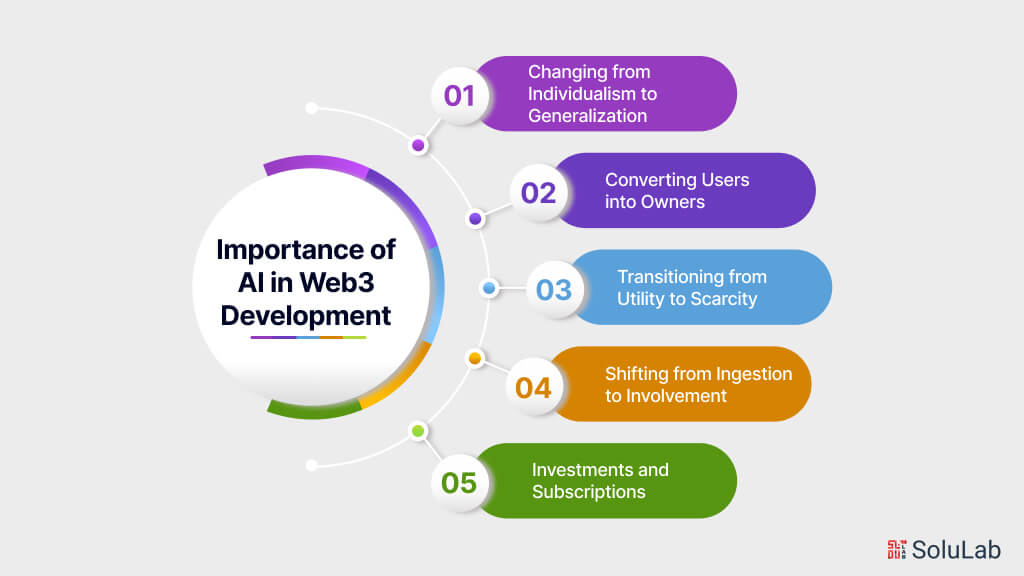
1. Changing from Individualism to Generalization
For a decade, big tech pointed centralized AI models at consumers and kept the insights. The capability being built now in AI and Web3works differently, and the point is that it works for everyone rather than a small circle at the top. Each model carries the fingerprints of whoever trained it: their experience, their interests, their expertise.
2. Converting Users into Owners
A handful of private firms produce and profit from nearly all of the material online. The people actually making the work stay invisible and underpaid. Web3 flips that: the artist holds the digital assets, the AI models, and the data outright. Some companies are building blockchain platforms specifically so creators keep full control of what they generate and can share it, license it, or reuse it however they choose.
3. Transitioning from Utility to Scarcity
A token on its own is not ownership and it is not an incentive. It certainly is not durable. For any of it to last, the token has to carry genuine value and hand the holder something concrete. Your personal AI, shaped by your taste and your judgment, pulls more value out of the material you already make. Add social tokens for access and participation, and that same AI starts opening doors: collaborations, shared upside, value created inside your own community instead of extracted from it.
4. Shifting from Ingestion to Involvement
Today’s platforms are built for consumption at scale, which makes the relationship between maker and audience a one way street. Personal AIs plus social tokens change the traffic pattern. Web3 artificial intelligence gives producers and their communities platforms they actually own. What emerges is a collaborative network structure where power sits with individuals rather than the platform, and the line between producing value and consuming it gets blurry in a useful way.
5. Investments and Subscriptions
The old playbook for creators: grind, accumulate subscribers, hope the pile eventually pays. Only a thin slice ever earns a real living from it, and that failure costs subscribers too, not just the people making things. A different creator economy is forming around web3 and the AI platforms coming with it, one where a community can invest in the creators it loves and in the personal AIs that improve its own day to day. Creators get a shot at building an actual business around their ideas. The community that backed them shares in what follows.

How Can Web3 Make Use of AI?
AI is spreading fast enough to reshape entire sectors, and Web3 is one of them. AI and Web3 together will shape the decentralized web that comes next, mostly by making it usable and by solving problems nobody had good answers for.
- Web3 AI earns its keep first in analysis and decisions. Blockchains generate enormous volumes of data, far more than anyone reads by hand, and AI algorithms can chew through it and hand back something a person can act on.
- Point AI Web3 at predictive analytics and trends surface earlier, patterns become visible, risks get flagged before they bite. That changes how capital and effort get allocated in decentralized Web3 ecosystems.
- Then there is security. Machine learning Web3 algorithms catch fraudulent behavior mid-flight, surface weak points before an attacker does, and sharpen encryption practice. Decentralized systems end up harder to break and easier to trust.
Read More: AI x Web3 Execution Playbook
The Benefits of Using AI in Web3
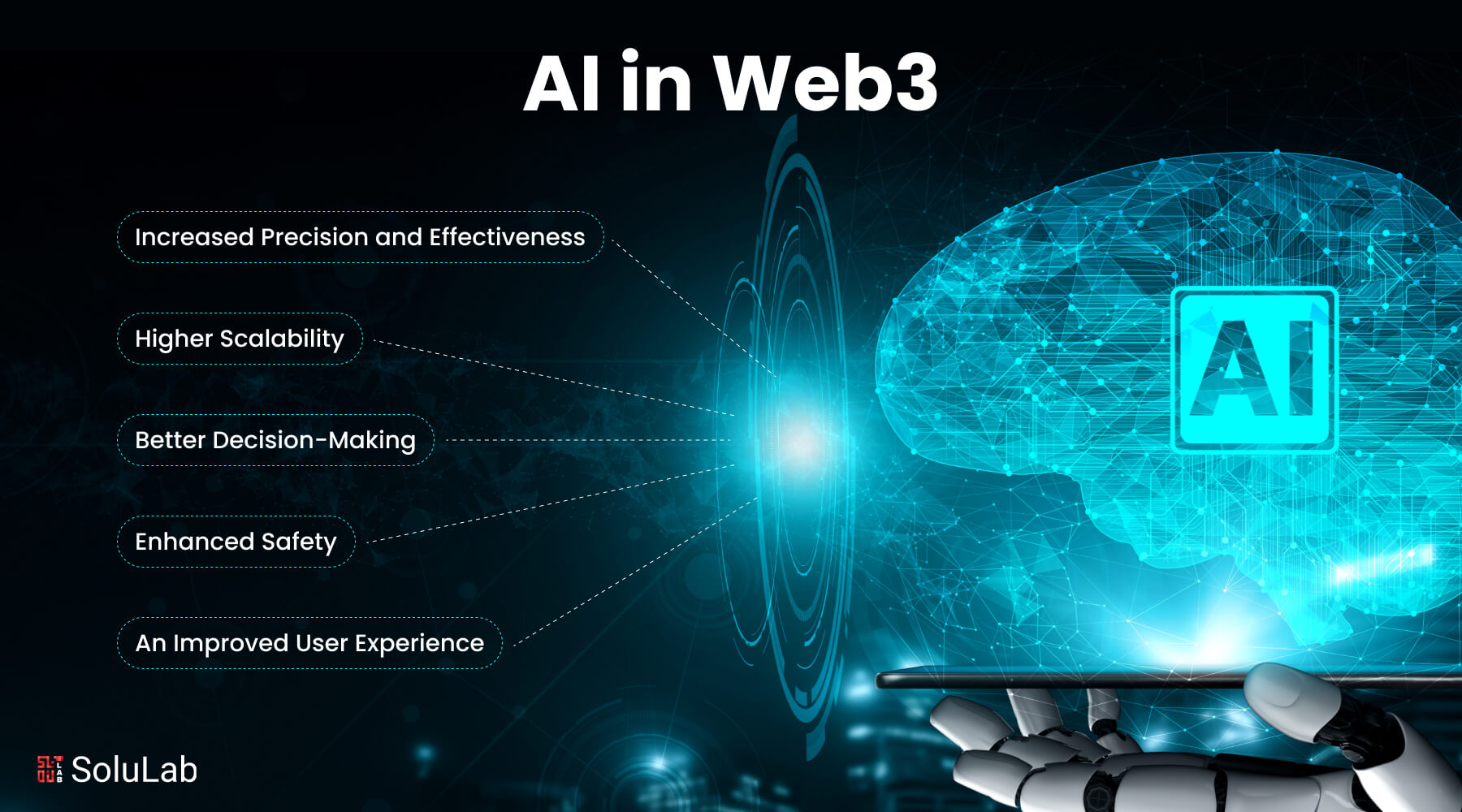
So what do you actually get by putting AI inside a web3 application? Several things, and they compound:
1. Increased Precision and Effectiveness
Manual steps come out, automation goes in, and both throughput and accuracy improve. Fewer mistakes means a better product, which is less exciting to say than it is to live with.
2. An Improved User Experience
AI makes a web3 app more useful by returning results that fit the person in front of it. The app feels less like a form to fill out and more like something that knows why you opened it.
3. Higher Scalability
Automation is why artificial intelligence (AI) scales better than the conventional alternative. For a company growing its operations, that difference shows up directly in the budget and the calendar.
4. Better Decision-Making
Some decisions simply cannot be made without insight you do not have yet. AI supplies it: the recurring pattern, the likely outcome, the reason customers behave the way they do.
5. Enhanced Safety
An online app that is not secure is a liability, full stop. Adding AI to a web3 app puts one more layer between your users and the usual threats, from data leaks to outright attacks.
Key Domains in Web3 Where AI Is Potential
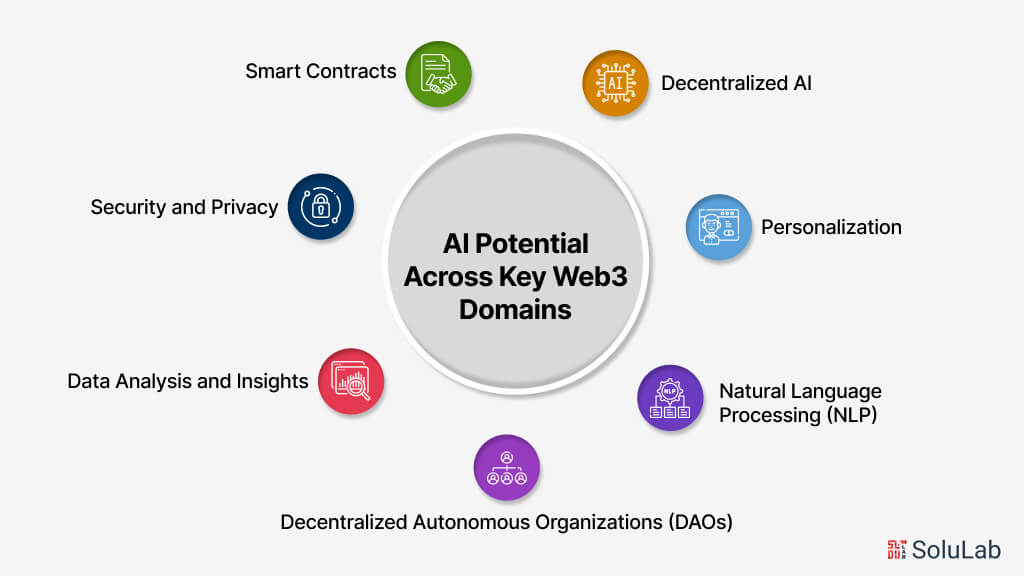
AI is doing a lot of the work of getting Web3 to a place that is genuinely decentralized, safe, and built around the person using it. Fold AI into the various Web3 domains and the digital experiences that come out are smarter, faster, and shaped around you.
These are the areas where Web3 AI moves the needle most:
Smart Contracts
- AI integration for intelligent decision-making: Give a smart contract AI capability and it stops being a rule that fires. It starts reading the situation. Market data, user behavior, outside signals: the contract weighs them and decides within its own terms, which opens the door to pricing that moves with the market or terms that bend to individual preference.
- Automation of complex workflows: AI-powered smart contracts can run processes with many parties and many conditional branches without a human babysitting each step. Supply chain is the obvious case. The contract watches live data and triggers a raw material order or books a shipment on its own.
- Optimization and refinement: Reinforcement learning can keep working on contract code long after deployment, tuning for performance, security, and reliability. Test, refine, repeat. The inefficiency you would have missed on review gets caught, the vulnerability gets flagged, and the contract that results is tighter than the one a team shipped on deadline.
Decentralized Autonomous Organizations (DAOs)
- Enhanced governance and decision-making: Governance is where most DAOs bog down. Too many proposals, too little attention. AI can read proposals, member preferences, and what happened the last dozen times a similar vote passed, then flag what matters, predict the likely effect, and rank what deserves a look first. The process gets faster and the reasoning stays visible.
- Improved transparency and adaptability: When a decision comes with a clear justification attached, members trust it more and can hold someone to it. AI also helps a DAO react when circumstances move, spotting the shift in conditions or member behavior early enough to do something about it.
- Resource allocation optimization: Funds, compute, attention: all finite, all easy to misallocate. By reading project performance against stated needs and priorities, AI helps a DAO put its resources where they do the most good, which is usually the difference between a DAO initiative that ships and one that stalls.
Related: AI in Web3 – Exploring How AI Manifests in the World of Web3
Decentralized AI
- Distributed model training: Federated learning and similar techniques let models train across distributed data sets while the data itself stays put. You build the AI system without ever pooling sensitive records in one place, which is better for privacy and better for security.
- Collaborative model development: Secure multi-party computation and homomorphic encryption let several parties build a model together while nobody hands over raw data. Rivals can cooperate on the model and still keep their own records private.
- Incentive mechanisms: Decentralized AI can pay people, in tokens, for sharing data, contributing to training, or lending compute. Participation stops being charity.
Personalization
- AI-driven recommendations: Read the user data, generate suggestions that fit: content, products, services. People stay longer and complain less when what they see is actually relevant to them.
- Context-aware communication: Natural language processing (NLP) techniques let a Web3 application take a question or an instruction in plain language and respond sensibly. The interface stops requiring a tutorial.
- Automated content generation: AI can write the personalized piece itself, whether that is a news summary or a product suggestion, so nobody has to hand-curate every variant. That is what makes it scale.
Natural Language Processing (NLP)
- Seamless communication: With NLP, a Web3 application reads what the user typed and answers in kind. No command syntax to memorize, no documentation to open first.
- Contextual understanding: AI-powered NLP picks up on context and sentiment in user-generated content, so the response fits the mood and the moment rather than just the keywords.
- Automated content generation: NLP can produce readable copy without a person drafting each piece, which takes a large and thankless chunk of work off the table.
Data Analysis and Insights
- Uncovering patterns and trends: Decentralized data sets are rich and almost nobody mines them properly. AI-driven analysis pulls out what is buried there, and those findings feed straight back into how Web3 applications and services get built and tuned.
- Optimization and innovation: An insight you can act on is worth more than a dashboard full of numbers. AI supplies those inside Web3, pointing at the thing worth fixing or the market shift worth chasing.
- Enhancing security: AI-powered threat detection works ahead of the incident rather than after it, surfacing vulnerabilities and malicious behavior early. That is what keeps Web3 platforms and the applications on top of them worth trusting.
Security and Privacy
- AI-powered threat detection: AI watches the data flow and analyzes it continuously, catching cyber threats before they land and keeping Web3 platforms intact.
- Robust authentication methods: Biometric recognition and behavioral analysis raise the cost of impersonation considerably. Authentication gets stronger and fraud gets harder.
- Advanced encryption and anonymization: AI-driven encryption and anonymization keep user data private in environments where no single operator is in charge of protecting it.
Why Web3 Adopts ML Technologies Top-Down?
Adoption of machine learning Web3 tends to start at the top and work down, and the reason is unglamorous: the infrastructure is complicated and wiring ML into a decentralized system takes people who have done it before. Experts and organizations that genuinely understand Web3 build and deploy the ML first. Everyone else picks it up later.
1. Complex Technical Integration: Putting ML into a Web3 platform means knowing decentralized infrastructure and ML algorithms well, not one or the other. Blockchains, smart contracts, and decentralized applications each have their own failure modes, and connecting ML cleanly to all three is specialist work.
2. Prioritizing Security and Privacy: Web3 stakes its case on secure, privacy-preserving design. Drop ML in carelessly and you undermine exactly that. Top-down adoption puts the design work in the hands of people who already understand the security and privacy tradeoffs, so what gets built still matches what Web3 claims to stand for.
3. Emphasis on Standardization and Interoperability: ML will not spread across Web3 platforms without shared standards. Top-down adoption is how common frameworks, protocols, and standards get written in the first place, which is what makes fitting ML solutions into the wider Web3 stack straightforward instead of a one-off integration every time. Less fragmentation, fewer dead ends.
4. Addressing Scalability and Performance Challenges: Decentralized systems come with scalability and performance problems built in, and ML does not get a pass on them. Designing from the top means those constraints shape the solution from day one, so what ships actually runs at scale.
5. Facilitating Ecosystem Growth and Maturity: Web3 is still maturing, and a top-down approach lets ML arrive at a pace the community can absorb. Introduce it faster than the surrounding infrastructure can support and you get breakage instead of growth.
Related: Web3 Trends Shaping the Future of AI
What Challenges Does AI Face?
None of this arrives clean. Several problems have to be sorted out before AI is broadly usable and properly tuned. The big ones:
1. Moral Issues: Pairing AI and Web3 raises hard questions about privacy, bias, who answers when something goes wrong, and whose job disappears. Those need rules and laws with teeth, not a values page.
2. Availability and Quality of Data: Data is the substrate. If it is thin, skewed, or locked away, the output is unfair or wrong, and no amount of model tuning fixes that.
3. Transparency and Interpretability: Explaining how an AI and Web3 algorithm reached its conclusion is genuinely difficult. The systems are complex and they do not interpret easily, which is a problem when someone asks why.
4. Risks to Security: Adversarial manipulation and direct attacks on AI and Web3 systems can corrupt the data or knock the system over entirely.
5. Insufficient Domain Expertise: Building an AI solution that works usually demands deep knowledge of the field it serves. In plenty of fields, that combination of skills is simply hard to find.

Conclusion
Web3 meeting AI could reshape a long list of industries. Take what each side is good at and you get systems that are more transparent, more accountable, and more useful to the people they serve.
Worth noting which direction the help runs, too. Web3 technologies like blockchain and decentralized networks answer several of the AI industry’s sorest problems, covering data management, compute, and how algorithms get built. They open room for cooperation, make the process visible, and pay people to take part. Better models, cleaner data, smarter allocation of what is scarce.
SoluLab is a leading AI development company, and we build end to end solutions for the messy problems decentralized technology throws up. Blockchain and artificial intelligence sit side by side in our team’s experience, and that is what lets companies actually put AI in Web3 to work instead of talking about it. SoluLab builds to the client’s requirements, whether that means smart contracts that make AI-driven decisions, decentralized autonomous organizations (DAOs) running on AI-powered governance, or decentralized AI for machine learning that never exposes private data. Ethics, transparency, and security are where we start, not where we tack on a review at the end. If you want Web3 development built with AI underneath it, talk to us.
FAQs
Shipra Garg is a tech-focused content strategist and copywriter specializing in Web3, blockchain, and artificial intelligence. She has worked with startups and enterprise teams to craft high-conversion content that bridges deep tech with business impact. Her work translates complex innovations into clear, credible, and engaging narratives that drive growth and build trust in emerging tech markets.