Startups move fast, and Artificial Intelligence (AI) has changed what a small team can actually get done in a week. Strip the marketing off it and AI means one thing: machines that learn from data, reason over it, and decide. That is the whole definition. For a company running lean, it matters far more than it does for a corporation with a floor full of analysts.
AI for startups is a wide bucket. It covers algorithms that chew through data, spot patterns, and adjust when conditions shift underneath them. Machine learning sits at one end, natural language processing at the other. What they share is the useful part: they take work off your plate and hand back something you can act on the same day.
Early on, picking up AI is not really a technology decision. It is a resource decision. You have fewer people than the incumbent and less money than the incumbent, so you buy back hours wherever you can. Done properly, the payoff lands in three places: operations get cheaper to run, the product gets sharper, and you finally understand what customers want instead of guessing at it in a meeting.
What is AI’s Fundamental Role in Startups?
Ask a founder where AI fits and you usually get something vague about efficiency. Fair enough. The honest version is narrower: AI absorbs the parts of the business that are repetitive, data heavy and dull, and it does them from day one rather than after you have hired three people to do them by hand. That is the role. Everything else in this article follows from it.
Benefits of AI in Startup Inception
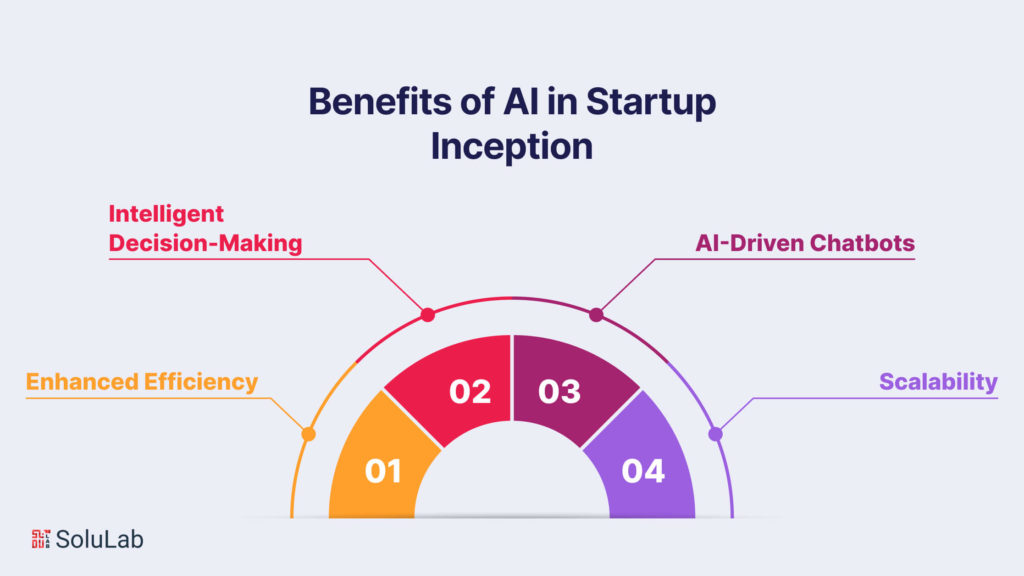
Enhanced Efficiency
Repetitive work eats junior hours. AI tools swallow most of it: sorting, tagging, routing, drafting, reconciling. Costs drop, which is the benefit everyone quotes. The bigger one is quieter. Your team stops doing clerical work and starts doing the work you actually hired them for.
Intelligent Decision-Making
Market research used to mean a consultant and six weeks of waiting. Now you point a model at the data and get back trend lines, the things buyers keep asking for, and a read on what competitors shipped last quarter. You still have to make the call yourself. You just make it with something solid underneath you instead of a hunch.
AI-Driven Chatbots
A chatbot answers at 2am. It handles the same handful of questions you get every single day, remembers what a customer bought, and passes the genuinely hard ones to a human. Customers get an answer immediately. Your support person gets to work on the difficult tickets instead of resetting passwords all afternoon.
Scalability
Growth breaks things. Volume triples and the process that worked fine at a low order count quietly falls apart. AI systems absorb that curve without a matching jump in headcount, which happens to be the exact problem a fast-growing startup runs into first.

How Can Startups Harness the Power of AI for Growth and Innovation?
Customer Service Enhancement
Support is where most startups feel the strain first. Chatbots reply instantly, and engagement climbs for the least surprising reason in business: people hate waiting. Recommendations tuned to an individual user do the other half of the job. They make the product feel like it pays attention, and retention tends to follow that feeling.
Operational Efficiency
Routine work automated is routine error removed. Teams get their calendars back. And the algorithms sitting on top of your workflows will point at the places where things stall, which in practice is almost always somewhere nobody thought to look.
Product Development and Innovation
Building the wrong thing is the most expensive mistake a startup makes. Pointing AI in product development at market research narrows those odds: you see what buyers prefer, where the market is drifting, and what looks likely to matter a few quarters out. Predictive tooling will not tell you what to build. It is very good at telling you what not to.
Marketing and Sales
Marketing is where AI pays back fastest, because the feedback loop is short enough to see. Targeting built from what customers actually did beats targeting built from a persona document somebody wrote in a workshop. Forecasting and lead scoring handle the rest, sorting your pipeline into what deserves a call this week and what does not.
This is not a trend you can sit out and catch later. Startups that wire AI into how the business actually runs, rather than into a slide deck, end up with a cost structure and a feedback loop the rest of the market does not have.
Read Also: AI In Marketing
How Has the Integration of AI Empowered Early-Stage Success for Startups?
So what does this look like when it works? What follows are the patterns that keep turning up in early-stage companies: where AI got applied, and what changed afterwards. Read them as shapes to borrow, not as a template to copy line for line.
AI for Startups: Catalyst for Growth
Founders reach for AI because it reads more data than a person can and finds the shape hiding inside it. Decisions that used to rest on instinct now rest on evidence. One familiar case: a tech startup aiming AI at market research and coming back with a picture of trends, buyer preferences and competitor moves that nobody on the team had the hours to assemble by hand.
AI-Driven Chatbots: Transforming Customer Interaction
Chatbots with natural language processing do two jobs at once. They answer, and they collect. Every conversation is a record of what confuses people, what they nearly bought, what made them close the tab. One e-commerce case study fits here: a startup using AI-powered chatbots for personalized product recommendations, with both sales and customer satisfaction moving up noticeably afterwards.
Scalability Unleashed: AI Tools for Startups
Scale problems are usually process problems wearing a disguise. Automate the routine steps, add prediction, tighten the workflow, repeat. A logistics startup did precisely that, applying AI integration to route planning: shorter delivery times, lower operating cost per run, and enough slack to expand into new territory without rebuilding operations from scratch.
Unlocking Insights: AI Use Cases in Startups
The insight side gets less attention than the efficiency side and is often worth more. Healthcare, finance, anywhere the data runs deep: teams are using AI to read patterns nobody had the time to go looking for. One healthcare startup analyzed patient data this way and surfaced findings that pointed toward far more individual treatment than the standard protocol allowed for.
How Can Startups Navigate the Complexities of AI Integration to Overcome Challenges?
Here is the part the case studies skip. Integration is messy. Your data lives in four systems and two formats, nobody on the team has shipped a model before, and half the tooling assumes infrastructure you do not own. The upside is real, and it is still sitting behind a genuine engineering problem. Plan for that, and it becomes manageable.
Understanding the Landscape: AI for Startups
There is no default AI setup that suits every startup. Begin with what is actually broken. Audit the processes you run today, find the ones that are slow, manual or error prone, and ask honestly whether a model would improve them. Skip that step and you will buy something impressive that solves nothing you have.
AI Use Cases in Startups: Tailoring Solutions to Needs
Different industries, different bottlenecks. Operations, customer experience, decision support: pick whichever one hurts most this quarter. Market research is a common first move because the payoff arrives quickly and the cost of getting it slightly wrong is low, which makes it a reasonable place to learn.
Related: Use Cases Of AI Agents
The Rise of AI-Driven Chatbots: Personalized Customer Interactions
Chatbots keep coming up, and for good reason. They are cheap to start, they improve as they see more conversations, and the effect on support load shows up quickly rather than in some distant quarter. Put one in front of your help desk and the change in your queue is hard to miss.
Overcoming Integration Challenges: A Strategic Approach
Three things kill AI projects: data that does not line up, infrastructure that cannot carry the load, and a team that quietly refuses to use the tool. Take them one at a time. Working with AI experts, putting real budget into training people, and rolling out in small pieces beats a single dramatic launch every time.
Strategies and Solutions for Overcoming AI Integration Challenges
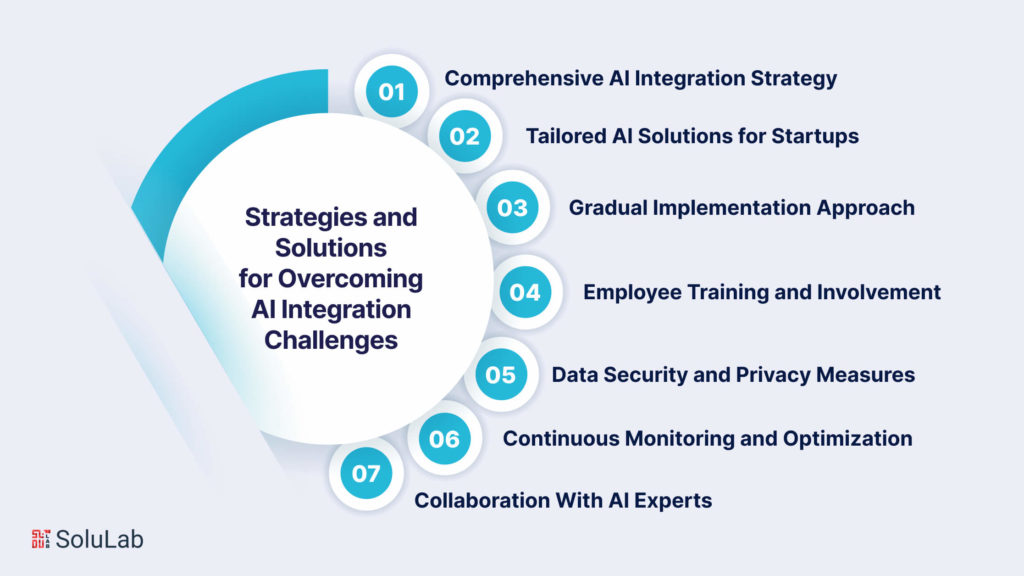
So, concretely. Startups keep reaching for AI to get an edge, and they keep hitting the same wall when it meets the systems they already run. What follows is a workable sequence, from the first assessment through to the tools you end up living with day to day.
Comprehensive AI Integration Strategy
Write the plan before you buy anything. Walk through your processes, mark the places where a model would earn its keep, then rank those against what the business is genuinely trying to achieve this year. Focus beats coverage. Two use cases done properly are worth eight done halfway.
Tailored AI Solutions for Startups
Off-the-shelf rarely fits. It was built for the average company, and you are not one. Custom work costs more upfront, then saves you from the slow bleed of a tool that almost does what you need and never quite gets there.
Gradual Implementation Approach
Do not rush it, particularly on a thin budget. Phase the rollout instead. Start somewhere contained, a chatbot on support or basic AI use cases in startups, and give the team room to adjust around it. Small launches surface the problems while those problems are still cheap to fix.
Employee Training and Involvement
This one is cultural, not technical, and it is where plenty of rollouts die. People need training before they will trust a tool, and they need some say in how it gets used. Bring them into the process and most of the resistance evaporates. Leave them out and you will own expensive software nobody opens.
Data Security and Privacy Measures
AI runs on data, so your exposure grows with every system you connect to it. Set the rules early: what you collect, where it sits, who can touch it, how long you keep it, which compliance standards apply. Customer trust is expensive to build and close to impossible to rebuild once you have lost it.
Continuous Monitoring and Optimization
Launch is not the finish line. Models drift as the world around them changes. Check what the chatbot is actually doing, read the conversations it handles badly, retrain when your business shifts. Treat it as ongoing maintenance rather than a project with a completion date, and it stays useful.
Collaboration With AI Experts
If you are attempting anything complicated, market research at scale or custom modeling, bring in people who have already done it. Partnerships with specialists in AI integration will save you months of learning the expensive way.
Read More: How Can AI Help Businesses Cut Costs?
How Can Startups Strategically Implement AI Tools to Drive Innovation and Growth?
Tooling next. Specifically: what is available to a company without an enterprise budget, and what is worth paying for while you are still small.
AI for Startups: A Game-Changer in Business Strategy
AI shows up across the whole company now, not only in engineering. Processes run faster. Data turns into something a human can read. The way you handle customers changes shape. The thread running through most startup use cases is strategic rather than technical: AI is not a feature you bolt on, it is a change in how the business operates.
AI-Driven Chatbots: Enhancing Customer Interaction
Worth repeating, because it is the most common entry point of all. Bots answer instantly and get better as volume grows. For a startup that means coverage around the clock and support that feels personal, without hiring a night shift to deliver it.
AI Integration in Business: Maximizing Efficiency
Support is only the doorway. Past it sits task automation, analysis of datasets too large to eyeball, and decisions made against live numbers instead of last month’s spreadsheet. Inventory. Forecasting. Pricing. The pattern repeats everywhere: less work spent producing information, more spent acting on it.
Cost-Effective AI Solutions for Early-Stage Companies
Plenty of vendors build for startup budgets on purpose. Basic automation at the entry level, serious analytics further up, priced so an early-stage team can begin without a funding round behind it. You do not need the enterprise tier to start, and starting small teaches you which tier you eventually need.
AI for Market Research: Unveiling Insights for Growth
You cannot build for an audience you do not understand. Research tooling now handles advanced analytics, sentiment reading and predictive modeling in roughly the time it used to take to write the survey. The saved hours are nice. The things you learn that you were not even looking for are better.
The Future of AI in Startups
The future of AI in startups keeps growing, and the thing separating companies will not be access to the technology. Everyone gets that. It will be judgment: which problems you aim it at, which tools you choose, whether you keep pace as the field moves under you. Chatbots at the front, automation underneath, and a team that knows how to work with both.
How is the Integration of Artificial Intelligence (AI) Influencing the Trajectory of Startup Ecosystems?
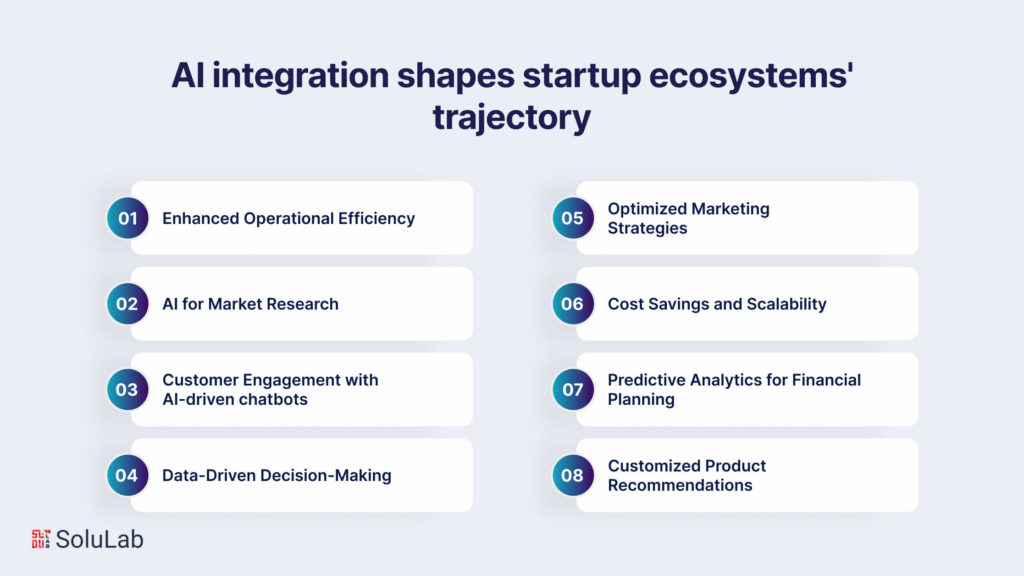
Zoom out from any single company and the effect on startups as a whole gets easier to see. Here is where it lands, use case by use case:
Enhanced Operational Efficiency
Putting AI-driven tools and the algorithms around them to work takes operational steps off people’s desks and puts your budget somewhere more useful.
The repetitive work goes first. What remains is the work that genuinely needs a person, which is where a small team should have been spending its time all along.
AI for Market Research
A startup can run AI across a large pile of market data and get accurate results back in a fraction of the usual time.
What comes out is a read on how buyers behave, what they prefer and where the market is heading. Enough to steer a strategy with, rather than guess at one.
Customer Engagement with AI-driven chatbots
Chatbots change the texture of customer contact. Immediate, personal, never closed.
Startups running them see better satisfaction and stronger engagement, and measured against competitors who still reply to email two days later, that alone is an advantage.
Data-Driven Decision-Making
AI tools let a handful of people analyze data at a scale that would otherwise require a whole analytics department.
Patterns surface, trends become visible, and choices get made on evidence instead of opinion. That is the growth engine, described without any of the usual decoration.
Optimized Marketing Strategies
Targeting improves the moment it is built from what customers actually do rather than what you assume about them.
Campaigns assembled by AI from preference and behavior data reach the right people more often, and conversion rates move accordingly.
Cost Savings and Scalability
Automation cuts cost by cutting how much human intervention each process demands in the first place.
And scale stops being frightening. The system takes on heavier workloads without your operating costs rising in lockstep with them.
Predictive Analytics for Financial Planning
Predictive analytics give founders a forward view: where the money is trending, which risks are quietly building up behind it.
By integrating AI into financial planning, startups end up with sturdier strategies and rather more confidence when conditions turn. You still cannot see the future. You can stop being blindsided by it.
Customized Product Recommendations
The algorithms read preference and purchase history, then suggest the thing that particular customer is most likely to want next.
Better experience for the shopper, more sales for the startup. Recommendation systems are one of the few places where those two interests genuinely point the same direction.

Conclusion
AI stopped being optional equipment for a startup some time ago, and the use cases above are the reason. SoluLab works from that assumption, building AI into what early-stage companies ship rather than treating it as an upgrade they will get around to after the next raise.
Chatbots are the clearest example of the shift. They carry the customer conversation, cut response time to almost nothing, and leave people with a better impression of a young company than a ticket queue ever manages. For a startup, that impression is most of what the brand actually is.
And the application of AI in market research might matter more still. SoluLab, as an AI development company, puts its weight behind AI tools that let founders read market movement, customer behavior and competitor positioning, then change course quickly when the numbers say to. If you take one thing from this: pick a single process this quarter, measure it before and after, and decide from there. That is the entire starting point.
FAQs
Shipra Garg is a tech-focused content strategist and copywriter specializing in Web3, blockchain, and artificial intelligence. She has worked with startups and enterprise teams to craft high-conversion content that bridges deep tech with business impact. Her work translates complex innovations into clear, credible, and engaging narratives that drive growth and build trust in emerging tech markets.