Finance stopped being a numbers job a while ago. It’s a speed job now, and decisions get made while the data is still warm. Markets keep getting knottier, customers keep expecting more, and the older systems sitting underneath most institutions were never built for that pace.
Enter AI agents. They’re already handling back-office grunt work, catching fraud mid-transaction, and shaping financial advice around one person instead of a customer segment. Quietly, mostly. But past the noise, finance teams are asking a blunter question.
Where do these things actually pay for themselves? And how do you roll them out without breaking the core systems the business runs on?
This guide answers both. Real use cases, benefits you can measure, and an implementation path that gets you out of pilot purgatory and into something that moves the numbers in 2026.
Key Takeaways
- SoluLab works across AI and fintech, so the financial systems we build are meant to grow with you rather than get rebuilt in two years.
- Work that used to eat hours now takes minutes. AI agents analyze, decide, and execute while the data is still current.
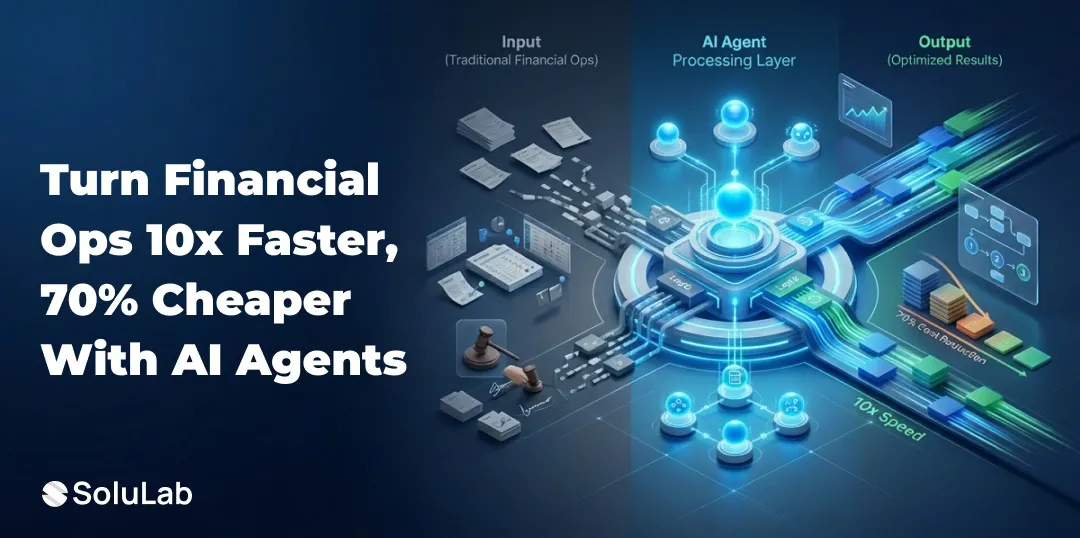
- Operational costs can drop by as much as 70%, with workflows running roughly 10x faster once intelligent automation is in place.
- Document review, risk assessment, compliance checks, transaction monitoring: these are the choke points agents clear first.
- Pick one high-impact use case to start. Fraud detection or reporting usually. Adoption moves faster when the first win is obvious.
- An experienced AI development partner saves you the architecture rewrite, the security scramble, and about six months of calendar time.
- SoluLab designs and ships AI agent systems built for finance specifically, with automation, compliance, and ROI as the scorecard.
Why Are AI Agents In Finance Important?
Because the alternative is falling behind. Financial data keeps multiplying, and the institutions that read it fastest make better calls, spend less doing it, catch risk earlier, and treat each customer like a person instead of a row in a CRM.
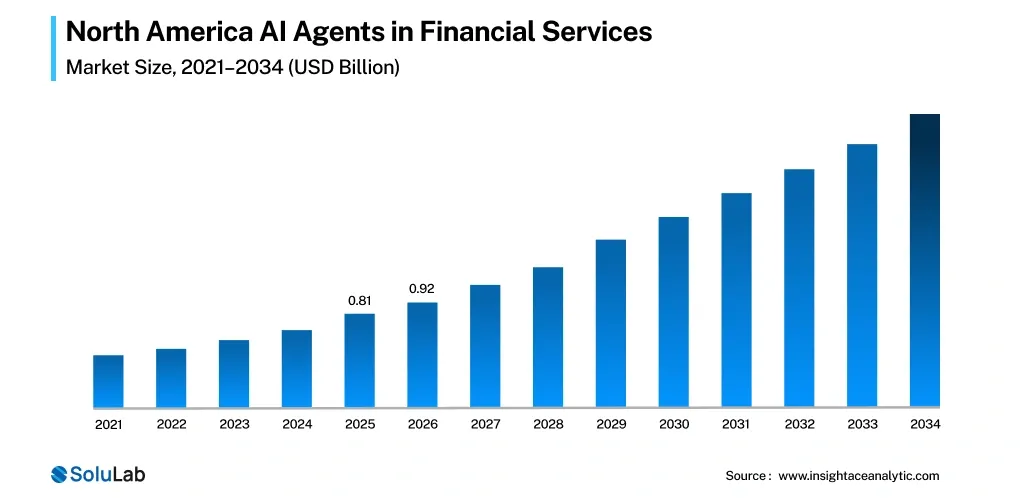
According to Fortune Business Insights market is expected to reach $5.71 billion by 2034, highlighting strong long-term adoption across banking and fintech.
- Competitive advantage in a digital-first market: Institutions running AI agents move quicker, see more, and add volume without adding headcount. In a sector where everyone is shipping the same products, that difference compounds.
- Faster and data-driven decision-making: AI agents chew through enormous financial datasets as the data arrives, which sharpens investment calls, risk positions, and the planning cycle that sits on top of both.
- Cost reduction and operational efficiency: Data entry. Reconciliation. Month-end reporting. Hand those to an agent and the manual hours, and the costs attached to them, fall away.
- Advanced fraud detection and risk management: Agents watch transactions without blinking and surface anomalies as they happen, so fraud gets caught during the event instead of during the postmortem.
- Personalized financial services at scale: Customer data becomes advice that actually fits the customer: the right strategy, the right product, recommended at a point where it still matters to them.
- Enhanced customer support and experience: Chatbots and assistants answer immediately, clear routine queries, and keep the lights on at 3 a.m. Response time drops. So does the queue your human team inherits each morning.

Role of AI Agents in Finance
AI Agents in Accounting have already changed how financial firms run day to day: processes automate themselves, decisions get better inputs, and customers notice the difference. The spread is wide. Wealth management, investment banking, accounting, risk. Few corners of the industry have been left alone.
1. Operational Finance and Accounting: Accounting AI agents have quietly taken over the parts of finance ops nobody enjoyed. Keying in data, pushing invoices through, chasing expense reports. The people who used to do that get handed work that actually requires judgment.
2. Risk Assessment: Cutting financial risk is where agent-powered finance earns its keep. Read the current market, read the history behind it, and flag the exposures that could destabilize things before they do.
3. Trading and Investment Banking: On the investment banking side, finance AI agents sharpen the call. Feed them enough market data and they’ll forecast asset values, surface opportunities the desk hasn’t spotted, and refine the trading approach as they go.
4. Asset Allocation: Wealth management is about to look very different, because AI financial advisors give personalized advice at a scale human advisors can’t match. Risk tolerance, stated preferences, what the client is actually saving for: all of it folds into the portfolio.
5. Customer Support: Across banking, AI chatbots and virtual assistants have raised the floor on client experience. They answer on the spot, fix what they can, and tailor the guidance to the person asking. The longer they observe what a client cares about, the more useful the conversation gets.
Benefits of AI Agents in Finance
Efficiency goes up, cost goes down, decisions improve, service gets personal. That’s the short version of what AI agents are doing to financial operations, and it’s why the institutions that adopted early are hard to catch.
- Increased operational efficiency: Repetitive work goes to the agent. Entry, reconciliation, reporting. Fewer human hours, fewer typos, and financial operations that close faster across every system they touch.
- Improved decision-making: Big volumes of financial data, read live, turn into patterns and trends a person would need a week to find. Investment and business calls get made on evidence instead of instinct.
- Cost reduction and resource optimization: Less manual labor means lower operating cost, and the agent tends to point out where money is leaking while it works. Margins improve from both ends.
- Enhanced fraud detection and risk management: Constant transaction monitoring, anomalies flagged early, suspicious behavior caught while it’s still small. Risk shrinks and the security posture holds.
- Personalized customer experience: Behavior and preference data drive the advice, the recommendation, the offer. Customers stick around longer when what they’re shown actually applies to them.
- Faster and scalable operations: Transaction spikes and support surges stop being fire drills. The business grows without the cost line growing at the same rate.
How to Implement AI Agents in Finance?
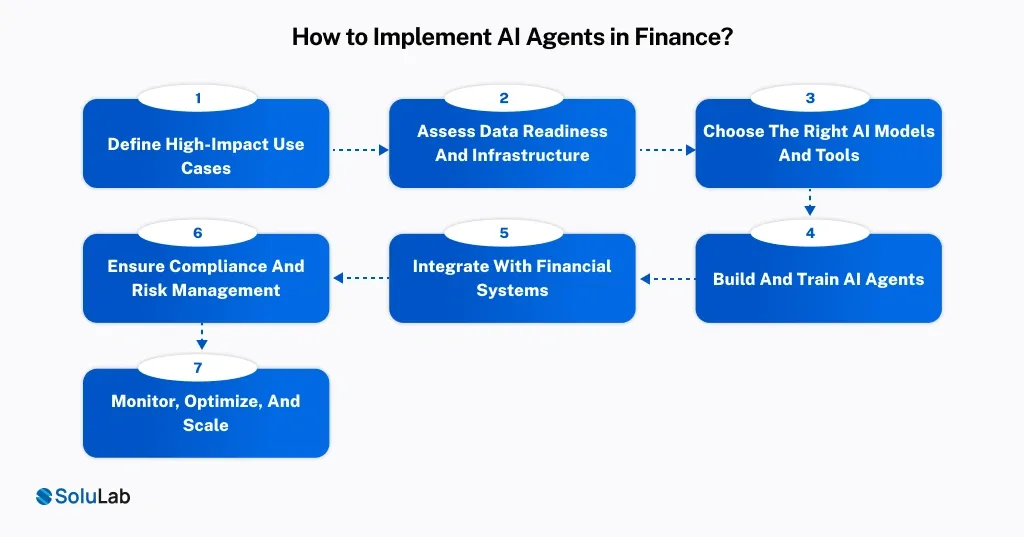
Done properly, an AI agent rollout automates the drudgery, improves the decisions, lowers the risk, and makes customers happier. Done as a science project, it produces a demo nobody uses. Here’s the sequence that avoids the second outcome.
Step 1. Define High-Impact Use Cases
Start where the pain is loudest. Fraud detection, risk assessment, customer support: pick the one where AI delivers measurable ROI and where the business already agrees something is broken. Alignment with strategy matters, but visible impact in the first quarter matters more.
Step 2. Assess Data Readiness and Infrastructure
Now the unglamorous part. Look hard at data quality, at what’s actually available, at how well your systems talk to each other. Agents run on clean, structured, current financial data. Feed them anything less and the outputs will be confidently wrong. In practice, this is where most projects stall.
Step 3. Choose the Right AI Models and Tools
Machine learning, NLP, predictive analytics: the use case decides, not the vendor deck. Whatever you pick has to scale, satisfy your compliance team, and sit alongside the financial systems you already run.
Step 4. Build and Train AI Agents
Develop AI models using historical and live data. Train them to spot patterns, catch anomalies, and forecast in a way the business can act on rather than admire.
Step 5. Integrate with Financial Systems
Deploy AI agents into the core: ERP, CRM, the banking platform. An agent that can’t reach into those systems is a dashboard. One that can moves work end to end and makes decisions in the flow of the operation.
Step 6. Ensure Compliance and Risk Management
Governance, data privacy, the regulatory frameworks your auditors will ask about. Build all of it in from the start, because retrofitting compliance onto a live AI system in a regulated industry is a miserable exercise.
Step 7. Monitor, Optimize, and Scale
Then keep watching. Track performance, retrain when accuracy drifts, tighten the process, and only then push into the next department. Scale is the reward for getting the first one right, not the opening move.
AI Agents In Finance: Real World Use Cases
Theory aside, here’s where agents are earning their budget today: banking, insurance, and investment operations, taking on complicated work, improving the calls, trimming risk, and giving customers a faster answer.
Read More: AI Agent Use Cases
1. Fraud Detection and Prevention
Transaction data pours in, the agent reads it live, and anything that looks off gets flagged. The point is timing: stopping the fraud before the customer, or the bank, absorbs the hit.
2. Personalized Wealth Management
AI in wealth management systems weigh a client’s goals against their appetite for risk and what the market is doing, then build the strategy around that. Wealth managers get more precision per client and can serve far more of them.
3. Financial Chatbots for Customer Service
AI-powered chatbots answer queries the moment they land, walk customers through transactions, and tailor the reply to the account in front of them. Faster for the customer, lighter for the support desk.
4. Claim Adjustments in Insurance
Claims are a document problem dressed as a customer problem. Agents read the paperwork, check the data against the policy, and assess damage quickly, which cuts the manual handling, the errors, and the wait for settlement.
5. Automated Regulatory Compliance
Rules change. Transactions don’t stop. AI systems track both at once, keeping the institution inside the law, reducing exposure to penalties, and turning audit prep into automated reporting instead of a month of spreadsheets.
Future of AI Development in Finance
Where does this go next? Decisions get faster, services get built around individuals rather than segments, and automation starts handling processes end to end. For finance businesses that means leaner operations, less risk on the books, and revenue lines that didn’t exist before.
- Hyper-personalized financial services: Products shaped around actual behavior, actual risk appetite, actual goals. Banks and fintechs keep customers longer and earn more per relationship through AI development services.
- Autonomous financial operations: Underwriting, compliance, reporting, all running start to finish without a human in the middle of every step. Faster, more accurate, and it scales without a hiring plan attached.
- Advanced fraud detection and risk management: Anomalies spotted the instant they appear, security tightened around them, losses kept small. That’s the promise of monitoring built on AI agent development solutions.
- Smarter investment and wealth management: Market trends, sentiment, whatever else the data holds, read at a scale no analyst team can match. Better portfolio decisions, tighter forecasts, for investors and the firms serving them.
- AI-powered regulatory compliance: Regulations keep moving, and AI keeps institutions aligned with them, automating audits and keeping the paper trail transparent while compliance costs and complexity come down.
- Human-AI collaboration in decision-making: Not replacement. Augmentation. The agent brings the evidence, the professional makes the judgment call, and oversight stays where regulators expect it.

SoluLab Transforms Banking and Finance with Gen AI
Challenge
Banks are squeezed from every side at once: customers want more, too much of the work is still manual, risk keeps shifting, regulations keep changing, and the cyber threats aimed at their data keep multiplying.
Solution
SoluLab brought in Gen AI to take over the repetitive work, make each customer interaction feel personal, and harden security. The banks got a leaner operation out of it.
Impact
- Customer satisfaction tripled once services got personal.
- Processes ran 70% faster, and operating costs followed.
- Cyber threats fell by 98%, with data kept safe.
Conclusion
Financial services are being rebuilt around automation, better decisions, and customers who expect an answer now. Fraud detection, personalized advisory, intelligent automation: the payoff shows up early and keeps growing as you extend it.
With competitors moving, regulators watching, and cost pressure never letting up, AI agents have stopped being a nice experiment. They’re a strategic call, and the firms making it now are the ones pulling ahead on efficiency, risk, and growth.
Getting there is the hard part, and it’s rarely a solo effort. SoluLab, an AI agent development company, can help you design, deploy, and tune AI solutions that fit how your financial operations actually work. Start with one use case. Prove it. Then go wider.
FAQs
Shipra Garg is a tech-focused content strategist and copywriter specializing in Web3, blockchain, and artificial intelligence. She has worked with startups and enterprise teams to craft high-conversion content that bridges deep tech with business impact. Her work translates complex innovations into clear, credible, and engaging narratives that drive growth and build trust in emerging tech markets.