Customers browse. They add things to their carts. Then they leave. That’s the whole problem, and it costs e-commerce businesses a staggering amount of revenue every single year.
Cart abandonment rates hover near 70%, abandoned cart which makes recovery not a nice-to-have but a serious operational priority. Why do shoppers bail? Surprise shipping costs at checkout. A clunky payment flow. No payment method they actually trust. Or just a distraction that pulls them away mid-session. Any of those can kill a sale that was nearly done.
More stores are turning to tools like AI agents to close that gap. This piece covers what abandoned cart recovery actually is, where AI agents fit in, and what the real trade-offs look like.
What is Abandoned Cart Recovery?
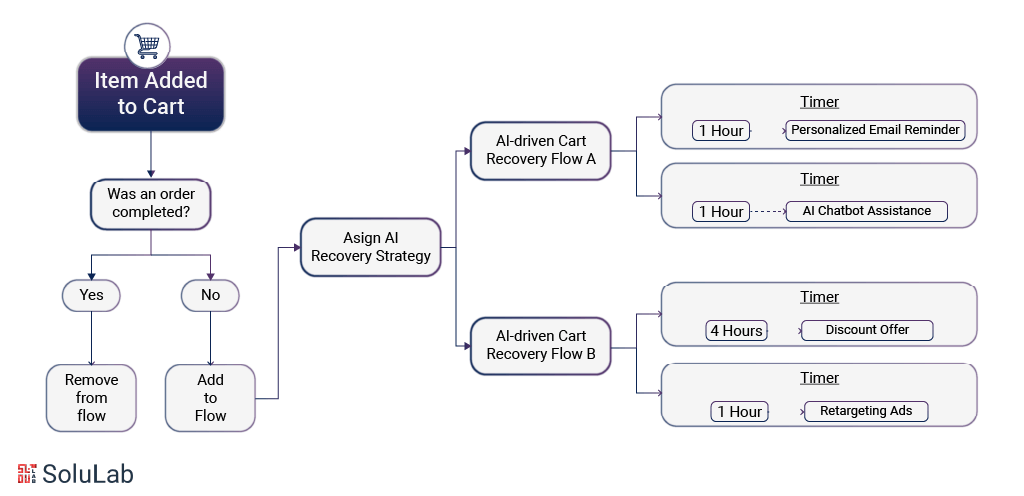
Abandoned cart recovery is the practice of re-engaging shoppers who loaded up a cart and then vanished before paying. The goal is simple: bring them back and get the transaction done. Done well, it directly reduces the revenue that leaks out after a customer has already shown purchase intent.
Common Methods of Cart Recovery:
- Email Reminders: Follow-up emails that remind shoppers what they left behind. Still the most common tactic, and often the highest-converting.
- Push Notifications: Mobile or desktop nudges triggered when someone abandons a cart. Works best with opted-in users who actually want to hear from you.
- Discount Offers: A coupon or free shipping offer as an incentive to finish the checkout. Effective, but watch out: if you do it every time, customers learn to abandon carts on purpose.
- Retargeting Ads: Paid ads that follow the shopper across the web, showing them what they left behind. High visibility, though costs vary significantly by channel.
Use Cases of AI Agents for Abandoned Cart Recovery
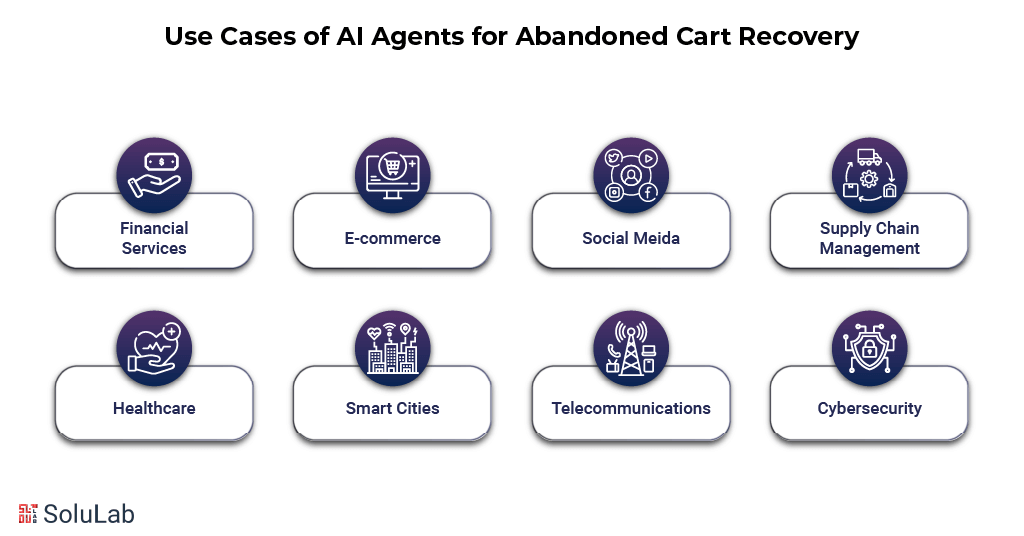
Here are some of the AI agents use cases of for abandoned cart recovery listed below:
1. Financial Services
In banking and fintech, real-time processing catches unusual spending patterns the moment they appear. That’s what keeps accounts safe and customers trusting the platform. Tools like Apache Kafka and Spark Streaming handle the speed requirements. When something looks off, the system flags it immediately rather than finding out hours later in a batch report.
2. Healthcare
Patient monitoring systems track vitals continuously and push alerts when readings move outside safe ranges. Doctors can act on a deteriorating reading within minutes rather than waiting for a scheduled check-in. Predictive programs AI in healthcare, built in tools like Python, go a step further by modeling which patients are likely to need intervention before anything goes wrong.
3. E-commerce
When an online store surfaces “you might also like this” right after you look at a product, that’s real-time behavioral processing at work. It tracks clicks, dwell time, and browsing sequences, then adjusts what you see on the fly. Stores that do this well report higher average order values. The underlying method is real-time data enrichment, and it runs silently in the background on most major platforms.
4. Smart Cities
Traffic management systems in smart cities use sensor feeds and real-time stream analytics to adjust signal timing based on actual congestion, not fixed schedules. The result: fewer jams, lower emissions, faster emergency response. It also feeds into public safety systems where response times matter.
5. Social Media
Instagram and YouTube don’t just show you content you’ve liked before. They analyze engagement patterns in real time, weighing what you skip past, what you rewatch, and what triggers a share. Python-based pipelines process that signal fast enough to shape the next item in your feed within seconds of you interacting with the current one.
6. Telecommunications
Telecom networks handle enormous traffic volumes, and problems need to be caught before customers notice them. Real-time processing monitors network health, spots degradation early, and lets engineers reroute traffic or push fixes without waiting for a complaint spike to surface the issue.
7. Supply Chain Management
AI Agents in the supply chain track inventory and shipments in real time, triggering restocks and delivery scheduling automatically rather than waiting for manual counts. The efficiency gains add up quickly when you’re managing hundreds of SKUs across multiple warehouses.
Read Blog: The Role of an AI Agents for Procurement
8. Cybersecurity
Security systems inspect network traffic as it moves, not after the fact. Processing works like a security token offerings that checks inbound and outbound data continuously, flagging anomalies before they become breaches. Near real-time ETL processes form the detection layer that separates legitimate activity from threats.

Benefits and Value Proposition for AI Agents for Abandoned Cart Recovery
Here are a few benefits of abandoned cart recovery:
1. Revenue Recovery
Revenue recovery in e-commerce means chasing down money that nearly made it into your account but didn’t. That includes customers who walked away mid-checkout, orders that got disputed, or subscriptions that quietly lapsed. Left unaddressed, it compounds fast.
Automated billing reminders, targeted re-engagement sequences, and AI-driven timing can all push recovery rates higher. Beyond the revenue itself, good recovery practices also keep you on the right side of financial compliance obligations.
2. Customer Retention
Keeping a customer is cheaper than finding a new one. That’s not a novel insight, but it’s worth taking seriously: retained customers also tend to spend more per order and refer people in their networks.
The feedback loop matters here. Customers who feel heard after raising an issue are significantly more likely to stay than those whose complaints disappear into a support queue.
Loyalty programs, exclusive events, and fast resolution when things go wrong all compound over time. None of these require big budgets. They require consistency.
3. Personalization at Scale
Sending a single email blast to your entire list is fast but rarely effective. Personalization at scale means every message feels like it was written for that specific person, even when the same system sent ten thousand of them.
- Data Insights: Purchase history and browsing behavior tell you what a customer actually wants, not just what demographic they belong to.
- Content: Email copy and product recommendations shift based on individual behavior, so the message stays relevant rather than generic.
- Automation Tools: Triggered sequences fire at the right moment based on user actions, rather than sending at a fixed time regardless of context.
- Customer Journey Mapping: Understanding where a customer is in their decision process determines which message makes sense to send right now.
When this is done right, customers don’t experience it as marketing. They experience it as a store that actually knows what they’re looking for.
4. Cost Efficiency
AI-driven recovery cuts manual effort. Fewer staff hours spent chasing abandoned orders. Less guesswork on timing. That’s where the cost savings actually show up.
- Smart Workflows: Automating repetitive outreach tasks frees your team to focus on work that genuinely needs human judgment.
- Tech Tools: Cloud-based systems generally cost less to operate than the older on-premise setups they replace.
- Buying in Bulk: Volume pricing on messaging platforms and SaaS tools adds up to meaningful savings at scale.
- Outsourcing: For specialized functions, bringing in external expertise is often cheaper than building and training an in-house team.
- Energy Saving: Modern cloud infrastructure is considerably more energy-efficient than running equivalent workloads on-premise, and some vendors offer sustainability incentives on top.
5. Enhanced Customer Experience
A good recovery experience doesn’t feel like a recovery attempt. The customer just feels like the store noticed and cared.
- Easy Support: Multiple contact options, available when the customer actually needs help, not just during business hours.
- Friendly Websites: If the checkout flow is broken or confusing, no recovery campaign will fully compensate for that upstream problem.
- Listening to Feedback: Post-abandonment surveys, even short ones, surface friction points you wouldn’t otherwise see.
- Personal Touch: Using a customer’s name and referencing what they actually left in their cart beats any generic “you have items waiting” message.
- Keeping Them Updated: Order status updates and proactive communication signal that the business is on top of things, which matters to anxious buyers.
6. Data-Driven Decision Making
Recovery campaigns generate data. That data tells you what’s working, what’s annoying customers, and where the real drop-off points are. If you’re not reading it, you’re flying blind.
- Data-Driven Insights: Large volumes of customer behavior data reveal patterns that aren’t visible in aggregate metrics. Segment-specific campaigns, informed by those patterns, tend to outperform broad ones on both conversion and ROI. Adobe’s personalization work at scale illustrates how data can directly shape effective marketing decisions.
- Content: Email copy, website messaging, and ads can all shift based on what individual users have actually done. When customers see content that matches their situation, engagement rates go up and so does revenue. Personalization at scale is what makes this sustainable beyond small teams.
- Automation Tools: Marketing automation lets you segment audiences and trigger messages based on real behavior rather than assumptions. McKinsey’s personalization research consistently highlights automation as the piece that separates brands that do this well from those that only talk about it.
Advanced Personalization Techniques of AI Agents for Abandoned Cart Recovery
Generic outreach doesn’t recover carts. What works is showing the right customer the right message at the right moment, based on who they actually are and what they actually did. Advanced personalization is how you get there.
1. Segmentation: Group your audience by behavior, purchase history, or preferences, not just demographics. Our AI solutions handles precise segmentation so your campaigns reach the people they’re actually meant for, whether you’re targeting repeat buyers or first-timers who bounced.
2. Content: Let behavior drive what a customer sees. Someone who lingered on product pages should get different messaging than someone who bailed immediately after hitting the shipping cost screen.
3. User Activity Tracking: Tracking what users do on your site and app gives you the raw material for personalization. Our blockchain solutions handle the storage and management of that data securely, providing actionable insights while respecting user privacy.
4. Predictive Analytics: Knowing what a customer is likely to want next, before they tell you, is where real competitive advantage sits. Our AI models analyze historical data to surface those patterns and help you get ahead of customer needs rather than reacting to them.
5. Omnichannel Personalization: Consistency across email, social, and your website matters. A customer who sees conflicting messages on different channels loses trust quickly. Aligning personalization across all touchpoints fixes that problem.
Brands that get personalization right build stronger relationships with customers, and that shows up directly in retention and conversion numbers.
Components of AI Agents for Abandoned Cart Recovery
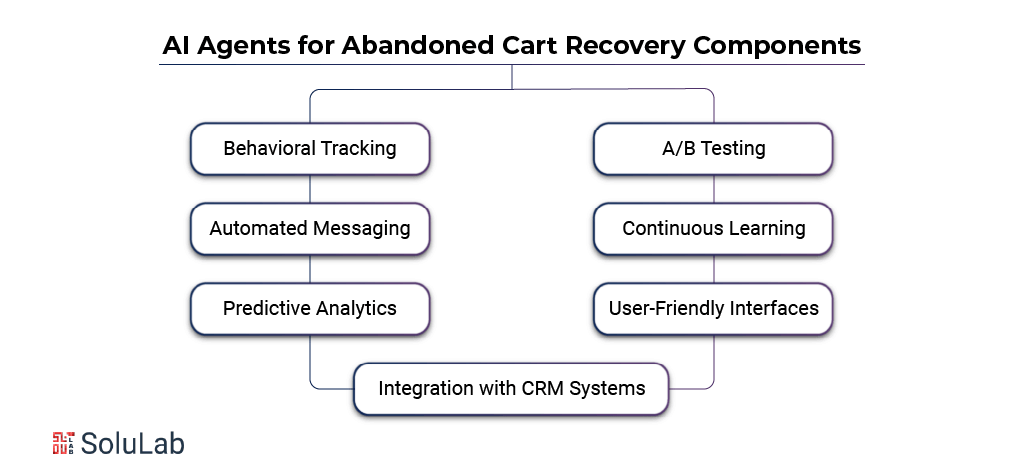
An AI cart recovery agent isn’t one thing. It’s a stack of connected capabilities that each handle a different part of the problem. Understanding what’s actually inside the black box matters if you want to configure and optimize it properly.
1. Behavioral Tracking
The agent watches the session: what got added to the cart, how long the user spent on the checkout page, whether they opened the payment form. These signals tell the system when a cart is truly abandoned versus when someone just stepped away for a minute.
2. Automated Messaging
Once abandonment is confirmed, the agent fires a message. Email, SMS, push notification, depending on what channel the customer is most responsive to. Timing matters as much as channel. And yes, sometimes a discount code helps, but it shouldn’t be the first card you play.
3. Predictive Analytics
Good agents don’t just react. They look at a customer’s past behavior and score the likelihood that this cart gets abandoned before it happens. That means you can intervene earlier, sometimes before the customer has even decided to leave.
4. A/B Testing
Recovery messaging isn’t set-and-forget. The agent tests variants against each other continuously: different subject lines, different offer types, different send times. What wins gets more traffic. What loses gets replaced. In practice, this is where teams often stop looking once the initial setup is done, which is a mistake.
5. Integration with CRM Systems
The agent connects to your CRM to pull customer history and context. That’s how it knows to address a customer by name, reference products they’ve bought before, or suppress an offer to someone who just complained about the last one.
6. User-Friendly Interfaces
The agent’s interface determines whether your team actually uses it. Complex dashboards that require a specialist to interpret kill adoption. The best systems surface the key metrics up front and make campaign adjustments straightforward without requiring a developer.
7. Continuous Learning
AI cart recovery agents use machine learning to refine their approach over time, based on real interactions and customer responses. Seasonal behavior shifts, new product categories, changes in your customer base: a well-built agent adapts to all of that rather than needing a manual rebuild each time something changes.
Challenges and Limitations of AI Agents for Abandoned Cart Recovery
Predictive cart recovery is genuinely useful. But there are real limitations that get glossed over in vendor pitches, and understanding them is half the battle when you’re trying to set realistic expectations.
The predictions are only as good as the data feeding them. Incomplete or inconsistent customer records lead to misfires: wrong offers, wrong timing, wrong channel. And integrating predictive analytics into an existing tech stack is rarely as clean as the documentation suggests.
This means solid data hygiene and ongoing model tuning aren’t optional. They’re the cost of keeping the system working well as your business changes.
1. Privacy Issues with Data
This is the area where companies most frequently underestimate complexity. Collecting and analyzing behavioral data at scale puts you squarely in the territory of GDPR, CCPA, and the regulations that will follow them. Customers are paying more attention to where their data goes, and the tolerance for vague privacy policies is shrinking.
- Personalization: Legal compliance is non-negotiable, but trust is the deeper issue. Transparency about what data you collect and why, combined with genuine user control, produces better long-term outcomes than trying to collect as much as possible and dealing with fallout later.
- Data security: Strong data Asset-Backed Securities (ABS) vs. Mortgage-Backed Securities (MBS) mechanisms that protect customer information at rest and in transit. Clear, plain-language privacy policies. Opt-out paths that actually work. These aren’t just compliance checkboxes. They’re how you avoid becoming a case study in what not to do.
- Predictive Analysis: Teams that prioritize data protection alongside predictive capability tend to earn more durable customer trust. The two aren’t in conflict, but getting the balance right requires intentional architecture decisions, especially in areas like software development, data management, and system integration where technical complexity compounds quickly.
2. Diverse Technologies
The tooling landscape is fragmented. Dozens of platforms claim to do the same thing, and choosing the wrong one creates technical debt that costs far more to unwind than it would have cost to evaluate carefully upfront. Legacy systems add another layer: older infrastructure often wasn’t built to talk to modern APIs, and forcing the connection creates ongoing maintenance overhead.
- Scalability Problems: A setup that works at current volume may not hold up when traffic doubles. Build this assumption into your evaluation criteria from the start, not as a later optimization.
- Data Administration: High-volume data requires real architecture decisions around accessibility, integrity, and storage costs. Treating it as an afterthought shows up quickly as performance problems.
- Security Issues: Building secure systems without strangling their usability is a genuine engineering challenge, especially given the current threat environment. Our AI consulting services can help teams work through these decisions without having to figure everything out from scratch.
3. Difficulties with Integration
Getting systems to talk to each other is consistently where projects take longer than planned. Format mismatches, authentication conflicts, and undocumented API behavior all slow things down, especially when you’re connecting tools from different vendors built in different eras.
- System Compatibility: Different protocols and data schemas between systems are not always fixable with off-the-shelf connectors. Sometimes you need custom middleware.
- Data Silos: Customer data fragmented across separate platforms is a very common problem. Until it’s unified, your recovery agents are working with an incomplete picture.
- Change Management: New integrations change workflows. Teams that aren’t prepared for that change push back, sometimes killing adoption entirely regardless of how good the technology is.
- Resource Allocation: Integration projects are time-intensive. Budget for them honestly, or they drag.
- Testing and Validation: Integrated systems need thorough testing before they go live. Skipping this step to move faster almost always results in having to move slower later.
Ethics in technology isn’t abstract. How you build these systems reflects directly on the trust your customers place in you, and on the decisions your business makes.
4. Ethical Considerations
The ethical questions in AI-driven personalization aren’t hypothetical. They come up in real product and engineering decisions, and ignoring them tends to generate problems down the road.
- Data Privacy: Handling personal data responsibly and complying with GDPR and equivalent regulations isn’t optional. It’s the baseline.
- Algorithmic Bias: Algorithms trained on skewed data produce biased outputs. Without regular audits and active monitoring, those biases affect real decisions in ways that can damage both fairness and reputation.
- Transparency: Being open about how customer data is used, and what the algorithm is actually doing, builds more durable trust than keeping it opaque.
- Environmental Impact: The energy footprint of large-scale AI workloads is real and growing. Factoring that into infrastructure choices is both a practical and a reputational consideration.
- Social Responsibility: Companies that operate with the communities they’re part of in mind, not just their own conversion metrics, tend to build more resilient businesses over time.
5. Enhancement of Performance
A slow checkout page is a cart abandonment machine. Performance optimization, meaning load times, responsiveness, and mobile behavior, directly affects whether customers make it through to payment at all.
- Minimize HTTP Requests: Fewer page elements mean faster loads. Combine files, use CSS sprites where practical, and cut images that don’t earn their weight.
- Optimize Photos: Oversized images are one of the most common performance killers. Use WebP, compress properly, and match dimensions to the actual display size.
- Use Browser Caching: Returning visitors shouldn’t have to reload assets they already downloaded. Set appropriate cache headers and let browsers do the work.
- Employ a Material Delivery Network (CDN): CDNs serve content from servers closer to each user’s location, which cuts latency on a global audience without any changes to your core infrastructure.
- Use Hyvä Theme: For Magento-based websites, adopting Hyvä Theme Development, a modern, lightweight frontend, can drastically improve load times and overall performance without sacrificing design flexibility.
- Minify HTML, CSS, and JavaScript: Stripping unnecessary whitespace and comments from code files reduces their size. It’s a small change that compounds across every page load.
- Use Lazy Loading: Load images and videos only when they’re actually needed, not all at once. This cuts initial load time significantly, especially on image-heavy product pages.
- Optimize Server Response Time: Server latency affects every page on your site. Choose a reputable hosting company and configure your server properly to keep response times low.
- Regularly Check Performance: Use tools like Google PageSpeed Insights or GTmetrix on a regular cadence. Performance regressions sneak in with deployments. Catching them early is far cheaper than debugging a traffic drop weeks later.
Future Trends of AI Agents for Abandoned Cart Recovery
Cart recovery is getting more sophisticated, not less. Several shifts are already underway that will change what’s possible over the next few years.
1. Predictive Commerce and Artificial Intelligence
AI is shifting commerce from reactive to proactive. Instead of responding to what just happened, predictive systems analyze behavioral data to anticipate what’s about to happen, and act on that signal first.
- Improved Customer Insights: AI can find behavioral patterns in large datasets that no analyst would spot manually. Those patterns drive product decisions, not just marketing messages.
- Better Inventory Control: Demand forecasting via predictive analytics reduces both overstock and stockouts, which are two different ways to lose money on the same problem.
- Customized Marketing Plans: Campaigns built around predicted audience behavior outperform broad-strokes approaches on conversion. The targeting becomes tighter as the models improve.
- Pricing Models: Dynamic pricing adjusts in real time based on demand, competition, and customer signals. Done carefully, it improves margins. Done poorly, it creates customer backlash.
- Simplified Supply Chain Operations: Predictive analytics spots disruptions before they hit, which lets logistics teams reroute and replan instead of scrambling after the fact. Directly benefits the generative AI in the supply chain industry.
2. Conversational Commerce
Shoppers increasingly want to ask questions and get answers in the same flow as their purchase, not be redirected to a FAQ page or wait hours for an email reply. Conversational commerce, via chatbots, voice assistants, and messaging platforms, meets that expectation.
- Improves Consumer Interaction: Real-time responses to product questions and personalized recommendations during the buying process reduce hesitation at the point of decision. That translates directly into fewer abandoned carts.
- Improve Conversion Rates: Simplifying the path from question to purchase, through a chat interface rather than forcing navigation back to a product page, reduces friction and raises close rates.
- Encourages Availability: Chatbots handle volume at 3 AM when no support agent is online. For time-sensitive purchase decisions, that availability matters more than most businesses realize.
- Data Collection: Every conversation is a source of intent data. What questions customers ask before buying, and what objections come up repeatedly, feeds directly back into both product and marketing decisions.
- Popular Platforms: Facebook Messenger, WhatsApp, and WeChat are already being used for transactional commerce. The audience is there. The question is whether your systems can meet them on those channels.
3. Blockchain Integration
Blockchain is moving from concept to practical infrastructure in e-commerce. The case for it isn’t hype: it solves specific, real problems around transaction security and supply chain transparency.
- Increased Security: The decentralized structure of blockchain technology makes it far harder for bad actors to alter transaction records, creating a more trustworthy foundation for online purchases.
- Increased Transparency: Public ledger records let buyers trace the origin and chain of custody for goods, which is particularly valuable in categories where product authenticity matters.
- Decreased Transaction Costs: By removing intermediaries from payment processing, blockchain can cut fees, especially on cross-border transactions where those fees are highest.
- Smart Contracts: Self-executing smart contracts development that trigger automatically when conditions are met remove manual steps and processing delays from the transaction flow.
- Acceptance of Cryptocurrencies: Blockchain integration opens the door to crypto payments, which a growing segment of technically literate customers actively prefer.
4. Experiences With Augmented Reality
One of the biggest reasons customers abandon carts is uncertainty: “will this actually look right in my home?” or “does this fit?” AR reduces that uncertainty by letting shoppers see the product in their actual context before committing.
- Virtual Try-ons: Seeing how a piece of clothing or a makeup product looks before purchasing cuts return rates, which are expensive for retailers and frustrating for customers.
- Interactive Product Demos: AR lets brands show how a product works in real conditions rather than relying on static photography and marketing copy to carry the load.
- Improved Storytelling: AR creates a more direct emotional connection between a customer and a product than any image can. Brands that invest in this early are building a differentiated experience that’s hard to replicate quickly.
- Popular Applications: Sephora and IKEA have both demonstrated that AR works at scale in retail: customers can try makeup virtually or see furniture placed in their room before they buy. The category is expanding.
5. Advanced Personalization Technologies
Machine learning, artificial intelligence (AI), and data analytics are changing what personalization can do. The gap between basic segmentation and individual-level adaptation is closing fast.
- Data-Driven Insights: Behavioral signals from past purchases, browsing, and social activity combine into a picture of what each customer wants now and what they’re likely to want next.
- Delivery of Content: E-commerce sites can show different product recommendations to different users in real time, based on current session behavior. Higher relevance, better conversion rates.
- Predictive Analytics: Historical behavior predicts future intent. Businesses that act on those predictions proactively, rather than waiting for the customer to signal need, get ahead of the competition.
- AI-Powered Chatbots: AI powdered chatbots can understand what a specific user is asking and respond with tailored answers, not generic scripts. That’s a materially better experience than what most support queues deliver.
- Targeting and Segmentation: Advanced tools allow finer audience segments than basic demographic buckets. The more precisely you can define who you’re talking to, the more effectively you can reach them.
- Real-Time Personalization: Website and app content can adapt to user behavior within the same session, not just across sessions. What a user sees shifts as they interact, keeping the experience relevant in the moment.
- Omnichannel Experience: Personalization that works consistently across in-store, web, and mobile removes the disconnect customers feel when a brand seems to forget who they are the moment they switch channels.
- Ethical Issues: More data and more personalization raise the stakes on privacy. Companies need to be upfront with customers about how their data is used, and they need to comply with the regulations that exist to protect it.

Conclusion
Cart abandonment isn’t going away. But the tools for dealing with it have gotten sharper. AI agents that combine behavioral tracking, predictive scoring, personalized messaging, and continuous learning can recover meaningful revenue from sessions that would otherwise just be lost. The difference between brands that do this well and those that don’t is rarely the technology. It’s whether they’ve actually tuned the system, kept the data clean, and treated the ethical side as something worth thinking about rather than something to manage around.
If you’re a small retailer or a large enterprise, the case for AI-driven recovery is straightforward: the revenue is already there, sitting in abandoned carts. The question is whether you have a system working to get it back.
SoluLab, helped a travel company integrate an AI-powered chatbot to improve customer support and personalization. Faced with high query volumes, slow response times, and a lack of customized travel recommendations, the company sought to book and offer a unique, efficient customer experience. SoluLab an AI Agent development companyhas a team of experts to solve your business problems contact us today.
FAQs
Shipra Garg is a tech-focused content strategist and copywriter specializing in Web3, blockchain, and artificial intelligence. She has worked with startups and enterprise teams to craft high-conversion content that bridges deep tech with business impact. Her work translates complex innovations into clear, credible, and engaging narratives that drive growth and build trust in emerging tech markets.