


Online banking, a crypto wallet, a login screen. Every one of them asks the same question: prove you are who you say you are, but don’t show your hand. That gap, between proving and revealing, is exactly what Zero-Knowledge Proofs were built to close.
Say you need to prove you know a password, or that you hold a valid ID, without ever putting it on screen. Older systems just ask you to hand the data over, and every handover is a new place for it to leak. ZKPs sidestep the whole problem: you prove the statement is true, the other side never sees what’s behind it. That single trick now shows up in cryptocurrencies, in identity checks, in places you wouldn’t expect, and it’s quietly rewriting how privacy gets handled online.
This piece walks through how ZKPs actually work, then goes industry by industry through where they’re already in production. If privacy is anywhere on your radar, this is worth twenty minutes of your time.
What is Zero-Knowledge Proof?
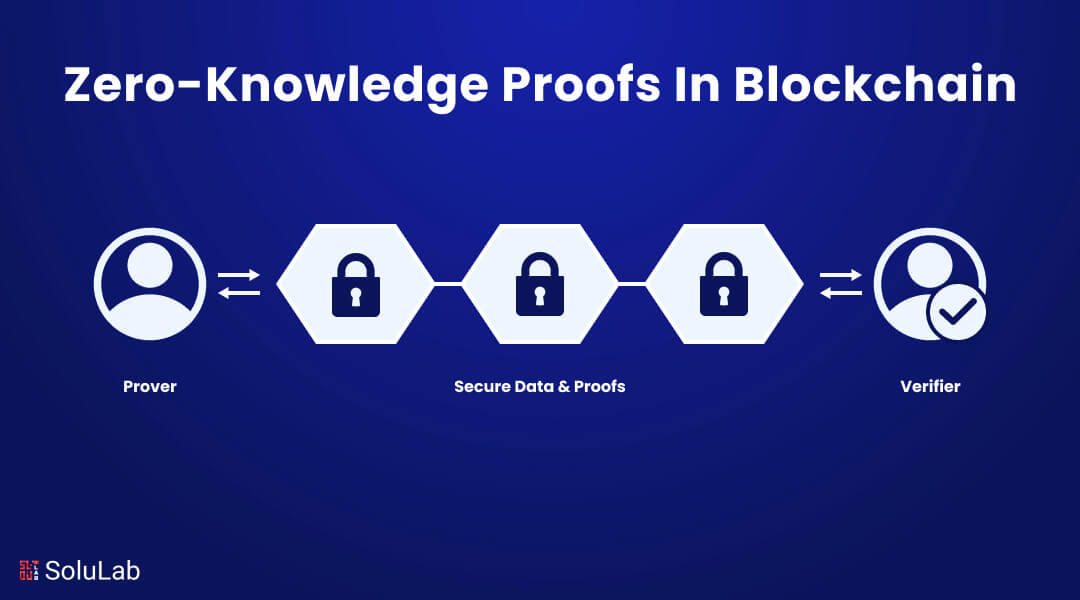
A Zero-Knowledge Proof (ZKP) is a cryptographic method where one party, the prover, convinces another, the verifier, that they know a value or a secret, without giving up a single detail of what that secret actually is.
Think of it like proving you solved a puzzle, without ever showing your working. Blockchain systems and privacy-first apps lean on this idea constantly, using it to validate data while keeping the sensitive parts locked away.
Three properties define what makes something a genuine ZKP:
Completeness
If the statement is true, and both sides play by the rules, the prover gets through. That’s completeness in a sentence. The verifier, working honestly, has no reason to withhold the input the prover was after, because the transaction itself checks out.
Reliability
This is the soundness side of the equation. A false claim simply cannot talk its way past an honest verifier, no matter how the circumstances are dressed up. If the transaction details don’t line up and the statement is false, the verifier has no path to approving it, and no path to certifying the prover either.
Zero-Knowledge
The verifier only ever learns one thing: whether the statement holds. Nothing else about it leaks. Anything private that belongs to someone else in the process stays exactly that, private.
Zero-Knowledge Proof Architecture
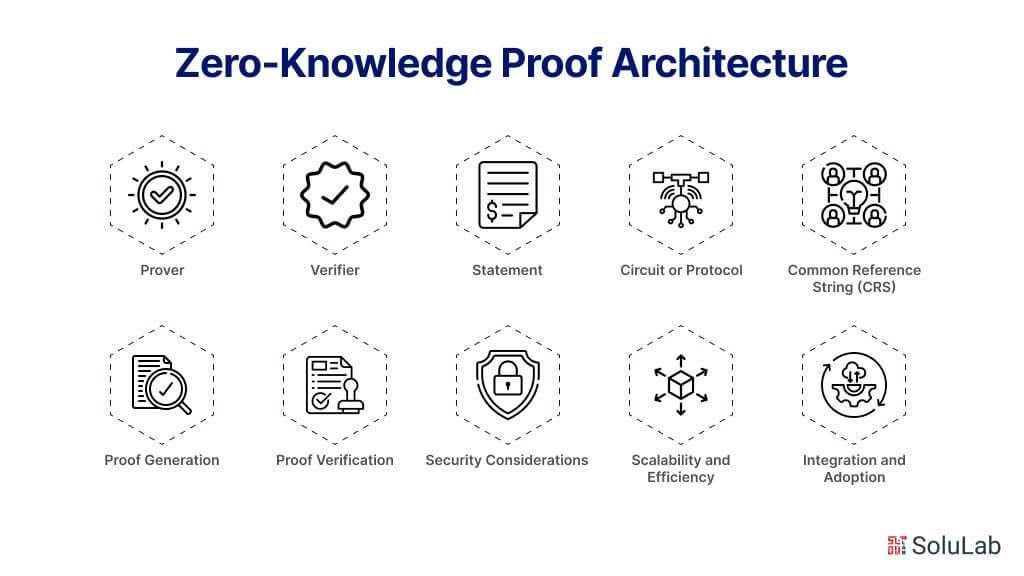
Strip a ZKP system down to its parts and you get a set of protocols and components built specifically to keep interactions private without sacrificing security. In practice, teams building this stuff end up wiring together the same handful of pieces every time. Here’s what those pieces are:
- Prover: The party trying to prove a claim, without leaking anything beyond the fact that the claim holds. The prover builds and runs the zero-knowledge protocol to bring the verifier around.
- Verifier: The party on the other end, checking the claim without learning anything past whether it’s true. The verifier and prover go back and forth through the protocol, and privacy holds the whole way through.
- Statement: Whatever the prover is trying to establish. Could be that a cryptographic transaction is correct, could be that someone holds a specific credential. Either way, it has to be phrased so the proof can actually be checked, efficiently and securely.
- Circuit or Protocol: This is the machinery, the algorithm that encodes the statement and turns it into a proof. Under the hood you’ll find hash functions, encryption schemes, commitment schemes, and named protocols like zk-SNARKs (Zero-Knowledge Succinct Non-Interactive Argument of Knowledge) or zk-STARKs (Zero-Knowledge Scalable Transparent Arguments of Knowledge).
- Common Reference String (CRS): Some ZKP systems need a shared reference string, generated once and used by both prover and verifier during proof generation and checking. It holds random parameters, and the whole scheme assumes a trusted party generated it honestly.
- Proof Generation: The prover pulls together the statement, the circuit, the protocol, and the CRS if there is one, then runs the cryptographic computations that produce a compact proof. The statement checks out, and nothing else about it gets exposed.
- Proof Verification: Now the verifier checks the proof itself. Cryptographic checks run to confirm the proof is valid and actually matches a true statement. Pass, and the verifier accepts it, still with zero knowledge of anything beyond the bare truth of the claim.
- Security Considerations: Confidentiality, integrity, authenticity, all three have to hold up under attack. That means mapping out the ways an attacker could poke at the system, hardening the cryptographic primitives underneath, and building in defenses against anyone trying to tamper with proof generation or verification.
- Scalability and Efficiency: A proof system that works beautifully on paper but chokes at scale isn’t much use. So teams optimize the generation and verification algorithms, cut down computational and communication overhead, and look at batching or parallelizing to handle real transaction volumes.
- Integration and Adoption: None of this matters if nobody can actually plug it in. That’s why ZKP tooling has been pushing toward developer-friendly libraries, clearer standards, and better education for the people who have to decide whether to adopt zero-knowledge-proof technology in the first place.
Put it all together and ZKP architecture is really a blueprint, a way to design and ship systems that stay private without giving up trust. Get the cryptographic pieces right, and you end up with interactions that are both efficient and genuinely safe for the people relying on them.
What are the Different Blockchain Use Cases of Zero-Knowledge Proof?
At the core, a ZKP lets a prover convince a verifier that something’s true, and nothing more leaks out. Simple idea, huge range of uses, because privacy, security, and efficiency all benefit from it at once.
Security goes up, user privacy stays intact, layer 2 scaling becomes possible, and a whole set of Web3 use cases open up that weren’t practical before. Some of the biggest, on-chain:
Private Transactions on Blockchain
A ZKP lets users verify a transaction happened correctly without exposing the sender, the receiver, or the amount. Zcash built its whole reputation on this. Ethereum’s zk-rollups are heading the same direction. Confidentiality, without giving up decentralization or trust in the process.
Scalability Solutions (ZK-Rollups)
Zk-rollups sit right at the center of this. It’s a Layer 2 scaling solution that bundles a batch of transactions off-chain, then proves the whole batch valid with a single on-chain proof. Gas fees drop hard. Throughput climbs. Ethereum and networks like it get noticeably faster.
Decentralized Identity Verification (DID)
A ZKP can prove you’re over 18, or that you hold citizenship, or that you have a given credential, all without handing over the personal data behind it. That’s exactly what decentralized, privacy-preserving identity systems need, and it’s why the idea keeps coming up in Web3 logins, KYC flows, and access control.
Secure Authentication & Passwordless Login
You can prove you know a password or a key without the key ever touching the wire. That’s privacy-first authentication in practice. Fewer breaches, fewer phishing wins, less identity theft, and it works whether you’re building for a bank or for a consumer app.
Regulatory Compliance (Without Data Exposure)
AML, KYC, GDPR, financial rules of every stripe, a platform can prove it’s compliant without ever handing over the underlying user data. For institutions trying to enter decentralized finance (DeFi) or Web3 without tripping over privacy mandates, that distinction matters a great deal.
Benefits of Zero Knowledge Proof
Zero-knowledge proofs don’t just sound clever, they change how information gets shared, how transactions get run, how privacy gets upheld across an entire domain. Here’s what actually shows up on the benefit side:
- Enhanced Privacy: This is the headline benefit. Users prove a statement or transaction is valid while sharing only what’s strictly necessary, nothing more. Confidentiality stays intact, by design rather than by policy.
- Improved Security: Less exposed data means fewer ways in for an attacker. Since verification only ever needs the minimum, breaches and unauthorized access both become less likely. Blockchain networks and zero-knowledge authentication protocols lean on exactly this property.
- Efficiency: Cut out the back-and-forth of exchanging and verifying full datasets, and you cut out a lot of wasted time. Only the validity of the statement needs proving, so transactions move faster with far less overhead.
- Trust and Transparency: A cryptographic guarantee, without a data dump attached, that’s a strange combination until you see it work. Parties can verify each other’s claims directly, trust builds between them, and the need for a middleman handling that trust starts to shrink.
- Scalability: Blockchain networks in particular benefit here. Verifying transactions or smart contracts efficiently, without demanding the full dataset every time, takes real pressure off systems trying to process high volumes on a decentralized network.
Powerful Applications of Zero-Knowledge Proofs
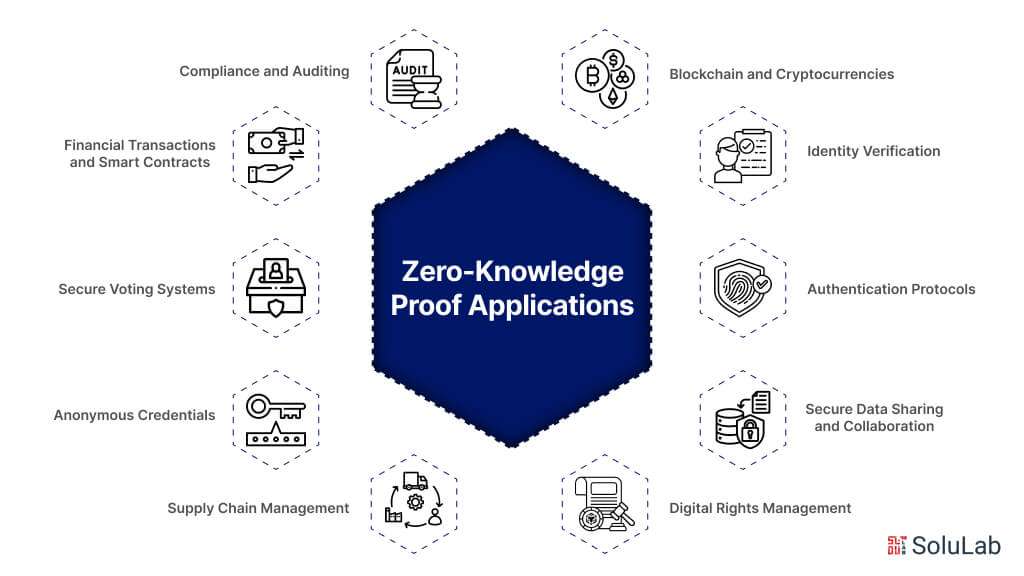
Here’s the thing about ZKPs: once you understand the core trick, you start spotting places to use it everywhere. Privacy problems, security problems, efficiency problems, they show up across almost every industry, and a surprising number of them respond to the same fix. A few of the clearer examples:
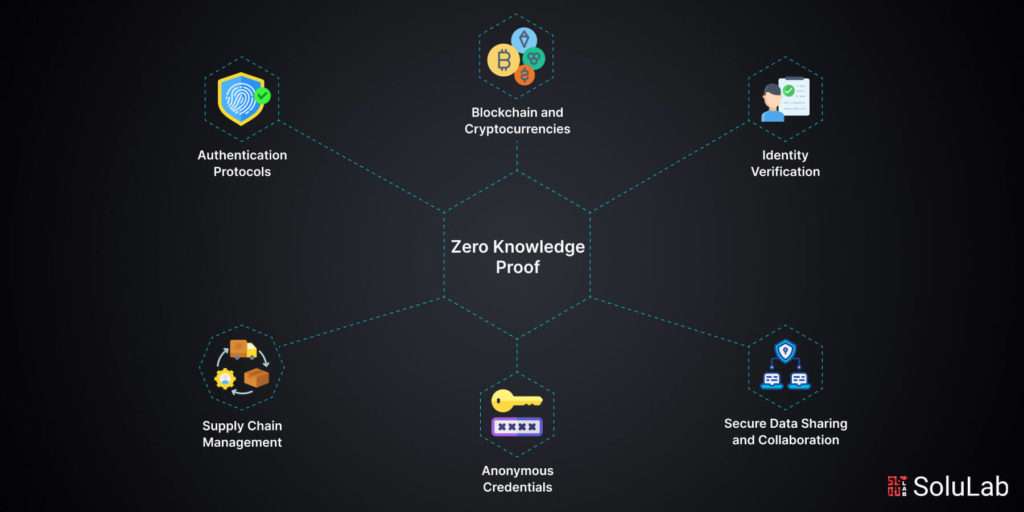
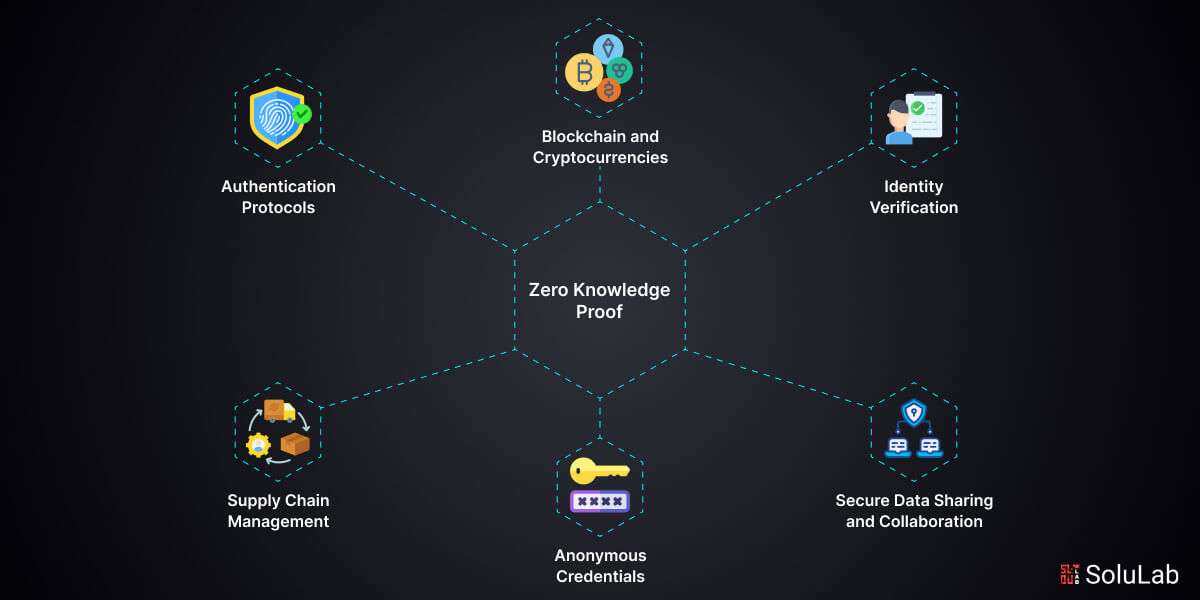
Blockchain and Cryptocurrencies
This is where ZKPs made their name, tightening privacy and confidentiality across blockchain development. Zcash and Monero both build private transactions on top of ZKPs, keeping sender, receiver, and amount hidden while the transaction still checks out as valid and legitimate.
Identity Verification
Prove an attribute, not your whole file. Age checks, citizenship, access control, all of these can run on a ZKP instead of a full identity dump, which matters a lot once privacy regulation and user confidentiality enter the picture.
Authentication Protocols
Prove who you are, skip the password, skip the biometric handoff. That’s the pitch behind ZKP-based authentication, and it directly cuts down identity theft and unauthorized access to whatever digital service sits behind the login.
Secure Data Sharing and Collaboration
Multiple parties, one dataset, zero exposure. Healthcare and research groups are already using this pattern, letting researchers analyze sensitive data in aggregate without ever pulling up an individual’s record, which keeps them on the right side of privacy regulation and patient confidentiality at the same time.
Supply Chain Management
Prove a product is authentic, prove a transaction is legitimate, without opening up proprietary business data to every party in the chain. That’s a trustless, transparent supply chain, one where provenance is verifiable but trade secrets stay put.
Anonymous Credentials
Prove you have a credential, stay anonymous while doing it. Voting systems use this. Access control systems use this. Online services use this. The identity stays hidden, the credential still gets verified.
Secure Voting Systems
A voter proves their ballot was cast correctly, without ever revealing what’s on it. Tampering gets harder. Anonymity holds. And trust in the electoral process, which is usually the hardest part to engineer, gets a real boost.
Financial Transactions and Smart Contracts
Verify that a transaction or a contract condition was met, keep the financial details behind it private. That’s the whole appeal for decentralized finance, where confidentiality and integrity both need to hold at once.
Digital Rights Management
A content owner can prove ownership, or prove entitlement to access, without exposing the sensitive information behind that claim. Piracy gets harder to pull off, and unauthorized distribution loses one of its easier paths in.
Compliance and Auditing
Auditors need a verifiable record. They don’t need every raw detail behind it. ZKPs let organizations demonstrate they’re meeting regulations and standards while keeping confidential information out of reach of anyone who shouldn’t see it.
Future of Zero-Knowledge Proofs Beyond 2025
Blockchain scaling is going to lean on ZKPs more, not less. Faster transactions, more private ones, and as DeFi and Web3 keep growing, ZKPs give a way to prove identity, or transaction validity, or ownership, without ever putting the raw data on display.
Healthcare, finance, supply chain, all three are experimenting with ZKPs right now to hit compliance targets without compromising user privacy in the process. And zk-rollups are already doing real work on Ethereum, batching transactions off-chain and clearing congestion with a single verifying proof.
Give it a few more years and this becomes standard infrastructure: digital authentication, secure voting, digital IDs, private smart contracts, all running on the same underlying idea. ZKPs are quietly rewriting how trust gets established online, and that makes them a foundational piece of whatever comes next in secure systems.
Conclusion
Zero-Knowledge Proofs solve a problem most systems never actually solved well: sharing enough to be trusted, without sharing everything. Logins, identity checks, blockchain transactions, confidential data sharing, ZKPs make trustless interaction actually workable.
Validate the claim, hide the data behind it, that combination is why finance, healthcare, and cybersecurity keep circling back to ZKPs. They’re becoming a basic building block for systems that need to be secure, scalable, and privacy-preserving all at once. Solulab, as a leading blockchain developemnt company, offers all kinds of services backed by years of experience and expertise.
Web3, digital ID, compliance workflows, wherever you look, Zero-Knowledge Proofs are headed toward more use, not less. Want to bring this into your own business? Contact us today.
FAQs
Shipra Garg is a tech-focused content strategist and copywriter specializing in Web3, blockchain, and artificial intelligence. She has worked with startups and enterprise teams to craft high-conversion content that bridges deep tech with business impact. Her work translates complex innovations into clear, credible, and engaging narratives that drive growth and build trust in emerging tech markets.

![How to Choose a Blockchain Development Company [2026 Edition]](https://www.solulab.com/wp-content/uploads/2026/09/Banner-Before-You-Hire-Check-These-Blockchain-Essentials.webp)