Digital art, animal pictures, trading cards, music, online gaming: NFTs touched all of it. By late 2021 they were impossible to ignore, and the daily trading volume on Ethereum had climbed to levels nobody predicted. Then, in March of that year, Beeple’s crypto art piece “First 5000 Days” sold for most expensive NFT in the world 69 million U.S. dollars, and the rest of the internet finally paid attention. But NFTs weren’t actually new. Crypto Kitties, those randomly generated cat pictures, had a whole secondary market running back in 2017. So how do NFTs actually work, and what were they disrupting by 2022?
Past the surface-level “it’s just a JPEG” dismissal, NFTs carry real potential for event ticketing, digital art, and “phygital” goods. What a screenshot cannot capture is the utility baked into the token itself. That’s the part that matters.
One angle most people miss: NFTs can generate passive rewards. A number of NFT collections let you “stake” them, similar to crypto staking, and earn something back in return. Dedicated staking platforms also exist for both holders and non-holders to put these assets to work.
This article covers how NFT staking works, what platforms are out there, and how you can actually earn passive income from staking rewards, whether you own NFTs already or are starting from scratch.
What is NFT Staking?
NFT staking means locking up a digital asset you own for a set period, and getting paid rewards, usually in cryptocurrency, for doing so. Some collections let you stake indefinitely. Others impose a hard time limit.
There are also dedicated staking platforms that go beyond a single collection. They accept NFTs from multiple projects and blockchains, handing out tokens in exchange. More on those platforms later.
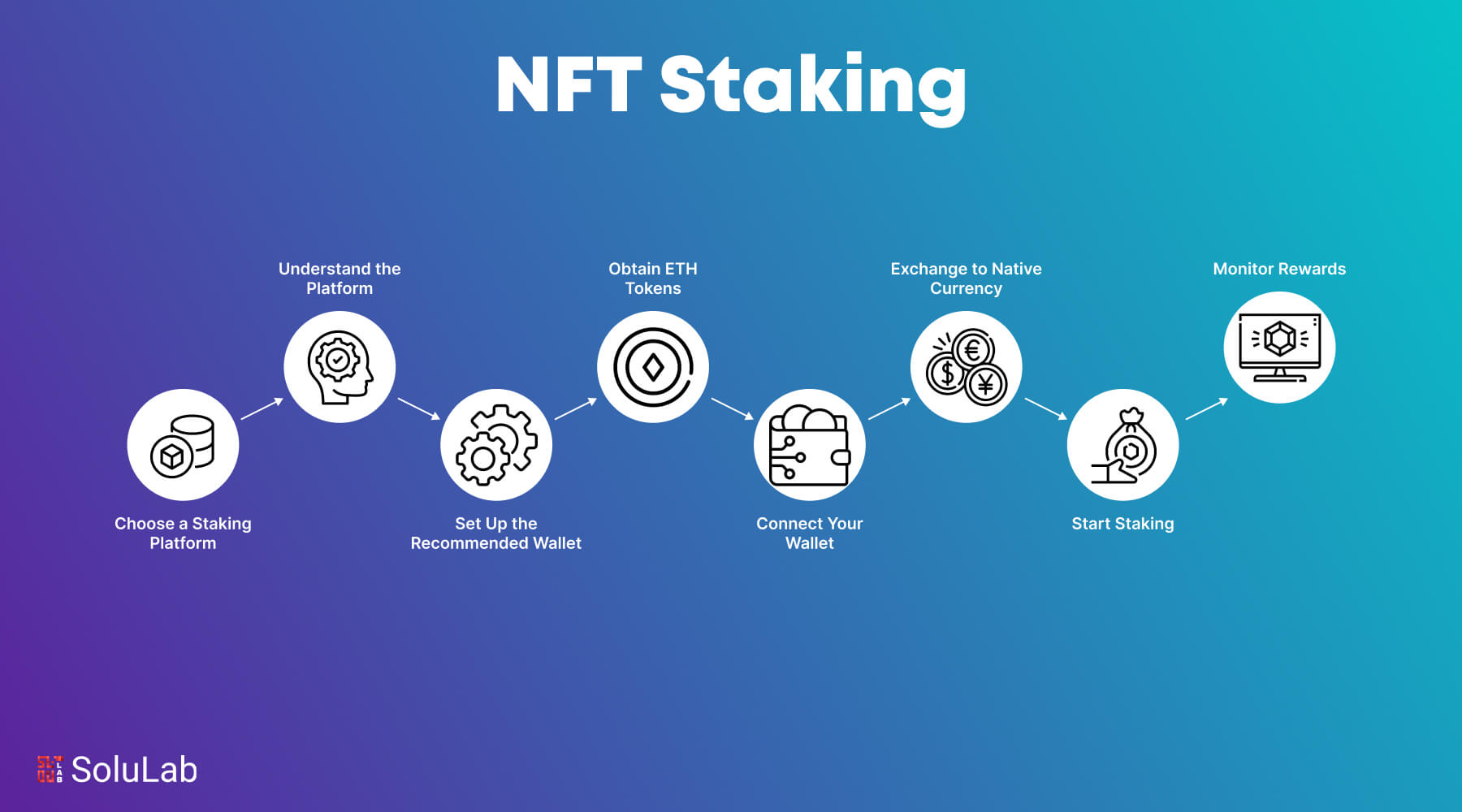
How To Stake NFT: Step-by-Step Process
Eight steps. That’s all it takes.
1. Choose a Staking Platform:
- Pick a platform that fits how you prefer to work. Not all platforms accept all collections, so check compatibility first.
2. Understand the Platform:
- Read the rules before you commit anything. Understand the rewards structure, lock-up terms, and how you claim earnings.
3. Set Up the Recommended Wallet:
- Install whatever wallet the platform supports. MetaMask is the standard for most Ethereum-based staking.
4. Obtain ETH Tokens:
- Buy ETH or move it from another wallet if you already hold some. You’ll need it for gas fees at minimum.
5. Connect Your Wallet:
- Connect your wallet to the staking platform. Usually a one-click process, but double-check the URL before signing anything.
6. Exchange to Native Currency:
- If the platform runs on its own token, swap your ETH for it through the platform’s built-in instructions.
7. Start Staking:
- Lock your NFTs into a smart contract on the platform. Once locked, the clock starts on your rewards.
8. Monitor Rewards:
- Track what’s accumulating. Rewards usually come in additional tokens, and most platforms show your running total in the dashboard.
How are NFT Staking Rewards Calculated?
Every NFT staking collection sets its own reward rate, and most are structured to reward holders who lock up longer. Some platforms display an APY figure, similar to traditional crypto staking. Others skip the percentage and just tell you a flat token amount, say 10 tokens per day, without converting it to an annualized yield.
The projected number is just a projection. Actual returns can differ, sometimes by a lot, so research the platform before committing. Reward value also varies across NFTs, though most projects pay out utility tokens for staking.
Those tokens often carry extra benefits: voting rights, governance participation in decentralized autonomous organizations (DAOs), or the ability to stake the tokens themselves on top of the original NFT stake.
How could you Benefit from NFT Staking?
The core appeal: you keep ownership of your digital collectible and still earn something from it. According to Synodus, staking also creates scarcity, because staked NFTs are pulled from the open market and can’t be sold while locked. That supply reduction helps the broader collection. And like crypto staking, it contributes to the blockchain’s usability and security.
To participate, you need a crypto wallet connected to an NFT staking platform. These platforms run on specific chains, and staking activity is endorsed and validated by smart contracts on the blockchain.
When a large share of a collection gets staked, it reduces circulating supply and can push up the price of remaining NFTs on the open market. Both individual holders and the wider collection benefit from that dynamic.
Rewards come as platform native tokens, which can be traded for currency or other crypto. Each platform sets its own interest calculation method, competing to attract holders for as long as possible. High rates sound attractive. But high rates also come with higher risk, and some projects won’t sustain them.
Do your own research before staking anything. The factors that shape your actual returns: the platform’s annual interest rate, how long you stake, and how many NFTs you put in. Some NFTs also have unique staking mechanics set at launch by the project team.
Related: Multifunctional Fractionalized NFTs
Is NFT Staking right for me?
NFT staking has real upside. It also has real conditions. Before you lock anything up, check these five factors carefully.
1) Annual NFT staking yield/APY
The first thing to ask: what return can I realistically expect? Some collections advertise rates that look incredible. Be skeptical. Rates fluctuate, and the headline number at launch rarely holds for long.
Some projects boost APY rewards when you stake multiple NFTs or higher-rarity pieces. If you’re holding several NFTs from the same collection, check whether stacking them improves your rate.
2) NFT collection price
Experienced NFT traders know when to hold and when to exit. If the floor price has just spiked, selling might return more than staking will over the lock-up period. Staking can lock you out of selling at exactly the wrong moment.
Staking offers some protection against short-term price swings. But if the floor climbs sharply while your NFT is locked, you’re watching gains you can’t touch. Timing that optimally is hard, even for seasoned traders.
3) Cryptocurrency price movement
The NFT price isn’t the only variable. The crypto it’s priced in matters too. If you buy an NFT for 1 ETH when Ethereum is at $3,000 and later sell it for 1.1 ETH when Ethereum has dropped to $2,500, you’ve actually lost $250 despite selling for more ETH than you paid.
4) Percentage of total NFTs staked
Check the project’s site and see what share of the total supply is currently staked. A high staking percentage is a signal that holders plan to keep their assets long-term.
It’s not a guarantee, but a collection where most NFTs are locked, especially with long lock-up periods, is less likely to see a sudden mass sell-off crater the price.
5) Lock-up period
Lock-up terms vary considerably across collections and platforms. If you might need to move your NFT quickly, a lock-up of days beats one that runs for weeks. Shorter lock-ups mean more flexibility, even if the APY is slightly lower.
Consider the Advantages and Disadvantages of NFT Staking
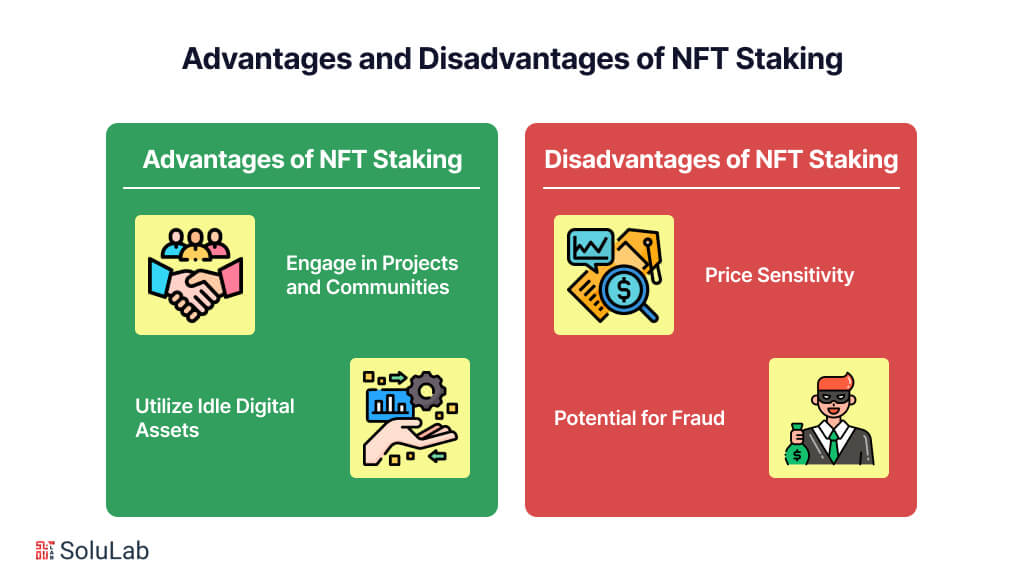
There are real upsides and real downsides. Here’s what to weigh before deciding.
Advantages of NFT Staking
1. Engage in Projects and Communities: Most projects reward users who commit their non-fungible tokens (NFTs) with utility tokens. The exact payouts vary by project. But beyond the financial side, those tokens often come with voting rights and governance participation, giving you actual say in where the project goes.
2. Utilize Idle Digital Assets: If you’re holding an NFT with no immediate plan to sell, staking puts it to work. You keep ownership. You don’t give it up. And the locked asset starts generating rewards instead of sitting dormant in a wallet.
Disadvantages of NFT Staking
1. Price Sensitivity: Market conditions can shift while your NFT is locked. The digital art world moves fast, and you may not be able to respond during an extended lock-up. If you’re a long-term holder, short-term swings probably don’t concern you. But if you trade actively, staking can put you in a difficult position.
2. Potential for Fraud: Staking rewards attract attention, and not all of it is legitimate. The NFT space is still relatively young, and spotting a fraudulent platform is harder than it should be. Some platforms exist to drain user funds. The only real protection is research: check the platform, check the team, and if something feels off, walk away.
How to Make More Money with NFT Staking
Staking within your crypto wallet is one of the more direct paths to passive income from NFTs. It’s a distinctive application of blockchain technology, but it does require an upfront investment. That investment is usually financial, though time, specifically the time spent holding and understanding the asset, matters too. Long-term holders, the HODLers, have the clearest case for staking: rather than leaving NFTs sitting unused in a digital wallet, you lock them up and let them generate returns.
A significant portion of stakeable NFTs live inside blockchain games. Axie Infinity, The Sandbox, MOBOX, and Zookeeper all offer staking options that let players earn money from their in-game assets.
Before NFT staking existed, the metaverse in gaming platform limited in-game NFTs to a single use within that specific game. Their utility was narrow. Staking changed that, expanding what those assets could do and how they could generate value.
Before jumping in, research the NFT itself: its market, its utility, and the staking incentives on offer. That groundwork is what separates informed decisions from expensive mistakes.
NFT Staking Platforms
If you own NFTs eligible for staking, the official collection website is the first place to check for instructions. Beyond that, several cross-collection platforms let you stake NFTs from various projects regardless of which chain they’re on. Here are a few currently running options:
1. LooksRare
LooksRare launched in January 2022 as an NFT marketplace that doubles as a staking platform. Its launch strategy was aggressive: it airdropped 120 million of its native $LOOKS tokens, with eligibility tied to having made over 3 ETH in trades on OpenSea.
Trading stays central to how the platform rewards users. Buy and sell NFTs on the marketplace, earn more $LOOKS. Those $LOOKS can then be staked directly on the platform to earn additional $LOOKS and wrapped Ethereum (WETH).
The token is primarily aimed at active NFT traders, but it’s also available on decentralized exchanges like Uniswap.
Right after launch, staking APY hit 9000%. It eventually came down and settled below 200%. At the time of writing, it sits around 9.24%, driven by trading volume and market conditions.
2. WhenStaking
WhenStaking is a staking platform built on Onessus, a WAX-based decentralized app development studio. Onessus created NFT play-to-earn games, including HodlGod and NiftyVille.
NFTs from those games can be staked on WhenStaking to earn VOID, the native Onessus token. Both Onessus and WhenStaking integrate with WAX Cloud Wallet, which makes the experience fairly smooth for fans of those games.
Rewards on WhenStaking scale with NFT rarity, collection value, and the platform’s level system. NFTs earn more over time as they level up, and the APY rises the longer you stake. One practical detail: you can still use your NFTs in-game through a leased version of the staked token, so staking doesn’t freeze your gameplay.
Related: Best NFT Marketplace Platforms
NFT Collections Available for Staking
1. The Sandbox
The Sandbox is a metaverse platform on Ethereum that lets holders of its native SAND token stake for crypto rewards. How much you can stake depends on how many LAND NFTs you hold.
For example, holding up to 5 LAND NFTs lets you stake a maximum of 10,000 SAND tokens on the Polygon (MATIC) chain. In 2023, one SAND token traded between roughly $0.28 and $0.90, putting the stake value for that 10,000 token cap somewhere between $2,800 and $9,000 depending on when you checked.
The Sandbox is on OpenSea, and in-game items are also sold through the platform’s own NFT marketplace. SAND tokens can be bought with a payment card via MoonPay.
2. Axie Infinity
Axie Infinity peaked at over 2.8 million daily users in 2021. Players collect avatar NFTs called Axies, battle with them, and earn Axie Infinity Shards (AXS) as rewards. AXS is the native token and covers in-game purchases on the Axie Infinity Marketplace: Axies, accessories, Lands, Land items. Staking options:
- Cryptocurrency Staking: Stake AXS tokens to earn more Axie Infinity Shards.
- NFT Staking: Land NFT holders can stake their plots for additional AXS. Rarity of the Land determines the daily AXS payout.
3. CyberKongz
CyberKongz was one of the earlier NFT staking projects and remains one of the more interesting models. Holders of the original 1,000 Genesis CyberKongz earn 10 $BANANA tokens per day for each first-generation NFT they hold. That reward schedule runs through 2031.
4. Mutant Cats
Mutant Cats is a collection of 9,999 feline avatars on Ethereum. Stake one and it generates 10 $FISH per day. $FISH represents fractionalized ownership of the project’s vault assets, so it’s not just a token, it’s a share in something.
Mutant Cats are available on OpenSea. Current staking rate: 10 $FISH per cat per day.
5. Doge Capital
Doge Capital is a Solana-based collection of 5,000 pixelated Dogecoin dog mascot avatars. Stake them to earn $DAWG tokens. $DAWG can also be picked up on decentralized exchanges like Raydium and Dexlab. It’s a meme coin, but one with actual utility: according to the official Doge Capital website, $DAWG powers the project’s whole token economy. Doge Capital NFTs trade on Magic Eden. Staking rate: 5 $DAWG per day.
Conclusion
NFT staking turns a passive holding into an active income source, without giving up ownership. The mechanics are straightforward: pick a platform that supports your collection, understand the lock-up terms, and keep a close eye on both the reward token’s value and the underlying NFT price. Smart contract-based staking through platforms like the ones above handles the execution automatically. Companies like SoluLab offer NFT Token Development and advisory on building staking infrastructure. As a leading NFT development company, SoluLab works through the technical complexity of NFT staking so you don’t have to start from scratch. Hire NFT developers from SoluLab to get the full potential out of your NFT investments.
Frequently Asked Questions (FAQs)
Bhavya is driving growth through data-backed demand generation for AI and Web3 solutions. With 9+ years in digital marketing, he has spearheaded initiatives that led to a 40% increase in qualified inbound leads. Bhavya shares insights on marketing ROI and scaling a digital presence via AI workflows. He is open to connecting with startups and enterprise teams to help them overcome their challenges.