Key Takeaways
- MPC wallet development cuts single-point key risk and tightens up wallet security.
- MPC crypto wallets bring better governance, tighter approval control, and smoother day-to-day operations.
- MPC and Multi-Sig each carry their own weight in enterprise decisions, and picking between them isn’t automatic.
- The development partner you choose determines whether your wallet infrastructure scales safely for the long haul.
Security isn’t optional anymore. Custodians, fintech platforms, payment providers, token-based businesses: they’re all growing, and every one of them needs wallet infrastructure that protects funds without gumming up daily operations. No exceptions. That’s exactly why MPC wallet development services is seeing rising demand across the digital asset space.
Traditional wallets make you pick a side: convenience or protection. Rarely both. One private key means one point of failure, full stop. Multi-signature setups tighten things up, sure, but they drag in operational friction, messy recovery paths, and approval structures that sit out in the open on-chain for anyone to see. Multi-party computation wallet development throws out that trade-off entirely. It splits signing authority across multiple parties and never lets the full private key exist in one place, at any point in the process.
If you’re managing treasury, client assets, partner payouts, or internal approval chains, MPC gives you a more workable route to secure wallet architecture. Here’s what an MPC wallet actually is, and where the real business upside sits.

Deciphering The MPC Wallet
An MPC wallet authorizes transactions using cryptographic computation, and it never needs the full private key sitting in one location. Instead of one complete key, you get key shares spread across multiple parties, devices, or systems. Those parties then sign a transaction jointly, through secure computation.
That design cuts the risk from a compromised device, an insider gone rogue, or a plain operational mistake. It also lets businesses enforce approval rules without ever putting sensitive signing material on display.
Why does this matter if you’re moving large-value crypto? Because wallet security has to hold at two layers, not one: the cryptographic layer and the operational layer. A secure crypto wallet needs access policies, auditability, role separation, and transaction workflows that actually hold up.
Understanding How MPC Wallet Works?
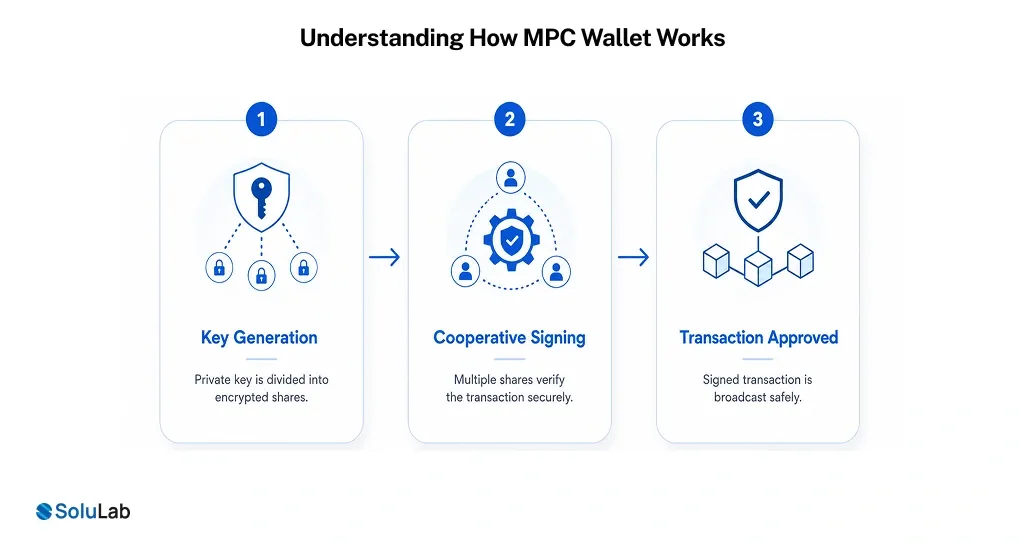
MPC stands for multi-party computation: multiple independent parties compute a shared result together, and none of them ever reveal their private input to the others. In a wallet, those private inputs are key shares. Nobody holds the whole private key, not one single participant. When a transaction comes up for approval, the signing happens as a group effort. Practically, that means:
- A stolen device, on its own, doesn’t expose the full signing key
- No employee can move funds solo without policy approval, however senior
- Trust gets spread across teams, systems, even geographies
- Signing material stays fragmented from start to finish
An MPC wallet runs on two tracks at once: cryptographic and operational. The cryptography protects the key itself. The operational design decides who approves what, when, and under which conditions. Both have to work. Neither one alone is enough.

Why This Model Is Stronger for Business Use?
For an enterprise, MPC isn’t just about stopping hacks. It’s also about closing off internal risk and tightening wallet governance, two things that rarely get enough attention until something goes wrong.
Here’s what an MPC wallet can support:
- Role-based transaction approvals: Approval sits only with users who actually hold the right role and permissions, nobody else.
- Department-level controls: Different departments get their own wallet access and their own action rules, managed separately.
- Treasury workflows: Funds move through structured approval and review steps built specifically for treasury work.
- Time-based restrictions: Certain wallet actions get locked to specific time windows or business hours.
- Policy-driven transaction signing: A transaction gets signed only once it clears the predefined business and security rules, not before.
- Secure backup and recovery mechanisms: Lose a device, a share, or an access point, and wallet access still comes back safely through protected recovery methods.
Why Businesses Are Moving Toward MPC Crypto Wallet Solutions?
What’s driving the shift toward MPC crypto wallet solutions? Security concerns, usability demands, and compliance pressure, usually all three at once.
- Better Security Without a Single Point of Failure
A traditional wallet leans on one secret, too much weight on one point. Steal it, leak it, mishandle it: the loss happens immediately, no warning. MPC breaks up that concentration of risk entirely. For enterprise use, that’s arguably the single biggest benefit on the list.
- Stronger Internal Controls
Technical security alone isn’t enough. Businesses need governance too. MPC handles distributed approvals and controlled access without locking teams into rigid, unworkable workflows. Treasury teams, custodial products, trading desks, fintech apps, institutional platforms: it fits all of them.
- Cleaner User Experience
Plenty of organizations compare MPC against multi-signature (multi-sig) wallets, and it makes sense: both improve control. But MPC usually wins on flow. It skips the visible, on-chain coordination that multi-sig setups typically require, which means less complexity for admins and less friction for end users alike.
MPC vs. Multi-Sig: What Is the Difference?
MPC vs. Multi-Sig: this comparison comes up in nearly every wallet conversation you’ll have. A multi-signature wallet needs multiple private keys before a transaction gets approved. Better than a single-key wallet, definitely, but you’re still managing separate full keys somewhere. And it tends to create approval logic that’s visible on-chain, plus extra coordination overhead nobody asked for.

How MPC is Different from Multi-Signature Wallet?
MPC never distributes full keys. What it distributes are cryptographic shares of a signing secret, used together, collaboratively, without ever rebuilding the complete private key anywhere. When businesses weigh MPC vs. Multi-Sig, here’s what usually comes under scrutiny:
- Security model: MPC cuts single-point key exposure; multi-sig still leans on securely managing multiple full keys.
- User experience: MPC tends to deliver a smoother approval flow, with far less signing complexity on show for users.
- Transaction policy design: MPC handles more flexible, layered approval rules tailored to actual business requirements.
- Recovery flexibility: MPC offers more adaptable recovery, and you’re not stuck relying on one complete key backup.
- Operational efficiency: MPC simplifies execution and strips out coordination friction between teams.
- Suitability for enterprise-scale workflows: Large organizations running secure, scalable, policy-based wallet operations tend to find MPC the better fit.
For most modern platforms, enterprise MPC wallet solutions strike a better balance between control and usability. That doesn’t write off multi-sig entirely; it still earns its keep in simpler governance setups. But once you’re building institutional-grade crypto wallet infrastructure, MPC usually bends more easily to what you actually need.
How to Use MPC Wallet in a Business Setting?
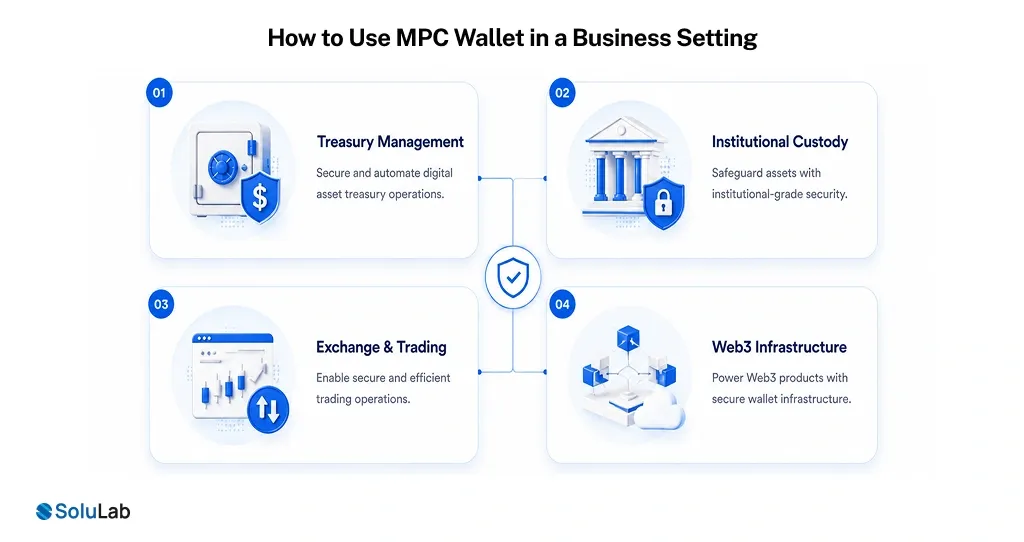
A business can put MPC wallets to work in a handful of ways:
- Treasury Management
Finance and operations teams lean on MPC wallets to manage reserves, vendor settlements, and internal transfers, all gated by approval logic.
- Institutional Custody
Crypto wallet platforms offering asset custody use MPC to cut key exposure while still supporting secure transaction authorization.
- Exchange and Trading Operations
Trading platforms use MPC wallets for hot wallet control, withdrawal approvals, and segmented access split across teams.
- Web3 Product Infrastructure
Projects launching token products, gaming platforms, or DeFi-connected apps use MPC to secure backend wallet operations, and none of them have to depend on a single signing environment to do it.
In every case, the goal doesn’t change: a secure MPC wallet that runs the business without dragging in friction that slows growth down.
Cost to Develop MPC Wallet: What Shapes the Budget?
What does it cost to develop MPC wallet infrastructure? That depends on scope, risk level, and how deep the product goes. A simple wallet integration costs a fraction of a full enterprise-grade platform loaded with governance, recovery, analytics, and multi-chain support. The main drivers:
Product Scope
A basic wallet, just send, receive, approval, sits at one level of effort. A smart crypto wallet platform built with admin dashboards, workflow logic, notifications, compliance checkpoints, and API layers sits at a completely different one.
Blockchain Support
One blockchain is simple. Multiple networks, each with its own transaction standards, is not.
Security Requirements
Advanced authentication, policy engines, HSM integration, monitoring, incident response: each one adds to the development effort.
User Roles and Workflow Logic
Complex approval chains demand more planning and more engineering. There’s no way around it.
Integration Depth
Connect the wallet to exchanges, custody layers, internal ledgers, or reporting systems, and the backend architecture grows right along with it.
That’s exactly why businesses hire MPC wallet developers with real security and crypto infrastructure experience, instead of handing it to a general app team and hoping for the best.
How To Choose the Right MPC Wallet Development Company?
Plenty of firms claim blockchain capability. Far fewer can actually deliver a secure wallet architecture.
A crypto wallet development company worth trusting should be able to show:
- Real experience with wallet security models
- Backend engineering that can actually hold up
- A working grasp of cryptographic signing flows
- The ability to build for scale and for auditability
- Hands-on knowledge of enterprise transaction controls
- A delivery process that’s actually clear, from discovery through deployment
The right partner explains how an MPC wallet works in business terms, not just technical jargon. Decision-makers care about three things: how it cuts risk, how it supports approvals, and how it fits into product operations day to day.
Conclusion
MPC wallet adoption is about more than tighter security. It signals a bigger shift in how businesses treat digital assets altogether. Wallet infrastructure now touches customer trust, platform resilience, operational continuity, and commercial readiness, the whole stack.
The most successful crypto products don’t win on feature count. They win because the underlying systems scale safely. That’s why multi-party computation wallet development keeps showing up in long-term product strategy for companies that take digital asset operations seriously.
For businesses entering crypto, upgrading legacy wallet systems, or launching institutional products, MPC gives you a sturdier foundation to build on. It supports control without turning execution into a mess. It strengthens security without dragging you back to single-point risk. And it hands teams a better framework for managing digital value in a real commercial environment.
Partner With SoluLab for Smarter Online Payment Infrastructure!
Ready to strengthen your online payment capabilities on a more secure, more reliable foundation? Partner with SoluLab and work with a team that knows how to build MPC wallet solutions focused on payment security, operational efficiency, and user trust.
We help organizations tackle the hard problems around digital payments, transaction safety, and usability, without piling on complexity nobody needs. If you’re looking to make a real dent in the digital payments space, now’s a good time to start that conversation.
FAQs
Shipra Garg is a tech-focused content strategist and copywriter specializing in Web3, blockchain, and artificial intelligence. She has worked with startups and enterprise teams to craft high-conversion content that bridges deep tech with business impact. Her work translates complex innovations into clear, credible, and engaging narratives that drive growth and build trust in emerging tech markets.