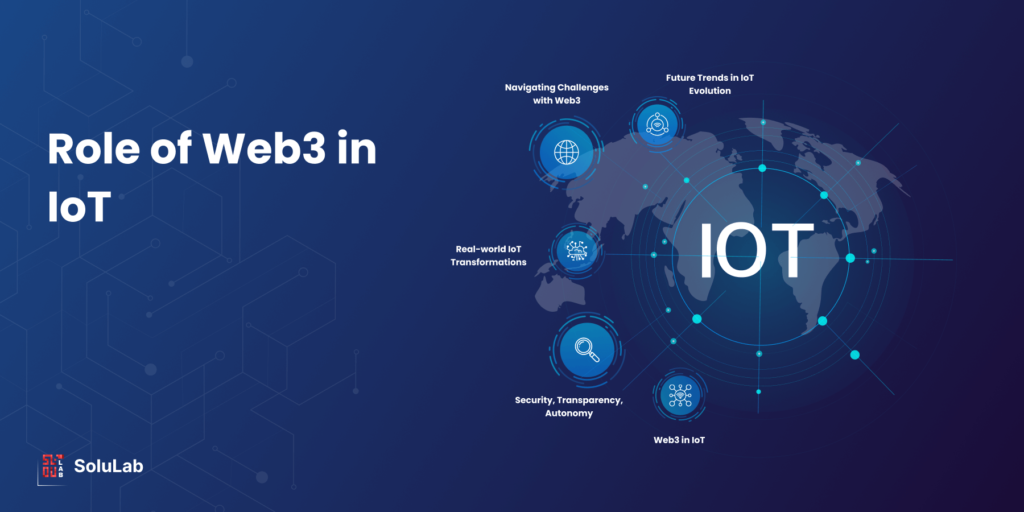
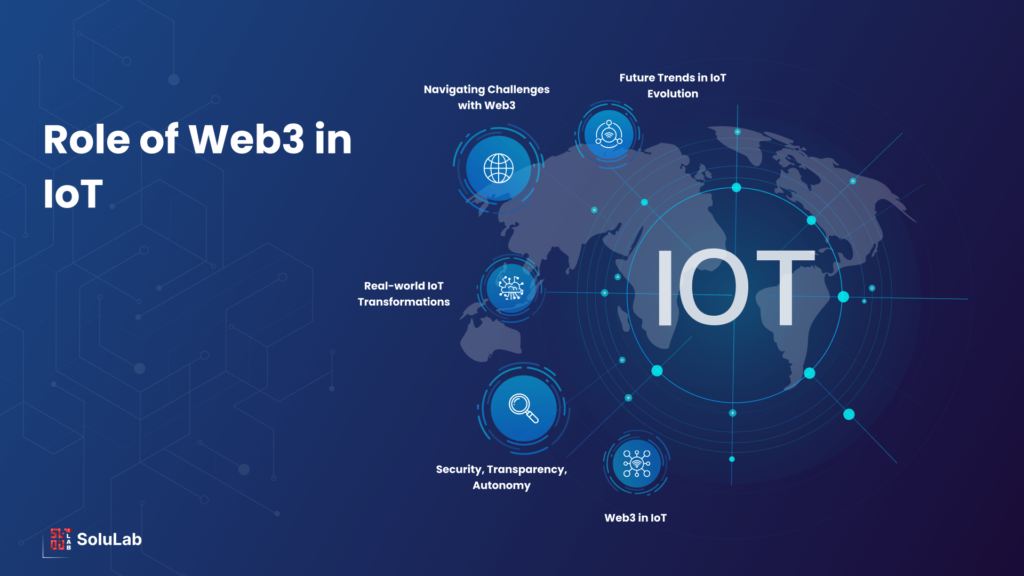
Two technologies that grew up separately are now being wired together. Web3 and the Internet of Things (IoT) were never designed for each other, yet the overlap keeps widening, and the results are messier and more interesting than either camp predicted. This piece walks through what actually happens when you bring Web3 and IoT together: what changes for connected devices, what breaks, and where the real gains sit.
Start with the definitions, because people use both terms loosely. Web3 is a version of the internet built on blockchain rails, aiming to be more decentralized, more secure, and more transparent than what we use today. IoT is the other half: a sprawl of physical devices hooked to the internet, quietly collecting and swapping data all day.
Put the two together and you get a different kind of platform. Web3 gives you creating decentralized applications (dApps) running on blockchains, and those dApps can handle IoT device management with tighter security and less overhead than the usual centralized dashboard.
The traffic goes both ways. IoT devices feed data back into Web3 applications and make them better. Location tracking is the obvious case: devices reporting where users actually are sharpens any location-based service built on top.
This is early work. Very early. But the list of industries where Web3 and IoT could reshape how things run is already long, and it includes supply chains that waste less, healthcare delivery that moves faster, and entertainment formats nobody has built yet.
Expect the opportunities to multiply as the two stacks keep converging. If your business plans more than a quarter ahead, this is worth a serious look now rather than after your competitors have shipped something.

Understanding Web3 and IoT
Defining Web3
Web3 is the internet’s third act. It rewrites how information gets shared and who gets to reach it, and it runs on three ideas: decentralization, transparency, and cryptographic security. That is a sharp break from the centralized plumbing the web has leaned on for two decades.
- Decentralization means no single point of failure and no single point of control. Attack it and there is no head to cut off. Censor it and there is no gatekeeper to lean on. Users also keep a grip on their own data, which centralized platforms rarely allow.
- Transparency comes from writing every transaction to a public blockchain. You can follow your own data and check that it is being used the way you agreed to, instead of taking someone’s word for it.
- Cryptographic security is the third pillar. Cryptography, a branch of mathematics built around encrypting and decrypting data, keeps records from being quietly rewritten after the fact.
Stack those three and you get a safer, tougher, more open way to move information around. The knock-on effect could reach the way all of us use the internet, and it points toward something more democratic and more equitable than what we have.
The Essence of IoT
IoT sits at the opposite end. The Internet of Things (IoT) is a huge web of connected devices, everything from the thermostat in a living room to sensors bolted onto factory equipment. They gather data, they pass it around, and they stitch the physical world to the digital one. They are also everywhere already, quietly driving change across industry after industry.
Look at healthcare: IoT watches patients’ vital signs, tracks whether medications were actually taken, and supports care delivered from a distance. Manufacturing uses it to squeeze out efficiency by tracking assets, watching production lines, and automating the repetitive work. Retail uses it to read shopping habits and push offers that match them.
For all that reach, IoT is still young. Devices keep getting smarter and cheaper at the same time, which is usually the signal that a wave of new applications is about to arrive.
The Intersection: Web3 in IoT
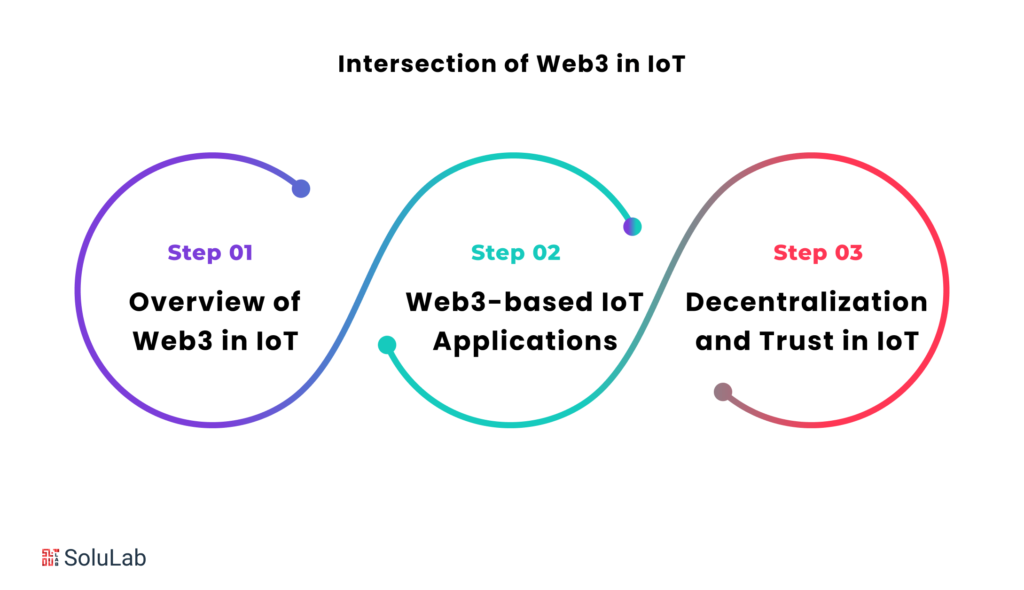
Overview of Web3 in IoT
Seen side by side, the fit is obvious. Web3 is decentralized by design and IoT is distributed by nature, so bolting one onto the other seldom requires forcing the architecture. What you get back is better security, clearer records, and devices that can act on their own.
Take blockchain technology inside an IoT network. Device-to-device messages become tamper-evident, which cuts off a whole class of cyberattacks and data breaches. It also makes tracking goods and services through a chain of custody far less painful.
Then there are smart contracts. Drop them into an IoT workflow and routine tasks run themselves: a payment fires the moment the agreed conditions are met, a delivery advances without anyone approving a form. Cost drops. Speed improves.
Decentralized applications open a third door. dApps let devices interact in ways that centralized software never really allowed, whether that is a marketplace where IoT devices trade with each other or a live analytics layer sitting across an entire network.
Put all three together, blockchain plus smart contracts plus dApps, and connected devices stop being dumb endpoints reporting to a server. They become safer, more efficient, and capable of acting without waiting for instructions. That shift matters as much to a factory floor as it does to a household.
Web3-based IoT Applications
Worth restating the frame here, because it explains why IoT people care. Web3 is an internet built on blockchain, and it aims at being more decentralized, more secure, and more transparent than the current web. IoT applications, by contrast, tend to be centralized and exposed to security breaches. So the overlap is not academic.
The first real win is trustless interaction between devices. Blockchain stores data in a way that resists tampering, which means two devices can deal with each other without a central authority vouching for either one. Supply chain management lives or dies on exactly that: records everyone can see and nobody can quietly edit.
Scale is the second win. Blockchain lets you build decentralized device networks, and a network with no single point of failure absorbs attacks that would take a centralized one offline.
Add it up and Web3 changes what an IoT application can be: more secure, more scalable, more transparent. Some of what becomes possible simply cannot be built on the web we have now.
Decentralization and Trust in IoT
Trust between machines is the hard problem, and blockchain, the technology sitting under Web3, is steadily becoming the answer. Decentralized ledgers let IoT devices record and verify transactions securely, and the transparency that follows is not optional in fields like healthcare and finance. It is the price of entry.
Three mechanisms do most of the work:
- Decentralized ledgers: A distributed database shared across many nodes, with no single point of failure to break into. IoT devices write and verify transactions against it, so the record stays accurate and resists alteration after the fact.
- Smart contracts: Self-executing agreements stored on a blockchain. They automate transactions between devices with no third party in the middle, which saves time and money and removes a common source of trouble: human error.
- Blockchain identity: Every device gets a unique digital identity. That identity proves a device is what it claims to be and confirms it is cleared for the network or resource it is asking for, which shuts out unauthorized access and the attacks that follow.
None of this is mature yet. Still, a secure and tamper-resistant way to record and verify what devices do is precisely what IoT networks have been missing, and it is what makes them dependable enough to build a business on.
Benefits and Challenges
Advantages of Web3 in IoT
What does a team actually get out of putting Web3 in IoT? Three things, mostly: stronger security protocols, data management that is no longer bottlenecked in one place, and devices that talk to each other more easily.
- Enhanced security protocols: Web3 runs on blockchain, which stores data in a form that resists tampering. IoT devices get a layer of protection against cyberattacks, and the data they report stays as recorded.
- Decentralized data management: Classic IoT architectures park data in one place. That makes it a target, and it caps how far the network can grow. Web3 spreads the data across a network of nodes instead, which is both harder to attack and easier to scale.
- Improved interoperability: Web3 leans on open standards, so different IoT devices and Web3 platforms have a far easier time understanding each other. Less glue code, fewer integration headaches.
Those three add up to IoT systems that are safer, steadier, and cheaper to run. Which is why Web3 has stopped being a curiosity in IoT circles and started showing up in architecture decisions.
Challenges and Considerations
Now the uncomfortable part. Scalability is still a genuine problem, because a decentralized network has to process every transaction everywhere. The Bitcoin network tops out around 7 transactions per second, which is nowhere near what conventional payment systems handle. Congestion and delays follow, and businesses and consumers notice.
Regulation is the other drag. Rules for this space are still being written, and they have to protect people without smothering the work. Cryptocurrency regulation in particular remains unsettled, which leaves businesses and investors guessing. Guessing slows product decisions, and slow product decisions slow everything else.
Even so, the upside is real. Blockchain records transactions securely and openly, which cuts fraud and removes friction. It also makes room for financial products that did not exist before, such as decentralized lending platforms.
Scalability and regulation are the two things the industry has to solve. Solve them and blockchain delivers on what it has been promising. Leave them unsolved and it stays a demo.
Real-world Applications
1. Smart Cities
Cities are where Web3 and IoT get tested at scale. Decentralized networks can tune traffic management, waste disposal, and energy consumption, and the payoff shows up as urban environments that cost less to run and are better to live in.
Traffic first. Web3-enabled traffic systems pull live readings from IoT sensors and adjust flow to clear congestion before it sets in. Cleaner air is the direct result, along with lower greenhouse gas emissions, and residents and visitors feel the difference on an ordinary Tuesday commute.
Waste is the next target. Sensors follow rubbish as it moves through a city, and that data reshapes collection routes and flags the neighbourhoods where recycling is falling short. Smaller environmental footprint, smaller waste management bill.
Energy works the same way. Sensors watch consumption inside buildings and homes, the data shows where the waste is, and the city acts on it. Carbon footprint down, energy costs down.
Traffic, waste, energy. Three unglamorous systems, three places where combining Web3 and IoT makes a city measurably more sustainable and more efficient for the people who live in it.
2. Industrial IoT (IIoT)
On the plant floor, Web3 reshapes Industrial IoT (IIoT) by making control systems decentralized. Three benefits show up first:
- Predictive maintenance: Sensor data and device telemetry surface problems before they turn into failures. Less downtime, more output.
- Supply chain optimization: Products can be tracked and traced end to end, which tightens operations and trims cost.
- Secure data sharing: Data moves between parties without leaking, so partners collaborate instead of hoarding.
Together they make industrial operations quicker on their feet. Predictive maintenance alone changes the economics of a production line, because unplanned downtime is usually the single most expensive thing that happens in a plant. In a market that moves this fast, that is an edge worth having.
Sustainability gets a lift too, and it is often overlooked. The same sensor data that predicts a bearing failure also shows where energy is being burned for nothing. Cutting that consumption lowers both the bill and the environmental impact.
So: decentralized control systems, better maintenance, tighter supply chains, safer data sharing, and less waste. That is a reasonable summary of what Web3 brings to industry, and it explains why the pilots keep getting funded.
3. Healthcare
Health data is the most sensitive data most of us generate, which is why Web3 in IoT matters here more than almost anywhere else. Secure, decentralized management of that data is a genuine shift, and it moves the needle on both patient privacy and data integrity.
Consider how records are stored today: centralized, and breached often enough that it barely makes the news anymore. Web3 flips the model by putting patient data on a distributed ledger, which raises the difficulty for anyone trying to reach records they have no right to see.
Privacy improves for a related reason. Right now your records get passed between organizations, and every handoff is another chance for a leak. Under Web3 the patient decides who gets access. They can encrypt the data as well, which narrows the window further.
Integrity is the third piece. Records get corrupted. Records get lost. A distributed ledger makes both far harder, so what a clinician reads is what was actually entered, and it is current.
All of this is early, and healthcare adopts slowly for good reason. But a secure, decentralized, patient-controlled approach to Web3 in IoT data management is the direction the field is heading, and better privacy, better integrity, and better care follow from it.
Future Trends
Evolving Technologies
Where does Web3 in IoT go next? Toward Artificial Intelligence (AI) and machine learning, which are already being folded in. They give connected devices more to work with, so interactions become smarter and aware of context rather than merely reactive.
Three jobs AI takes on:
- Automate tasks: Work people currently do by hand, like watching sensor feeds and reacting to them, moves to the machine. People go do something that needs judgement.
- Optimize operations: AI finds the inefficiencies and fixes them. Predicting maintenance needs and spotting where energy is being wasted are the two clearest examples.
- Personalize experiences: Information and recommendations get tailored to the individual, based on what they bought before or what they have been looking at.
Machine learning pulls its own weight here too. Train an algorithm on device data, let it make predictions, and the accuracy and efficiency of the whole IoT system improve. Three concrete uses:
- Detect anomalies: Odd readings in sensor data get flagged early, while a problem is still cheap to fix.
- Predict failures: Models estimate when a device is about to give out, so downtime gets scheduled instead of suffered.
- Optimize performance: Bottlenecks in an IoT system get identified and cleared without someone hunting for them manually.
Fold AI and machine learning into IoT devices and you get systems that know their own state and their surroundings. That is a real break from the sensor-and-dashboard era, and it changes how we deal with the world around us.
Decentralized Autonomous IoT
Decentralized Autonomous Organizations (DAOs) are blockchain-based organizations run by smart contracts, which are pieces of code that execute themselves, automating tasks and reaching decisions with nobody in the loop. Applied to IoT, a DAO hands devices the authority to decide for themselves. Interconnected systems get faster and more responsive as a result.
Picture a DAO running a smart home. It adjusts the temperature according to the weather outside, brings up the lights when someone walks in, and picks music to match the mood of whoever is home. No one taps through four apps to make any of it happen. The house simply behaves sensibly, and it uses less energy doing so.
Security benefits too. Automating tasks and decisions takes human error out of the equation, and DAOs can enforce controls that a traditional centralized setup would struggle to implement at all.
Early days again. But DAOs make IoT systems more efficient, quicker to react, and harder to compromise, and as the tooling matures the range of applications will widen well past smart homes.
Interconnected Web3-IoT Ecosystems
The longer view is connected environments where devices communicate over decentralized networks without friction. Collaborative projects built on Web3 and IoT together are the ones pushing that boundary.
Web3 and IoT are each disruptive on their own. Combined, the decentralized architecture of one meets the real-world reach of the other, and devices gain new ways to deal with each other and with their surroundings.
Which opens up things like:
- Smart cities that are more efficient and sustainable
- Self-driving cars that are safer and more reliable
- Healthcare devices that are more personalized and effective
- Industrial automation that is more efficient and productive
The constraint is not the technology anymore. It is what people decide to build with it.
Conclusion
Web3 and IoT belong together more than either field expected, and the combination opens up innovation, stronger security, and genuine decentralization. Apply Web3 principles to IoT applications and connected devices start operating with a degree of autonomy, transparency, and efficiency they have never had.
Getting there is the hard part. Working at the intersection of Web3 in IoT takes a Web3 development company that has actually shipped in both areas. SoluLab works squarely in that space, offering Web3 services backed by a team of skilled Web3 developers.
SoluLab has spent years building Web3 solutions and has a track record to point at. That experience lines up with what Web3 in IoT demands, which is why businesses and industries working through this convergence tend to get usable results rather than a proof of concept that stalls.
The work ranges from decentralized applications that rethink what IoT devices can do, to solutions built specifically around security and data integrity. As a Web3 service provider, SoluLab helps organizations get through the awkward parts of decentralized networks, so IoT ends up running on transparency, trust, and real innovation rather than on promises.
In a Web3 world, an IoT application is not just a device. It is a working part of a decentralized system. SoluLab stays focused on driving adoption of Web3 technologies, with a full range of services that let businesses get real value out of Web3 in IoT instead of watching from the sidelines.
If you are building anything where Web3 and IoT meet, the question is not whether the two converge. That is already happening. The question is whether your devices end up smarter but still locked inside someone else’s platform, or genuinely decentralized, transparent, and secure. SoluLab is here to help you land on the second one.
FAQs
Bhavya is driving growth through data-backed demand generation for AI and Web3 solutions. With 9+ years in digital marketing, he has spearheaded initiatives that led to a 40% increase in qualified inbound leads. Bhavya shares insights on marketing ROI and scaling a digital presence via AI workflows. He is open to connecting with startups and enterprise teams to help them overcome their challenges.