Web3 changes how companies operate at a basic level. Hotels are not exempt. The idea is an internet that is decentralized and built around the user rather than the platform, and it brings a different set of expectations about openness, trust, and how parties work together. Below, we cover what Web3 actually is, why a hotelier should care, and how it got here, with the focus kept firmly on the hotel business.
Think of Web3 as the internet’s third generation. Its defining traits are decentralization, blockchain, and far more control in the hands of the user. Earlier versions of the web routed almost everything through a central company; Web3 favors direct, peer-to-peer connections, so people own more of their data and more of what happens to it online. The bigger ambition? Cut out the middlemen and let trust come from the network itself.
Getting from Web1 to Web3 was a big jump. Web1 was static. Mostly pages you read and left. Web2 added dynamic content and interaction, the era of social media and collaboration web3 platforms. Web3 goes further, using blockchain and decentralized protocols to hand users real ownership of their data, along with stronger privacy and security.
How Does Decentralization Impact the Traditional Models of the Hospitality Sector?
Web3 is already reshaping how the hotel business thinks about technology. So let’s start with the basics that define it, then get to what they mean for the people who run properties.
Fundamentals of Web3
Key Principles and Characteristics
A handful of principles set Web3 apart from what came before. Transparency, trust, and interoperability sit at the top of the list, and together they build a decentralized Web3 ecosystem in which users hold far more say over their own data.
Then there are smart contracts. Running on a blockchain, they carry out agreements automatically, which gives transactions a framework that is secure and very hard to tamper with. Add immutability and consensus mechanisms on top, and everyone involved has good reason to believe the data is what it claims to be.
Decentralization and Blockchain Technology
Decentralization is the core of the whole thing. Today’s internet is run by a few central players; Web3 is a break from that. Blockchain is what makes the break possible, since it keeps a distributed ledger that records every transaction across a network of nodes instead of one company’s server.
For a hotel, that means better Web3 security in transactions, less reliance on intermediaries, and operations that run with less friction. Because a blockchain is transparent and auditable, accountability goes up too. In a business that lives or dies on trust, that matters a lot.
What is the Web3 Impact on the Industry?
Hospitality is in the middle of a real change as Web3 tools arrive, including decentralized applications (DApps) and smart contracts. Expect them to rewrite what counts as efficient operations, sound security, and a good guest experience.
Decentralized Applications (DApps) in Hospitality
Decentralized applications are changing how hospitality services reach the guest. A DApp gives you a transparent, secure, decentralized place to handle bookings, payments, and customer reviews. Take the intermediaries out of that chain and something useful happens: hotels and service providers deal with guests directly, which tends to make the experience more personal and cheaper to deliver.
Smart Contracts and Their Applications
Smart contracts are one of the load-bearing pieces of Web3. They carry out and enforce an agreement with no middleman in between. In a hotel, that covers the dull but constant work: confirming bookings, handling cancellations, settling payments. Operating costs drop. Transactions move faster. And neither the guest nor the provider has to take the other party on faith, because the contract does what it says.
Enhanced Security and Privacy Features:
Security and privacy may be where Web3 changes the most for hospitality. With blockchain underneath, data is handled in a way that is both secure and visible. Guest records, payments, and other sensitive information sit on decentralized networks rather than one central store, so a breach is less likely. Guests notice that. It earns their trust.
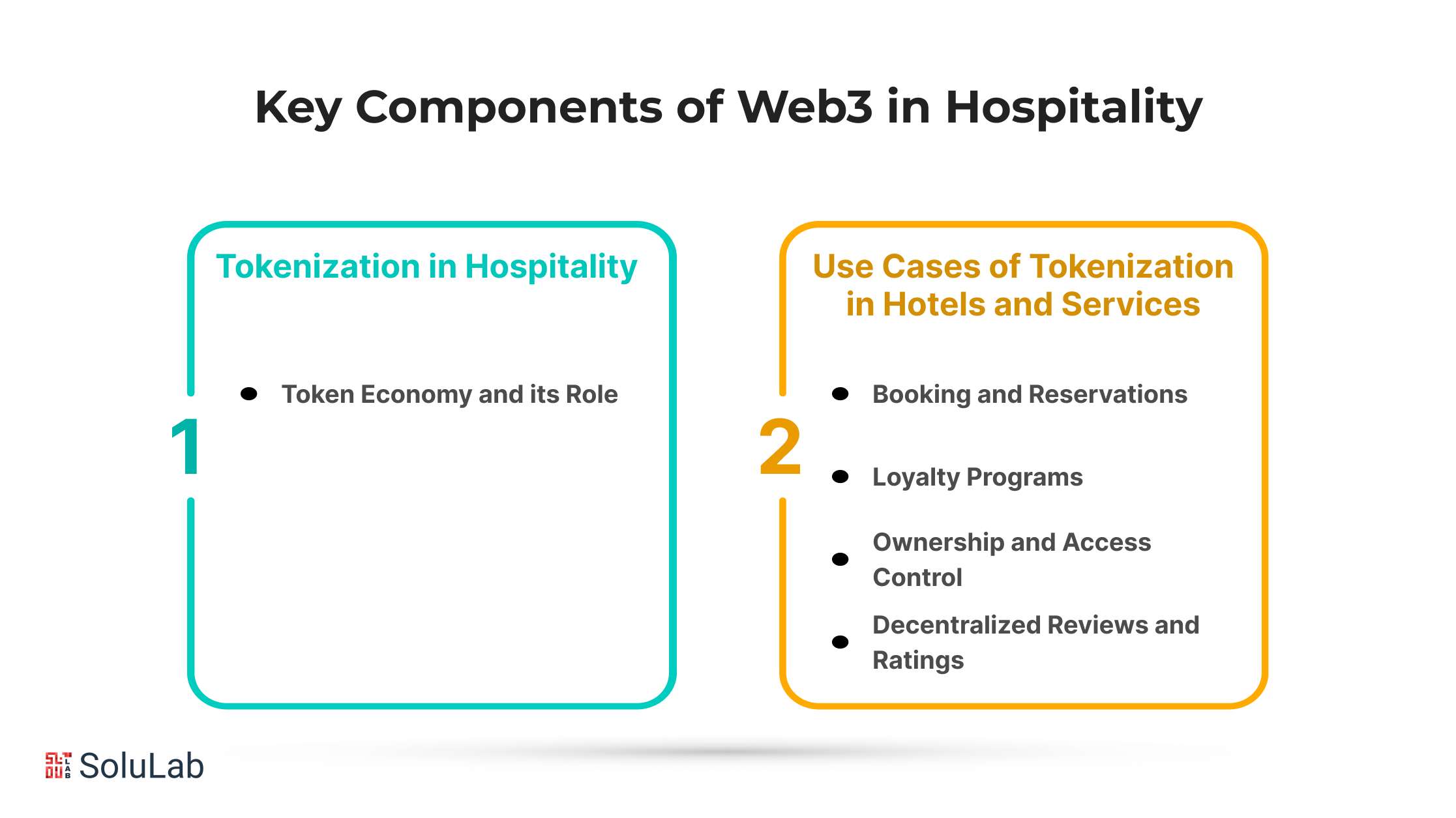
What are the Key Components of Web3 in Hospitality?
Web3 is the internet’s next stage, and it is set to shake up plenty of industries, hospitality among them. A few components do most of the work of reshaping how hotels have always done things. Tokenization is one of the most important.
A. Tokenization in Hospitality
Token Economy and its Role
Tokenization brings a new economic model into hospitality: the token economy. The concept is simple enough. You create digital tokens on a blockchain, and each one stands for an asset or a unit of value. Those tokens make transactions secure and transparent, and they help build a network where no single party sits in the middle.
Why does that matter to a hotel? Because control over transactions and assets stops being concentrated. Things become more transparent, fewer intermediaries take a cut, and value gets shared more fairly among everyone involved. A hotel or service provider can even issue its own tokens, which makes transactions smoother and opens up revenue streams that did not exist before.
B. Use Cases of Tokenization in Hotels and Services
There are plenty of ways tokenization rewrites the usual hotel playbook. A few of them:
Booking and Reservations
Use tokens for bookings and reservations, and the transactions become secure and much harder to defraud. Smart contracts handle the booking steps on their own. No intermediary required.
Loyalty Programs
Tokenization also makes decentralized loyalty programs possible. A guest earns tokens at one place and spends them at another, across any affiliated service or property that belongs to the same decentralized hospitality network.
Ownership and Access Control
It reaches the physical side of the hotel as well. Ownership and access can be tokenized, so a room key becomes a digital token. That tightens security and shortens check-in, and the guest gets a stay that feels both smoother and safer.
Decentralized Reviews and Ratings
Reviews are another good fit. On a decentralized rating system, people earn tokens for leaving useful feedback. The payoff is evaluations of hospitality services that are genuine and open to inspection.
So, is Web3 in hospitality just a buzzword? No. It is already reshaping the industry. Tokenization in particular brings efficiency, transparency, and decentralization, and it pulls the hotel business into line with the principles the decentralized web was built on.
Given all this, new trends at the intersection of Web3 and hospitality are showing up quickly. Hospitality companies can see they need to adapt, and more of them are turning to Web3 development companies for help. Demand for skilled Web3 developers keeps climbing as the industry moves toward decentralized, blockchain-based systems.
To get through the shift in one piece, hospitality businesses are looking at partnerships with Web3 development companies and weighing whether to hire Web3 developers of their own. It is a sensible bet. It keeps them close to the front on innovation and lets them put Web3 to full use, both for the guest experience and for day-to-day operations.
How does Decentralized Identity Management Contribute to Enhanced Security in the Hospitality Industry?
Decentralized Identity Management, or DID, is changing a number of industries. Hospitality is one of them. Adopt it, and you get better security plus a better stay for the guest.
Security first. Most traditional identity systems keep sensitive guest details in a central database, and a central database is exactly what attackers go after. DID shrinks that exposure by spreading identity information across a decentralized network. There is no single vault to crack, so unauthorized access and data compromise become less likely.
The guest experience improves too, because services can be smoother and more tailored. Guests look after their own identity information and grant specific permissions to specific services during their stay. The hotel or resort only sees what is relevant, and only with the guest’s explicit approval. The result feels more personal, and it wastes less of everyone’s time.
Web3 pushes these gains further. Its technologies run on decentralized protocols such as blockchain, which make identity checks more transparent and easier to trust. Check-in gets faster. Visitor identities can be verified quickly and securely. And the stay itself goes more smoothly and is simply more pleasant.
What is The Role of Smart Contracts and Web3?
Hospitality never sits still for long, and new technology keeps overturning the old way of doing things. One of the more significant shifts is pairing smart contracts with Web3 to tidy up booking and make transactions safer. This section looks at what smart contracts change about bookings and payments in hotels, and at how Web3 helps bring openness in and push fraud out.
Streamlining Booking Processes with Smart Contracts
Smart contracts in Web3 security, which run on blockchain, give booking a decentralized and automated backbone. They execute themselves. That lets everyone in a booking, meaning guests, hotels, and the intermediaries themselves, deal with one another smoothly without needing a middleman to referee.
Once the terms are agreed, a transparent and immutable blockchain makes sure nobody can quietly change them. Fewer disputes. Better efficiency all round.
With smart contracts, a hotel can automate several stages of booking at once: confirming the reservation, settling the payment, applying the cancellation policy. The whole thing moves faster, and there are fewer chances for a human slip. What you end up with is a booking system you can actually rely on.
Ensuring Transparency and Reducing Fraud
Hospitality runs on transparency, and smart contracts add a lot of it. Every transaction lands on a decentralized ledger, so stakeholders can see a clear, traceable record of every booking and payment as it happens. That builds trust between the parties. It also makes fraud harder to pull off.
Here is why. Once a transaction is written to the blockchain, nobody can tamper with it or change it after the fact. The full history is stored securely and anyone can check it, which cuts the risk of fraud considerably. Guests benefit. So do service providers. Both end up working in a booking environment that is safer and more dependable.
What are the Primary Technological Barriers that the Hospitality Industry Faces?
Bringing Web3 into hotels changes how the business runs, making it more decentralized and more connected. But it is not a frictionless change. Below, we get into the hard parts of implementing Web3 in the hotel industry, on the technical side and the regulatory side. Even with those limits, the rise of Web3 creates a lot of room for innovation and growth.
A. Challenges of Implementing Web3 in Hospitality
Technological Barriers
The technology itself is usually the first wall a hotel hits. Legacy systems often do not play nicely with decentralized tools, and that gets in the way of adopting blockchain, smart contracts, and decentralized applications (dApps). In practice, this is where many teams stall. The fix is either retraining the staff you have or bringing in specialist Web3 developers, and one of the two is not optional.
Regulatory Considerations
Regulation needs just as much attention. Web3 is decentralized and leans on blockchain and cryptocurrencies, and both make compliance with current law more complicated. A hospitality business has to deal with data privacy, consumer protection, and financial regulation, all at once. Working with legal experts who know this ground is the only realistic way to make the transition without nasty surprises.
B. Opportunities Amidst Challenges
Innovation and Efficiency
Get past the technical hurdles and there is a real chance to innovate and run leaner. Smart contracts are a good example: they can simplify bookings, payments, and loyalty programs. Adopt these tools and you can save money while giving customers a better experience.
Enhanced Security and Trust
Blockchain gives Web3 better security and more transparency. Hotels can put that to work, winning customer trust by locking down transactions and guarding sensitive data. Because the network is decentralized, the risk of fraud and cyberattacks falls as well.
Competitive Advantage
Moving early on Web3 can give a hospitality business a real edge. Invest in the newer technology, give customers a smooth decentralized experience, and you may draw in tech-savvy travelers. In a crowded market, that is how you stand out.
What are the Future Trends in Web3 and Hospitality?
Technology is moving fast, and Web3 in hotels looks set to change how guests experience and interact with the services on offer. Several new technologies are converging here. The clearest picture is one where AI and IoT work hand in hand with Web3 and change what hospitality technology looks like.
Integration of AI and IoT with Web3
As hospitality heads toward a more decentralized and connected future, Artificial Intelligence (AI) and the Internet of Things (IoT) with Web3 will carry a lot of the weight. AI running on Web3’s decentralized foundations is expected to improve the guest experience by tailoring recommendations, automating routine processes, and predicting what each guest prefers with far better accuracy than before.
AI does not work alone here. The Internet of Things is changing how services get delivered, too. Smart devices linked through Web3 protocols keep information flowing steadily and efficiently, so the environment responds and adapts to the guest. Smart room controls are one example; stays tailored to each person are another. Put AI, IoT, and Web3 together and new opportunities keep appearing.
Predictions for the Future of Hospitality Technology
Web3 is more than a label. It drives innovation past the usual limits. The future of hotel technology sits in its decentralized design, where openness, security, and efficiency come together in a system that works for providers and guests alike.
In that future, expect demand to surge for qualified specialists and development firms that focus on Web3. Being able to bring in Web3 developers who know blockchain, smart contracts, and decentralized apps (dApps) will be a strategic advantage. For any hospitality group that wants to stay competitive as the field shifts, it may be the deciding one.
Conclusion
Web3 touches a lot of the hotel business at once, and working through all of it needs an organized plan. This is where SoluLab stands out. As a top Web3 development firm, SoluLab understands the complexity of a technology that is still taking shape, and it gives hotels a complete guide to getting the most out of it.
Hotels are close to a major shift, and adopting Web3 is how you stay ahead of it. SoluLab’s Web3 development expertise makes it a strong partner for firms that want to rethink their digital presence and the way they engage customers. It connects long-standing hospitality standards with the newest Web3 technology, so companies can do well in a changing market.
Hiring SoluLab’s web3 developers is a strategic call for any company that wants to put Web3 to work. SoluLab’s experienced team keeps up with the latest advances in blockchain, decentralized apps, and smart contracts, which lets hospitality firms fold these technologies into their operations without the usual pain.
Put SoluLab’s experience next to what Web3 can do, and the hospitality sector gets a real push into its next phase. As companies adjust to a digital world, SoluLab acts as a partner they can trust. It offers more than development work. It offers a practical route to rebuilding how hospitality itself works in the Web3 era.
FAQs
1. What is Web3 and how does it relate to the hospitality industry?
Web3 is the internet’s next stage, built on decentralization, blockchain, and giving users real control. For hospitality, it can reshape everyday processes, tighten security, and create systems that are more transparent and built on trust.
2. How can Web3 benefit hospitality businesses?
The benefits include stronger data security from decentralized systems, simpler transactions using cryptocurrencies, and more trust between businesses and guests thanks to transparent, immutable ledgers.
3. Are there specific use cases for Web3 in the hospitality sector?
Yes, several. Think decentralized identity checks for guests, smart contracts that make bookings automatic and secure, and loyalty programs that run on blockchain tokens. Each of these can change both the guest experience and how efficiently a property runs.
4. Can I hire Web3 developers for my hospitality business?
Yes. You can bring in Web3 developers to build blockchain solutions, smart contracts, and decentralized applications shaped around what your hospitality business actually needs. Look for people who understand the industry as well as the technology.
5. How do I find a reliable Web3 development company for my hospitality project?
To find a reliable Web3 development company, check their track record in both hospitality and blockchain. Review their portfolio, read client feedback, and confirm they have built decentralized applications before. Clear communication and a real grasp of your business requirements matter just as much.
6. What are the key challenges in implementing Web3 solutions in hospitality?
The usual ones are regulatory compliance, fitting new tools into existing systems, and teaching staff and guests why Web3 is worth it. Getting past them takes careful planning and a close working relationship with experienced Web3 developers.
Shipra Garg is a tech-focused content strategist and copywriter specializing in Web3, blockchain, and artificial intelligence. She has worked with startups and enterprise teams to craft high-conversion content that bridges deep tech with business impact. Her work translates complex innovations into clear, credible, and engaging narratives that drive growth and build trust in emerging tech markets.