Key Takeaways
- Hire for shipping experience, not framework familiarity. Someone who has been through Play review, staged rollouts and a rejection knows things no interview question reveals.
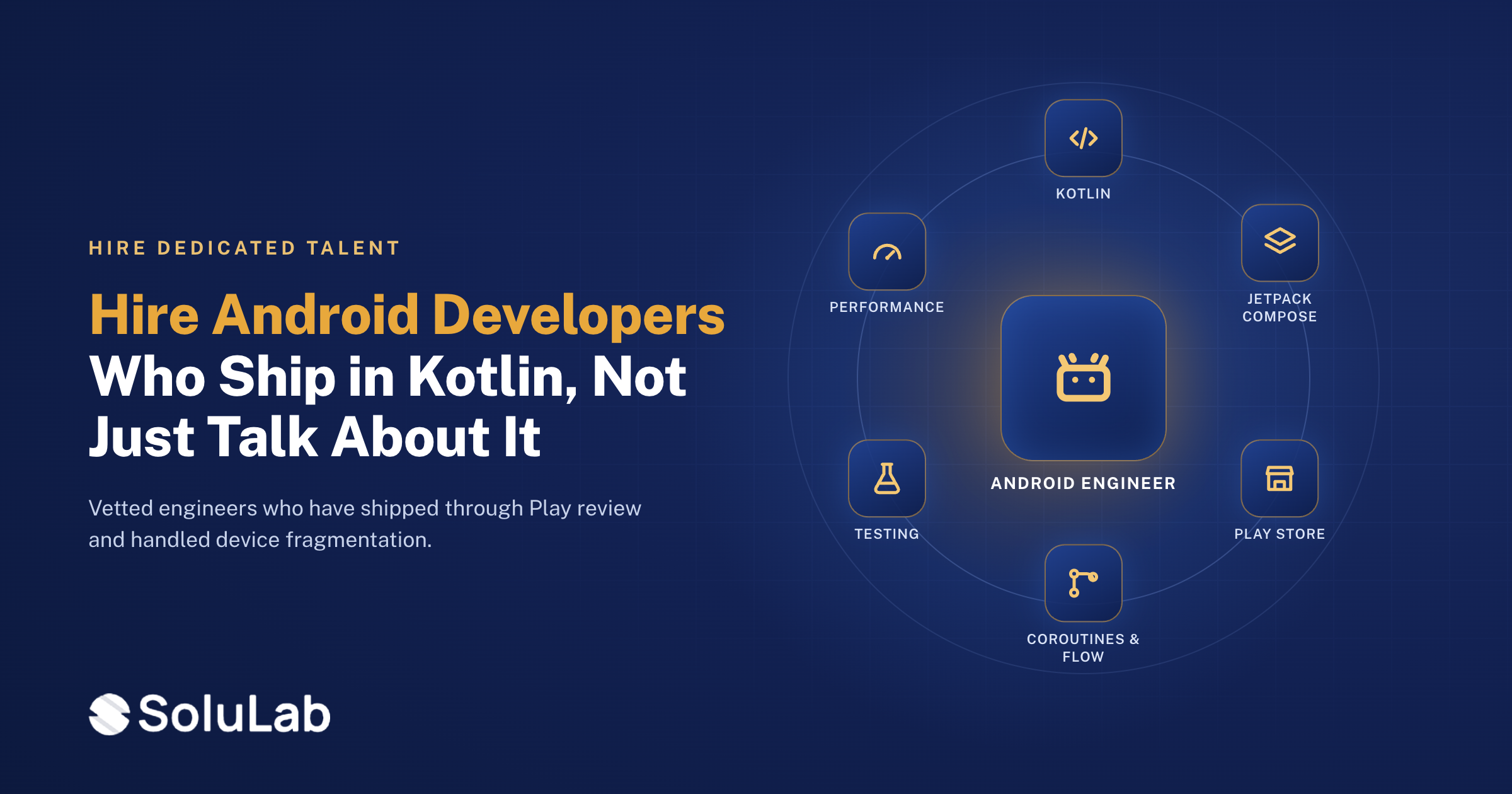
- Kotlin, Compose and coroutines are the non-negotiables. Everything else can be learned on your codebase. These cannot, quickly.
- Interview and reject, always. A vendor who will not let you interview before contract is deciding your team for you. Put the right into the contract.
- A short paid trial task beats any interview. Thirty minutes reviewing real code on your real codebase tells you more than an hour of questions.
- Dedicated beats freelance when the roadmap is alive. If you will still be shipping in six months, continuity and context are worth more than a lower hourly rate.
- Settle IP, replacement and notice terms before onboarding. IP should assign on creation rather than final payment, and the clause must cover subcontractors.
- Compare total cost of ownership, not the hourly rate. A cheaper developer who needs more review, more rework and more supervision is not cheaper.
Hiring a dedicated Android app developer means bringing on an engineer who works only on your product, employed by a vendor or hired directly, rather than splitting time across several clients. For Android specifically, the value is in platform depth: someone who has shipped through Play Store review, handled device fragmentation across manufacturers and OS versions, and knows why an app that runs beautifully on a flagship handset drains the battery on a mid-range one. You get continuity and platform judgement without running a hiring pipeline or carrying the employment risk.
On this page: what a dedicated Android developer actually does, the skills to test for, how the engagement models compare, the interview questions that separate real experience from a CV, what drives cost, and how to evaluate a vendor.

What Does a Dedicated Android App Developer Do?
More than writing Kotlin. A developer worth the “dedicated” label owns a slice of the product end to end.
- Architecture and code. App structure, state management, data layer and the decisions that determine whether feature six takes a week or a month.
- Platform integration. Camera, location, notifications, background work, permissions and the Play Services surface, each of which behaves differently across OS versions.
- Performance and battery. Cold start time, memory, jank and background power draw. This is where mid-range devices punish careless code.
- Release engineering. Play Console, staged rollouts, signing, app bundles and the review process, which has its own failure modes.
- Testing across real devices. Emulators miss manufacturer skins, older OS versions and the memory constraints most of your users actually have.
- Post-launch maintenance. Android ships a major version every year, and target SDK requirements are enforced with deadlines.
The build side sits within Android app development and the broader mobile app development services.
Which Android Skills Should You Test For?
Team shape matters, but for a single hire the skills checklist decides the outcome.
| Skill area | Non-negotiable | Nice to have | Why it matters |
| Kotlin | Yes | — | The default language for Android since 2019; Java-only is a red flag in 2026 |
| Jetpack Compose | Usually | — | The modern UI toolkit; XML-only experience limits you on new work |
| Coroutines and Flow | Yes | — | Asynchronous work done wrong is the top source of crashes and ANRs |
| Architecture patterns (MVVM, MVI) | Yes | — | Determines whether the codebase survives a second developer |
| Room, Retrofit, dependency injection | Yes | — | The standard data and networking layer |
| Play Console and release process | Yes | — | Shipping is a skill, not an afterthought |
| Testing (unit, UI, instrumentation) | Yes | — | Without it, every release is a gamble |
| Kotlin Multiplatform | No | Yes | Valuable if iOS sharing is on the roadmap |
| Compose for TV, Wear OS, Auto | No | Yes | Only if those surfaces are in scope |
| CI/CD and build optimisation | Part-time | — | Slow builds quietly cost more than they look |
The pattern: hire for Kotlin, Compose, concurrency and shipping experience. Everything else can be learned on your codebase; those four cannot be learned quickly enough to matter.
Dedicated Developer vs Freelancer vs Staff Augmentation vs Agency Project
The four options are not interchangeable, and picking wrong is the expensive mistake at this stage.
| Option | You get | Best for | Main risk |
| Dedicated Android developer | One engineer working only on your product, long term | Ongoing product work with an evolving roadmap | Paying for capacity you have not scoped work for |
| Freelancer | A contractor, task by task | Short, self-contained pieces of work | No continuity, no cover, no shared context |
| Staff augmentation | An engineer slotted into a team you already manage | Filling a gap on a team with its own process | You supply all the management |
| Agency project | A defined scope delivered for a fixed price | Well-defined scopes unlikely to change | Change requests become slow and expensive |
The dividing line is whether the work is ongoing. If the roadmap is alive and you will still be building in a year, a dedicated developer costs less per unit of output because nobody re-learns your codebase each quarter. SoluLab’s comparison of a dedicated team versus a freelance developer goes further into that trade, and the guide to hiring dedicated developers covers the mechanics.
How Does the Hiring Process Work?
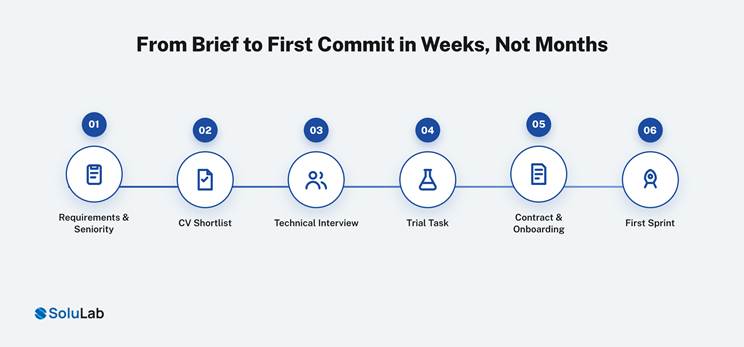
- Requirements and seniority. Stack, app maturity, whether you need someone to build from scratch or maintain an existing codebase, and the working-hours overlap you require.
- CV shortlist. Profiles within days if the vendor has a real bench. Slow shortlists usually mean they are recruiting against your brief.
- Technical interview. You interview and you reject. Insist on this even when a vendor offers a pre-vetted shortcut.
- Trial task or paid pilot. A short, real task on a real codebase tells you more than any interview. Two days is usually enough.
- Contract and onboarding. Rate, notice, replacement terms, IP assignment and NDA settled before anyone starts.
- First sprint. Repository access, build environment, code review standards and the definition of done. Expect one to two weeks before full velocity on an existing codebase.
Delivery runs on agile software development practice, with DevOps support for build pipelines and release automation.
What Should You Ask in the Interview?
Six questions that separate shipped experience from study.
- “Walk me through an app you shipped to Play and what got rejected.” Everyone with real experience has a review rejection story.
- “How do you handle background work that must survive the process death?” Tests WorkManager understanding and the Android lifecycle, which is where inexperienced developers fail.
- “What is your approach to state management in Compose?” Reveals whether Compose experience is real or a bullet on a CV.
- “How do you debug an ANR you cannot reproduce?” Tests production debugging, not textbook knowledge.
- “What is your minSdk decision process?” A good answer references the user base, not a default.
- “How would you cut our app’s cold start time?” Listen for measurement first, optimisation second.
Ask for a code sample or repository walkthrough. Reviewing thirty minutes of someone’s actual code tells you more than a two-hour interview.
What Drives the Cost of Hiring an Android Developer?
There is no honest flat monthly figure, because seniority and location move the number more than anything else. What matters:
- Seniority. A senior who prevents an architecture mistake costs less than a junior who makes one and a rewrite to fix it.
- Location of the developer. Rates vary widely by region, and this gap is the main commercial reason the model exists.
- Engagement length. Longer commitments usually reduce the rate because the vendor carries less bench risk.
- Full-time versus part-time. Maintenance work often does not need a full seat, and paying for one is waste.
- Time zone overlap required. Demanding heavy overlap with a distant time zone narrows the pool and raises the rate.
- Specialist surfaces. Wear OS, Android TV, Automotive or Kotlin Multiplatform experience is scarcer and priced accordingly.
Compare total cost of ownership, not the hourly rate. A cheaper developer who needs more review from your side costs more in practice. The mobile app development cost guide covers project-based pricing if you are weighing hiring against outsourcing the build.

How Do You Choose a Partner to Hire Through?
Six checks, in rough order of how much they predict the outcome.
- Bench depth in Android specifically. Ask how many Android engineers they have available now, not company-wide headcount.
- Retention. Ask the average tenure of their Android developers. Churn transfers directly onto your project as lost context.
- Your right to interview and reject, written into the contract rather than promised on a call.
- Replacement terms. How quickly a departing developer is replaced, and whether handover is billed.
- IP assignment on creation, not on final payment, with the clause covering subcontractors.
- Verifiable references from engagements of comparable length. The SoluLab case studies library is the kind of evidence to ask any vendor for.
Walk away from a vendor who will not let you interview, cannot name the developer before contracting, or quotes a monthly figure before discussing seniority.
Where Does SoluLab Fit?
SoluLab provides dedicated Android engineers and full mobile teams to clients across the US, UK, Europe and Asia-Pacific, working in the client’s time zone under the client’s product direction. You can hire mobile app developers for a single platform, hire dedicated developers across a wider stack, hire full stack developers where backend work travels with the app, or scale through offshore developers.
Frequently Asked Questions
Shipra Garg is a tech-focused content strategist and copywriter specializing in Web3, blockchain, and artificial intelligence. She has worked with startups and enterprise teams to craft high-conversion content that bridges deep tech with business impact. Her work translates complex innovations into clear, credible, and engaging narratives that drive growth and build trust in emerging tech markets.