
Key Takeaways
- Outsourcing blockchain development typically saves 30 to 50 percent on total cost compared to building an in-house team from scratch, without a meaningful drop in delivery quality.
- Three engagement models cover most startup needs: staff augmentation, a dedicated development team, or project-based fixed-scope outsourcing.
- Regional rates vary widely — from roughly $22–$55/hour in South Asia to $95–$220/hour in the US, UK, and Western Europe — while an in-house US senior blockchain hire regularly clears $200,000 a year fully loaded.
- The real risks aren’t cost overruns so much as vendor quality, IP exposure, and underestimating the 15–25 percent annual maintenance cost that comes after launch.
- A short paid trial, a written IP assignment clause, and a direct question about security audit practices catch most bad-fit vendors before they become a bad contract.
Building a blockchain product from scratch is not like spinning up a typical web app. You need people who understand consensus mechanisms, smart contract security, and the specific quirks of whichever chain you’ve chosen, and those people are expensive and hard to find. That’s the wall most founders hit around month two: the roadmap says “launch the token contract” and the hiring plan says “six months to find a senior Solidity engineer.”
This is exactly why outsourcing blockchain development has become the default path for startups rather than the fallback option. Recruiting a full in-house blockchain team means covering salaries, benefits, and the ongoing cost of keeping skills current in a field that changes every few months. Outsourcing shifts that burden onto a team that already has it solved, and it can reduce costs by as much as $77,000 annually compared to building the same capability in-house, according to Stanga’s 2026 outsourcing analysis.
Why This Decision Matters for Your Startup?
Your runway is the scarcest resource you have. Every month spent recruiting a blockchain team is a month not spent shipping product, and every dollar spent on a mis-hire is a dollar you can’t put toward your next milestone. Get the outsourcing decision right, and you free up capital for growth. Get it wrong, and you inherit technical debt, security gaps, or a vendor relationship that quietly stalls your launch.
The market backdrop makes this decision more urgent, not less. The blockchain market is projected to grow from roughly $57.64 billion in 2026 to $1,431.54 billion by 2030, an annual growth rate above 90 percent, according to Grand View Research figures cited by Stanga. Startups that move now, with a lean and capable team behind them, have a real window to establish a position before the space gets crowded.
What “Outsourcing Blockchain Development” Actually Means?
Outsourcing isn’t one thing. It covers a spectrum of engagement models, and picking the right one matters as much as picking the right vendor.
Staff augmentation. You keep your own project lead and product decisions in-house, and you bring in one or two external blockchain engineers to fill a specific skills gap, such as smart contract auditing or a particular chain’s SDK.
Dedicated development team. An outsourced team works exclusively on your product for the length of the engagement, often integrated into your existing workflow and communication tools. This model suits startups building a full product rather than a single feature.
Project-based or fixed-scope outsourcing. You define the deliverable upfront (a token contract, an NFT marketplace, a supply chain tracker) and the vendor quotes a fixed price and timeline. This works well when your requirements are already clear and unlikely to shift.
Most early-stage startups start with either staff augmentation or a dedicated team, since blockchain products tend to evolve quickly during the first year and fixed-scope contracts can feel restrictive when your roadmap is still moving.
In-House vs Outsourced: What the Numbers Actually Look Like
Here’s where the case for outsourcing becomes concrete rather than theoretical.
Salary reality for in-house teams. A US-based blockchain engineer typically commands between $70 and $150 or more per hour, and specialized blockchain roles carry an additional premium on top of standard software rates. Blockchain engineering specifically adds a 20 to 45 percent premium over general development work almost everywhere in the world, according to DevEntia’s 2026 offshore rate report. Add benefits, equipment, onboarding time, and the ongoing training needed to keep pace with a fast-moving field, and the true cost of one in-house senior blockchain hire regularly clears $200,000 a year in the US.
Outsourced rates by region. Where you outsource changes the math significantly:
| Region | Typical Rate | Notes |
| South Asia (India, Pakistan, Bangladesh) | $22 – $55/hour | Senior Indian blockchain/AI specialists now command $60–$90/hour, closing the gap with Eastern Europe mid-level pricing |
| Eastern Europe (Poland, Romania, Ukraine) | $35 – $75/hour | Senior Ukrainian specialists reach $99/hour on specialized engagements |
| Latin America | Comparable to Eastern Europe | Added advantage of overlapping business hours for US-based startups |
| US, UK, Western Europe | $95 – $220/hour | Reflects local cost of living rather than a meaningful skill gap |
Blended blockchain-specific rates. Across the board, blockchain developers charge an average of $81 to $100 per hour globally when hired as freelance specialists, according to Arc.dev’s 2026 rate data, though this varies heavily by region as shown above.
Net savings. Taken together, most cost analyses land in a similar place: outsourcing to an established external team, rather than building an in-house team from nothing, saves between 30 and 50 percent on total cost without a meaningful drop in delivery quality. On a mid-sized project, that’s often the difference between a startup that ships and one that runs out of runway first.
The Real Benefits of Outsourcing (Beyond the Obvious Cost Savings)
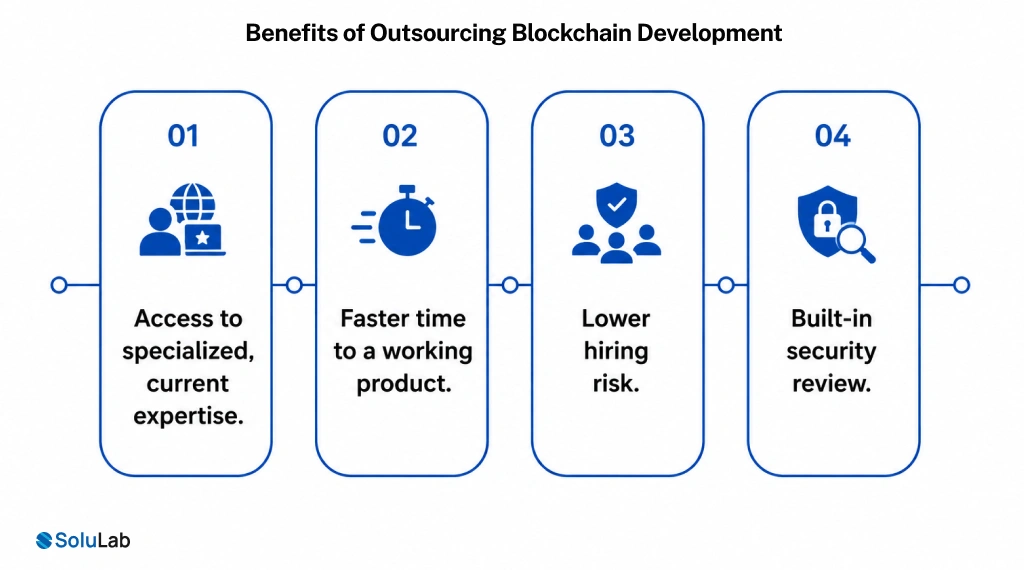
Access to specialized, current expertise. Blockchain moves fast. Layer 2 scaling patterns, gas optimization techniques, and security best practices that were standard eighteen months ago are already outdated. An outsourced team that works across multiple blockchain clients stays current on all of this by necessity. A single in-house hire, however talented, is working from one project’s worth of exposure.
Faster time to a working product. You skip the recruiting cycle entirely. A vetted outsourcing partner can typically start within one to two weeks, compared to the two to four months a specialized blockchain hire often takes to find, interview, and onboard.
Lower hiring risk. If a single in-house blockchain hire turns out to be the wrong fit, you’ve lost months and a meaningful chunk of your budget with little to show for it. An outsourcing contract gives you an exit point built in from day one, and reputable vendors will swap out an underperforming engineer rather than leaving you stuck.
Built-in security review. Smart contract bugs are unforgiving. A contract deployed with a flaw can’t simply be patched after the fact, the way a typical web app can, and exploits have cost projects tens of millions of dollars in a single incident. Established outsourcing partners usually build audit steps into their process rather than treating security as an afterthought, which matters far more for blockchain than for most other software categories.
Risks You Should Actually Watch For
Outsourcing isn’t without downsides, and pretending otherwise would do you a disservice.
Vendor quality varies enormously. The blockchain outsourcing market has attracted plenty of teams that learned the basics during the 2021 hype cycle and never went deeper. Ask for code samples, request references from projects similar in scope to yours, and if you can, have a technical advisor review a sample of the vendor’s prior smart contract code.
IP and confidentiality exposure. Your token economics, your contract logic, and your roadmap are competitive assets. A solid outsourcing contract should include a clear IP assignment clause and a non-disclosure agreement signed before any technical details are shared, not after.
Communication and time zone friction. A twelve-hour time difference can turn a quick clarifying question into a two-day delay. This usually improves with a structured handoff process and overlapping working hours, though results vary depending on how asynchronous your team is comfortable being.
Underestimating total cost of ownership. The hourly rate is only part of the picture. Ongoing maintenance, security monitoring, and feature updates typically run 15 to 25 percent of the initial build cost annually, according to Theblockopedia’s 2026 cost-reduction guide, and startups that budget only for the initial launch often get caught off guard by this recurring expense.
How SoluLab Approaches It?
One useful way to see this play out: an early-stage supply chain startup approached an outsourced blockchain team needing a proof-of-concept tracker built and audited within a single funding milestone. (Illustrative example.) Rather than starting with a custom architecture, the team scoped a minimum viable version tracking a single product category first, layered in a third-party smart contract audit before mainnet deployment, and used an established Layer 2 network to keep gas costs predictable. Most 2026 production apps now default to Layer 2 deployment for exactly this reason, unless there’s a specific need for mainnet liquidity or composability, per CMARIX’s 2026 development cost analysis. The result was a working product ready for investor demos in under ten weeks rather than the six months a from-scratch build would typically require.
That pattern, start narrow, secure early, and pick infrastructure that keeps ongoing costs predictable, is a reasonable template for most startups evaluating an outsourced blockchain development services partner rather than building from zero.
How to Choose a Blockchain Outsourcing Partner: A Practical Checklist
- Verify blockchain-specific experience, not just general development experience. Ask for two or three examples of smart contracts the vendor has shipped to production, and check whether any have been through a third-party security audit.
- Confirm the engagement model fits your stage. Early-stage and pre-seed startups usually benefit most from staff augmentation or a dedicated team rather than a fixed-scope contract, since requirements tend to shift.
- Get a written IP assignment clause before sharing technical details. This should be non-negotiable regardless of how strong the vendor’s reputation is.
- Ask directly about security audit practices. A vendor that treats a third-party audit as optional, rather than standard practice before mainnet deployment, is a warning sign for anything handling real value.
- Test communication before signing a long-term contract. A short paid trial project, even a small one, reveals more about working style and responsiveness than any sales call will.
- Budget for the full lifecycle, not just the build. Factor in the 15 to 25 percent annual maintenance cost mentioned above so your funding runway accounts for the product’s life after launch, not only its launch date.

Getting Started: Your Next Steps
If you’re ready to move forward, here’s a realistic sequence:
- Define your minimum viable scope in writing, resisting the urge to build every feature you can imagine into version one.
- Shortlist three to five vendors and request references from startups at a similar stage to yours.
- Run a small paid trial engagement before committing to a longer contract.
- Put the IP, confidentiality, and audit requirements into the contract terms explicitly, not as a verbal understanding.
- Budget separately for post-launch maintenance so it doesn’t come as a surprise six months in.
Outsourcing blockchain development isn’t a shortcut around doing the work. It’s a way to get the work done by people who already have the specialized skills your product needs, at a cost your runway can actually support. Startups that treat the vendor relationship with the same rigor they’d apply to a technical co-founder search tend to get the best outcomes from it.
If you want to talk through what an outsourced blockchain build could look like for your specific product, SoluLab’s engineering team is a reasonable place to start that conversation.
FAQs
Shipra Garg is a tech-focused content strategist and copywriter specializing in Web3, blockchain, and artificial intelligence. She has worked with startups and enterprise teams to craft high-conversion content that bridges deep tech with business impact. Her work translates complex innovations into clear, credible, and engaging narratives that drive growth and build trust in emerging tech markets.
![How to Choose a Blockchain Development Company [2026 Edition]](https://www.solulab.com/wp-content/uploads/2026/09/Banner-Before-You-Hire-Check-These-Blockchain-Essentials.webp)