Hong Kong isn’t just eyeing crypto, it’s already a hub, with HKD 26.1 billion in transaction volumes across crypto exchange software platforms in H1 2025 alone, up 233% YoY (AMINA Bank). Institutional capital loves the clarity here, especially with 11 SFC‑licensed Virtual Asset Trading Platforms (VATPs) live as of January 2026.
This guide breaks down how to launch your crypto exchange in Hong Kong in 2026: Hong Kong Crypto Exchange License steps, CEX/DEX development choices, white label crypto exchange software vs custom, realistic costs, and scaling strategies for institutions.
Key Takeaways
- The Problem: Most founders underestimate Hong Kong’s SFC licensing, compliance, AML/KYC, custody stack up, delaying launches 12 to 18 months.
- The Solution: Follow a realistic roadmap: Pick CEX/DEX/hybrid early; white-label live in 8–12 weeks ($25k); custom in 6–9 months ($150k+); target institutions.
- SoluLab Edge: After 10+ years in blockchain, SoluLab helps operators launch compliant (white-label or custom) exchanges with tech, liquidity, security, and SFC alignment faster.
Hong Kong Regulatory Landscape for Launching Your Crypto Exchange in Hong Kong
Since June 2023, any centralized platform operating in Hong Kong or actively marketing to Hong Kong investors must be licensed as a Virtual Asset Trading Platform under the Anti‑Money Laundering and Counter‑Terrorist Financing Ordinance (AMLO) and, where relevant, the Securities and Futures Ordinance (SFO).
In practice, this means:
- You need an SFC VATP license if you run a centralized exchange with custody or order‑matching targeted at Hong Kong users.
- Dual licensing (AMLO + SFO) is common when you deal in security‑like tokens or provide automated trading services.
By late 2025, 11 platforms were licensed, including HashKey and OSL, with others in the queue, which gives you an idea of the bar and the competitive set.
Core requirements you must design around
From a build perspective, four big buckets will influence your product and technical roadmap:
- Token admission: Only vetted assets, especially for retail. Tokens must meet liquidity, track record, and due diligence standards, often tied to reputable indices.
- Custody and segregation: Client assets must be segregated and held in qualified custody structures; this directly affects how you implement wallets and treasury.
- KYC/AML and Travel Rule: Full identity verification, transaction monitoring, reporting, and Travel Rule compliance are mandatory.
- Governance and reporting: Audit trails for all trades and movements, clear policies, and regular reporting to the SFC and HKMA.
Plan for 6–9 months from serious preparation to license approval, including external assessments and SFC queries.
Why Are Leaders Choosing Hong Kong to Launch Crypto Exchange Software
Here are the three signals that matter for you:
- Regulated status: The VATP regime, plus separate rules for stablecoin issuers under HKMA, makes Hong Kong one of the most structured digital‑asset regimes in APAC.
- Volume and growth: Digital‑asset trading revenue and volumes in Hong Kong surged in 2025; one report notes a 233% rise in trading volumes in H1 2025 alone, with new capital flowing into regulated venues.
- Institutional tilt: Major banks and institutional players are now launching or backing exchanges in Hong Kong, signalling that this is a venue for “serious money,” not just retail speculation.
This combination makes Hong Kong attractive if your goal is to serve family offices, funds, and corporations that need regulatory clarity and local infrastructure.
Competitive Landscape and Positionin
With 11 licensed platforms already live, including early movers like HashKey and OSL, you’re not entering a vacuum, but you also don’t have to be yet another generic spot exchange. We see three viable positioning plays:
- Vertical specialist: Focus on a narrower slice (e.g., institutional‑only venue, B2B rails, tokenized assets, or stablecoin corridors tied to specific currencies).
- UX and service‑led: Many regulated platforms are still “bank‑like”—functional but not user‑friendly. You can win on onboarding speed, UI quality, and operational responsiveness.
- Infrastructure provider: Use your exchange stack as a base to power partners (fintechs, brokers, banks) via APIs and white‑label deals.
The business case is strongest when you tie Hong Kong as a hub (licensing, reputation, banking access) to a clearly defined customer segment and problem.
Architecture Options for Launching Crypto Exchange Software in Hong Kong: CEX vs DEX vs Hybrid
Your architecture decision locks in the custody model, regulatory scope, and user experience, so you want to get this right before writing code.
Centralized exchange (CEX)
CEX is the default for Hong Kong‑licensed venues:
- How it works: Users deposit into custodial wallets, trades execute on an off‑chain matching engine, and you hold client assets.
- Pros: High speed and throughput, mature UX, easier integration with banks and fiat rails, proven monetization (fees, margin, listings).
- Cons: Full regulatory and custodial burden; higher capital, security and compliance costs.
For Hong Kong, most VATPs are centralized—so if your strategy is full licensing and deep fiat connectivity, CEX is still the natural default.
Decentralized exchange (DEX)
A DEX uses smart contracts and non‑custodial wallets:
- Pros: Users keep keys, settlement is on‑chain, and your custody risk is lower.
- Cons: UX friction, gas costs, fragmented liquidity—plus the regulatory picture is more nuanced if you control the front‑end or capture fees from Hong Kong users.
In the Hong Kong context, a pure DEX is more of a niche or ecosystem play, unless you are very careful with where and how you “operate” and monetize.
Hybrid models
Hybrid architectures seek CEX performance with DEX‑style transparency or custody:
- Typical pattern: Off‑chain matching engine, on‑chain or segregated settlement, optional self‑custody, and strong transparency around reserves.
- Why CXOs like it: You can speak to institutional concerns around counterparty risk while still giving them order quality and access to consolidated liquidity.
For institutional‑facing Hong Kong exchanges, hybrid is increasingly attractive, assuming you design it to fit within VATP requirements and custody rules.

Costs, Budgets & Monetization for Launching Crypto Exchange Software in Hong Kong
Development and setup
You can think in two broad tracks:
White‑label route:
- Typical dev/license cost for modern white‑label crypto exchange software is $13,000–$38,000 for most projects, rising above $60,000 with advanced features and compliance add‑ons.
- 8–12 weeks is realistic for a branded, configured launch if your requirements are clear and you avoid scope creep.
Custom route:
- For 2026, independent estimates put crypto exchange development between $20,000 and $150,000, with white‑label in the $25,000–$50,000 band and more feature‑rich custom cores in the $50,000–$100,000 bracket or higher.
- Timelines in practice: 6–9 months for a production‑grade custom CEX or hybrid with full integrations and testing.
On top of the build cost, you should plan a six‑figure spend for licensing support, audits, and legal work specific to the Hong Kong regime.
Operational and compliance spend
Annual opex will typically include:
- Compliance and legal (staff plus tools, audits, filings).
- Infrastructure and security (cloud, DDoS protection, code and penetration audits).
- Liquidity and market‑making commitments.
- Support and operations headcount.
The SFC regime is resource‑intensive by design; industry commentary notes higher staff‑cost budgets but also higher trust and stickier institutional demand as a result.
Revenue levers
To justify the spend, you need multiple revenue streams:
- Trading fees: Maker/taker models remain the core; even modest daily volume at 0.2–0.3% blended fee scales quickly.
- Listing, withdrawal, and funding fees: Carefully structured so they pass regulatory and reputational tests.
- Staking and yield products: Sharing yields while keeping a margin.
- B2B services: White‑labeling your stack, data/API monetization, or acting as infrastructure for partners.
Global crypto exchange market research suggests a multi‑year CAGR above 20%, with significant upside for regulated venues that secure institutional flows early.
Check Out Our Blog Post: Launch a Crypto Exchange in Indonesia
Go-to-Market Strategy for Institutional Crypto Exchange Software in Hong Kong
In 2026, three segments stand out:
- Local retail and pros: Attracted by regulated status and better protections; need simple onboarding, local fiat ramps, and mobile‑first UX.
- Institutions and family offices: Often access Hong Kong as a regional bridge; they care about custody options, reporting, and governance as much as pricing.
- B2B partners: Fintechs, brokers, banks and corporates wanting exposure or infrastructure without building everything in‑house.
You rarely win all three at once. The strongest exchange plays start with one or two segments and build out from there.
Channels and tactics we suggest
Common patterns we see working:
- Regulation‑led messaging: Lean into your license status, risk controls, and partnerships; that’s the real differentiator versus offshore venues.
- Content and education: Explain Hong Kong’s rules, safe access, and institutional workflows in plain language; this builds trust with non‑crypto CXOs.
- Partnerships: Work with custodians, market makers, and traditional finance brands to borrow credibility and access.
- B2B/API‑first: If your tech is strong, closing a few high‑value B2B deals may be more effective than chasing broad retail adoption in year one.
Make sure marketing is reviewed for compliance—Hong Kong is explicit about banning misleading promotions and certain inducements such as airdrop‑style rewards for retail.
Why Work with a Specialist Development Agency like SoluLab
For a founder or executive, the main risk isn’t – can we build a trading engine?- that’s a solved problem. The risk is burning 12–18 months and seven figures on a platform that fails licensing, cannot pass security review, or doesn’t fit how Hong Kong actually works in 2026.
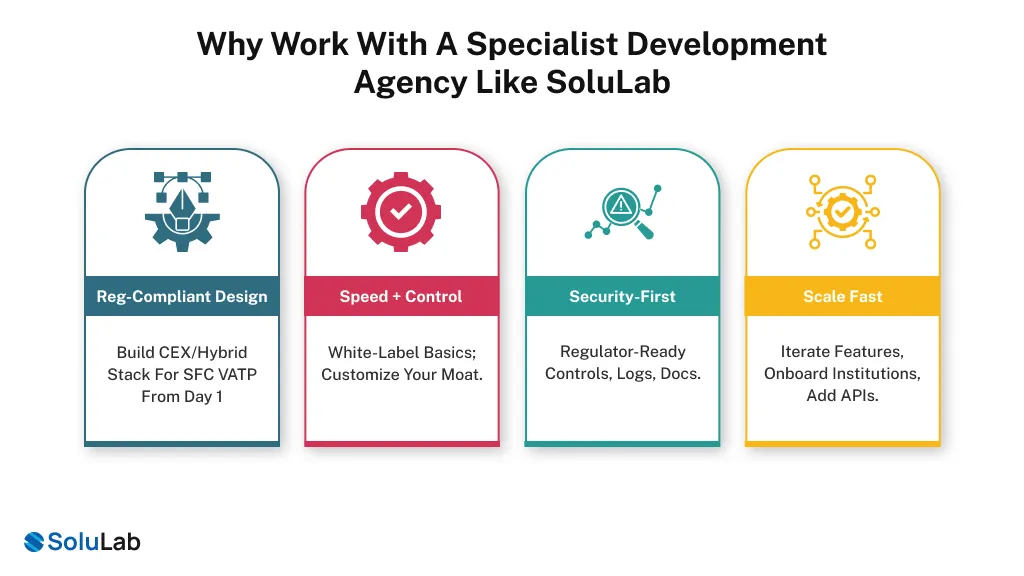
A specialist blockchain development partner like SoluLab helps by:
- Aligning architecture with regulation by designing your CEX/hybrid stack, custody flows, and audit trails around SFC VATP requirements instead of bolting compliance on later.
- Balancing speed and control using white‑label components where it makes sense (matching, wallets, admin) and customizing the layers that define your product and moat.
- Building with security controls, logging, and documentation that external assessors and regulators expect.
- We also help you iterate features, onboard institutions, and extend the stack into APIs or white‑label offerings of your own.
If your goal is to own a long‑term, regulated presence in Hong Kong rather than just launch something, that combination of technical depth and regulatory awareness is often the deciding factor between a functioning exchange and an expensive experiment.

Conclusion
Launching crypto exchange software in Hong Kong in 2026 is serious business, but the opportunity is real. Volumes are up 233%, institutions are entering fast, and clear regulation is pulling global capital into the market.
Success comes down to doing the basics right – SFC licensing, the right architecture, realistic budgets, and compliance-first tech from day one. Shortcuts don’t work here.
With the right partner like SoluLab, you can move faster without breaking rules. The next 12–18 months will decide who wins Hong Kong. Will you be one of them?
FAQs
With over 3 years of experience, I specialize in breaking down complex Web3 and crypto concepts into clear, actionable content. From deep-dive technical explainers to project documentation, I help brands educate and engage their audience through well-researched, developer-friendly writing.