Key Takeaways
- Most enterprises don’t actually need to rip out legacy systems to adopt Web3. They need the right integration layer sitting between the two.
- Legacy databases, ERPs, and core banking platforms were never built to talk to a distributed ledger, and that gap tends to be the single biggest obstacle enterprises run into.
- API-based and middleware setups are the most common starting points, mostly because they skip the need for a full system rebuild.
- Security testing and ongoing monitoring matter just as much as the integration itself. A blockchain layer bolted on carelessly creates new holes, not fewer.
- Supply chain and banking currently account for most live enterprise blockchain deployments, but healthcare, insurance, and government are catching up quickly.
A lot of enterprise IT teams want what Web3 offers. Real-time transparency, tamper-proof records, and fewer intermediaries sitting in the middle of every transaction. The problem is they’re sitting on decades of legacy infrastructure that was never built with any of that in mind.
Core banking platforms, hospital record systems, and manufacturing ERPs, they run on centralized databases with zero concept of a wallet, a smart contract, or a distributed ledger.
Leave that mismatch alone, and it turns into a real cost pretty fast. Teams either stall out waiting on a “someday” rebuild, or they bolt blockchain technology features on so carelessly that new security gaps open up faster than old inefficiencies close.
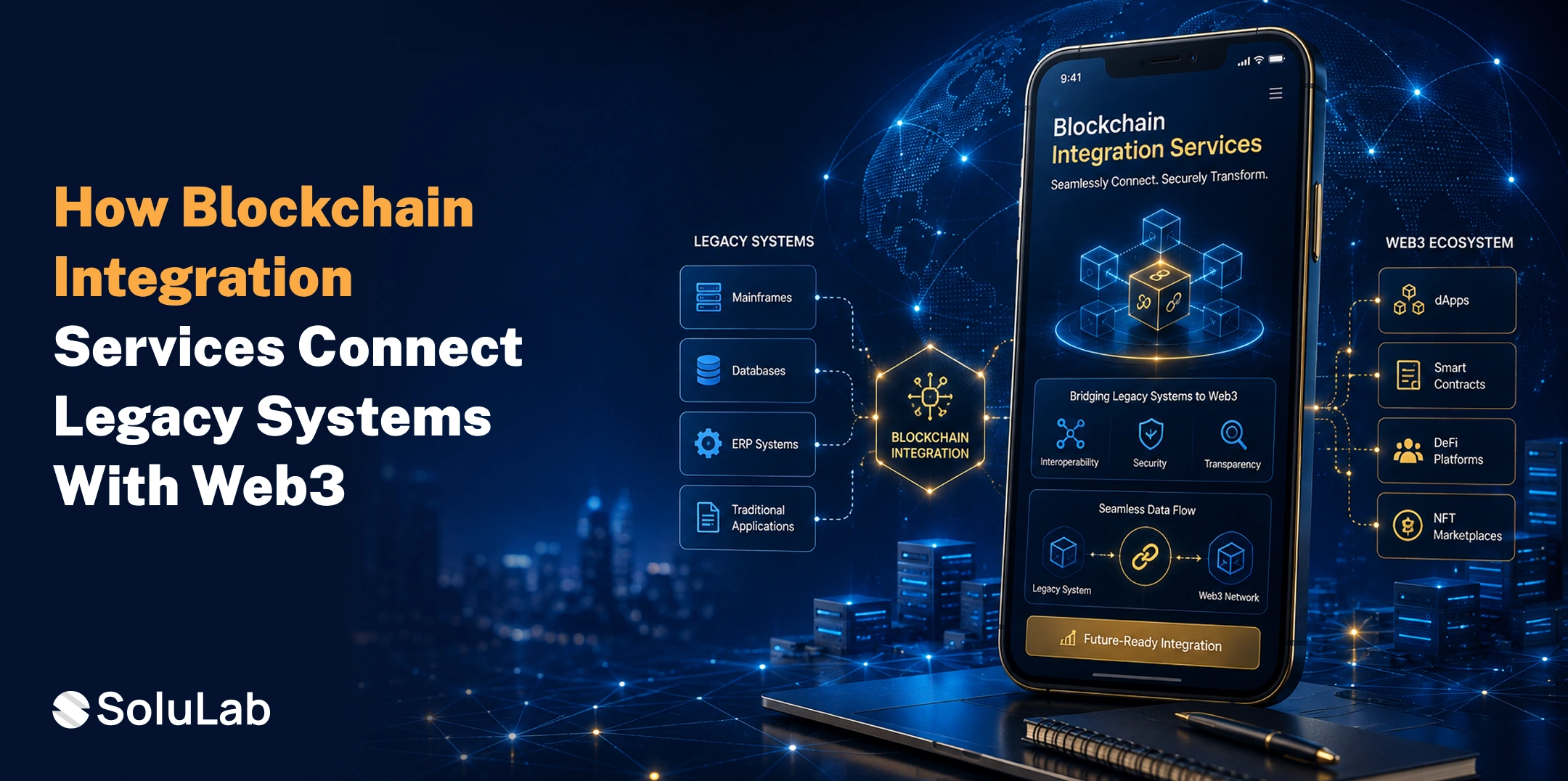
Neither path really works. Blockchain integration services take a different approach: connect legacy systems to Web3 through APIs, middleware, and oracles, without tearing out whatever’s already running the business day to day.
Understanding Blockchain-Legacy System Integration
At its core, this kind of integration means building a bridge between two systems speaking completely different languages. Legacy software runs on centralized databases, SQL queries, internal APIs, and predictable request-response patterns.
Deloitte states that Web3 reduces reliance on intermediaries, enabling faster, more transparent, and more secure digital transactions.
Web3 infrastructure runs on distributed nodes, cryptographic wallets, and smart contracts that fire off on their own once triggered. A skilled blockchain development company builds the translation layer between the two worlds, so data, transactions, and events can move between them without either system needing a ground-up rebuild.
Why Legacy Systems Struggle with Web3?
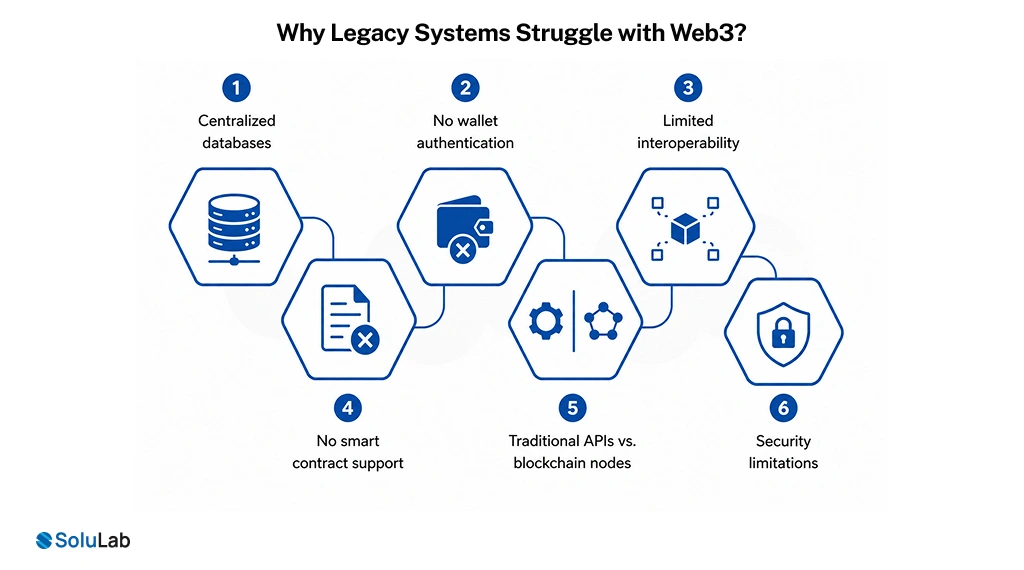
The friction isn’t really about age. Older systems can be perfectly fine at what they were built to do. The problem is that Web3 assumes a completely different architecture from the ground up.
- Centralized databases. Legacy systems keep a single source of truth in one place, which runs against blockchain’s entire premise of distributed, tamper-proof records.
- No wallet authentication. Most enterprise software still authenticates with usernames and passwords, not cryptographic wallet signatures.
- Limited interoperability. Older systems were built to talk to a handful of known internal services, not an open, permissionless network.
- No smart contract support. There’s simply no native way for a legacy system to trigger or respond to on-chain logic without a translation layer sitting in between.
- Traditional APIs vs. blockchain nodes. REST APIs expect quick, synchronous responses. Blockchain transactions can take time to confirm, and that breaks a lot of assumptions baked into older code.
- Security limitations. Legacy security models weren’t designed around private key management or on-chain transaction integrity, so gaps show up fast without careful, deliberate design.
Which Legacy Systems Can Be Connected to Web3?
More systems qualify than most IT teams initially assume, as long as there’s a clear reason to connect them. ERP platforms, core banking software, hospital record systems, supply chain databases, CRM platforms, and manufacturing execution systems are all realistic candidates for enterprise blockchain development.
The deciding factor usually isn’t the age of the system. It’s whether the process it manages actually benefits from the transparency, auditability, or automation that blockchain adds.
Common Blockchain Integration Architectures
There’s no single “right” way to connect legacy software to Web3. Which architecture makes sense depends heavily on how much change the existing system can actually tolerate.
- API-based integration. REST or GraphQL APIs expose blockchain functionality to legacy systems without touching their core codebase.
- Middleware integration. A dedicated middleware layer translates and queues requests between legacy databases and blockchain nodes.
- Oracle-based integration. Oracles feed real-world data into smart contracts and push on-chain events back into legacy systems.
- Event-driven architecture. Blockchain events trigger workflows in legacy systems asynchronously, instead of forcing a synchronous, blocking connection.
- Hybrid cloud architecture. On-chain and off-chain components run side by side, with sensitive data staying put in traditional cloud infrastructure.
- Multi-chain integration. Some enterprises need to connect legacy systems to more than one blockchain at once, which adds real complexity but avoids vendor lock-in down the line.
Blockchain Legacy System Integration Process (Step-by-Step)
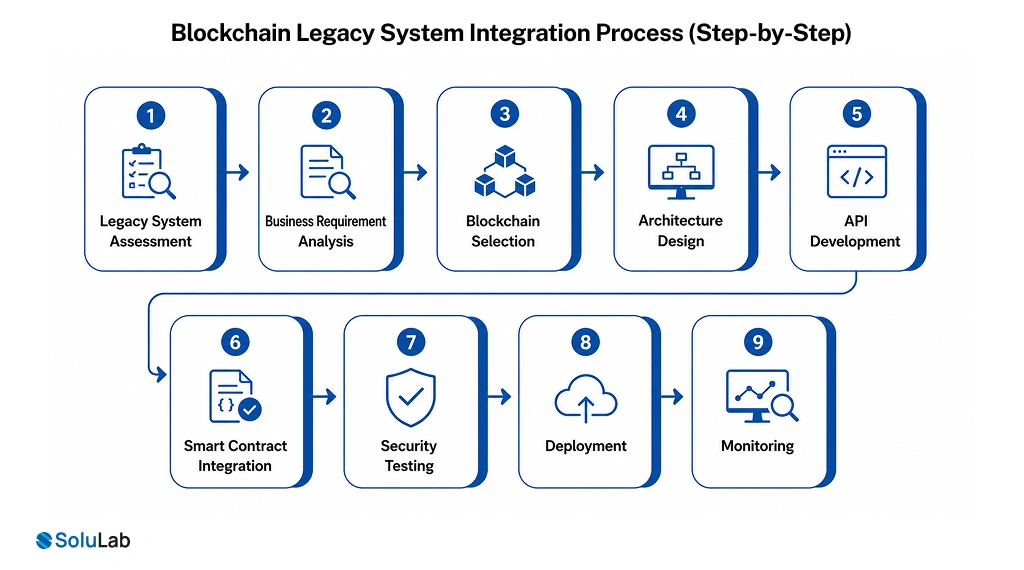
Getting this right takes a structured sequence, and skipping a step here is usually where projects run into expensive surprises later on.
1. Legacy System Assessment
Before touching any code, the existing system needs a full audit of its architecture, data structure, and integration points.
- Map the current system architecture
- Identify integration bottlenecks early
- Document existing data flows
2. Business Requirement Analysis
Every integration should tie back to a specific, measurable business outcome, not just a general curiosity about blockchain.
- Define exact use case scope
- Set measurable success metrics
- Involve stakeholders across departments
3. Blockchain Selection
Choosing the right chain comes down to transaction speed, cost, privacy needs, and whether a public or permissioned network actually fits better.
- Compare public vs permissioned options
- Match chain to compliance needs
- Factor in ongoing gas costs
4. Architecture Design
This is where the integration pattern, API-based, middleware, or hybrid, actually gets mapped out in real detail.
- Design data flow end-to-end
- Plan for system scalability
- Document security requirements upfront
5. API Development
Custom APIs get built so legacy systems can read from and write to the blockchain layer.
- Build secure API endpoints
- Handle blockchain latency gracefully
- Test against real legacy data
6. Smart Contract Integration
Smart contracts get connected to trigger or respond to events happening inside the legacy system itself.
- Deploy audited smart contracts
- Connect contract events to APIs
- Validate contract logic thoroughly
7. Security Testing
Before anything touches production, the whole integration needs rigorous testing against real attack scenarios, not a quick once-over.
- Run penetration testing thoroughly
- Audit smart contracts independently
- Test wallet and key security
8. Deployment
Rollout happens in controlled phases, not as one single, high-risk cutover.
- Deploy to a limited environment
- Monitor early transactions closely
- Keep a documented rollback plan
9. Monitoring
Ongoing monitoring catches issues that only ever surface once real transaction volume actually hits the system.
- Track on-chain and off-chain performance
- Watch for anomalous transaction patterns
- Update integrations as chains evolve
Real-World Enterprise Use Cases
Here are some blockchain use cases for legacy systems in web3, including banking, healthcare, insurance and more:
1. Supply Chain Monitoring
Tracking goods from origin to delivery on-chain gives every party the same tamper-proof view, which cuts down on disputes over what actually happened at each stage.
2. Banking
Cross-border settlement and trade finance benefit from faster, more transparent transactions than legacy correspondent banking rails typically allow.
3. Healthcare
Patient consent and access logs can be recorded immutably without ever putting sensitive medical data directly on-chain.
4. Insurance
Claims processing and fraud detection improve once policy and claims data are verifiable across multiple parties in real time.
5. Manufacturing
Component provenance and quality certification become a lot harder to falsify once they’re tracked on a shared, tamper-proof ledger.
6. Government
Public records, land titles, and procurement processes gain an auditable trail that’s genuinely difficult for any single party to quietly alter.
7. Retail
Loyalty programs and product authenticity verification give customers a way to confirm what they’re buying is real, instead of just taking a brand’s word for it.
Future Trends in Enterprise Blockchain Integration
Here are some future trends you’ll see in the next few years:
1. AI + Blockchain
Combining AI’s pattern recognition with blockchain’s verifiable data creates systems that end up both smarter and more trustworthy at once.
2. Agentic AI with Blockchain
Autonomous agents are starting to execute on-chain transactions directly, which raises new questions around permissions and who’s actually accountable when something goes wrong.
3. Cross-Chain Interoperability
Bridges and standards that let different blockchains communicate are becoming less of a workaround and more of a baseline expectation.
4. Zero-Knowledge Proofs
ZK proofs let enterprises verify information without exposing the underlying data, which matters a lot for compliance-heavy industries, especially.
5. Tokenized Assets
Real estate, commodities, and equities are increasingly represented as digital tokens, opening up fractional ownership and much faster settlement.
6. Decentralized Identity (DID)
Users are gaining more control over their own identity credentials instead of relying on one centralized authority to vouch for them every time.
7. Real-World Asset (RWA) Tokenization
Physical assets moving on-chain is quickly becoming one of the more active corners of enterprise blockchain, and it’s one of the Web3 trends worth watching closely heading into 2026.
8. Enterprise Wallets
Purpose-built wallets designed for corporate governance and multi-signature approval are replacing the consumer-grade wallets enterprises used to just make do with.
Why Businesses Must Partner with SoluLab for Blockchain Integration Services?
Here is how SoluLab can help you with legacy modernization, multi-chain development, and more:
1. Legacy Modernization
SoluLab’s team specializes in connecting decades-old systems to Web3 infrastructure without forcing a disruptive, full ground-up rebuild.
2. Multi-Chain Development
SoluLab builds across Ethereum, Polygon, Solana, and permissioned frameworks like Hyperledger, with a team that businesses can also hire blockchain developers from directly for ongoing integration work.
3. API Integration
Custom, secure APIs connect legacy databases and blockchain nodes without exposing sensitive internal systems to unnecessary risk.
4. Security-First Architecture
Every integration gets built with penetration testing, smart contract auditing, and key management baked in from day one, not added on afterward.
5. End-to-End Consulting
From initial assessment through deployment and monitoring, SoluLab’s team stays involved across the full lifecycle, not just the build phase and nothing after.
Conclusion
Connecting legacy systems to Web3 isn’t really about choosing between the old and the new. It’s about building the bridge that lets both work together at once.
The right architecture, careful security testing, and a phased rollout are usually what separates an integration that actually sticks from one that quietly gets rolled back six months in.
SoluLab, a blockchain development company in USA, can help your business connect existing systems to Web3 without the disruption of starting from scratch.
FAQs
Neha is a curious content writer with a knack for breaking down complex technologies into meaningful, reader-friendly insights. With experience in blockchain, digital assets, and enterprise tech, she focuses on creating content that informs, connects, and supports strategic decision-making.