Key Takeaways
- Content pipeline is the product. Ingest, transcoding, DRM and CDN decide both the architecture and the monthly bill. The app layer is the easy part.
- Discovery beats catalogue size. If a user cannot find something worth watching in under a minute, how much content you hold is irrelevant.
- Ship flawless playback first. Recommendations, social features and casting are differentiators, not v1 requirements. A recommendation engine over a catalogue that buffers just recommends things that buffer.
- DRM is a commercial requirement, not a technical nicety. Rights holders ask which systems you support before granting a licence, and supporting all three major ones adds real cost.
- Delivery cost scales with minutes watched. Architecture decisions made in week one determine whether the unit economics work at a million users. Model it before building.
- Store rules constrain your revenue model. Digital content sold in-app generally has to use store billing at their commission, which changes the business case rather than just the checkout.
- Soft launch matters more here than in most categories. Entertainment apps fail on device fragmentation and network variability, and neither shows up on a developer’s handset on office wifi.
An entertainment app development company builds the products people open for enjoyment rather than utility: video and music streaming, live and short-form video, games, ticketing and events, sports and fan engagement, reading and comics, and immersive AR or VR experiences. What separates an entertainment build from a standard app is the content pipeline and the economics around it.
You are handling licensed media, protecting it with DRM, delivering it through a CDN at a cost that scales with every minute watched, and monetising it through subscriptions or advertising that the app stores take a cut of.
On this page: what these services cover, the app types you can build, which features matter, the streaming and DRM stack, monetisation and store rules, licensing and compliance, cost drivers, and how to evaluate a partner.
What Does an Entertainment App Development Company Do?
A full-scope engagement covers six things, and the second is where entertainment builds diverge from everything else.
- Discovery and model definition. What the audience opens the app for, how often, and how the business earns. Subscription, ad-supported, transactional and hybrid models produce different products.
- Content pipeline design. Where media comes from, how it is ingested, transcoded, stored, protected and delivered. This decides both the architecture and the monthly running cost.
- UX and UI design. Discovery is the product. If a user cannot find something worth watching or listening to in under a minute, the catalogue size is irrelevant.
- Engineering. Client apps across phone, tablet, TV and web, plus the backend holding catalogue, entitlements, playback state and user profiles.
- Testing under real conditions. Poor networks, mid-stream quality switches, background playback, device fragmentation and launch-day traffic spikes.
- Launch and iteration. Store submission, then measuring retention and watch time rather than installs.
The engineering sits within mobile app development services, and the pipeline and architecture stage is usually scoped as software consulting before a build is quoted.
What Types of Entertainment Apps Can You Build?
The category covers several distinct engineering problems with different economics.
| App type | What it does | Main technical challenge |
| Video streaming and OTT | On-demand catalogue across mobile, web and TV | DRM, transcoding and CDN cost at scale |
| Music and audio streaming | Playlists, offline, background playback | Licensing, offline entitlement, gapless playback |
| Live streaming | Real-time broadcast with chat and reactions | Low latency, concurrency spikes, moderation |
| Short-form video | Vertical feed, creator tools, recommendations | Feed ranking and upload processing throughput |
| Gaming and social gaming | Real-time play, progression, in-app purchases | Latency, cheat prevention, state sync |
| Ticketing and events | Discovery, booking, digital tickets, entry scanning | Inventory contention at on-sale moments |
| Sports and fan engagement | Live scores, highlights, fantasy, community | Real-time data feeds and rights restrictions |
| Reading, comics and audiobooks | Catalogue, reader, downloads, subscriptions | Content protection and offline sync |
| Immersive AR and VR | Interactive and spatial experiences | Device performance and content production cost |
Streaming platforms specifically are covered in more depth on SoluLab’s OTT app development page. For the immersive end, see AR app development, AR/VR app development and metaverse development.
Which Entertainment App Features Actually Matter?
This is where budgets quietly double. The split below separates what a first release genuinely needs from what differentiates a product later.
| Feature | v1 must-have | Differentiator | Why |
| Reliable playback with adaptive bitrate | Yes | — | The single thing users judge the app on |
| Search and browse | Yes | — | Discovery is the product, not a navigation detail |
| Accounts, profiles and watch state | Yes | — | Resume-where-you-left-off is table stakes |
| Subscription or purchase flow | Yes | — | The revenue path, and store rules constrain it |
| Offline downloads | Usually | — | Commutes and flights are prime consumption time |
| Push notifications | Yes | — | The main lever for return visits |
| Personalised recommendations | No | Yes | Needs viewing history volume to beat editorial curation |
| Social and community features | No | Yes | Powerful with an audience, dead weight before one |
| Live chat and reactions | Depends | — | Essential for live products, irrelevant for VOD |
| TV and casting apps | No | Yes | High value for video, and a separate build each |
The pattern: ship flawless playback and findable content, then earn the rest. A recommendation engine over a catalogue nobody can stream reliably just recommends things that buffer.
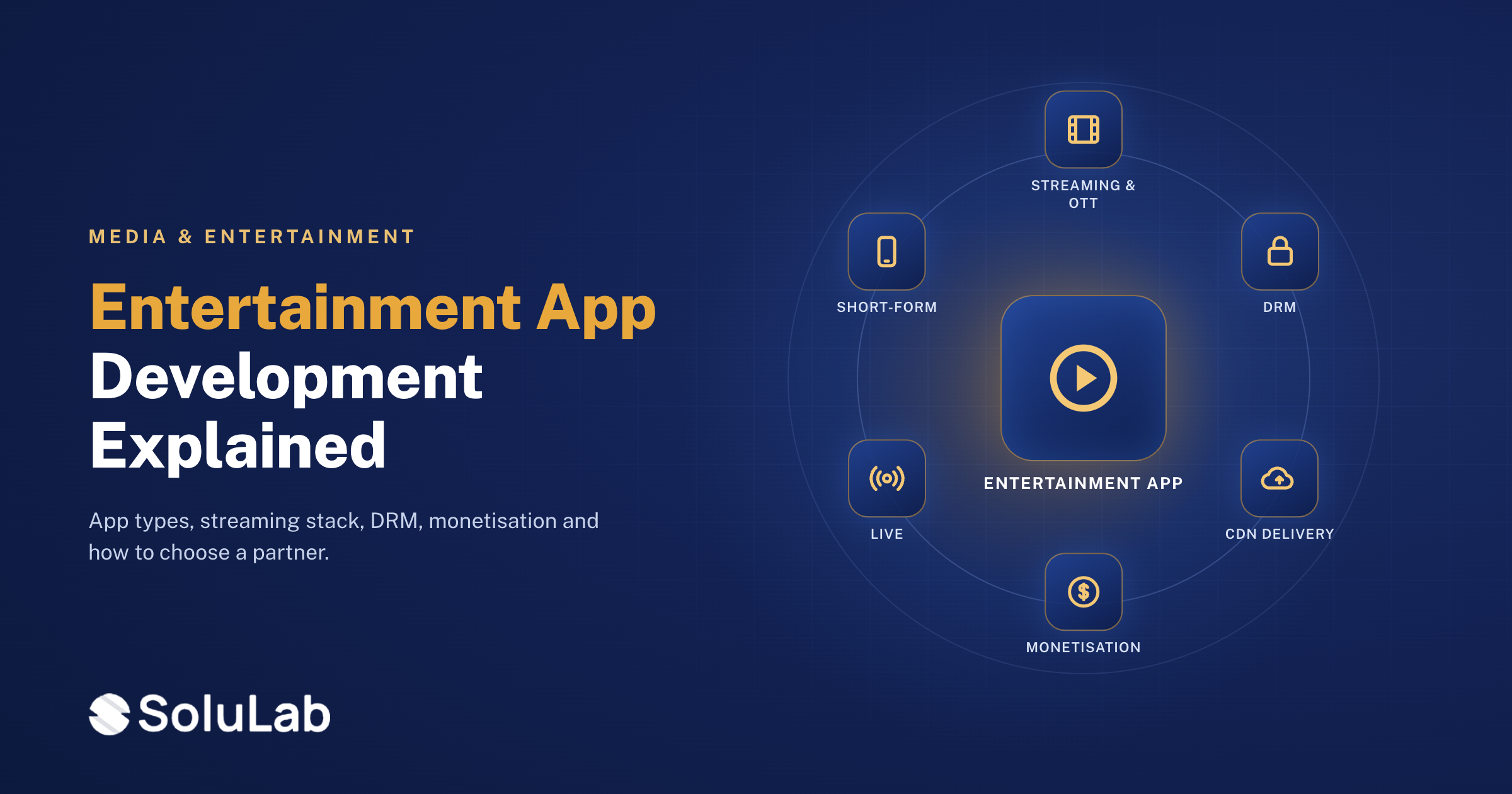
What Streaming Stack and Integrations Does It Need?
This is the section that separates entertainment builds from generic app work.
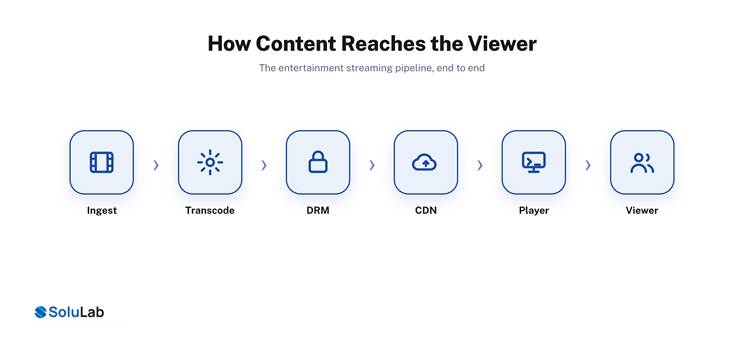
Ingest and transcoding. Source media has to be converted into multiple renditions so the player can switch quality as bandwidth changes. Transcoding is a real cost line, and the ladder of renditions you choose sets it.
Streaming protocols. HLS and MPEG-DASH deliver adaptive bitrate playback. Getting segment length and the rendition ladder right is what stops the picture dropping every time someone walks into a lift.
DRM. Widevine, FairPlay and PlayReady between them cover the major platforms, and licensed content usually requires all three. Rights holders will ask which you support before granting a licence, so this is a commercial requirement, not a technical nicety.
CDN and delivery. Delivery cost scales with minutes watched, which means architecture decisions made in week one determine whether the unit economics work at a million users. Model this before building, not after.
Player SDKs. Separate players and quirks per platform: iOS, Android, web, smart TV and console. Each is its own test matrix.
Monetisation. In-app purchase and subscription billing through the app stores, with their commission and their rules, plus ad serving through VAST and VMAP with server-side ad insertion where the experience needs to stay seamless.
Backend and infrastructure. Catalogue, entitlements, playback state and analytics, built on a proper cloud computing and DevOps foundation, because launch traffic in entertainment arrives all at once rather than gradually.
Optional layers. AI development and machine learning development for recommendations, ranking and content tagging, chatbot development for support at scale, and NFT development or blockchain game development where collectibles or ownership are part of the product. SoluLab’s write-up on AI in media and entertainment covers the AI side in more depth.
What Licensing, Store and Compliance Rules Apply?
Entertainment apps carry obligations that most app categories do not.
- Content licensing and territory rights. What you may show, where, and for how long. Geo-restriction and rights expiry have to be enforced in the product, and a catalogue that ignores territory will end the licence.
- App store rules on payments. Digital content sold in-app generally has to use the store’s billing, with the commission that implies. Design the business model around this rather than discovering it at review.
- Age ratings and content classification. Required at submission, and inaccurate ratings get apps pulled rather than just rejected.
- Children’s privacy. If under-13 users are in scope, COPPA and equivalent rules apply and change what you may collect and how you may advertise.
- Data protection. Viewing history is personal data under GDPR and equivalent regimes, and it is the exact data recommendation engines depend on.
- Accessibility. Captions, audio description and screen reader support are increasingly a legal requirement rather than a nice-to-have, and retrofitting captions across a catalogue is expensive.
Store commission rates, age rating requirements and territory obligations change and vary by market, so confirm the current position with legal counsel before committing to a monetisation model. Getting this wrong after launch usually means re-architecting billing.
How Does the Development Process Work?
- Discovery and model. Audience, consumption pattern and revenue model, plus which platforms matter first.
- Content pipeline design. Ingest, transcoding, DRM and CDN, with delivery cost modelled against realistic usage before any code is written.
- UX and prototype. Browse, search and playback tested on a real catalogue, not three sample files.
- Build and integrate. Apps, backend and player integrations in agile sprints with regular demos on real devices.
- Soft launch. One market or a limited audience, long enough to expose playback failures across networks and devices at real cadence.
- Scale and iterate. Platform by platform, measuring retention, watch time and churn rather than installs.
The soft launch matters more here than in most categories. Entertainment apps fail on device fragmentation and network variability, and neither shows up on a developer’s handset on office wifi.
What Drives Entertainment App Development Cost?
There is no honest flat figure, because a single-platform audio app and a multi-device streaming service are different orders of work. What moves the budget:
- Number of platforms. Phone, tablet, web, smart TV and console are separate builds and separate test matrices.
- DRM requirements. Supporting all three major DRM systems adds integration and licensing cost, and rights holders often make it non-negotiable.
- Live versus on-demand. Low-latency live streaming with chat costs materially more than VOD.
- Content operations. Ingest, metadata, artwork, captions and translations are a production cost, not just an engineering one.
- Expected concurrency. Architecture for a launch spike is different from architecture for steady growth.
- Recommendation and personalisation depth. Editorial curation is cheap, a trained ranking model is not.
Ongoing delivery cost is the number most projects underestimate. SoluLab’s mobile app development cost guide covers the build side; model CDN and transcoding separately, because they keep running after launch.
How Do You Choose an Entertainment App Development Partner?
Six checks, in rough order of how much they predict the outcome.
- Shipped streaming or media apps, not just apps. Ask specifically about DRM integration and smart TV builds, because that is where the category’s hard problems live.
- A modelled view of delivery cost. A partner who has not asked about catalogue size and expected watch hours has not understood the economics.
- Discovery before quoting. A fixed price offered before a platform and rights conversation is a guess you will pay for later.
- A real device testing setup, covering older Android handsets and at least the main TV platforms, not simulators.
- Named engineers and a communication structure — a point of contact, regular demos, a shared tracker.
- A defined post-launch model. Player SDKs, DRM and store rules all change on someone else’s schedule, and an app that stops shipping updates stops playing.
Walk away from a quote with no discovery call, a portfolio you cannot verify, or a proposal that treats DRM and CDN as line items rather than architecture.
Where Does SoluLab Fit?
SoluLab builds customer-facing media and entertainment products: streaming and OTT apps, music and audio platforms, social and community features, and the AI and data layers behind discovery and recommendations. Delivered work includes MusicalApp, and further projects are listed in the SoluLab case studies library. MusicalAppSoluLab case studies
Engagements run through mobile app development and custom software development, with streaming-specific capability on the OTT app development side. Platform businesses rather than single apps often start from SaaS product development, and teams needing capacity rather than a full build can hire dedicated developers.
Frequently Asked Questions
Neha is a curious content writer with a knack for breaking down complex technologies into meaningful, reader-friendly insights. With experience in blockchain, digital assets, and enterprise tech, she focuses on creating content that informs, connects, and supports strategic decision-making.