A carbon credit NFT marketplace turns verified carbon offsets into NFTs on a public blockchain. That gives each credit a unique on-chain ID, a visible retirement trail, and it kills the double-counting problem that has plagued this market for years. Buyers can pick up fractional credits, dig into the underlying project data themselves, and retire credits without a broker sitting in the middle. Toucan Protocol and Moss.Earth have already moved hundreds of thousands of tonnes of voluntary carbon credits on-chain. That is the technical pattern most of this architecture still follows.

The Carbon Credit Conundrum
The Kyoto Protocol landed in 1997. The Paris Agreement followed in 2015. Both set targets for cutting CO2 emissions worldwide, and nearly every nation on earth signed on, all but six. That near-universal buy-in pushed countries to write their own emission targets into law, along with the regulatory frameworks needed to enforce them.
As those regulations take hold, businesses are scrambling for ways to cut their emissions footprint. Right now, the go-to fix, at least in the interim, is buying into carbon markets.
Read Our Blog: Top 10 Carbon Crypto Companies to Watch Out in 2025
Carbon credits sit at the center of the fight against climate change. Each one represents a measurable cut in greenhouse gas emissions, and together they nudge individuals and organizations toward shrinking their own footprint. Traditionally, these get traded as certificates or permits, usually inside markets that are anything but simple.
But the traditional trading model has real limits: opacity, and access that is restricted to a handful of players. Carbon Credit NFTs step into that gap, offering a newer way to cut emissions while still making some money on the side.
Carbon credits let companies shrink their environmental footprint by funneling money into conservation projects around the world. And they can be resold. If a company ends up with more credits than it needs, it can flip the surplus to someone else for a profit.
Tesla is the textbook example here. In the first quarter of 2021 alone, the company pulled in $518 million just from selling carbon credits to legacy automakers.
Understanding the Operational Framework of Carbon Credit NFTs
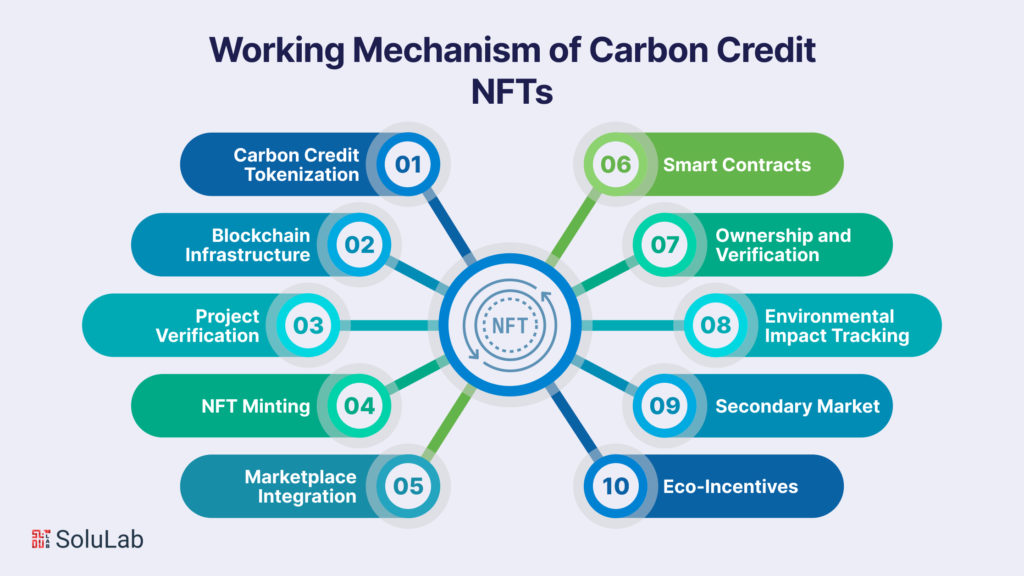
Carbon Credit NFTs run on a system that stitches together blockchain, environmental conservation work, and tokenization. That combination is what makes the whole climate solution function. Here is how it actually works, step by step:
- Carbon Credit Tokenization: It starts by converting a traditional carbon credit into a digital token, specifically an NFT. Each one maps to a set quantity of emissions that a verified project has reduced or offset.
- Blockchain Infrastructure: These NFTs sit on a blockchain, a decentralized ledger that cannot be quietly edited after the fact, which is exactly what you want when recording and checking transactions. Popular blockchain platforms like Ethereum get used for this most often.
- Project Verification: Before tokenization happens, a carbon credit goes through a strict verification process, one that checks the underlying project against established environmental standards and confirms the emissions numbers actually add up.

- NFT Minting: Once a credit clears verification, it gets minted as an NFT: unique, indivisible, tied to one specific reduction achievement.
- Marketplace Integration: From there, the NFT lands on a specialized marketplace where buyers and sellers trade it directly, turning what used to be a paper-based exchange into a digital one.
- Smart Contracts: Self-executing code, running on the blockchain, sets the rules for trading on the marketplace. It automates the whole thing, so a transaction fires the moment its conditions are met, ownership transfers the second a purchase clears, no manual step in between.
- Ownership and Verification: Every NFT’s ownership gets logged on-chain, so there is a clear, tamper-resistant record of who holds what. Want to check if one is legitimate? Just pull up the blockchain’s history.
Check Out the Blog: Best Tron NFT Marketplace Platforms of 2025
- Environmental Impact Tracking: Each NFT doubles as a traceable record of the actual environmental impact behind it. Buyers can measure, and follow, exactly how much their purchase contributed to cutting emissions.
- Secondary Market: You can resell these NFTs. Companies and individuals both buy and sell them on the open market, which keeps the whole space active and keeps the incentive to reduce carbon flowing.
- Eco-Incentives: Some of these NFTs bundle in extra perks, rewards for holders who keep up sustainable practices, which gives people a reason to stay involved instead of buying once and forgetting about it.
Facts and Benefits of Carbon Credit NFT Marketplace
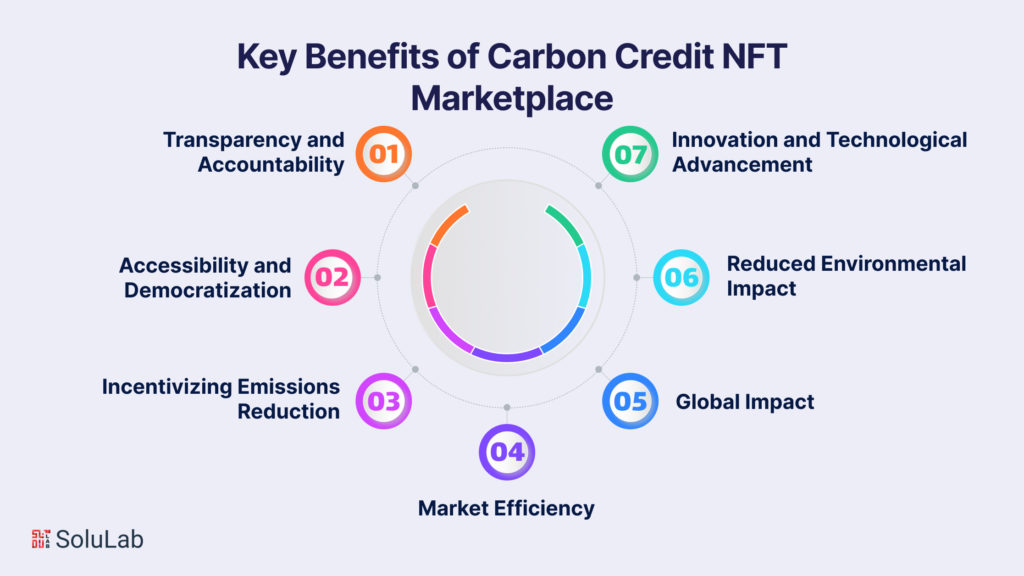
Carbon Credit NFT Marketplaces bring a mix of benefits, some environmental, some just plain profitable. Below are the ones worth knowing, backed by numbers:
- Transparency and Accountability
Fact: EY (formerly Ernst & Young) reported that blockchain, the tech underneath most NFT and carbon credit platforms, can cut fraud and errors in carbon credit trading by as much as 99%, mostly by making transactions traceable and transparent.
Benefit: These marketplaces keep an immutable ledger tracking a credit’s entire lifecycle, which is what transparency and accountability actually look like in practice. That builds real confidence for buyers and investors. And honestly, that is the whole point of going digital in the first place: giving everyone involved a system they can actually trust.
- Accessibility and Democratization
Fact: The World Bank counts more than 60 jurisdictions worldwide that have already rolled out, or are about to roll out, some form of carbon pricing initiative, carbon credit markets included.
Benefit: These marketplaces open the door to people and small organizations who were locked out before. Now sustainability is not just a big-company game, the load gets spread wider.
- Incentivizing Emissions Reduction
Fact: The International Emissions Trading Association (IETA) estimates carbon pricing mechanisms, carbon credits among them, could shave off up to 19 GtCO2e in global emissions per year by 2030.
Benefit: The point of Carbon Credit NFTs is to bake incentives directly into the system, giving companies and individuals an actual reason to cut emissions faster, not just a moral one.
- Market Efficiency
Fact: The Environmental Defense Fund found that carbon pricing, carbon credit markets included, could drive more than $200 billion a year into clean energy investment.
Benefit: These marketplaces tighten up how carbon credits trade, which channels money into clean energy and sustainable projects, and that, in turn, feeds economic growth.
Check Our Press Release: SoluLab Empowers Companies with Carbon Credit Marketplace to Foster Environmental Responsibility
- Global Impact
Fact: Per the UNFCCC, carbon credits sold under the Clean Development Mechanism (CDM) added up to $400 billion cumulatively by 2020.
Benefit: These marketplaces feed into the larger global fight against climate change, pulling serious investment toward environmental projects and helping countries actually hit their emission targets instead of just setting them.
- Reduced Environmental Impact
Fact: McKinsey & Company puts the ceiling on carbon offsetting programs, the kind carbon credits support, at 11 to 20 gigatons of avoided emissions per year by 2030.
Benefit: Carbon Credit NFTs give individuals and companies a direct lever to pull on their own footprint, rather than waiting on policy to do it for them.
- Innovation and Technological Advancement
Fact: Blockchain adoption in carbon credit markets keeps climbing. MarketsandMarkets projects the global blockchain market will hit $39.7 billion by 2025, a sign of just how fast the underlying tech is moving.
Benefit: These marketplaces push innovation forward by fusing blockchain with environmental conservation, which keeps producing new approaches to a genuinely hard problem.
Use Cases of Carbon Credit NFT Marketplaces
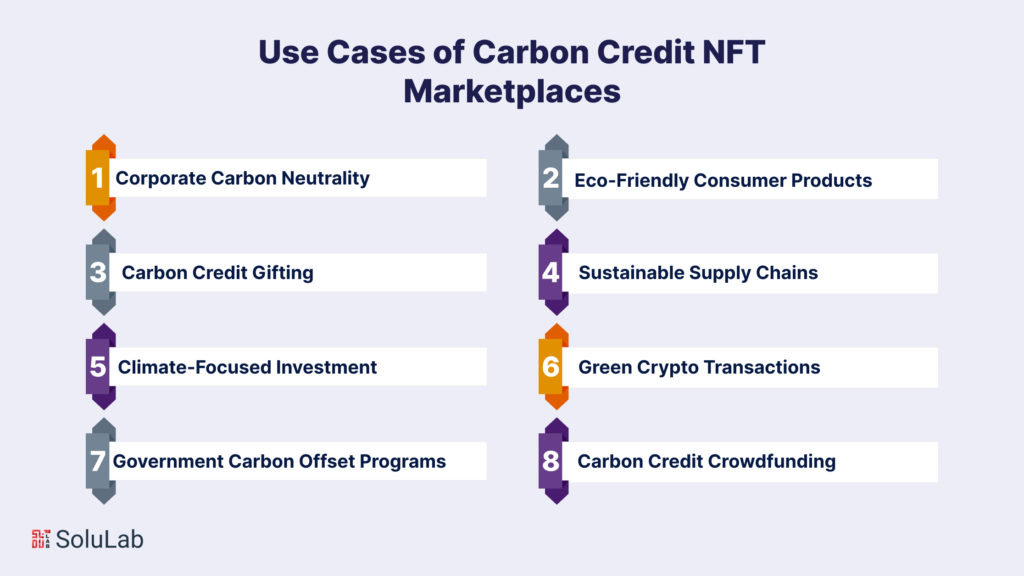
Carbon Credit NFT Marketplaces are changing how carbon credits get traded and used, full stop. Here is a rundown of the ways these platforms are showing up in practice, each with a real-world example attached so it is less abstract.
- Corporate Carbon Neutrality
Large corporations chasing carbon neutrality can buy verified carbon credits straight from these marketplaces and offset their emissions that way.
Example: A tech giant buys Carbon Credit NFTs matched to its data centers’ emissions output, and that is how it hits its sustainability commitments.
Have A Look at Our Blog: What are the Benefits of Using Digital Identity with Blockchain in the Future?
- Eco-Friendly Consumer Products
Companies making eco-friendly products can back up that claim with action, bundling Carbon Credit NFTs into merchandise like customized clothing, so customers can offset the footprint of whatever they just bought.
Example: A clothing brand tucks a Carbon Credit NFT into every organic cotton custom t-shirt sold, so each purchase quietly funds a reforestation project.
- Carbon Credit Gifting
People can gift these NFTs to friends and family. It is a small nudge toward environmental awareness, dressed up as a thoughtful present.
Example: Someone gifts a Carbon Credit NFT for a loved one’s birthday, a small symbol pointed at a greener future.
- Sustainable Supply Chains
Companies can green their supply chains by working with suppliers who already use Carbon Credit NFTs to offset the emissions tied to production and shipping.
Example: An automaker partners with suppliers using Carbon Credit NFTs to offset emissions across the whole chain, from raw material extraction down to final assembly.
Read Also: How To Launch Your Own NFT Marketplace Website in Less Than 2 Days?
- Climate-Focused Investment
Investors can diversify into Carbon Credit NFTs, backing carbon reduction projects while leaving room for the NFT’s own value to climb.
Example: An environmentally minded investor buys Carbon Credit NFTs tied to renewable energy projects, putting their money where their values already are.
- Green Crypto Transactions
Crypto exchanges can weave Carbon Credit NFTs into their transaction flow, letting users offset the emissions their own trades generate.
Example: A crypto exchange lets users buy Carbon Credit NFTs alongside their Bitcoin purchase, chipping away at the footprint mining leaves behind.
- Government Carbon Offset Programs
Governments can run their carbon offset programs through these marketplaces, which makes the whole thing more transparent and a lot less bureaucratic.
Example: A national environmental agency teams up with a Carbon Credit NFT Marketplace to run carbon credit trading for local businesses and individuals.
Read Also: Metaverse NFT – Foundation Of Next Blockchain Revolution!
- Carbon Credit Crowdfunding
Crowdfunding platforms can run campaigns that sell Carbon Credit NFTs to fund reduction projects, pooling small contributions from a lot of people into something real.
Example: A crowdfunding campaign sells Carbon Credit NFTs to fund reforestation, and backers get something concrete for their money: trees actually going into the ground.
Future of Carbon Credit NFT Marketplace
Where does this go from here? Two forces are converging: carbon credit trading and blockchain-based Non-Fungible Tokens (NFTs). Put them together and you get a fresh approach to how we tackle climate change and emissions over the next few years.
Start with the integration itself, it is picking up real speed. Statista projects revenue in the NFT industry will reach US$1,601.00m in 2023, which says a lot about how much interest is piling into the space, and how naturally that could spill over into carbon credits. Give it a few more years and Carbon Credit NFTs could be a genuinely mainstream way to trade and offset emissions.
Then there is blockchain itself, quietly rewriting how transparent and trustworthy these transactions can be. Blockchain’s immutable ledger and smart contracts allow real-time tracking, verification, and trading of Carbon Credit NFTs, which keeps each credit’s legitimacy and impact checkable. That kind of transparency matters. Without it, nobody trusts the numbers, and nobody verifies the reductions actually happened.
And global commitments to carbon neutrality are not slowing down. The Paris Agreement targets well below 2 degrees Celsius of warming, and countries keep setting more ambitious neutrality goals to match. To actually hit those numbers, companies and individuals will lean harder on Carbon Credit NFT Marketplaces to offset what they cannot cut directly, which keeps pushing the whole space forward.

Conclusion
Where this settles is fairly clear: more technological advancement, more participation, more demand for sustainable practices, all stacking on top of each other. Blockchain and NFT tech keep maturing, the world keeps getting more serious about climate change, and Carbon Credit NFTs sit right at that intersection. Right now, they are not a nice-to-have.
SoluLab has built a name for itself in carbon credit marketplace development, and that makes them a solid partner for top-tier carbon credit NFT marketplace development services and related solutions. Their team has actually shipped Carbon NFTs across a range of business models, not just one narrow use case. Bring SoluLab in to lead your Carbon Credit NFT marketplace build, and a whole set of advantages opens up.
This space keeps shifting, and SoluLab’s expertise is what lets you keep pace with it. They have built a track record on doing this well, which makes them a solid gateway into what carbon credit NFTs can actually do for you. Join hands with SoluLab today and start turning blockchain technology into environmental impact that also pays for itself.
FAQs
Shipra Garg is a tech-focused content strategist and copywriter specializing in Web3, blockchain, and artificial intelligence. She has worked with startups and enterprise teams to craft high-conversion content that bridges deep tech with business impact. Her work translates complex innovations into clear, credible, and engaging narratives that drive growth and build trust in emerging tech markets.