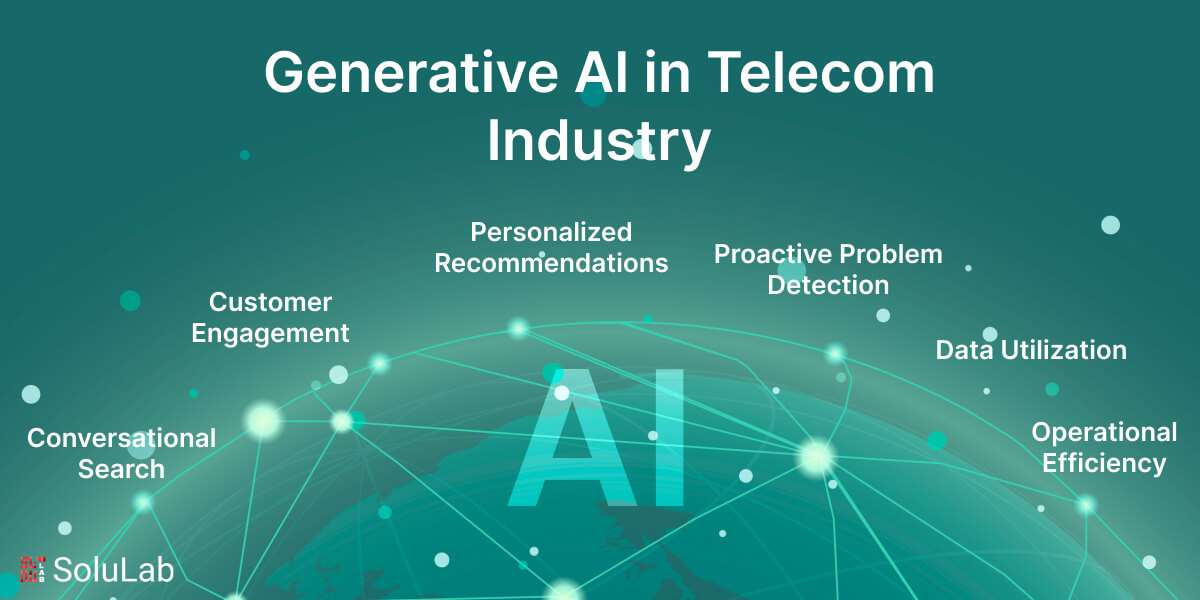
Telecom never sits still. What customers wanted from their carrier five years ago is not what they want now, and what businesses expect from a network keeps shifting too. Generative AI has landed right in the middle of that churn, and it is one of the few trends that could actually change how people get connected and how operators run the pipes behind it. The short version: it is the part of AI that makes new things, whether that is text, images, or audio, rather than just sorting what already exists.
Generative AI in telecom industry shows up in a lot of places. Think virtual assistants that hold a natural conversation, or systems that write content on their own. Marketing, customer service, data analysis, product design: each of these will feel it. The money says the same thing. According to Precedence Research, the generative AI in the telecom market stood at USD 150.81 million in 2022. The firm projects a CAGR of 41.59% between 2023 and 2032, which would take it to USD 4,883.78 million by 2032. That is not a niche experiment anymore. It is a line item operators are budgeting for.
Below, we walk through where generative AI fits in telecom, what it does well, and where it gets hard. First, though, a quick grounding in what the technology actually is.
What is Generative AI?
Generative AI is the branch of AI built to let machines produce fresh, original material. Classic AI systems follow rules and patterns someone defined in advance. Generative models don’t. They lean on neural networks and more sophisticated algorithms to produce outputs that imitate human creativity and judgement, without a person scripting each step.
The core trick is learning. Feed a model a huge dataset and it picks up the underlying trends and structure hiding in it. Once trained, it can turn out new pictures, text, music, or video that look a lot like the examples it studied.
Generative AI models are often built on advanced neural network designs, most commonly Generative Adversarial Networks (GANs) and Variational Autoencoders (VAEs). A GAN is really two networks arguing. One, the generator, makes new instances. The other, the discriminator, tries to tell the made-up ones from the real ones. By studying data and pulling out its intrinsic qualities, these systems learn to produce outputs with the right patterns, style, and semantic sense.
VAEs work differently. They split the job in two. The encoder takes the input data and maps it to a distribution of points in the data’s latent space, and that distribution carries a mean and a variance describing the statistical features of where the data sits.
Then the decoder runs the other way. It takes points from the latent space and tries to rebuild the original data. Here’s the interesting part: because it has learned from those encoded representations, the decoder can produce data points that closely match real input even though they never appeared in the training set.
Generative AI Use Cases in Telecom Industry
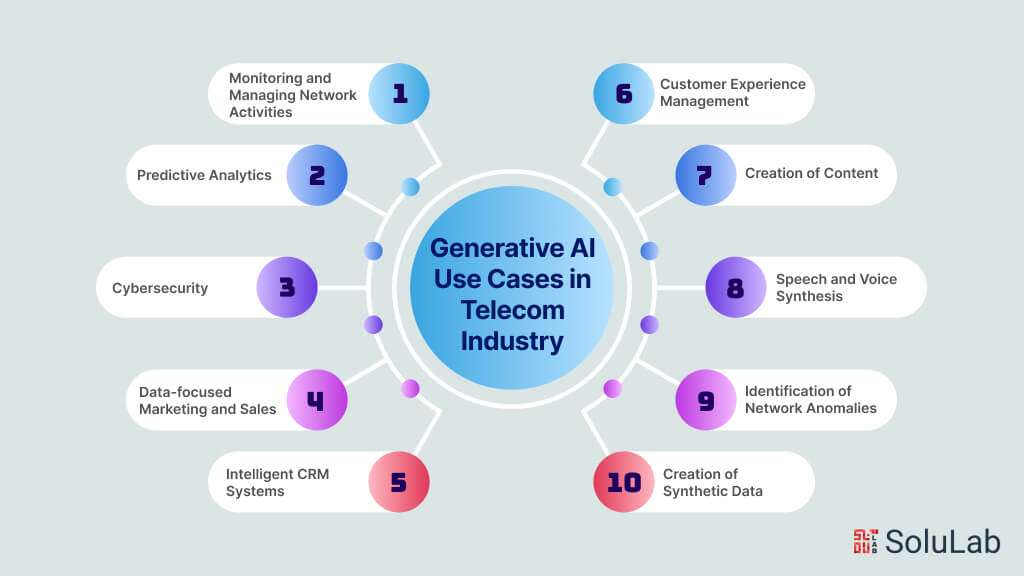
Customer expectations keep climbing and the operational headaches keep piling up, so bolting modern technology onto a telecom business is no longer optional. Generative AI is the one getting the most attention, and with reason: it changes both how services get delivered and how people use them. So where does it actually earn its keep? Here are the generative AI use cases in telecom industry worth paying attention to:
1. Monitoring and Managing Network Activities
Networks, and the applications riding on them, have become tangled enough that manual management can’t keep up. Operators need more automation and more agility. That means building telecom AI directly into network automation systems so management stays dependable, quick, and efficient. Some typical network-centric applications:
- Spotting anomalies in Operations, Administration, Maintenance, and Provisioning (OAM&P).
- Tracking performance, then improving it.
- Suppressing alerts so engineers stop drowning in pointless notifications.
- Suggesting next actions on trouble tickets, so network admins close problems faster.
- Resolving issue tickets automatically (self-healing), with less need for a human to step in.
- Forecasting network failures so they get fixed before anyone notices.
- Planning network capacity so resources land where they’re needed.
Where does the help actually come from? It traces root causes, pulls together data from many event sources, filters out false alarms, and flags failures and Service-level Agreement (SLA) breaches as they happen. That is how generative AI in telecom supports network operations day to day. And the timing matters. 5G and technologies like Network Functions Virtualization (NFV) add more layers of abstraction to network architecture, which makes correlation analysis harder, so existing service assurance systems may need backup during the transition.
2. Predictive Analytics
Networking systems built on generative AI use predictive analytics to see trouble coming: anomalies, likely breakdowns, the slow drift before an outage. With modern algorithms and machine learning doing the watching, operators can act before a small problem becomes a big one. Less downtime. Steadier service quality. Less money burned on disruptions. Both sides win here, the provider and the person holding the phone, because the network simply becomes more dependable.
3. Cybersecurity
Traditional security tools run on static rules and signatures. Those age badly. Attacks aimed at communications service provider (CSP) networks keep mutating, and a rulebook written last quarter often can’t recognise them. AI systems adapt as threats change, flag anomalies as malicious on their own, and hand human specialists the context they need to act.
This isn’t new territory, either. Generative techniques like VAEs and GANs have been used for years to sharpen the detection of threats and malicious code in telecom data. The value goes past detection, too. AI can surface the relevant data to security analysts so they make better-informed calls, and that opens the door to automated remediation.
Read Blog:
4. Data-focused Marketing and Sales
Telecom companies sit on mountains of data. Usage trends, transactions, every customer interaction, all flowing in from different sources. Generative AI is what turns that pile into something useful: it evaluates the data, draws conclusions worth acting on, and feeds targeted marketing and sales campaigns.
Using generative AI in telecom market lets you group customers by how they use the service, what they prefer, and how they behave. Then you build campaigns for each group instead of one blast for everyone. The payoff is simple. Messages, offers, and suggestions that actually fit the person tend to get more engagement and more conversions.
There’s a second layer. AI-driven analysis can dig out trends in customer data that nobody was looking for, and those findings point to better pricing, clear upsell and cross-sell openings, and the sales and marketing channels that really perform. Put generative AI behind those decisions and sales get more effective, which shows up in revenue.

5. Intelligent CRM Systems
Inside a CRM, generative AI chews through large volumes of real-time data and tells you how customers behave, what they like, and how they interact with you. With that in hand, you can respond to what a customer needs while it still matters. The result is more personal help and happier customers.
Look back at past data and customer trends, and predictive analytics can tell you who is likely to leave. That gives you a chance to reach out first and cut churn. Automation powered by generative AI also takes friction out of CRM processes and gives support teams a lift through effective AI-powered chatbots that make help faster and less painful.
Personalization is the big one. With generative AI inside the CRM, telecom companies can shape marketing messages, offers, and suggestions around each customer’s own preferences. This telecom AI lifts engagement, loyalty, and retention. It also brings more automation, sharper data analysis, and real predictive ability to CRM work across the telecom sector.
Read Blog: Generative AI Use Cases
6. Customer Experience Management (CEM)
Customer Experience Management (CEM) gets a real boost from generative AI’s ability to read customer interactions, sentiment, and behaviour data. Operators come away with a clearer picture of how satisfied people actually are. Dig through that data and you find the specific spots causing trouble or frustration. From there, you know what to fix, how to lower churn, and where service is falling short.
Analysis driven by generative AI also gets closer to how customers feel and what they prefer, so services and fixes can be shaped to specific needs. Offer people experiences that feel made for them, and they tend to stay happier, stay loyal, and build a stronger relationship with the brand.
And the predictive side helps too: anticipate what a customer will need, deal with problems before they’re raised, and care and retention both improve.
7. Creation of Content
Generative AI in telecom industry does a lot of heavy lifting on marketing materials and ads. The algorithms study trends, user preferences, and the relevant data, then produce tailored content on the fly that speaks to the audience you’re after.
Because messaging can be tuned for particular groups, telecom firms stay ahead of trends and communicate better. The market is crowded and cutthroat. Speed counts. Generative AI shortens the time it takes to produce content and makes the marketing more efficient and more engaging, which, over time, builds deeper relationships with customers.
8. Speech and Voice Synthesis
Generative AI can produce artificial voices that sound real, and that changes voice-based services, virtual personal assistants, and Interactive Voice Response (IVR) systems. Richer, more natural speech options make every interaction better. Nobody enjoys a robotic phone menu. Speech technology driven by AI simplifies operations and makes the customer experience feel personal.
For call routing, automated customer care, and hands-free operation, telecom AI gives users an interface that is smooth and even pleasant to use. That is why voice ranks as one of the key use cases in telecom: customers are happier, and the plumbing of communication gets simpler.
9. Identification of Network Anomalies
Generative AI models are a big part of forecasting network performance and keeping it steady. They learn how network elements normally behave, and from that they predict what performance indicators should look like.
When something deviates, say an unexpected traffic spike or a piece of equipment failing, the AI raises an alarm right away. Automated responses from this kind of monitoring let operators fix likely problems fast, so customers keep getting reliable, uninterrupted service. In practice, this is the use case that most clearly shows how AI catching performance oddities early makes networks both more efficient and more reliable.
Read Also: DePIN In the Telecom Industry
10. Creation of Synthetic Data
Telecom firms always need more data than they can safely use. Generative AI helps close that gap by producing synthetic datasets for testing, training, and research. The generated data closely resembles real-world situations, so new services and applications can be put through thorough evaluation. There’s a privacy upside as well. Synthetic datasets let businesses work around security and privacy concerns, keeping sensitive customer information out of the test bench. So innovation keeps moving, and building dependable, sturdy telecom solutions gets easier, without trading away privacy or compliance.
How Can Generative AI Solutions Be Applied in the Telecommunications Sector?
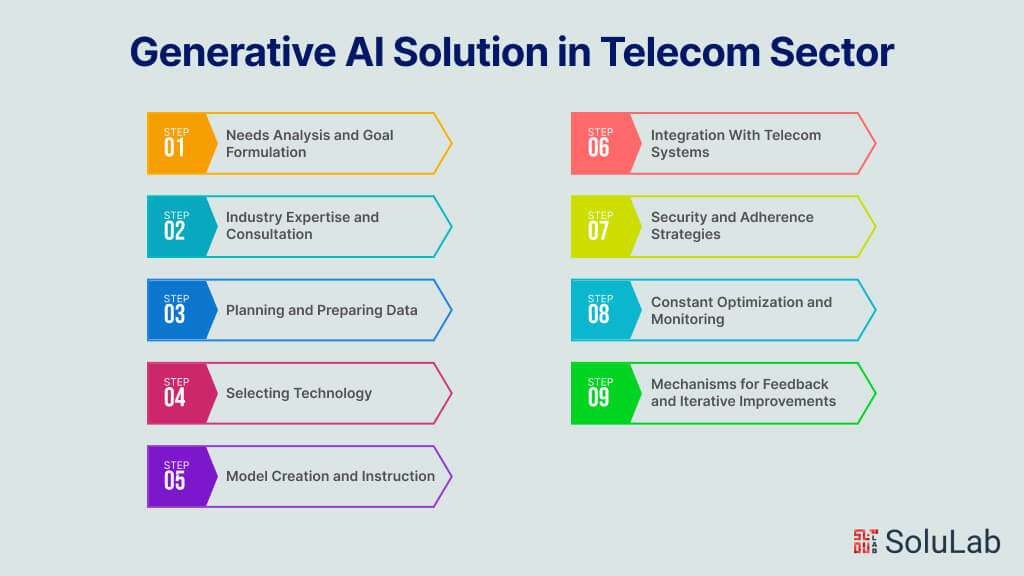
Don’t try to do it all at once. Rolling out generative AI in telecom works best when it is planned and done in stages. Here is a step-by-step guide to putting generative AI in telecom operations to work:
1. Needs Analysis and Goal Formulation
- Pin down which problems or opportunities in your telecom operations generative AI could actually address.
- Be precise about what you want the technology to achieve. Vague goals make for vague results.
2. Industry Expertise and Consultation
- Talk to AI experts or firms that know both generative AI and the telecom business.
- Work with those specialists to understand the likely uses, the benefits, and the difficulties specific to your own operations.
3. Planning and Preparing Data
- Find the data sources that matter inside your telecom system: operational logs, network performance data, customer interactions.
- Clean and preprocess those datasets, stripping out irrelevant and inconsistent records, so the quality holds up. This is where teams usually get stuck, and it is worth the time.
4. Selecting Technology
- Choose generative AI technologies that fit your goals. Common approaches include Deep learning models, variational autoencoders (VAEs), and generative adversarial networks (GANs).
- Weigh resource requirements, compatibility with the infrastructure you already run, and how well it scales.
5. Model Creation and Instruction
- Build generative AI models around your specific telecom use cases. That could mean models for customer interactions, predictive maintenance, anomaly detection, or something more specialised.
- Train them on historical data so the algorithms learn the trends and behaviours that are relevant to how you operate.
6. Integration With Telecom Systems
- Build interfaces and application programming interfaces (APIs) so the models plug cleanly into your existing processes and telecom systems.
- Make sure things run in real time for programs such as predictive maintenance, customer service, and network monitoring.
7. Security and Adherence Strategies
- Put solid security controls around the private telecom data your generative AI tools touch.
- Stay within industry regulations and data security guidelines.
8. Constant Optimization and Monitoring
- Set up tools that track your telecom generative AI applications in real time.
- Keep tuning the models as performance feedback comes in and as your telecom needs change.
9. Mechanisms for Feedback and Iterative Improvements
- Gather input from stakeholders, employees, and end users to see what the generative AI solutions are really doing.
- Use that feedback to keep refining and extending the systems.
Follow these steps, adapt them to your own use cases, and you can put Generative AI solutions to work lifting productivity, customer experience, and operations across your telecom business.
Benefits of Generative AI in Telecom
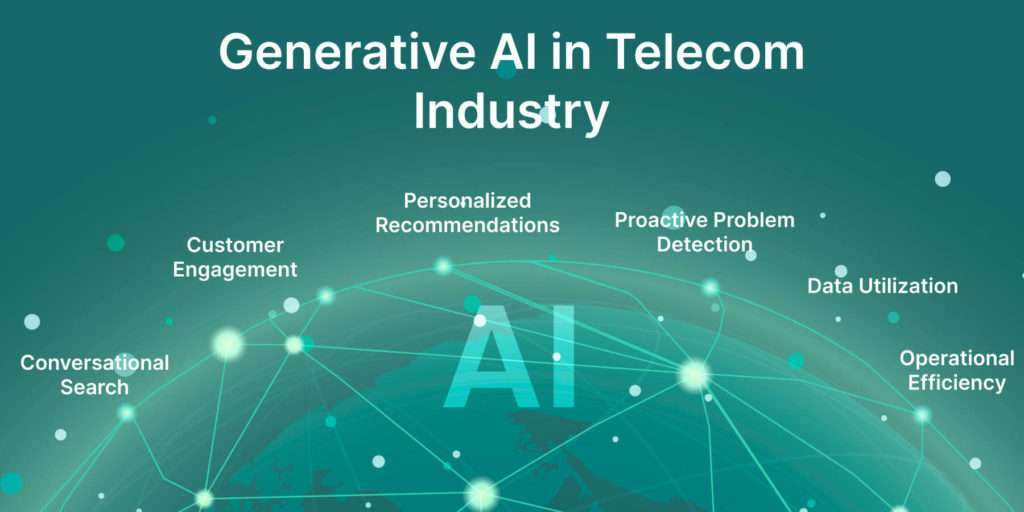
Why bother? Because generative AI makes the customer experience better, cuts costs, catches issues before they happen, and makes operations run leaner. Here is what the generative AI in telecom industry delivers in practice:
- Conversational Search: Chatbots powered by generative AI answer in a human-like way, so customers find what they need quickly. The real difference is language. It can return the right information in whatever spoken language the user prefers, which removes the need for translation services and saves the user effort.
Read Blog: Conversational AI
- Agent Help-Search and Summarization: Support agents work faster because generative AI serves up quick replies in whichever channel the customer is using. Auto-summarization adds short, usable references that keep communication clear and make trends easier to track.
- Call Center Operations and Data Optimization: By summarizing and analysing complaints, customer information, agent performance, and more, generative AI tightens the feedback loop. It can even flip the call center from a cost sink into a revenue producer, by showing which performance improvements lead to better services.
- Personalized Recommendations: It looks at a customer’s past interactions across platforms and support services, then shows them information that fits.
- Proactive Problem Detection: Anomalies in network data get spotted early, so likely faults or security risks surface before they bite. The network stays resilient, and service disruptions drop.
- Cost Savings: Through predictive maintenance and smarter network planning, generative AI keeps maintenance spend down, stretches equipment life, and gets more out of infrastructure investment.
- Data Utilization: Even when data is limited, generative AI helps telecom firms make the most of it, which improves the accuracy and dependability of AI-powered services.
- Innovation and Differentiation: Tailored content, products, and services built with generative AI help telecom firms stand apart and keep innovating.
- Operational Efficiency: Hand routine customer questions to AI-powered virtual assistants and support gets faster, with help available around the clock, 24/7.

Concluding Remarks
Generative AI marks a real shift for telecom, one that could reshape how people connect, how they interact, and how they picture what comes next. Look across the uses above and one thing is plain. This is not just a shiny new idea. Telecom AI reflects progress in the technology and in how people talk to each other through it. It can write tailored content, speed up network optimization, sharpen predictive maintenance, and rework customer service. The operators who get the most from it will be the ones who use it to see what customers need before they ask, while running a leaner, more inventive operation.
As a leading AI development company, SoluLab builds custom generative AI solutions around the particular needs of telecom companies. Our AI developers have deep experience putting advanced technologies to work for telecom providers, pushing innovation and tightening operations. Need better network performance? A stronger customer experience? Leaner marketing campaigns? SoluLab builds generative AI solutions that move telecom businesses forward on each of those. Get in touch to hire AI developers and put generative AI to work in your telecom operations.
FAQs
Shipra Garg is a tech-focused content strategist and copywriter specializing in Web3, blockchain, and artificial intelligence. She has worked with startups and enterprise teams to craft high-conversion content that bridges deep tech with business impact. Her work translates complex innovations into clear, credible, and engaging narratives that drive growth and build trust in emerging tech markets.