Profitable companies worked this out a long time ago: customer relationships need a system of record. Log the calls, score the deals, act on what the data says. That habit produced the classic CRM systems , and those tools are now being rebuilt around AI. Buyers noticed before the vendors did. Almost 80% of CRM clients now ask about AI or machine learning features while they are still shortlisting. Which is why Generative AI in CRM has stopped being a side experiment and started showing up in procurement checklists.
The pitch is simple enough. Put a large language model next to the customer record and it can draft, summarise, and answer instead of just storing. Teams that pair the two get closer to what a customer is actually about to do, adjust the approach before the quarter slips, and spend less of the day retyping things a machine could have written.
So here is the walkthrough: what generative CRM actually is, what it buys you, where it gets used, and which products are already doing it.
What is Generative AI CRM?
Customer relationship management (CRM) software has drifted a long way from where it started. The first generation was a filing cabinet with a login. What most teams run today is closer to an analysis layer: it reads the account history back to you and tells you what to do about it. Generative CRM is the next turn of that screw.
Strip away the marketing and generative AI CRM is the usual CRM machinery with a generative model wired into it. That combination lets a company:
- Read through customer data instead of querying it
- Surface angles nobody thought to look for
- Forecast what happens next
- Write to each client in a way that sounds like it was meant for them.
The practical effect is that the tedious half of the job shrinks and the hours go somewhere that matters. And because the system keeps reading both your records and public sources, the replies it drafts next month should be better than the ones it drafts today.
Benefits of Generative AI CRM
Think about how a campaign actually gets built. Somebody pulls the data. Somebody else reads the research. A draft gets written, killed, rewritten. Meanwhile an angry customer is holding on line two and the same person is expected to sound calm. Hours vanish into work nobody would put on a resume.
Now picture a tool that takes the boring half off the table, whatever department you sit in. That is roughly the promise of generative CRM: the customer platform you already run, plus a model that can produce work. The AI CRM benefits below are the ones teams tend to notice first.
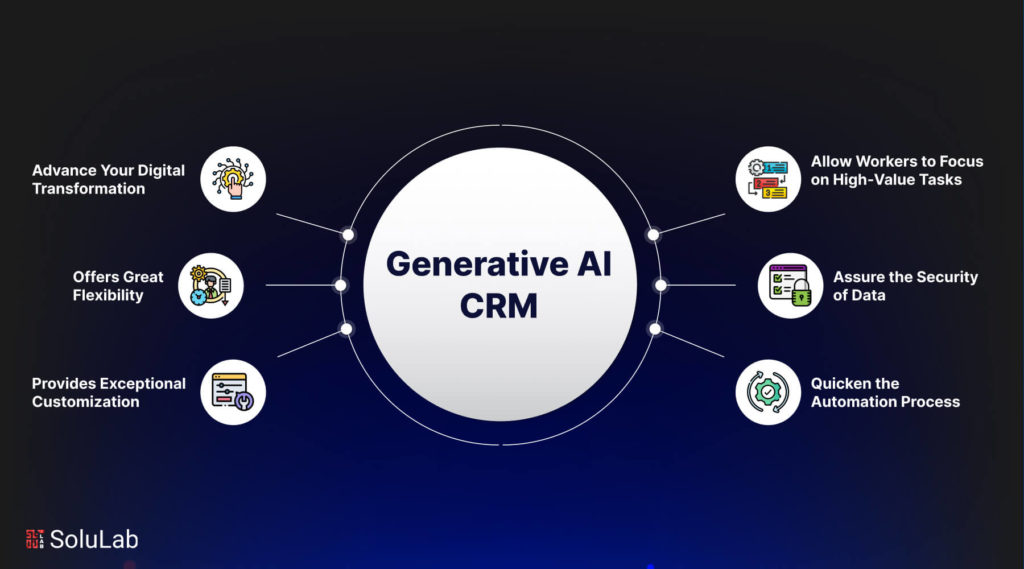
Assure the Security of Data
Generative CRM systems treat storage as the first problem, not the last one. Whatever your users hand over and whatever the system pulls from public sources get kept apart. Private client data stays in the cloud under lock, even when the model is reading public and private material side by side to produce an analysis. Two lanes, one output. You get the full value of the data without handing it around.
Allow Workers to Focus on High-value Tasks
Repetitive work is the first thing to go. The AI features inside generative CRM absorb the copy-paste layer of the job, which moves people off data entry and onto the parts that need judgement. Once the busywork is gone, your specialists can sit with the messy accounts, build real relationships with the clients worth keeping, and put together solutions that fit one customer rather than forty. Clients feel the difference. So does the range of what your team can offer.
Quicken the Automation Process
Standard automation follows a script somebody wrote in 2019. Generative CRM does not stop there. It suggests edits to the workflow, points at the step where deals keep stalling, and shifts tactics while the campaign is still running. The procedures stop being static and start correcting themselves. That is what keeps a company efficient without making it rigid when the market moves.
Related: Generative AI Automation
Advance Your Digital Transformation
Adopting generative CRM is not another box ticked on a digitisation plan. It changes what the software is for. Collecting data was the old job. This one reads the collection, calls where a client and a market are heading, and rewrites the approach around one customer’s preferences and history. Companies running on it can turn faster when demand shifts, because the system noticed the shift first.
Provides Exceptional Customization
Customisation is where generative CRM earns its keep. It writes material that fits the person reading it and the moment they are reading it in, one customer at a time, at a volume no copywriting team could match. Talk to people in terms they already care about and the relationship holds. Brand loyalty follows from that, not from the logo. And messages that read as though somebody sat down and wrote them tend to get answered.
Offers Great Flexibility
Old CRM stacks do not grow with the business, so every new customer lands as extra weight on the support desk. The generative AI CRM handles a large share of those client contacts itself, which is what makes it scale. Your customer count can double without the experience getting worse.
Use Cases for Generative AI in CRM
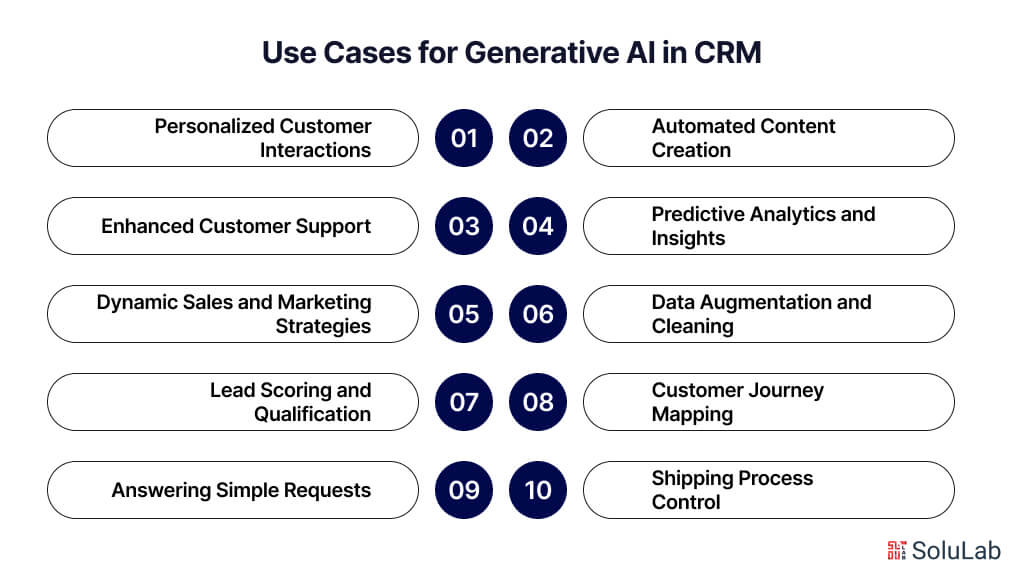
Where does this actually show up in a working week? Generative AI is reshaping Customer Relationship Management (CRM) on three fronts at once: the conversations, the workflow underneath them, and what you can learn from both. The main use cases of Generative CRM:
1. Personalized Customer Interactions
Generative AI applications in CRM make one-to-one communication practical at volume. The model reads what a customer has bought, clicked, and complained about, then writes the message and picks the recommendation to go with it. People engage more when the note is clearly about them. Conversion rates move, and so does the number of customers who stay.
2. Automated Content Creation
Content is the most obvious of the use cases of Generative CRM. Emails, social posts, campaign copy: the model drafts them. The time saved is the smaller win. The bigger one is that the brand sounds like itself everywhere a customer runs into it, which rarely survives a busy quarter otherwise. Segment the audience and the same engine writes a different version for each group, so campaigns land harder.
3. Enhanced Customer Support
Support is being rebuilt around chatbots and virtual assistants that run on generative models. They answer a wide spread of questions on the spot, work through the knotted ones, and hand a case to a person when it needs one. The replies read like sentences rather than canned macros, because the model is writing them against the actual context of the ticket. Queues get shorter. Customers stop repeating themselves.
4. Predictive Analytics and Insights
Generative AI use cases in CRM reach into prediction too. The system builds models of how customers behave, which tells you what an account is likely to want next, which accounts are quietly heading for the exit, and which marketing spend is doing nothing. Knowing that a week early is the whole point. Decisions stop being reactions.
5. Dynamic Sales and Marketing Strategies
Plans can now change while the data is still arriving. A generative model will write a pitch for one specific buyer, or tell a rep that Tuesday morning is when this contact actually replies. Small adjustments, made constantly. The result is that sales and marketing stay pointed at what customers want this month instead of what they wanted when the deck was approved.
6. Data Augmentation and Cleaning
A CRM is only as good as what is in it, and most of them are full of half-finished records. Generative AI can fill the gaps, fix the typos, and force fields into one consistent format across the database. Boring work. It also happens to be the work that decides whether the customer profiles and the reports built on them are worth reading.

7. Lead Scoring and Qualification
Scoring leads by hand is guesswork with a spreadsheet attached. Generative AI reads the historical record, finds the patterns that separated the deals you won from the ones you chased for six months, and puts a number on every new lead. Reps then work the top of the list. Same team, better use of their week.
8. Customer Journey Mapping
Generative AI can stitch every touchpoint into one map of how a customer actually got here. What they do, what they prefer, and the exact step where they give up. That last one is usually the useful part, and it is the part nobody has time to find manually. Fix the friction where the map shows it.
9. Answering Simple Requests
Most of what lands in a CRM inbox is the same handful of questions, asked again. A generative model can be trained to read and answer them with nobody watching. For example:
- “When was a customer’s last purchase?”
- “How much did a customer spend last month?”
- “Does the customer have an updated address?”
Hand those off and two things happen: the service desk gets its day back, and the answers come faster and match the record. The model can also be taught where its limits are, so anything complicated or delicate goes to a human before it turns into a complaint. That handover is what makes the whole arrangement hold together.
10. Shipping Process Control
Logistics is an underrated place to put a generative model. It can:
- Build shipping routes off live data, so deliveries land sooner and cost less.
- Flag trouble before it hits: an empty container, a delay building up two ports away.
- Write the status updates customers get, on time, so nobody has to sit there wondering where the order went.
Answer the shipping question before the customer asks it, and Generative AI applications in CRM turn the most complained-about part of the experience into the quiet part.
Read Also: Generative AI In CRM & ERP
Real-life Examples of Generative CRM
Enough theory. Here are shipping products. These CRM examples sit under the banner of Generative Customer Relationship Management, a way of running CRM where machine learning and AI are used to start relationships and conversations rather than only record them:
1. Salesforce’s Einstein Sales Navigator: Out since 2019. It applies AI-driven sales intelligence to the question every rep asks on a Monday: who is worth calling? It reads customer data, social activity, and buying behaviour, then names the connections and the approach to try.
Example: A sales team sees that a target company just posted a role for a marketing manager. Einstein Sales Navigator points them at the right people to contact, with email addresses and social profiles attached.
2. Drift’s Conversational CRM: Drift automates the interaction layer and starts conversations with people who have not spoken to anyone yet. Its models read customer data to work out the moment a prospect is ready to talk to a rep.
Example: Someone lands on a site and starts typing at a chatbot running on Drift’s Conversational AI. The bot works out what they came for and builds the conversation around it, putting the relevant product or service in front of them.
3. HubSpot’s Conversational Forms: A form that talks back. HubSpot uses AI-driven chatbots to qualify leads mid-conversation and open new ones, and it reads the interactions to tell sales teams what to do with each name.
Example: A visitor fills in a conversational form powered by HubSpot’s Conversational Forms. The chatbot behind it asks follow-up questions as they go, and the sales team ends up with a list of leads that have already been qualified.
4. AmyInbox: AmyInbox is an AI-poweredsales engagement software built to open conversations with prospects. Its machine learning models read the customer data and predict when somebody is ready to hear from a rep.
Example: A prospect downloads an e-book. AmyInbox catches it, writes the outreach sequence around what they downloaded, and suggests what to follow up with next.
5. SalesLoft: SalesLoft is an AI-driven sales engagement platform, also built around starting conversations with prospects. Machine learning reads the customer data and calls the moment a buyer is likely to respond to a rep.
Example: A prospect shows interest in the product on social media. SalesLoft builds an email sequence around that signal, drops in content that matches it, and proposes the follow-up.
That is a short list from a crowded field, and the pattern across all of them is the same: machine learning is being pointed at the start of the relationship, not the record of it. New openings get found, new opportunities surface, and personalisation stops being something you can only afford for the top twenty accounts.
The Future of Generative AI in CRM
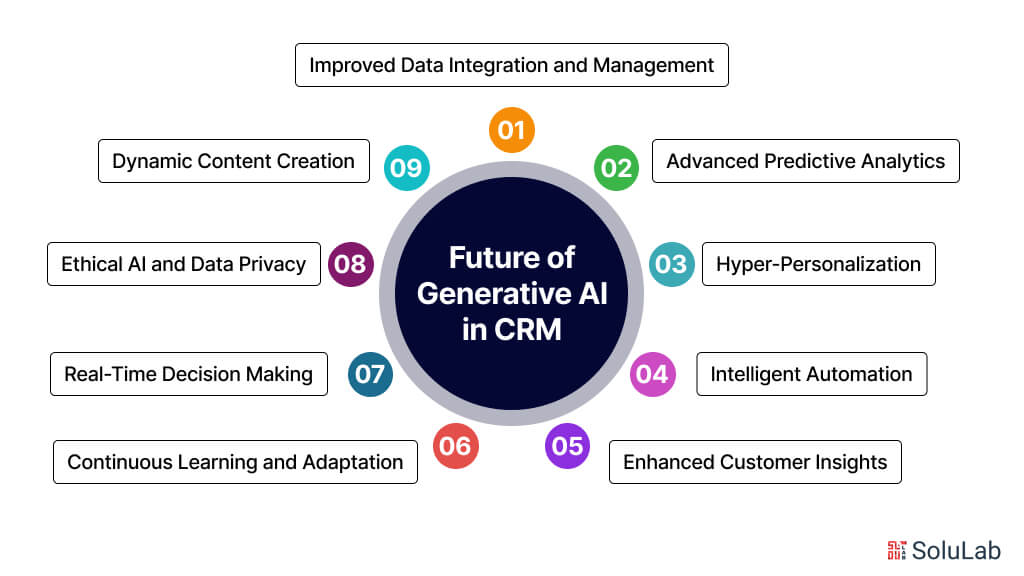
The future of generative AI in Customer Relationship Management (CRM) changes three things at once: how companies talk to customers, how they hold the data, and what they can pull out of it. This technology is not going away. These are the directions CRM appears to be heading:
1. Hyper-Personalization
Personalisation at the level of one person, for every person. Generative AI reads whatever the customer left behind across every touchpoint and writes the content, picks the products, and sets the tone from there. Done well, it does not feel like marketing at all. Satisfaction climbs, people stay longer, and the relationship stops being transactional.
2. Advanced Predictive Analytics
Prediction gets sharper when a generative model sits on top of the CRM. The algorithms mine the history for what customers are about to do, want, and need. You get warning. That is the value: problems can be handled before the customer raises them, campaigns can be corrected mid-flight, and retention work starts while the account is still yours.
3. Intelligent Automation
Expect more of the CRM process to run itself. Chatbots and virtual assistants take the routine questions and answer them instantly, and the workflow behind them stops needing a human to move each card along. Response times drop. The better outcome is quieter: your agents finally get to spend the day on the cases that actually need a person.
4. Enhanced Customer Insights
Most of what customers tell you is not in a database field. It is in reviews, replies, and feedback forms nobody reads. Natural language processing (NLP) and machine learning (ML) algorithms can work through that unstructured pile at scale. What comes out is how people feel, not just what they bought, plus the trends showing up before they are obvious. Then you adjust.
5. Dynamic Content Creation
Content that is written on demand changes marketing economics. The model produces the email, the post, or the ad that fits the person it is going to, and it produces a different one for the next person. Nothing goes stale, because nothing is sitting in a queue for three weeks waiting to be sent to everybody at once.
6. Real-Time Decision Making
The future of generative AI in CRM is partly about speed of judgement. When data is processed as it arrives, a decision that used to wait for the Monday report can be made on Thursday afternoon. Kill an underperforming campaign mid-week. Resolve a customer problem during the call rather than after it. Competitors working off last week’s numbers are the ones you beat.
7. Improved Data Integration and Management
Customer data is scattered across systems that were never meant to speak to each other. Generative AI can merge those sources into a single view of the customer without a six-month integration project behind it. One view, one version of the truth, and an experience that does not contradict itself depending on which channel the customer used.
8. Ethical AI and Data Privacy
The deeper this goes into CRM, the louder the questions about ethics and privacy get. Businesses will have to show that their AI is transparent, fair, and locked down, not simply claim it. Regulators are one reason. Customers are the better one: trust is slow to build and quick to lose, and it is the thing the whole customer relationship rests on.
9. Continuous Learning and Adaptation
These systems keep learning after you install them. As customer behaviour shifts and the market moves, ongoing training and refinement pull the models along with it, so accuracy improves with age instead of decaying. A CRM that gets better every quarter is a different proposition from one you have to replace every four years.
Final Words
So where does that leave you? The case for generative CRM in 2025 comes down to a few concrete gains: personalisation at a level of detail you could not staff for, prediction that gives you warning instead of hindsight, and routine work that stops consuming the week. Add decisions made on live data, content written on demand, and customer records that finally agree with each other, and the operation gets both faster and harder to knock off course. The applications are still arriving. What is already clear is that customer relationships handled this way are sharper than the ones handled by a database and a rota.
None of which makes the rollout easy. Putting generative AI in CRM into a live business means solving data privacy properly, holding a defensible ethical line, and fitting AI systems to infrastructure that was built before any of this existed. In practice, that last one is where projects stall. SoluLab, a leading Generative AI development company, builds around those specific problems rather than around the demo. Transparency, security, and AI that does something useful on day one. Want your CRM to actually do this? Contact Us today and we will talk through what it would take.
FAQs
Shipra Garg is a tech-focused content strategist and copywriter specializing in Web3, blockchain, and artificial intelligence. She has worked with startups and enterprise teams to craft high-conversion content that bridges deep tech with business impact. Her work translates complex innovations into clear, credible, and engaging narratives that drive growth and build trust in emerging tech markets.