Remember when a single graphic ate up half your afternoon? Videos, blog drafts, social posts, all of it done by hand, one slow piece at a time. That grind is fading. Generative AI development now puts tools in your hands that draft the content and take the boring, repeat work off your plate.
You can also lean on it like a virtual assistant. No new hire required.
And this isn’t fringe behaviour. According to industry research, 78% of companies worldwide already use generative AI in at least one part of how they run.
So here’s the plan. This blog walks you through generative AI, start to finish. Let’s dig in.
Key Takeaways
- Generative AI doesn’t just read data. It makes new things: text, images, video, code. That’s what makes it useful for both creative work and automation.
- The popular tools are simple to pick up. Marketing, customer support, design, software work, you can put them to use without a deep technical background.
- The field keeps moving. Multimodal AI, autonomous agents, adoption across whole companies, these shifts will change how organisations work day to day.
- Start early. Companies that experiment now will be in a far better spot to stay competitive as the technology keeps changing.
What is Generative AI?
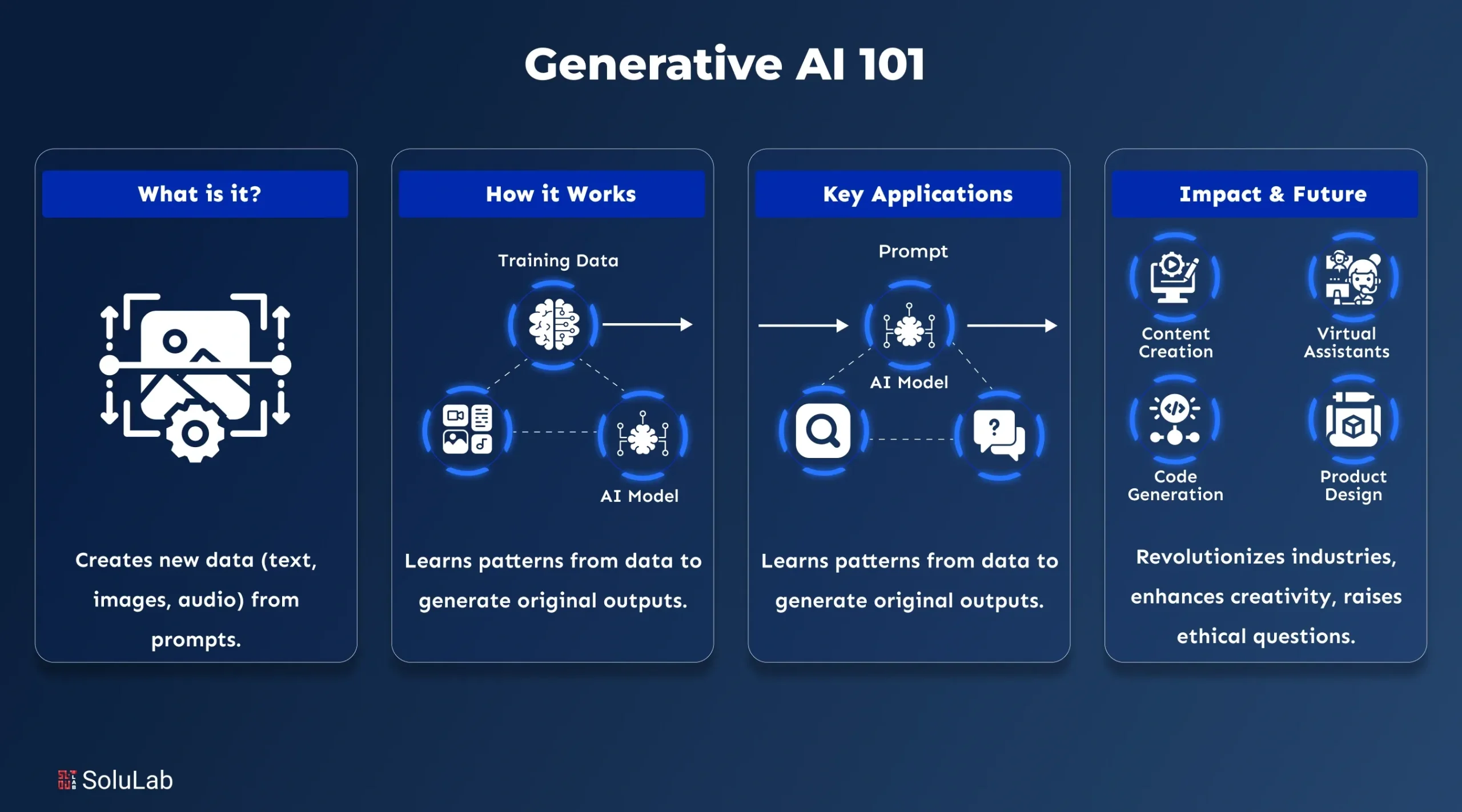
Generative AI is the kind of artificial intelligence that makes new content, text, images, video, music, code, rather than just chewing through data you already have. How? It studies patterns across huge piles of data, then uses what it learned to produce outputs that read and look human-made.
ChatGPT, image generators, video creation platforms: you’ve probably used one this week. Here’s the sort of thing it produces:
- Text (blogs, emails, scripts)
- Images and designs
- Videos and audio
- Code and software logic
Why Businesses Need Generative AI in 2026?
Competition is tighter in 2026, and customers expect more. That pressure is forcing companies to rethink how they actually operate. Generative AI for enterprises isn’t a nice-to-have anymore. It’s what keeps productivity, innovation, and long-term digital standing from slipping.
- Faster content and execution: Content, designs, code, reports, generative AI turns them around quickly. That means shorter turnaround, and teams get to spend their hours on strategy instead of busywork.
- Better customer experience: Chatbots and AI assistants answer in real time and answer more personally. Brands can meet people where they are, dig deeper into their questions, and leave them more satisfied.
- Scalability and cost efficiency: By handing off the repetitive tasks, Gen AI cuts a company’s reliance on large teams. You can grow the operation without watching costs balloon at the same rate.
- Better decision-making: Point Gen AI at a massive dataset and it surfaces the patterns and openings buried inside. You spot market trends, and act on them, before the competition does.
- Competitive advantage: Adopt early and you innovate faster, ship products sooner, and react to market swings quicker than the businesses still waiting to start.
AI vs Generative AI: What’s the Real Difference?
Artificial intelligence is the wide field. It’s the branch of computer science trying to build systems that do the things we’d normally call intelligent: reasoning, solving problems, working through a decision. Generative AI sits inside that field as a narrower slice. Its job isn’t to analyze or decide based on old data. Its job is to make something new.
| Feature | Traditional AI | Generative AI |
| Primary Goal | To analyze data and provide specific outputs like predictions, classifications, or recommendations. | To create new, original content such as text, images, audio, video, or code. |
| Learning Method | Often uses supervised learning with labeled datasets to recognize patterns and make decisions. | Often uses self-supervised learning on vast, unstructured datasets to learn how to generate new data. |
| User Interaction | Interaction is typically structured through dashboards, alerts, or predefined command systems. | Users interact via natural language prompts, allowing for a conversational and iterative experience. |
| Transparency | Generally, more transparent and interpretable (e.g., decision trees), making it easier to explain decisions. | Often operates as a “black box” due to complex neural network architectures, making its logic hard to trace. |
| Common Examples | Spam filters, fraud detection, recommendation engines (Netflix/Amazon), and chess bots. | ChatGPT, Gemini, DALL-E, and Midjourney. |
Key AI Technologies Behind Modern Generative AI
No single trick makes today’s generative AI work. It’s a stack of technologies working together to process the data, pick up the patterns, and produce content that passes for human: text, images, audio, code.
1. Natural Language Processing (NLP)
NLP is what lets the AI read language, break it down, and write it back. It reads context, grammar, intent, even sentiment, so conversations, translations, summaries, and drafted content come out feeling natural rather than stitched together.
2. Deep Learning
Deep learning stacks many layers of a neural network onto enormous datasets to catch patterns too tangled for simpler methods. Loosely, it copies how the human brain learns from experience, and that’s what lets generative AI turn out precise text, images, and video.
3. Machine Learning
Machine learning is the part that improves with use. The system learns from data instead of hand-written rules. So generative models sharpen over time, and the more you use them, the more relevant, personalised, and accurate their output gets.
4. Neural Networks
Neural networks are the foundation the whole thing rests on. Input data moves across layers of interconnected nodes, and along the way the model spots patterns, makes predictions, and produces output that lands close to what a person would make.
Types of Generative AI Models
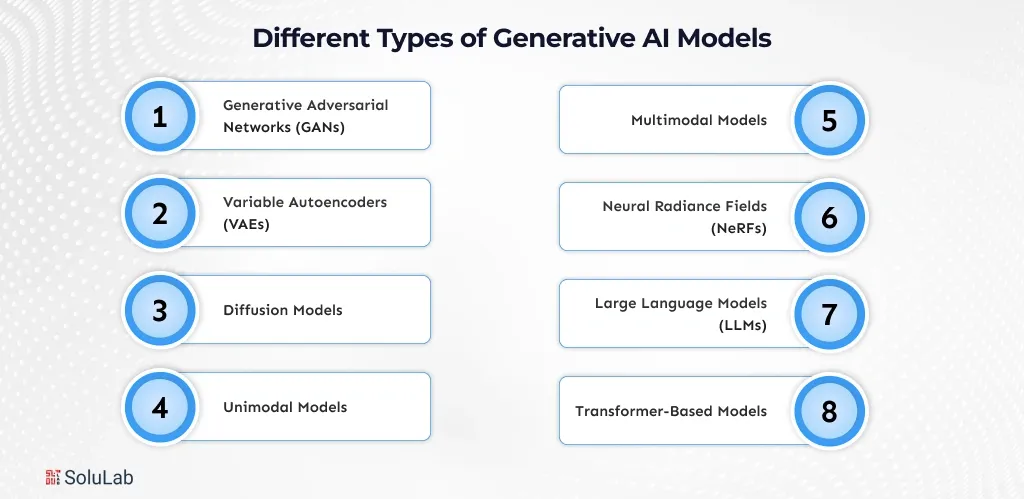
There’s no one model that does it all. generative AI models come in several types, and each was built to tackle a different problem, from generating images and text to reading the patterns hidden in different data types and real-world situations.
1. Generative Adversarial Networks (GANs)
Generative Adversarial Networks (GANs) pit two neural networks against each other: a generator and a discriminator, competing. The tug-of-war produces strikingly realistic images, videos, and designs. You’ll find it most often in art generation, fashion, and image enhancement.
2. Variable Autoencoders (VAEs)
VAEs compress data into a latent space, then rebuild it with small, deliberate variations. That makes them handy for generating images, flagging anomalies, and producing a range of outputs, all without wrecking the structure of the original data.
3. Diffusion Models
Diffusion models start from noise and clean it up, step by step, until a clear output emerges from the static. They’re known for high-quality images, and they power a lot of the image and video tools people reach for today.
4. Unimodal Models
Unimodal models handle one type of data. Just text, or just pictures, or just audio. They’re simpler to build, and you’ll see them in jobs like text classification, speech recognition, or image detection.
5. Multimodal Models
Multimodal models take in several data types at once: text, images, audio, together. That’s what lets them handle the harder jobs, like captioning an image, analyzing a video, or holding a chatbot conversation.
6. Neural Radiance Fields (NeRFs)
NeRFs build 3D scenes out of flat 2D images by learning how light behaves in a space. The payoff shows up in virtual reality, games, digital twins, and realistic 3D reconstructions of an environment.
7. Large Language Models (LLMs)
LLMs train on staggering amounts of text until they can read and produce natural language. They’re the engine behind chatbots, content tools, coding assistants, and the smarter search systems now showing up across every industry.
8. Transformer-based Models
Transformers use attention to work out how words, or data points, relate to one another. They sit under most modern AI systems. They train faster, read context better, and let language and vision models scale in ways older approaches never could.
How Does Generative AI Work?
Strip it down and generative AI does two things: it trains on patterns from big datasets, then uses advanced models to make new, human-like work, text, images, audio, code.
- Data Training: It gets fed enormous amounts of data so it can grasp language, pictures, and patterns. That’s how the model learns how real content is put together and how the pieces connect.
- Neural Networks: It runs on neural networks that echo the human brain, which is what lets the system catch subtle connections and produce output that actually fits the context.
- Model Learning & Fine-Tuning: Pre-trained models get tuned on specific data and feedback. The result is output that’s more accurate, more relevant, and closer to what the user actually needs.
- Content Generation: Once trained, the model predicts the next word, pixel, or sound based on probability. String enough of those guesses together and you get original content that reads and sounds human.
What are the Benefits of Generative AI?
By 2026, generative AI stops being the experiment nobody’s sure about. It becomes a requirement, the thing companies use to automate their processes, personalise experiences, cut costs, and keep pace in a market that now runs on AI.
- Quick decision-making: Gen AI reads high volumes of data on the spot, so businesses can spot patterns, predict trends, and decide on the evidence rather than waiting on a stack of manual reports.
- Increased productivity at a lower cost: It handles the monotonous work, content, customer care, data processing, which frees people up for strategy and drops operational costs sharply.
- Enhanced customer experiences: Gen AI can hold personalised conversations at volume, tailoring messages, suggestions, and support replies to how each person behaves and what they prefer.
- Competitive advantage: First movers use Gen AI to innovate more often, roll out faster, and adjust to shifting conditions before the rest of the field catches up.
- Scalable expansion: Gen AI grows the operation without piling on the usual growth costs, more headcount, more infrastructure, more overhead.
A Step-by-Step Breakdown of Generative AI Product Development Process
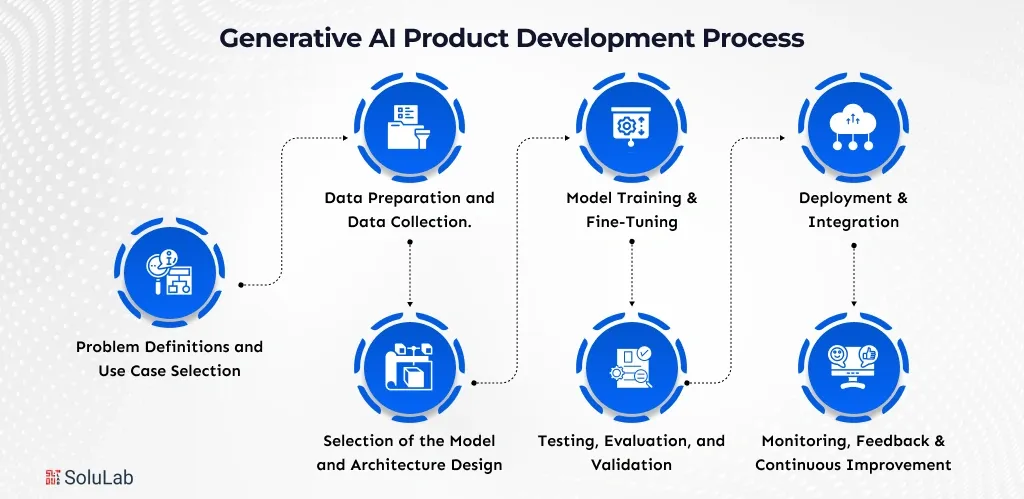
Turning an idea into a stable, scalable product doesn’t happen in one leap. The development of generative AI solutions is a methodical loop: data, models, testing, and steady improvement, each feeding the next.
1. Problem Definitions and Use Case Selection
Start with the business problem, and be honest about where generative AI actually earns its keep. This is where teams get stuck: the goal is to solve a real user need, not to bolt on AI because it looks impressive.
2. Data Preparation and Data Collection.
Generative AI is only as good as the data behind it. This step means pulling together the right datasets, scrubbing out the noise, stripping bias, and shaping everything into a format the model can actually learn the right patterns and context from.
3. Selection of the Model and Architecture Design.
Match the model to the job. A large language model for some cases, a diffusion model for others. The architecture you pick ripples through everything after: performance, cost, how well it scales, and how it reacts to messy real-world inputs.
4. Model Training & Fine-Tuning
You can run AI model training on existing data, then refine it with fresh examples pulled from your specific domain. That’s what lifts accuracy, relevance, and output quality, and it’s what makes the AI’s answers feel built for your business and your users.
5. Testing, Evaluation, and Validation
Test it hard, on accuracy, on bias, on safety, on the weird edge cases. This is the guardrail. It’s how you confirm the AI behaves responsibly, holds to your quality bar, and produces steady results before a single real user touches it.
6. Deployment & Integration
Push the model into production and wire it into your apps, APIs, or workflows. At this point, watching performance, keeping latency down, and controlling cost are what stand between a smooth experience and a frustrating one.
7. Monitoring, Feedback & Continuous Improvement
Launch isn’t the finish line. Watch how the model behaves in the wild, and use real feedback and analytics to guide it. Regular updates, retraining, and small fixes are what keep a generative AI product accurate, relevant, and competitive over the long haul.
Generative AI Common Use Cases
The experiments are over. Modern generative AI use cases now let companies build real systems that create content, run workflows on their own, and back up decisions as they happen.
1. Content creation
Feed it your intent and your brand tone, and generative AI drafts blogs, social posts, videos, images, and marketing copy. It saves time, keeps the voice consistent, and lets a small team produce good content in real volume.
2. Code generation
It writes code, hunts down bugs, suggests optimisations, and untangles logic that’s gone knotty. Development moves faster, mistakes drop, and it’s a genuine help whether you’re a first-year dev or a veteran.
3. Customer support
Chatbots and virtual agents running on generative AI field the common questions, walk through troubleshooting, and reply the moment someone asks. Support gets better, the cost drops, and it’s there at 3 a.m. without anyone staffing the desk.
4. Medical discovery
Generative AI in drug discovery can move things along by reading complicated biological data and simulating molecules. That helps researchers zero in on a possible cure sooner, trims the development timeline, and, in the end, improves outcomes for patients.
5. Virtual assistants
Enterprise AI assistants handle scheduling, reminders, digging up information, and voice search. Over time they adapt to how you work, and that quietly lifts productivity in both your personal and professional life.
Generative AI Applications in Various Industries
Generative AI is changing the way industries work; it’s automating creative work, sharpening decisions, and speeding up innovation across any industry sitting on scalable, data-driven problems.
- Healthcare: Generative AI in healthcare helps draft clinical reports, medical notes, and treatment plans tailored to a patient’s information. It also shows up in drug discovery, in sharpening medical imaging, and in virtual health assistants, taking weight off doctors and lifting the quality of care patients get.
- Marketing and Sales: Generative AI for sales and marketing lets businesses turn out high-performing ad copy, social posts, emails, and visuals at scale. You can personalise campaigns from customer behaviour, run rapid A/B tests across many creatives, and optimise in real time, which pushes engagement and ROI higher.
- Finance and Banking: Generative AI for banking and finance helps institutions produce reports, automate customer support, catch fraud patterns, and back up risk analysis. It’s also useful for shaping individual financial advice and for making compliance documentation both more accurate and less of a slog.
- Education and E-learning: Generative AI for education builds courses, quizzes, and learning materials. It opens up personalised learning, instant feedback, and AI tutors, so lessons get more engaging while educators claw back the hours routine academic work used to eat.
- eCommerce and Shopping: Generative AI in eCommerce powers personalised product recommendations, AI-written product descriptions, dynamic pricing insights, and conversational shopping assistants. Read the browsing and buying signals well, and you keep more customers, lose fewer carts, and convert more of the online traffic you already have.
Best Generative AI tools in 2026
Generative AI tools are rewriting how content, visuals, and video get made in 2026. Across text, images, and multimedia, they hand creators, developers, and businesses more room to be inventive, and a lot more speed to do it with.
1. ChatGPT
Probably the best-known assistant for writing, brainstorming, coding, and plain conversation. It turns out natural, human-sounding text, answers questions, drafts content, and slots into marketing, support, and creative workflows.
2. Scribe
A writing assistant that summarises content, drafts reports, and makes writing tasks less painful. Students, professionals, and researchers lean on it when they need clear, structured information and they need it fast.
3. Claude
Claude is Anthropic’s conversational AI assistant, built with safety in mind. It writes, explains, summarises, and automates tasks, and it’s the kind of tool that holds up on deep work and complicated workflows.
4. DALL-E2
A text-to-image generator that turns a prompt into images across a wide range of styles, with strong visual quality. Creators and businesses use it to build creative, brand, and visual stories, and to push their design, branding, and storytelling further.
5. Synthesia
An AI video maker that turns a written script into polished video, complete with realistic avatars and voiceovers. Good for training clips, marketing, and multilingual videos.
How Businesses can Expect a Positive ROI by Adopting Generative AI solutions?
The returns aren’t abstract. Businesses using a generative AI strategy can point to measurable gains: lower costs, tighter efficiency, sharper decisions, and fresh revenue streams, all while staying competitive in their markets.
- Cost Optimization: Generative AI takes over the repetitive, dull work, content generation, customer service, data scanning, so a company leans less on a large workforce. Operating costs fall, productivity climbs, and your people get to focus on the strategic work that actually moves the needle.
- Increased Revenue: It helps you pull in more customers and convert more of them, through personalised marketing, content-driven product suggestions, and faster product development. Those abilities feed straight into higher sales and revenue growth.
- Risk Mitigation: Generative AI can comb through huge volumes of data and flag the risks, anomalies, and compliance problems early, before they grow teeth. That helps businesses sidestep costly mistakes, tighten security, and decide well with less exposure on both the operational and financial side.
- Faster Decision-Making: With real-time, AI-generated data in front of them, leaders decide faster and more precisely. Companies react to market shifts sooner and cut the delays that so often turn into missed opportunities.
- Increased Customer Service: Chatbots, virtual assistants, and personalised messaging, all generated by AI, sharpen response times and satisfaction. Better experiences bring people back, and that loyalty compounds into repeat business.
- Scalability and Growth: AI solutions stretch to meet demand as a business grows, without costs rising in lockstep. So companies can scale operations, move into new markets, and absorb heavier workloads without performance falling apart.
Generative AI Trends for Business Benefits in 2026
Generative AI trends are moving fast. By 2026 they’ll reshape how businesses make content, run operations, and reach smarter decisions, all while lifting speed, efficiency, and the customer experience.
1. Hyper-Personalised Customer Experiences
By 2026, generative AI will let brands send deeply personalised messages, product recommendations, and support replies in real time. That means happier customers, better conversion, and stronger relationships, none of which requires a bigger marketing or support team.
2. AI-Driven Content at Scale
Generative AI will help businesses turn out blogs, ads, videos, and product descriptions faster and more consistently. Teams can scale up production, trim creative costs, and hold the brand steady across every platform and market.
3. Smarter Business Decision-Making
AI models will chew through large datasets and hand back insights, forecasts, and reports on the spot. Businesses can use them to catch trends, cut risk, and reach data-backed decisions far quicker than the old analysis methods allowed.
4. Automated Software Development
Generative AI will back up developers by writing, reviewing, and testing code on its own. That cuts development time, lowers errors, and lets companies ship products sooner while spending engineering time where it counts.
5. AI-Powered Virtual Assistants and Agents
Advanced AI agents will take on customer queries, internal workflows, and operational tasks by themselves. The payoff: faster responses, lower operating costs, and human teams freed up for the high-value strategic work only they can do.
The Future of Generative AI in 2026
Generative AI keeps evolving and spreading across industries, and by 2026 it’s set to reshape business, technology, and ordinary daily life. The biggest shift? A move toward multimodal systems that read and produce text, images, video, and audio all at once, opening up richer interactions for users and organisations alike.
Meanwhile, the reactive chatbot starts to fade. In its place come agent-style AI helpers that plan a task and then carry it out, which makes room for far more independent digital workflows. To push automation and one-to-one customer interaction, businesses will fold generative AI deeper into the everyday tools they already run, CRM systems, service platforms, and the rest.
Then there’s synthetic data. These are AI-generated datasets that train a model without ever exposing a single piece of private information. That matters. Those datasets could become a core part of deploying AI safely in the fields where privacy simply isn’t up for negotiation, the ones like healthcare and finance where a leak isn’t an inconvenience but a catastrophe.
And as generative AI gets more ordinary, the arguments get louder. Ethics, privacy, copyright: expect all three to boil over as the technology works its way into more corners of everyday business, and expect that mounting pressure to push both companies and the regulators watching them toward clearer, firmer rules for using AI responsibly.

Conclusion
Generative AI is reshaping how companies create, communicate, and innovate. Its reach keeps widening fast, from content creation to customer support to product design and software development.
It lifts productivity, trims expenses, and opens creative doors at a scale that used to sit well out of reach for anyone but the biggest players. The tools keep getting better. They keep getting cheaper. And the businesses that start learning and experimenting today are the ones that will still be standing out in front tomorrow, while the ones who waited spend that time playing catch-up.
SoluLab, a generative AI development company USA, can help you weave AI into how your business runs, and build custom tools from the ground up. Book a free discovery call today to talk it through.
FAQs
Neha is a curious content writer with a knack for breaking down complex technologies into meaningful, reader-friendly insights. With experience in blockchain, digital assets, and enterprise tech, she focuses on creating content that informs, connects, and supports strategic decision-making.