A Generative Adversarial Network (GAN) is a deep learning model in which two neural networks, a generator and a discriminator, train against each other so the generator learns to produce new data that looks like real training data. Ian Goodfellow and colleagues invented GANs in 2014. Since then, they’ve driven image and video generation, text-to-image synthesis, and data augmentation at scale.
Unlike models that only classify or recognize data, GANs create it from scratch. That distinction matters more than it sounds: generating a realistic portrait is orders of magnitude harder than identifying one.
This guide covers what GANs are, how they work, where they get used, and the real challenges you’ll run into. One note on where the field stands today: as of 2026, diffusion models have largely taken over mainstream text-to-image and image-to-image tasks. But GANs are still actively used for narrower jobs like image upscaling, style transfer, and super-resolution, and they keep showing up in research that blends GAN components with transformer architectures. They’ve been central to tackling data generation and data annotation problems across image, audio, video, and text domains.

What is a Generative Adversarial Network?
A generative adversarial network, or GAN, is a framework for deep neural networks that can learn from training data and generate new data with similar characteristics to the training data. Train one on photographs of human faces, and it will produce realistic-looking faces of people who don’t exist.
A GAN pairs two neural networks that compete during training:
- Generator: The generator takes random noise as input and produces a data sample, ideally within the latent space of the input dataset. During training, its job is to approximate the distribution of the real training data.
- Discriminator: The discriminator acts as a binary classifier: real or fake, training data or generator output. The generator pushes noise through a model to produce a candidate sample. The discriminator decides whether that candidate passes.
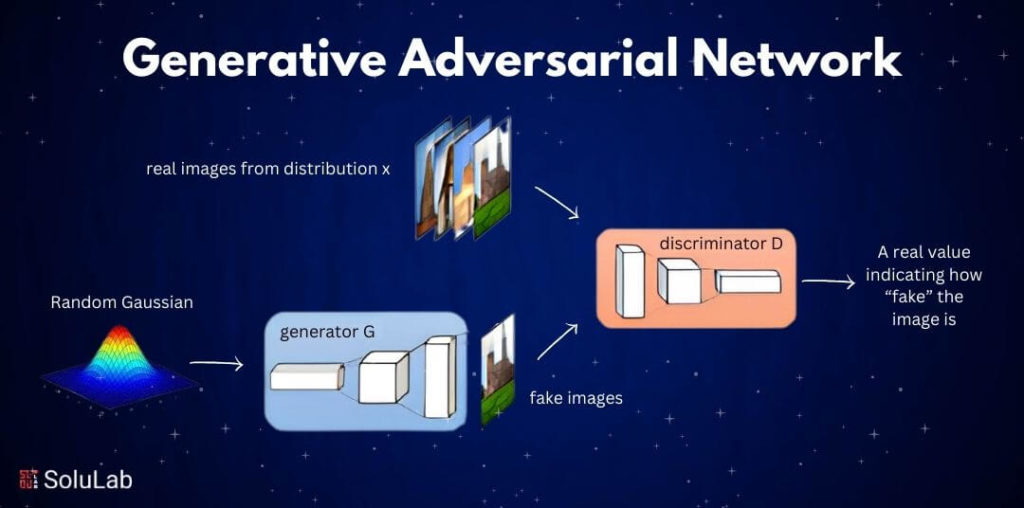
The image below shows how GAN training works.
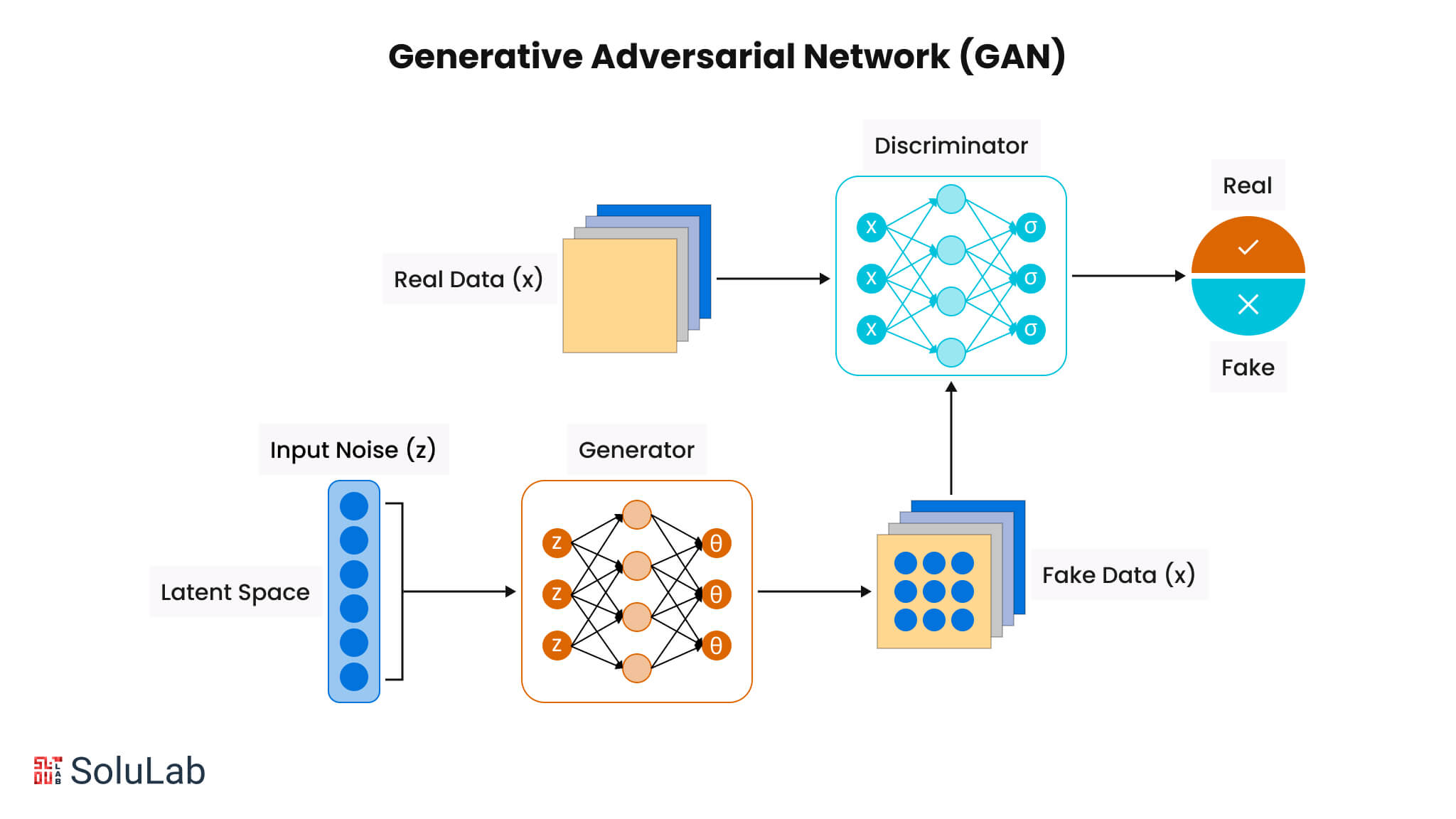
Working of Generative Adversarial Network
GANs consist of two networks that train separately. When both are multilayer perceptrons, the framework is surprisingly simple. Here is how it actually runs.
At the start, random noise from a normal distribution feeds into the generator. With no reference point yet, it produces a random distribution. Simultaneously, the discriminator receives a real sample, the ground truth, and learns what the real distribution looks like. When the generator’s output is shown to the discriminator, it compares distributions. A generated sample that closely matches the real one gets a score near 1 (real). One that looks nothing like it gets a score near 0 (fake).
How does the generator get better at producing samples that look real?
The answer is in the loss function, which measures the distance between the generated data distribution and the real one. Each network has its own loss: the generator tries to minimize its loss, and the discriminator tries to maximize its own. The generator doesn’t touch the loss function directly. It learns through the discriminator’s verdict.
If the discriminator outputs 0 (fake), the generator gets penalized. That penalty drives improvement.
After computing the loss, the generator’s weights update via backpropagation through the discriminator network. This is the part that actually matters: the generator’s parameters depend entirely on the discriminator’s feedback, which is what lets it produce samples that look increasingly real over time.
1. Training Process
Each training step starts with the discriminator loop, which you run several times before switching to the generator loop.
Discriminator Loop:
- Set a loop kkk where k>1k > 1k>1 to ensure that the discriminator becomes a reliable estimator of the original data distribution pdp_dpd.
- Sample mmm noise data from a normal distribution z1,z2,z3,…,zn{z_1, z_2, z_3, ldots, z_n}z1,z2,z3,…,zn and transform them through the generator.
- Sample mmm real data from a normal distribution x1,x2,x3,…,xn{x_1, x_2, x_3, ldots, x_n}x1,x2,x3,…,xn.
- Fake samples get labeled zero; real samples get labeled one.
- Use the loss function to calculate loss from these labels.
- Compute the gradient of the loss with respect to the discriminator’s parameters and update its weights. Gradient ascent handles this update, because the goal is to maximize the loss.
That completes the discriminator loop.
Generator Loop:
The generator loop follows a similar approach:
- Sample mmm noise data from a normal distribution z1,z2,z3,…,zn{z_1, z_2, z_3, ldots, z_n}z1,z2,z3,…,zn and transform them through the generator to produce fake samples.
- Since only the generator updates here, compute the gradient of the loss with respect to the generator parameters and set the derivatives to zero.
- The cost function in the generator loop drops the real sample entirely, leaving just the generator’s loss.
From there, gradient descent updates the generator’s weights.
What’s worth noting: the generator improves while treating the discriminator as a fixed constant. The discriminator is the teacher. The generator just keeps trying to fool it.

2. Generative Adversarial Networks Loss Functions
Two main loss functions dominate GANs:
- Min-Max Loss
- Wasserstein Loss
Minimax Loss:
Minimax loss comes from game theory: to win, maximize your own chance of success while minimizing your opponent’s. Goodfellow et al. introduced this framing in their 2014 paper.
In the GAN context, the discriminator tries to maximize its accuracy at catching fakes. It first learns from real images, outputting D(x)=1D(x) = 1D(x)=1, then from fake images, outputting D(G(x))=0D(G(x)) = 0D(G(x))=0.
The goal is to maximize 1−D(G(x))1 – D(G(x))1−D(G(x)). A wider gap means the discriminator is doing its job well. The generator, for its part, tries to shrink that gap by pushing D(G(x))D(G(x))D(G(x)) toward 1, driving its own loss toward zero.
This back-and-forth continues until one network helps the other improve past a useful threshold, or until the training run ends.
Wasserstein Loss:
Wasserstein loss was built for the Wasserstein GAN (WGAN). Here the discriminator doesn’t output a binary real/fake classification. Instead, it outputs a continuous score per sample: real samples score higher, fake samples score lower.
In Wasserstein generative adversarial nets, the discriminator is called a “critic,” and it uses these loss functions:
- Critic Loss: C(x)−C(G(z))C(x) – C(G(z))C(x)−C(G(z))
The critic tries to maximize this function, widening the gap between how it scores real versus fake samples.
- Generator Loss: C(G(z))C(G(z))C(G(z))
The generator tries to maximize this output, meaning it works to push the critic’s score on its fake samples as high as possible.
Why Were GANs Developed?
Traditional neural networks have a real vulnerability: add a small amount of noise to an image, and they misclassify it. Not sometimes. Dramatically, consistently. Even tiny distortions can flip a confident prediction to a wrong one. That brittleness pointed to a gap in the field. Models could recognize patterns, but they couldn’t generate them, and the two abilities turned out to be connected.
GANs were built to fill that gap. The core idea: train a network to produce new data that matches the original training distribution, not just categorize existing data. Instead of simply recognizing an image, a GAN can fabricate one that passes for real, good enough to fool even a well-trained classifier. That made GANs a practical tool for image, audio, and video generation in generative AI for data analysis and modeling.
Libraries like PyTorch and TensorFlow gave researchers the flexible tooling to actually build and train these systems, which is what made them practical beyond theoretical papers.
One notable extension: 3D generative adversarial networks, which take the same adversarial approach and apply it to three-dimensional data. Gaming, medical imaging, and virtual reality all need realistic 3D objects and environments. 3D GANs opened a path toward generating those at scale, with lifelike outputs that hold up in simulation, design, and entertainment contexts.
What are the Types of GANs?
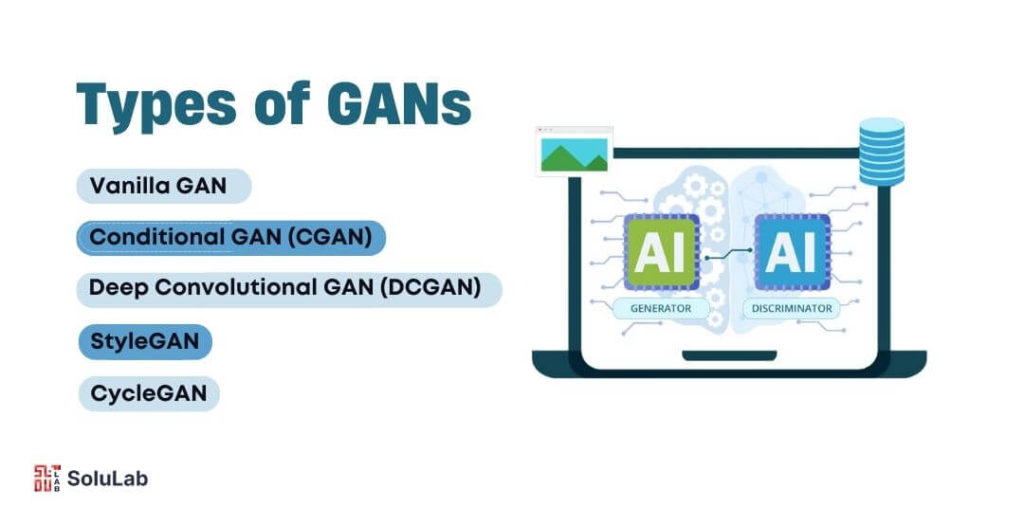
The original GAN architecture has spawned a range of variants, each tuned to handle specific tasks better than the baseline. Below are the most widely used types:
1. Vanilla GAN
The Vanilla GAN is Goodfellow’s original model. Two components: a generator and a discriminator, locked in an adversarial game. The generator tries to pass off synthetic data as real; the discriminator tries to catch it. Simple architecture, but it’s the foundation everything else builds on.
2. Conditional GAN (cGAN)
In a conditional GAN (cGAN), both the generator and the discriminator receive extra information as input, like a class label. That conditioning gives you control over what gets generated. Rather than producing a random image, the model generates one matching a specific category, dogs or cats, based on the label you feed it. This makes cGANs practical for text-to-image synthesis and targeted product design where you need a specific output, not a random one.
3. Deep Convolutional GAN (DCGAN)
Deep Convolutional GANs (DCGANs) are among the most widely used variants because they produce high-quality images. Both the generator and discriminator use convolutional neural networks (CNNs), which handle visual data well. The convolutional layers let the Multimodal model pick up spatial hierarchies in the data, making it well-suited for generating realistic images. DCGANs see heavy use in image generation, video synthesis, and art creation.
4. StyleGAN
StyleGAN generates ultra-realistic, high-resolution images with granular control over style and appearance. It separates high-level attributes like pose from low-level details like texture, so you can adjust the look of generated content precisely. Face generation and fashion design are the standout use cases: subtle style changes have outsized impact on the final output, and StyleGAN handles that with more precision than earlier architectures.
5. CycleGAN
CycleGAN handles image-to-image translation without paired training data. Take a photo of a horse, feed it to CycleGAN, and it outputs a zebra, no paired horse-zebra examples required. That unpaired capability is what makes it useful for image enhancement and style transfer, where collecting matched training pairs is impractical.
These variants show how far the core generative adversarial network architecture stretches: from generating images to transforming them across domains. GANs have become a real tool in AI-driven art, content creation, and scientific research.
Examples of GANs
GANs show up across a surprisingly wide range of domains. Here are some of the more concrete examples of what they actually do:
- Image Generation: The most recognized GAN application is generating photorealistic images. StyleGAN produces high-resolution portraits of people who don’t exist, built from random noise, indistinguishable from real photographs to most observers.
- Image-to-Image Translation: Models like Pix2Pix and CycleGAN convert images from one domain to another: sketch to colored image, daytime to nighttime. These networks learn the mapping between domains, producing specific outputs based on input conditions.
- Super-Resolution Imaging: SRGAN takes low-resolution images and upscales them while keeping fine detail intact. Medical imaging and satellite photography are the places where this matters most, because image clarity directly affects what conclusions you can draw.
- Video Generation: Video generative adversarial networks like VGAN generate short video clips or predict future frames from a prior sequence. This feeds into predictive ensemble modeling, video synthesis, and visual content for entertainment and augmented reality.
- 3D Model Generation: GANs have moved past 2D. Tools built on efficient geometry-aware 3D generative adversarial nets produce realistic 3D models from 2D images or random input. Gaming, virtual reality, and CAD all depend on accurate 3D representations, which is where these models find their most practical use.
- Text-to-Image Generation: StackGAN reads a text description, say “a small bird with yellow wings and a red belly,” and generates a matching image. The model interprets the text and produces a visual that fits the description.
- Music Composition: MuseGAN generates polyphonic music where multiple tracks are synthesized to harmonize together, producing complete musical pieces. This points toward AI-driven music production and automated composition tools.
Applications of Generative Adversarial Networks (GANs)
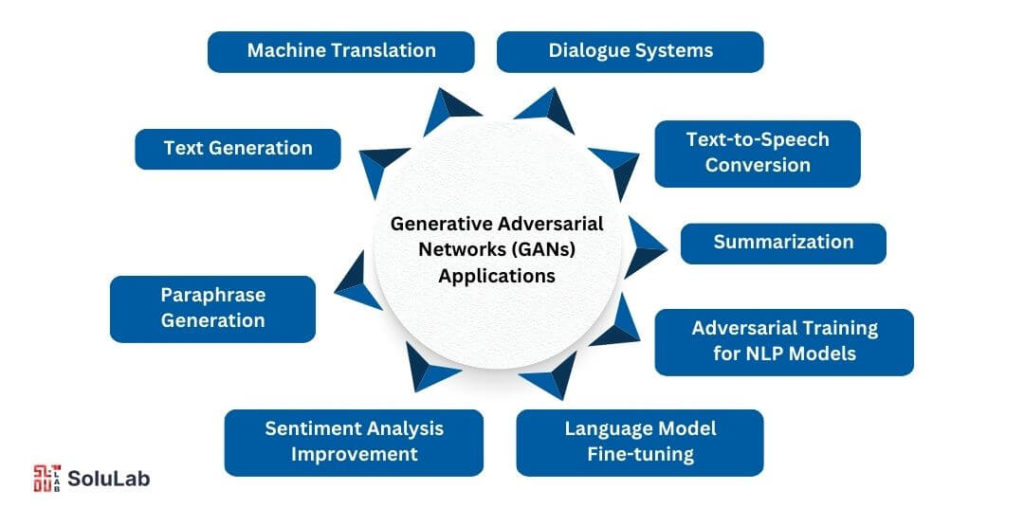
Since Goodfellow’s original paper, GANs have moved well beyond image generation. One area that doesn’t get enough attention: their use in natural language processing (NLP) and human language processing. The generator-discriminator setup transfers to language tasks in ways that aren’t obvious at first.
Here are the key language-related applications:
1. Text Generation: GANs generate coherent, human-like text for narrative creation, dialogue systems, and other content tasks.
2. Paraphrase Generation: GANs produce varied paraphrases of a given sentence. In practice, this feeds data augmentation and model training pipelines for NLP.
3. Sentiment Analysis Improvement: GANs generate adversarial examples that expose weak spots in sentiment classifiers, making those models more reliable when retrained against the adversarial data.
4. Language Model Fine-tuning: GANs tune small language models, improving fluency and coherence in text generation tasks.
5. Machine Translation: GANs reduce translation errors, particularly for low-resource languages where parallel training data is sparse.
6. Text-to-Speech Conversion: GAN-based models improve how natural and intelligible synthesized speech sounds, closing the gap between machine and human voice.
7. Summarization: Adversarial feedback during training helps summarization models produce concise outputs that still capture the key information from long texts.
8. Dialogue Systems: GAN-based architectures push chatbot and dialogue systems toward more contextually fitting responses.
9. Adversarial Training for NLP Models: GANs introduce adversarial examples during model training to stress-test NLP systems and improve how well they generalize.
A common question: is LLM a type of generative adversarial network? LLMs and GANs have fundamentally different architectures and use cases. But combining them is an active research direction, and the gap between the two may narrow as the field develops.
Related: Comparison of Large Language Models
GANs vs. Autoencoders vs. Variational Autoencoders (VAEs)
GANs, Autoencoders, and VAEs all belong to the generative models category, but they solve different problems and make different tradeoffs. Here’s how they actually differ.
1. Generative Adversarial Networks (GANs)
GANs use a two-network setup: a generator that creates realistic data samples, and a discriminator that judges whether each sample is real or generated. Through that adversarial loop, both networks improve, with the generator getting progressively better at producing outputs that fool the discriminator.
- Strengths:
- Can generate highly realistic samples, especially in image synthesis and art creation.
- Adversarial training pushes the generator toward sharp, detailed outputs.
- Strong track record in super-resolution, image-to-image translation, and creative generation.
- Weaknesses:
- Training is unstable and difficult to optimize.
- Mode collapse is a genuine problem: the generator sometimes produces limited output variety.
- Measuring convergence during training is hard.
2. Autoencoders
Autoencoders compress and reconstruct data. An encoder maps input down to a lower-dimensional latent representation. A decoder reconstructs the original data from that compressed form. The objective is simple: make the reconstruction as close as possible to the input.
- Strengths:
- Straightforward and effective for dimensionality reduction and feature learning.
- Good for denoising, anomaly detection, and data compression.
- Faster and more stable to train than GANs.
- Weaknesses:
- Not well-suited for generating realistic new data.
- Image generation tends to produce blurry results.
- No stochastic sampling means limited diversity in outputs.
3. Variational Autoencoders (VAEs)
VAEs extend the autoencoder idea by making the latent space probabilistic. Instead of learning a fixed mapping from input to latent representation, a VAE learns the parameters of a probability distribution (usually Gaussian) over that space. Sample from it, and you get new, diverse data points rather than reconstructions of existing ones.
- Strengths:
- Principled generative modeling: probabilistic sampling means the model generates novel, varied samples.
- More stable to train than GANs.
- Useful for image generation, text generation, and latent space exploration.
- Weaknesses:
- Generated samples tend to be blurrier than GAN outputs, because VAEs optimize for the full distribution rather than sharpness.
- Balancing reconstruction loss against KL divergence is tricky and can affect model performance.
Comparison Summary
| Feature | GANs | Autoencoders | VAEs |
| Architecture | Generator + Discriminator | Encoder + Decoder | Encoder + Decoder + Latent Distribution |
| Generative Ability | Strong, can create high-quality data | Limited, focused on reconstruction | Strong, generates diverse samples |
| Training Difficulty | High (unstable, adversarial) | Low (simple loss minimization) | Moderate (balance between losses) |
| Output Quality | High-quality, sharp outputs | Typically lower-quality (blurry) | Lower-quality but diverse |
| Diversity of Outputs | Low if mode collapse occurs | Low (deterministic) | High (probabilistic sampling) |
| Common Use Cases | Image generation, super-resolution | Data compression, anomaly detection | Data generation, latent space learning |
Popular GAN Variants
Researchers have built many GAN variants, each tackling a specific weakness in the original architecture. The most widely used:
- Deep Convolutional GAN (DCGAN)
DCGAN swaps fully connected layers for convolutional ones, which makes GANs more stable and effective for image generation. The convolutional structure captures spatial hierarchies better, producing sharper images. It’s a standard starting point for visual data tasks, and most PyTorch generative adversarial network implementations use it as a baseline.
- Conditional GAN (cGAN)
Conditional GANs add control over what gets generated by conditioning the model on extra data like labels or attributes. Instead of a random output, you get a specific one: MNIST digits of a chosen class, faces with particular features. That targeting makes cGANs useful wherever you need a specific output rather than a random one.

- Wasserstein GAN (WGAN)
WGAN addresses training instability and mode collapse by using Wasserstein distance as its loss function. The result is more stable, reliable training, with better diversity in the generated outputs. In practice, this matters most for tasks where standard GANs tend to collapse to a narrow set of outputs.
- Wasserstein GAN with Gradient Penalty (WGAN-GP)
WGAN-GP builds on WGAN by replacing weight clipping with a gradient penalty, which further stabilizes training. It’s widely used when you need precise control over output quality, particularly for generating realistic and varied images.
- Progressive Growing of GANs (PGGAN)
PGGAN starts at low resolution and progressively increases the resolution of both generator and discriminator during training. This staged approach keeps training stable and lets the model produce highly detailed images. Photorealistic faces at high resolution are its signature output.
- CycleGAN
CycleGAN handles image-to-image translation without paired data. A cycle consistency loss ensures the model can translate an image to a new domain and then back again, preserving key characteristics. Horse-to-zebra conversion is the textbook example, but the same approach applies across artistic style transfers and other domain pairs where paired training images don’t exist.
- StyleGAN
StyleGAN separates high-level features (structure, pose) from low-level ones (texture, detail), giving fine-grained control over what gets generated. It became the benchmark for photorealistic human face generation and is used across art, design, and media where that level of control over the output matters.
- BigGAN
BigGAN scales up GAN architectures by increasing model size and training on larger datasets. That scale translates directly to higher quality and more variety in generated images. It targets tasks that need exceptional fidelity: detailed visual artwork and complex image generation where smaller models fall short.
- InfoGAN
InfoGAN learns interpretable latent representations without supervision. By maximizing mutual information between latent variables and the generated data, it lets you control specific features in the output, like object rotation or facial expression variation. That control makes InfoGAN useful for feature learning and representation disentanglement tasks.
How SoluLab Can Help in Generative Adversarial Network Development?
SoluLab builds custom GAN solutions for image generation, data augmentation, and other machine learning tasks using PyTorch and TensorFlow. Our team works across GAN variants including DCGAN, WGAN, and StyleGAN, handling everything from prototyping and model optimization to deployment and ongoing support. Contact us to discuss your Generative Adversarial Network project.
FAQs
Shipra Garg is a tech-focused content strategist and copywriter specializing in Web3, blockchain, and artificial intelligence. She has worked with startups and enterprise teams to craft high-conversion content that bridges deep tech with business impact. Her work translates complex innovations into clear, credible, and engaging narratives that drive growth and build trust in emerging tech markets.