


Automated Financial Transactions
Smart contracts execute transactions automatically when predefined conditions are met, reducing manual intervention and improving operational efficiency.

As a DeFi smart contract development company, we build secure, scalable, and automated smart contracts that power decentralized finance platforms. From lending and borrowing protocols to DEXs, staking, and liquidity pools, we turn your DeFi vision into production-ready blockchain solutions.












DeFi smart contract development involves building blockchain-based programs that automate financial transactions, enforce protocol rules, and enable secure, transparent, and decentralized financial services without intermediaries.
Smart contracts execute transactions automatically when predefined conditions are met, reducing manual intervention and improving operational efficiency.
Developers create smart contracts that power decentralized exchanges, lending platforms, staking protocols, and liquidity pools.
Blockchain-based execution enables users to verify transactions and contract rules without relying on centralized authorities.
Our DeFi smart contract development services help businesses build, secure, and optimize decentralized financial applications with tailored blockchain solutions designed for scalability, transparency, and efficiency.

We assess your business requirements, blockchain infrastructure, and protocol goals to define the right architecture, technology stack, and development strategy.

We identify vulnerabilities, analyze contract logic, and evaluate security risks through comprehensive code reviews and testing to strengthen protocol reliability.

We develop customized smart contracts with application-specific logic, automated workflows, and token functionality to support your unique decentralized finance requirements.

We optimize contract code, reduce gas consumption, improve execution efficiency, and refine transaction logic without compromising functionality or security.

We build automated market maker protocols and liquidity pools that enable decentralized token swaps, liquidity provision, and efficient on-chain trading.

We integrate DeFi smart contracts with wallets, oracles, token standards, payment systems, and external protocols to enable seamless blockchain interactions.

We develop cross-chain smart contract solutions that connect compatible blockchain networks, enabling interoperable financial applications and streamlined digital asset transfers.

Talk to our experts to map out your protocol, budget, and launch timeline.
DeFi smart contracts automate financial transactions on blockchain networks without intermediaries. They execute predefined rules to manage lending, borrowing, trading, staking, and liquidity based on user actions.
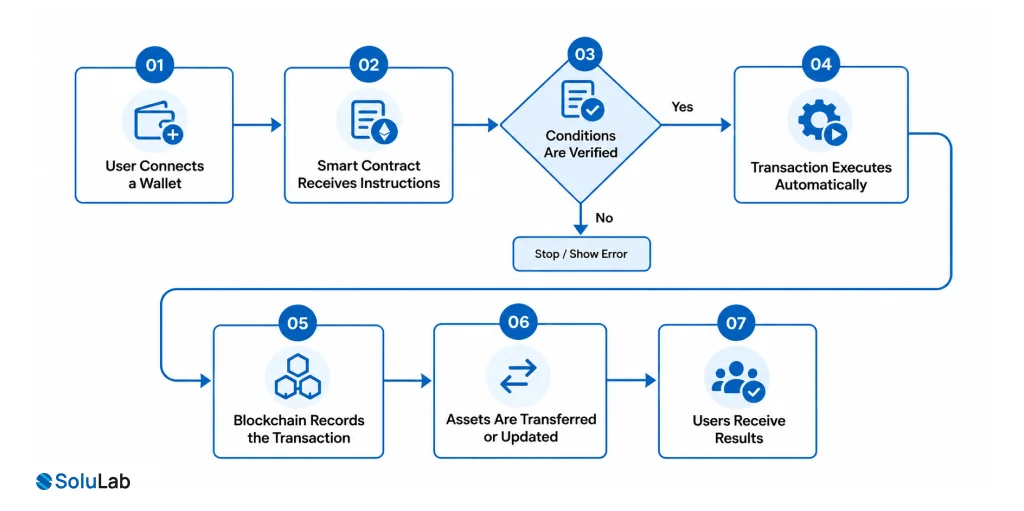
Users connect their crypto wallets to a DeFi application to access services and authorize transactions securely.
The contract receives transaction requests, such as token swaps, loan applications, or liquidity deposits, through the decentralized application interface.
The smart contract checks predefined rules, including token balances, collateral requirements, transaction parameters, and eligibility conditions, before executing operations.
Once all conditions are satisfied, the contract automatically processes the transaction without requiring approval from a centralized intermediary.
The blockchain validates and records transaction details, creating a transparent, tamper-resistant record accessible to network participants.
The contract transfers tokens, distributes rewards, updates loan balances, or adjusts liquidity positions according to the executed transaction.
Users can verify completed transactions through their wallets and blockchain explorers, while the DeFi application reflects their updated balances and positions.
Explore our portfolio of DeFi smart contract development projects, showcasing how we transform blockchain concepts into secure, scalable, and production-ready decentralized finance solutions.
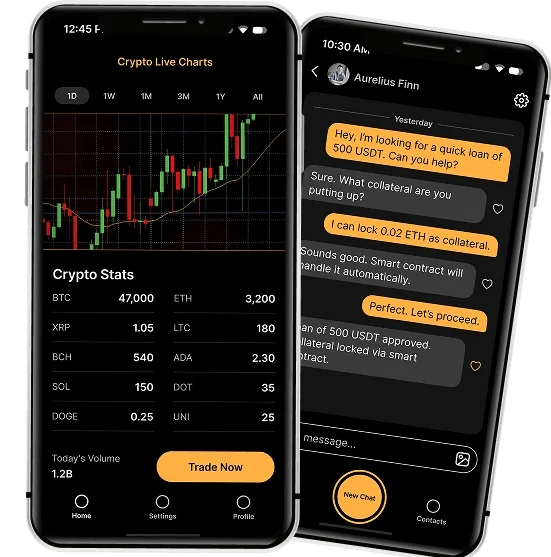
Trading, lending and borrowing were too complex for the client's users, with onboarding spread across custody methods, unstable collateral management and poor interoperability.
A DeFi platform for automated trading, lending and borrowing, with fiat and crypto onboarding, real-time collateral marking, per-transaction verification and role-based access. Built on Ethereum, Polygon and BSC with Solidity and Chainlink.
70% surge in lending and borrowing activity, 60% faster decision-making, 50% more cross-platform interactions and 3x user engagement, as published.
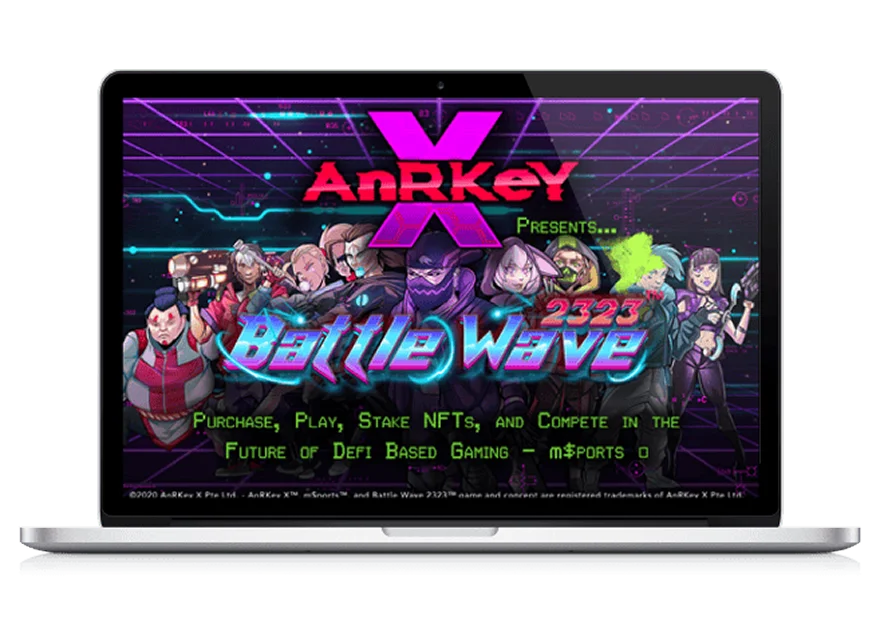
Contracts had to reward gamers fairly on a decentralised esports platform, and the proprietary gDEX protocol had no precedent to build from.
Awarded NFTs act as power boosts tied to a user's yield-farming rank, tradeable outside the ecosystem, with liquidity mining running during play. Built on Polygon with Solidity, Chainlink and Unity.
gDEX shipped with a self-balancing economy where reward distribution tracks genuine contribution.
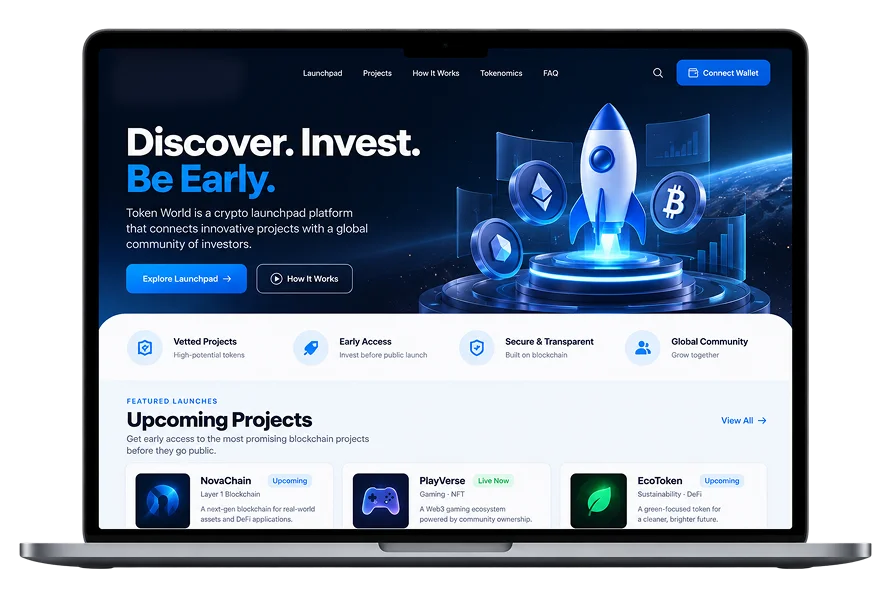
A launchpad holds other people's fundraising capital, which concentrates contract risk, multi-jurisdiction KYC/AML and securities obligations, and sale-window load spikes.
Contract audits and testing protocols, compliance frameworks mapped per jurisdiction, and a load-balanced architecture for peak sales. Features span project review, investment rounds, dashboards, bilingual support and fraud detection. Built on Polygon and Solidity.
Launched across multiple jurisdictions with compliance frameworks in place, holding through peak sales load.
We support leading blockchain networks for DeFi development, helping businesses choose the right infrastructure for secure smart contract execution, scalability, interoperability, and cost-efficient transactions.









We deliver DeFi smart contract development solutions across industries, enabling businesses to automate financial operations, improve transparency, streamline transactions, and build decentralized financial ecosystems.


Decentralized lending, borrowing, asset management, and automated financial transactions that reduce intermediary dependency and improve access to digital financial services.


Token swaps, liquidity pools, staking protocols, and decentralized exchanges that support secure digital asset trading and efficient on-chain transactions.


Smart contracts for fractional ownership, tokenized property investments, automated distributions, and transparent ownership transfers through blockchain-based platforms.


Decentralized insurance protocols, automated claims processing, parametric coverage, and predefined payout mechanisms that improve transparency and reduce manual intervention.


Decentralized payment processing, crypto payment settlements, escrow contracts, and automated merchant transactions that enable efficient digital commerce.


Smart contracts for in-game asset trading, NFT marketplaces, token-based rewards, and decentralized economies that support transparent transactions and digital ownership.


Blockchain-based trade settlements, invoice financing, escrow arrangements, and automated payment releases triggered by verified delivery or contractual milestones.


Governance contracts, community voting mechanisms, treasury management, and automated proposal execution that enable transparent, rules-based decentralized decision-making.

Let’s turn your concept into a production-ready DeFi solution.
We use a blockchain technology stack for DeFi smart contract development, combining programming languages, development frameworks, testing tools, and security solutions to build reliable decentralized applications.
 Truffle
 OpenZeppelin
 HardHat
 Infura
 Alchemy
 Ganache
 Pinata
 Metamask
 Geth
 Chainlink
 Solidity
 Vyper
 Rust
 Python
 C++
 Node.JS
 Ether.JS
 Web3.JS
 React.JS
 Angular.JS
 Next.JS
 The
Graph
 MongoDB
 CouchDBMetamask
 Trust
WalletBinance
 Coinbase
 WalletConnect
 ERC-1155
 ERC-20
 ERC-721
DeFi smart contract development costs depend on protocol complexity, blockchain selection, security audits, integrations, and testing requirements. Understanding these cost factors helps businesses estimate budgets and plan secure decentralized finance applications.
| Engagement | Typical Range | Timeline |
|---|---|---|
| Architecture and mechanism review | $5,000 to $12,000 | 2 weeks |
| Single contract set (staking, token, vesting) | $15,000 to $40,000 | 4 to 7 weeks |
| AMM or DEX protocol | $50,000+ | 10 to 16 weeks |
| Lending or vault protocol | $70,000 to $80,000 | 12 to 20 weeks |
| Multi-chain protocol deployment | $80,000+ | 16 weeks+ |
A structured roadmap helps build secure, scalable DeFi smart contracts, from defining protocol requirements to deployment, validation, and continuous maintenance.

Define business goals, user needs, tokenomics, protocol features, and blockchain requirements before development begins.

Design contract structures, transaction flows, token standards, access controls, and protocol interactions for reliable execution.

Write smart contracts, implement DeFi logic, and integrate wallets, oracles, tokens, and external protocols.

Conduct code reviews, vulnerability assessments, automated tests, and penetration testing to identify potential security risks.

Deploy contracts on a testnet to validate functionality, simulate transactions, and resolve issues before launch.

Launch audited contracts on the mainnet, monitor performance, address emerging risks, and maintain protocol reliability.
SoluLab delivers DeFi smart contract development services focused on security, scalability, and protocol efficiency, helping businesses build reliable decentralized finance solutions tailored to their goals.






SoluLab delivered exactly what we needed: a high-end DeFi platform that makes crypto trading, lending, and borrowing secure, transparent, and effortless. Their deep expertise in blockchain, security, and automation enabled us to create a truly differentiated solution for the finance sector. The platform’s performance and flexibility exceeded our expectations.

Our challenge was creating a DeFi ecosystem where NFT transactions could be backed by greater trust and transparency. SoluLab helped us bring together the NFT protocol, NFTY token, USD-backed stablecoin, and reputation layer into a cohesive platform. Their team understood the intersection of DeFi and digital assets and translated that into a practical product.

Our biggest challenge was removing the friction that keeps users away from decentralized exchanges. SoluLab helped us bring together cross-chain liquidity, account abstraction, and gasless transactions into a single trading experience. The team understood that DeFi adoption depends as much on usability as it does on blockchain infrastructure.

Smart contract development is writing, testing and deploying self-executing code on a blockchain that runs exactly as written and cannot be altered once deployed unless an upgrade mechanism was deliberately built in. In DeFi it also holds user funds.
Define the invariants that must always hold, write the contract in Solidity, Rust or Move, test with unit, fuzz, invariant and mainnet-fork suites, get an independent audit, remediate findings, deploy to testnet, then launch to mainnet with caps and a pause path.
An engineer who writes on-chain code that moves value. The role combines software engineering with adversarial thinking and, in DeFi, economic reasoning, because a contract can be syntactically perfect and still be drained through its incentive design.
Start with Solidity fundamentals and the EVM execution model, then build in Foundry, read audited code from OpenZeppelin and major protocols, and work through published post-mortems of real exploits. Studying failures teaches more than studying tutorials.
A single contract set runs four to seven weeks. An AMM or DEX protocol takes ten to sixteen weeks, and a lending or vault protocol twelve to twenty. Independent audit adds two to six weeks on top, depending on contract surface area.
Architecture review runs $5,000 to $12,000, a single contract set $15,000 to $40,000, and an AMM or lending protocol $50,000 to $80,000. External audit is a separate pass-through cost from $15,000 upward, scaling with contract complexity.
Yes, if the contract holds funds. An audit is necessary but not sufficient: current loss data shows most severe damage now comes from key compromises, privileged access weaknesses and configuration errors rather than from code bugs an audit would catch.
It depends on your governance appetite. A proxy lets you fix bugs but creates an admin key capable of replacing the protocol. Immutable contracts remove that risk and remove your remediation path. Timelocks and multisig are the middle ground.
Fork when your differentiation is distribution, assets or community rather than the core mechanics. Build when the mechanism itself is the product. A fork still needs re-auditing of any path affected by your parameter or logic changes.