Generative Artificial Intelligence (AI) does something most software never could. It makes things. Pictures, paragraphs, melodies, code: material that did not exist until the model produced it, and that reads as though a person sat down and made it. The machinery underneath is less mysterious than the output suggests. A model trains on an enormous pile of data, absorbs the patterns and quirks buried in that pile, then produces fresh material carrying the same fingerprints.
Here is the part that actually matters. Most AI you have used sorts things or predicts things. Is this email spam, will this customer churn, what digit is in this image. Generative systems do not sort. They invent, and what comes out is frequently a combination nobody on the team expected, which is exactly why arguments about where creativity lives got loud so quickly.
Read Our Blog Post: Top 10 Generative AI Development Companies
Technology and creativity used to sit in separate rooms. They do not anymore. What follows is a close look at how these systems work, where they have already landed in real industries, what they break on the way, and what it takes to build with them without getting burned.
What are the Evolution and Advancements in Generative AI Technology?
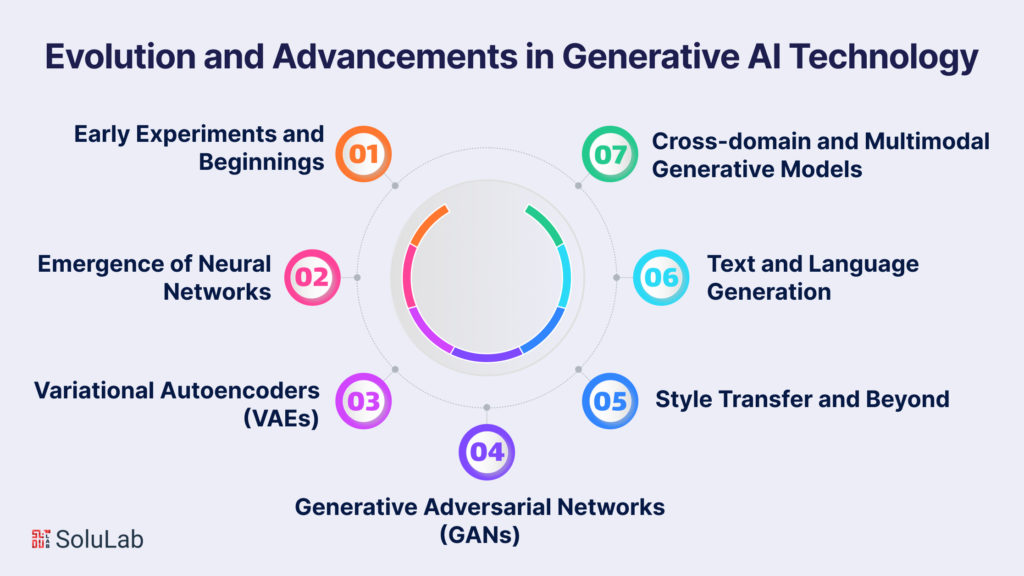
The road here was long. Decades of it, several dead ends, and a handful of moments where the whole field lurched forward at once:
Early Experiments and Beginnings
The first attempts were not impressive. Rule-based programs producing simple patterns, hand-coded by researchers who were mostly curious what would happen. Nobody would have called it creative. But the questions those toys raised stuck around long after the code stopped running.
Read Also: Top Generative AI Trends You Need to Know Before 2027
Emergence of Neural Networks
Then neural networks came back, and deep learning came with them. Suddenly models could pull structure out of messy data instead of having every rule spelled out for them, and the quality of what a machine could generate jumped hard.
Variational Autoencoders (VAEs)
VAEs brought probability into the picture. Rather than memorizing examples, these models learn the statistical shape of a dataset, which lets them sample output that belongs to the same family without copying anything inside it.
Generative Adversarial Networks (GANs)
GANs landed in 2014, courtesy of Ian Goodfellow, and they reset every expectation about the Generative AI landscape. The setup is close to adversarial theater. One network generates, a second network judges, and the two train against each other. The generator wants output the judge cannot flag as fake. The judge wants to catch every fake it sees. Run that contest long enough and the fakes get unsettlingly good.
Style Transfer and Beyond
Generative AI models like GANs made style transfer possible: take the look of one image, wrap it around the content of another. Painters and engineers finally had something to argue about together.
Text and Language Generation
Then language. Models such as OpenAI’s GPT-3 showed that a system could hold context across paragraphs and write something that made sense, which rearranged the economics of content work more or less overnight.
Cross-domain and Multimodal Generative Models
The newer work crosses modes entirely. Describe a scene in words, get an image back. Feed in an image, get a description. The walls between formats are getting thin.
What are the Generative AI Solutions in the Industry?
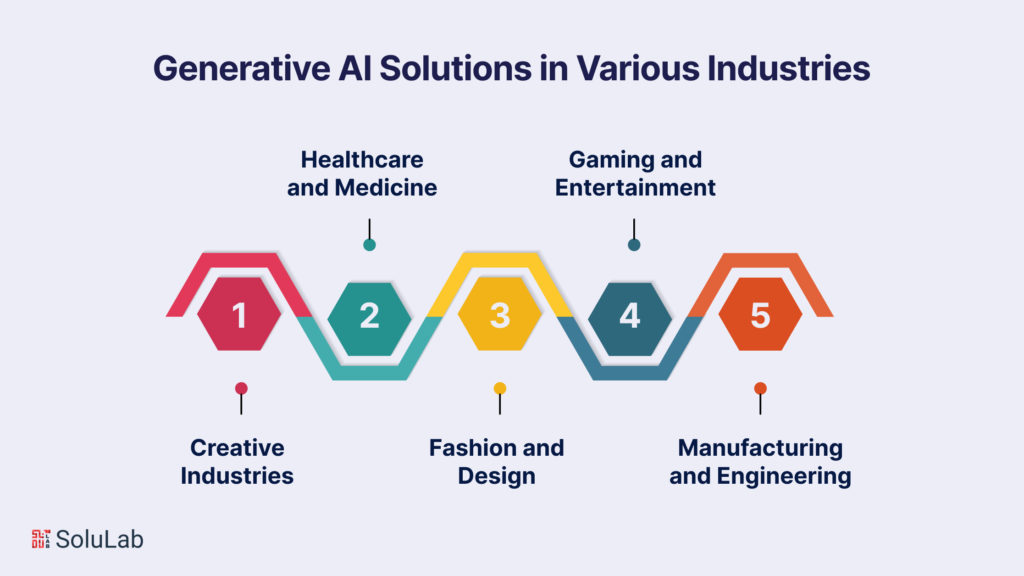
Generative AI left the lab some time ago. It now sits inside production workflows in industries that have almost nothing in common with each other, and each one has bent the technology toward its own stubborn problems.
Creative Industries
Artists, designers and composers treat these models less like tools and more like odd collaborators. A visual artist feeds in constraints, gets back variations they would never have drawn by hand, then picks and refines. Composers run the same loop with melody and harmony, chasing progressions that sit outside their own habits, which is the whole point.
What comes out of that back and forth is neither purely human nor purely machine. Most of the people doing it seem fine with that.
Check Out Our New Blog: Generative AI and Human-AI Collaboration: A Look into the Future
Healthcare and Medicine
Healthcare picked it up for the unglamorous heavy lifting: drug discovery and imaging. Models generate candidate molecular structures, which shortens the slow early screening stage of drug development rather than eliminating it.
On the imaging side, generative methods clean up and denoise scans so a radiologist has something clearer to read, which feeds straight into diagnosis and treatment planning. Plenty of clinics now run platforms like PatientNow medical aesthetics software to keep patient management tidy and push AI-driven insight into the actual treatment workflow instead of a side dashboard nobody opens. The same class of models also simulates biological processes, which is quietly useful for researchers trying to work out how a disease behaves.

Fashion and Design
Fashion and architecture use it at the front end of design, where ideas are cheap and commitment is not. A designer gets AI-generated patterns and textures as raw material, not as finished product.
Architects run generative models to test how a structure uses space and how it performs environmentally, then carry the interesting results forward into real drawings. The creative range widens. The physics stays exactly as unforgiving as it was.
Gaming and Entertainment
Games got here early. Developers generate terrain, characters and scenarios on the fly, so the world keeps shifting underneath the player instead of sitting still.
Procedural generation means two players rarely see the same thing, which is a design philosophy as much as a technique. Over in film and television, the same family of algorithms produces effects and visualizations that used to swallow enormous amounts of manual work.
Manufacturing and Engineering
Manufacturing and engineering use it to redraw the design step itself. Engineers hand a model the performance targets, and it returns geometries that hit them using less material than a human would have spent.
Aerospace and automotive teams care about that more than most, because weight is money in both. Generative models also spin up prototypes and test scenarios, which tightens the loop between an idea and the next revision of it.
What are the Challenges and Ethical Considerations in Generative AI?
None of this comes free. The exact capability that makes a model useful, producing content that passes for real, is the capability that makes it dangerous. The problems below are not hypothetical, they are already here, and most of them have no clean answer yet.
Misinformation and Manipulation
A model that generates convincing content generates convincing lies just as easily. Deepfakes swap a face into a video well enough to fool a viewer who is not looking closely, and viewers who are not looking closely make up most of the internet.
Know More: From Data to Business Success: Role of AI in Sentiment Analysis
Intellectual Property and Ownership
Who owns the output? Nobody has settled it. The model learned from existing work, the result is new, and the boundary between derivative and original happens to be the exact place where the law is thinnest. Fair compensation for the people whose work trained the thing remains an open fight.
Creative Originality
If a machine writes a decent short story, what exactly does that say about writing? The question sounds like a seminar topic right up until it is your job on the other side of it.
Unintended Bias and Fairness
Models absorb whatever sits in the training data, including the parts nobody audited. Skewed input produces skewed output, and generated content can carry those biases forward at a scale no human process ever managed.
Privacy and Consent
Training data was often collected for something else entirely. The people who contributed it did not agree to this use, and generated output can occasionally surface something sensitive that was supposed to stay buried.
Reliability and Authenticity
Telling real from generated keeps getting harder. That is a slow corrosion problem for digital media. When anything could be synthetic, trust in everything slides.
Check Our Post: Generative AI for Enterprises: Understanding Architecture, Implementation, and Implications
Technological Accessibility
Building these systems takes expertise most people do not have and will not easily get. That concentrates control in a small number of hands, and leaves everyone else using what they are handed, with very little say in how it works or why.
Ethical Deployment
And then the harder question. Where should the line sit? Working out which Generative AI use cases genuinely match what a society wants, and which ones should simply not be built at all, is not a technical problem. No better model solves it.
What Skills and Expertise Are Required for Generative AI Development?
Building generative systems takes hard math, engineering discipline, and a kind of taste that is difficult to teach and obvious when it is missing. You need to understand the algorithms, the networks, and the peculiarities of whatever data you are feeding them. Here is what the work actually demands:
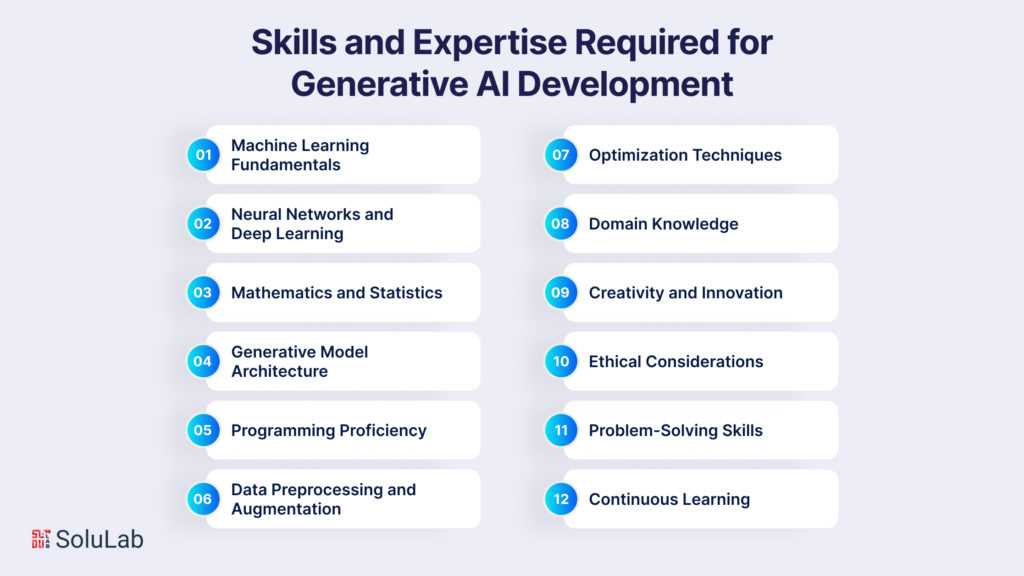
Machine Learning Fundamentals
Start with the basics, because everything sits on them. Supervised and unsupervised learning, classification, regression, clustering. Skip this layer and the advanced work turns into copying code you do not understand.
Neural Networks and Deep Learning
Deep learning is the engine here. You have to build and train the networks yourself, CNNs and RNNs included, and know why a given architecture behaves the way it does on your data.
Mathematics and Statistics
Linear algebra, calculus and probability theory are not decoration on a job description. They are how you design a generative model, tune it, and figure out why it started producing nonsense on Tuesday.
Check This Blog Also: 10 Benefits of Incorporating Generative AI in the Manufacturing Process
Generative Model Architecture
Generative Adversarial Networks, Variational Autoencoders, autoregressive models. Each one has its own quirks, its own failure modes, and its own sweet spot. Knowing which to reach for first can save a team months.
Programming Proficiency
Python, realistically. Along with real fluency in TensorFlow, PyTorch or Keras, since that is where generative models get built and trained.
Data Preprocessing and Augmentation
Data work is most of the job, whatever the job description says. Preprocessing, augmentation, normalization. Feed a model garbage and no architecture on earth will rescue the output.
Optimization Techniques
Gradient descent, backpropagation, and the temperament of different optimizers. Training a generative model comes down to knowing what to adjust when the loss curve starts misbehaving.
Read Also: From Theory to Reality: Real-World Applications of Generative AI and GPT
Domain Knowledge
Context matters more than people expect. If the application is medical imaging, somebody on the team has to understand medicine, not just tensors.
Creativity and Innovation
There is a judgment call running through this work that no textbook covers. Deciding what is worth generating, and what counts as a good result once you have it, takes taste.
Ethical Considerations
Privacy, bias, authenticity. Developers who think about these while designing produce better systems than the ones who bolt a review onto the end of the project and hope.
Problem-Solving Skills
Most of the day goes to debugging something that should work and does not. Hyperparameters, collapsed training runs, models that diverge for no visible reason. In practice, this is where teams get stuck, and patience counts as a technical skill.
Check Out Our Post: Top 7 Generative AI Integration Services For Your Business
Continuous Learning
AI moves fast enough that an approach from two years ago can already be the wrong one, so reading new research is part of the job rather than a weekend hobby
Where to Find Generative AI Developers: A Spotlight on SoluLab
Finding people who can actually build this is the real bottleneck for most companies. Demand keeps climbing, and the pool of engineers who have shipped generative work rather than read about it stays small. SoluLab is worth a look, and here is the case.
Diverse and Proficient Team
The team covers machine learning, data science and neural network engineering rather than one narrow specialty. That matters, because generative projects tend to sprawl across all three before the first milestone.
Expertise in AI Frameworks
TensorFlow, PyTorch, Keras. SoluLab’s developers work in these every day, so building and deploying a generative model shaped to your requirements does not begin with a learning curve on your budget.
Read Also: Top 10 Enterprise AI Development Companies
Collaborative Approach
Generative projects go sideways when the builders guess at what the client meant. SoluLab’s team works close to the client from the start, asks the awkward questions early, and shapes the solution around what you actually need instead of what somebody assumed during kickoff.
Project Portfolio
The portfolio holds a spread of delivered AI projects, generative work among them. Past delivery is more or less the only evidence that counts in this business.
Industry Integration
Healthcare, finance, e-commerce and others besides. Each sector brings its own constraints and its own regulators, and having worked across several of them shortens the time spent learning yours.
Thought Leadership
The team publishes research, turns up at conferences, and shares what it finds. That habit is how a firm stays current in a field that partly reinvents itself every few months.
Check Blog Post: Unleashing Business Value: How Generative AI is Transforming Industries
Ethical Approach
Responsible use gets treated as part of the build, not a compliance box ticked at the end. Solutions are designed to sit inside ethical guidelines and the social norms of wherever they are deployed.
Holistic Solutions
Ideation through development, deployment and maintenance. One team owns the whole arc, which removes the handoff gaps where projects usually stall out.
What Are the Benefits of Collaborating with Generative AI Development Experts?
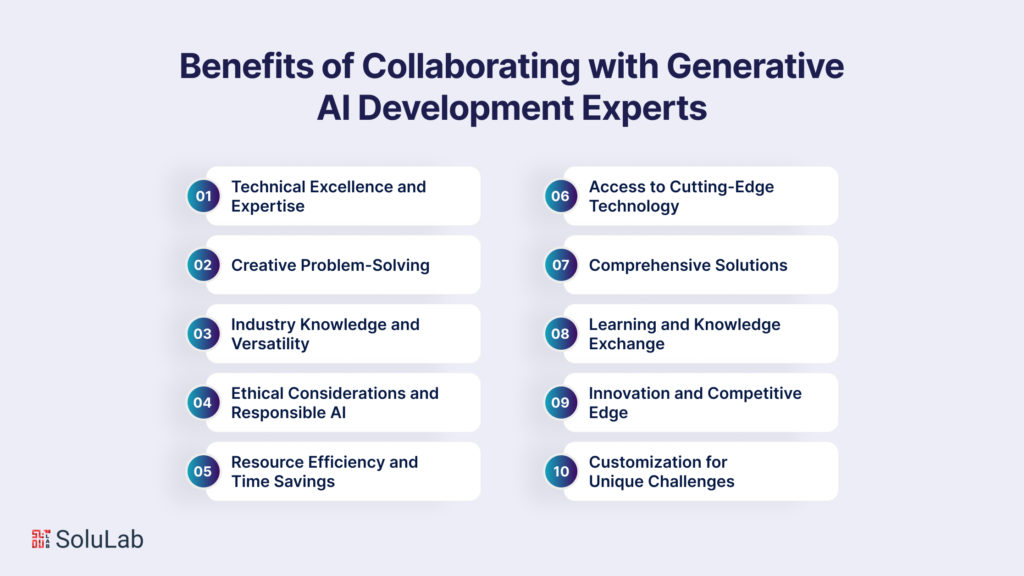
So what do you actually get by bringing in specialists? More than a faster build, though that alone often pays for itself. Here is the practical breakdown:
Technical Excellence and Expertise
They know the algorithms, the network architectures and the frameworks well enough to make design calls quickly and get them right. Your generative models come out built properly and tuned properly, which is not the same thing as built once and hoped over.
Creative Problem-Solving
Half of generative AI work is technical. The other half is judgment about what good output even means for your goals. Experienced practitioners bring both, and the second half is far harder to hire for.
Read Also: What is an AI-powered chatbot?
Industry Knowledge and Versatility
Art, entertainment, healthcare, manufacturing. The applications differ wildly and so do the constraints wrapped around them. Specialists who have crossed industries can shape something for yours instead of handing over a generic build with your logo on it.
Ethical Considerations and Responsible AI
Bias, privacy and authenticity questions surface in every serious project. Experts who have met them before catch the problems during design, while they are still cheap to fix, and keep the generated output inside ethical guidelines rather than arguing about it after launch.
Resource Efficiency and Time Savings
Building from scratch burns months and money. Working with a team that already owns the tooling, the workflows and the scar tissue cuts that down sharply.
Access to Cutting-Edge Technology
New techniques land constantly. Specialists track them as a matter of routine, so your project gets current methods instead of whatever was state of the art on the day the requirements document was written.
Comprehensive Solutions
Ideation to deployment to maintenance, handled by one group. Fewer handoffs, fewer things lost between teams, and considerably less of your own week spent coordinating people who do not talk to each other.
Learning and Knowledge Exchange
Your own team learns. Working next to experienced practitioners, people absorb techniques, working practices and a feel for what is coming, and that knowledge stays with you long after the engagement closes.
Innovation and Competitive Edge
Fresh eyes notice the options your team stopped seeing a year ago. That is usually where an edge comes from in a market that keeps shifting under everyone.
Customization for Unique Challenges
No two projects match. Experts bend the approach to your constraints rather than bending your problem to fit a template they already had lying around.
Conclusion
Generative AI stopped being a curiosity a while back. It writes, draws, composes and synthesizes data at a level that would have sounded like wishful thinking not long ago, and the models keep improving at precisely the things they were worst at. Creativity, problem-solving and the shape of a decent user experience all look different now than they did before these systems arrived.
Adoption spread because the technology bends. Art, design, music, text, scientific research: the same underlying approach adapts to all of them without much argument. For businesses and individuals both, being able to produce something new that also fits its context has opened doors that were shut, and it keeps opening more of them.
But generative AI tools are not finished technology. Fine-tuning them is fiddly work. Ethical use takes actual decisions, not a policy document filed somewhere. And quality control does not happen by itself, ever. Anyone planning to build on this should budget for those problems now rather than meet them in production later.
SoluLab builds with the current generation of generative models, ChatGPT, DALL-E and Midjourney among them, and shapes them around what your company specifically needs rather than what demos well. If you want Generative AI Development Services built for your requirements instead of a generic deployment, that is the work we do. Agile development, and a stubborn focus on business outcomes over impressive screenshots. Hire Generative AI Developers from SoluLab today and put generative AI to work on something real. Contact SoluLab Now to explore the possibilities.
FAQs
Shipra Garg is a tech-focused content strategist and copywriter specializing in Web3, blockchain, and artificial intelligence. She has worked with startups and enterprise teams to craft high-conversion content that bridges deep tech with business impact. Her work translates complex innovations into clear, credible, and engaging narratives that drive growth and build trust in emerging tech markets.