
The system allows to train its own Bot to be able to answer phone calls, greet user over the phone/sms, provide information about client’s services
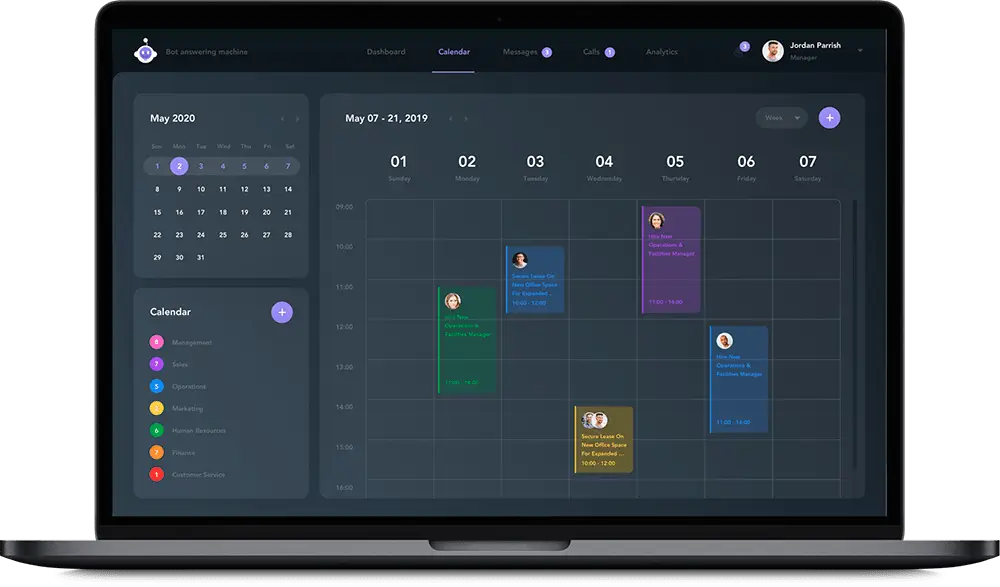
The system allows a business to train its own chatbot that will be able to answer phone calls, greet user over the phone/sms, provide information about a client’s services and also help a user to schedule an appointment based on the available time slots.
The application is HIPAA-compliant and has emergency calls scripts. There is also a dashboard where clients are able to create, configure and train very own conversational agent.
NLP, NER, Speech to Text, Text to Speech
1 Tech Lead, 1 Full-stack developer, 1 BA/PM, 1 QA engineer
Powered by a robust ecosystem of enterprise-grade technologies, databases, and communication protocols.






Because of the nature of the chatbots and in spite of some specific application requirements, the project is based on the following core technologies.
As the application should be able to understand human’s natural language and translate it into signals understood by a machine, we address this as a Natural Language Classification (NLC) problem.
Required to recognize and extract elements like products, pricing, location, and dates from user speech to appropriately schedule practitioner appointments.
A system component responsible for translating recorded or streamed voice into text, which can then be processed by the NLC component.
A component responsible for converting predefined text answers back into voice, allowing the answer to be transferred to the user via phone.
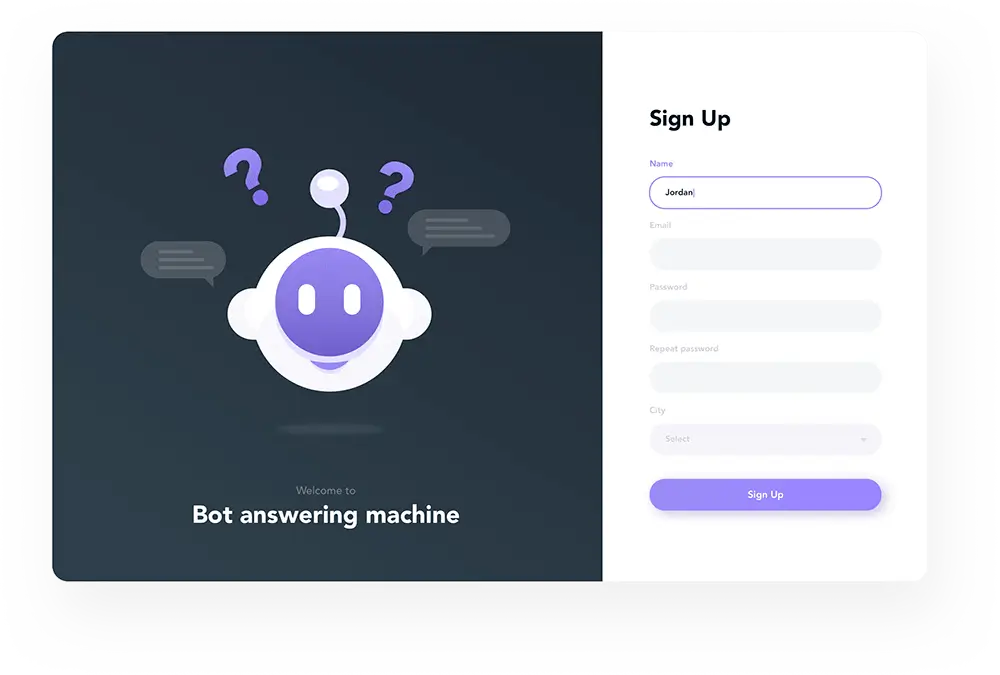
As the team was developing an MVP, speed to market is one of the key factors. Instead of third-party services such as Google Tensorflow or API.ai, we utilized IBM Watson services to solve project tasks.
Quickly build and deploy chatbots and virtual agents across a variety of channels, including mobile devices, messaging platforms, and robots.
Easily convert audio and voice into written text for the quick understanding of content.
Convert written text into natural-sounding audio in a variety of languages and voices.
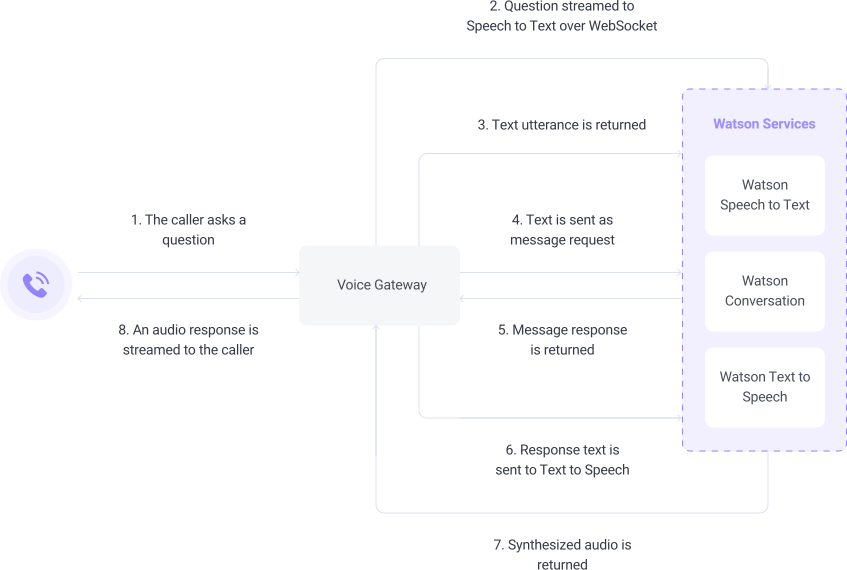
Cognitive self-service agent that connects to a telephone network and routes calls through Watson Speech-to-Text, Conversation, and Text to Speech services.
Voice Gateway acts as an orchestration tool built to help construct Interactive Voice Response systems. It tightly orchestrates IBM Watson services together.
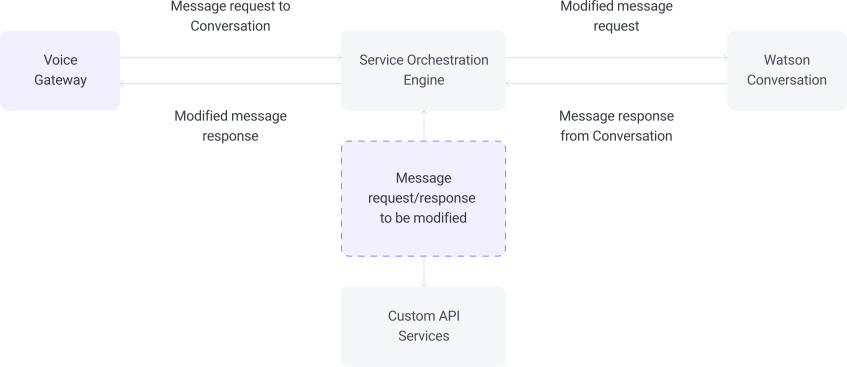
To de-identify requests to remove personal information such as PHI, PII, and PCI before it is sent to the Conversation service.
To personalize responses from the Conversation service, for example by using customer location information to provide a personal weather forecast.
To enable telephony features, such as including caller ID or collecting DTMF digits for account numbers.
To customize interactions with customers by using APIs.
To use Voice Gateway state variables, for example to complete a long transaction.
To integrate voice security by using DTMF or biometrics.


