The Philippines is in a different place with crypto right now. While a lot of markets still talk about future adoption, Filipinos are already using it in their day-to-day lives. Around 12–13% of the population holds crypto in 2026, but more importantly, they’re using it for real things, getting paid for freelance work, sending money home, or just avoiding bank fees that feel unfair. What really puts things in perspective is remittances.
| Over $38 billion moved into the country in a single year, and traditional channels still take a painful cut. Stablecoins quietly changed that, dropping fees to under 1%, which makes a real difference when that money is meant for rent, food, or school fees. |
When you see that happening at scale, it becomes clear this isn’t about charts or speculation, it’s about efficiency and trust. That’s why white-label crypto wallets work here. They let teams move fast on proven infrastructure instead of wasting time rebuilding the basics. The challenge isn’t launching, it’s doing it right, within regulation, with trust, and before the window closes.
Key Takeaways
- The problem: Many crypto wallets fail to monetize due to weak security, poor UX, and unclear regulatory alignment with BSP guidelines.
- The solution: A profitable white-label crypto wallet focuses on compliance-first architecture, local payment rails, and multi-asset support.
- How SoluLab helps: SoluLab builds Philippines-ready white-label crypto wallets with BSP-aligned compliance, robust security, and revenue-driven features—helping businesses launch faster and scale profitably.
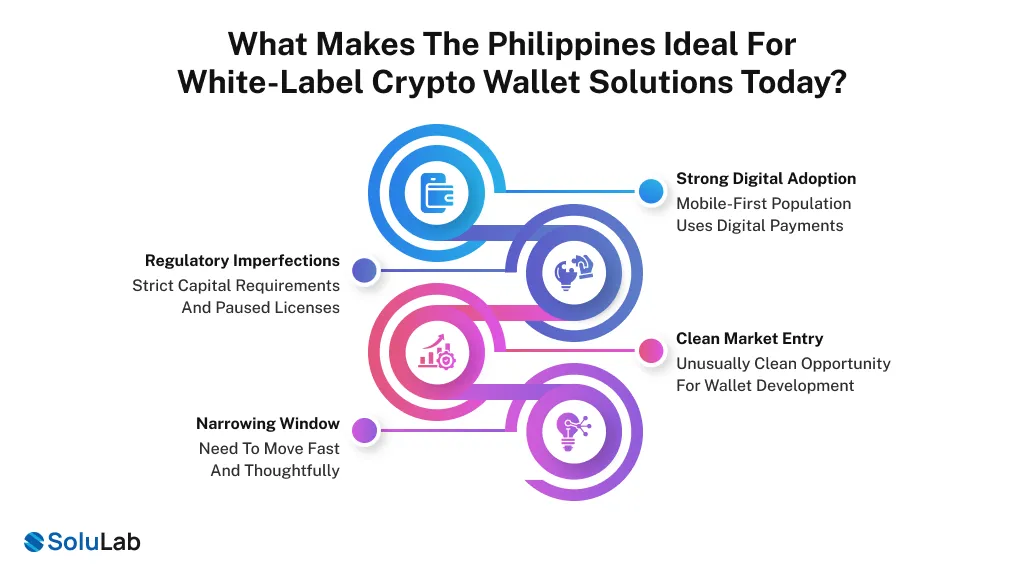
What Makes the Philippines Ideal for White-Label Crypto Wallet Solutions Today?
We’ve been around long enough to watch crypto reinvent itself every few years. ICOs came and went, and NFTs had their moment. Then there was that phase where everything needed a token, even when it didn’t make sense.
What’s happening in the Philippines right now feels different. It’s quieter. More grounded. And from a business point of view, that’s usually where the real money gets built. Chainalysis ranked the Philippines 9th globally for crypto adoption in 2025. That ranking matters, but not for the reason people think. It’s not about speculation. It’s about usage. People here use crypto because it fits into how money already moves.
1. The Remittance Reality
Everyone knows Filipinos send money home. What’s often missed is how big and how painful that flow really is. Remittances hit $38.34 billion a year, which is close to 10% of the country’s GDP. Traditional rails still charge anywhere between 5–10% and can take days. For families living month to month, that delay isn’t a small inconvenience.
When stablecoins move value in minutes and cost under 1%, this stops being crypto innovation and starts becoming common sense. You saw this play out when Coins.ph partnered with BCRemit. Fees dropped hard, settlement became near-instant, and recipients saw funds in their digital wallets the same day. No hype, just a better pipe.
That’s why digital wallet solutions work here. They don’t ask users to change behavior, and they simply make existing behavior cheaper and faster.
2. Mobile-First Population, Bank-Second Reality
Here’s where the Philippines becomes especially interesting. More than 80 million people already use mobile wallets. GCash alone is approaching full population penetration. Maya isn’t far behind. Mobile money is normal here.
So when you launch a crypto wallet in the Philippines, you’re not teaching people about QR codes, balances, or digital payments. That muscle memory already exists. Your real job is making the crypto layer feel invisible, familiar, and safe.
At the same time, traditional banking still doesn’t reach everyone.
- Rural users struggle with access
- Small merchants avoid banks due to friction
- Younger users don’t see banks as essential
This is where customized crypto wallet development solutions fit naturally. They meet users where they already are, without forcing them into legacy systems.
3. Regulation: Imperfect, but Real
Regulation here isn’t friendly, but it is clear enough to build around. The BSP’s VASP framework and the SEC’s CASP rules give serious operators something to work with. Yes, the capital requirements are high. Yes, new licenses were paused. But that also means fewer reckless players flooding the market.
If you’re building for the long term, this actually helps. It’s why experienced cryptocurrency wallet development companies are still entering the market. They understand that regulated environments create defensibility once you’re in.
4. Adoption That Didn’t Disappear After the Hype
One of the strongest signals in the Philippines is what didn’t happen. After the 2021 bull market, adoption didn’t collapse. Roughly 10% of the population still uses crypto, and projections show continued growth into 2026. Usage is spread across remittances, freelance payments, gaming, and small business activity.
That kind of adoption mix usually means the market is past its “experiment” phase. You can see it in how Web3 gaming, government pilots, and payment infrastructure are all growing at the same time. When crypto isn’t tied to a single trend, it tends to stick.
So, if you’re looking to build a crypto wallet in the Philippines, the opportunity right now is unusually clean. You have:
- Users are already comfortable with digital money
- Real economic drivers beyond speculation
- Rules that exist, even if they’re strict
- And competitors who are still moving more slowly than they should
The opportunity isn’t theoretical. It’s executional. And as always in markets like this, the question isn’t if there’s room to build something meaningful. It’s whether you move fast enough and thoughtfully enough before the window starts to narrow.
How to Build a Crypto Wallet in the Philippines Without Overcomplicating Architecture?
If you’re building for the Philippines, architecture is not a tech debate. It’s a survival decision. Get it right, and you scale quietly. Get it wrong, and you rebuild in six months.
Frontend
- Must work smoothly on budget Android phones, not just flagship devices
- Biometric login is expected, not optional
- UI should feel familiar, close to GCash / Maya flows
- Tagalog support helps trust and adoption, especially outside Metro Manila
If users feel lost or unsafe, they leave. Simple as that.
Backend
- Needs multi-chain support (USDT on Tron, ETH, Solana) without confusing users
- BSP reporting hooks must be built in early, not patched later
- Strong PHP on/off-ramps decide whether the wallet grows or stalls
Most Philippine wallets fail here, not in features.
Security
- Hot wallets for daily use (small balance, fast access)
- Cold storage for most funds (offline, SEC-aligned segregation)
- If security breaks once, the business is done
Key Management
- Non-custodial is good, but users lose keys
- Use encrypted key storage (KMS / HSM)
- Add simple recovery flows, not scary technical steps
Good wallets protect users from their own mistakes.
Integrations
- PHP fiat gateways (banks, GCash, Maya)
- KYC / AML tools aligned with BSP + SEC
- Real-time price feeds
- Instant transaction notifications (users expect this)
The wallets that win here are not the most complex ones, but the ones that feel familiar, move money smoothly, and never scare users. That usually means working with a crypto wallet development team that understands how Filipinos actually use money, not just how blockchains work.
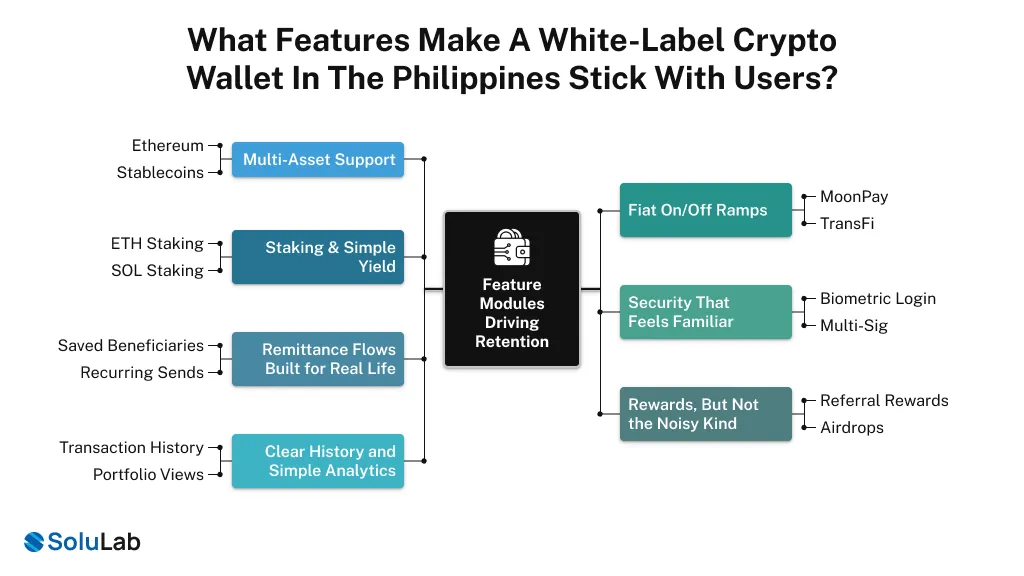
What Makes a White-Label Crypto Wallet Stick With Users in the Philippines?
This is where most wallets quietly fail. On paper, many white-label wallets look similar. They store assets, they send assets, they tick the basic boxes. But once real users come in, especially in the Philippines, the gaps show up fast. People try the app once, maybe twice, and then disappear. The wallets that survive here don’t win on complexity; they win because they fit how people already use money.
1. Multi-Asset Support
Filipino users don’t just hold Bitcoin. They move between Ethereum, stablecoins, and whatever makes sense at the moment. Chainalysis data shows activity spread across multiple chains, not concentrated in one. If your wallet launches with limited assets, users won’t complain.
They’ll just leave. Coins.ph supports close to 90 assets, and you don’t need to beat that on day one, but you do need to be in the same conversation. Think 50+ assets minimum, or you’re already behind.
2. Fiat On/Off Ramps
If there’s one feature that decides whether a wallet becomes a habit or a one-time experiment, this is it. People need to move pesos in and out without thinking too hard. If they hit friction – manual steps, delays, and confusing partners, they won’t push through. They’ll close the app.
Wallets that integrate clean fiat ramps, whether through providers like MoonPay, TransFi, or local processors, consistently show 30–40% higher engagement. That’s not a nice-to-have metric. That’s survival. In a market where many users are still learning crypto, fiat access is what turns curiosity into routine.
3. Staking & Simple Yield
Younger users in the Philippines are already comfortable with the idea of earning from idle assets. DeFi didn’t scare them off; it pulled them in. In-app staking for assets like ETH or SOL does two things at once. It gives users a reason to keep funds inside the wallet, and it creates a clean revenue stream for the operator through reward sharing.
You don’t need exotic strategies. Simple, understandable yield works better here. When users see their balance grow, even slowly, they stop moving funds out.
4. Security That Feels Familiar, Not Heavy
As crypto adoption grew, so did phishing and SIM-swap attacks. People are more cautious now, even if they don’t talk about it openly. Biometric login, like fingerprint, face ID, feels normal because users already trust it in crypto-friendly banking apps.
Add an optional multi-sig feature in the wallet for higher balances, and suddenly your wallet feels “serious” without feeling complicated. This matters more than you think, especially if you plan to onboard businesses or high-value users later.
5. Remittance Flows Built for Real Life
Remittance isn’t a feature in the Philippines. It’s a daily reality. Wallets that treat remittances as just another transfer miss the point. What works better are purpose-built flows like saved beneficiaries, recurring sends, lower stablecoin fees, and clear confirmations. When a wallet makes it easier for someone abroad to support family back home, it stops being crypto software. It becomes infrastructure.
6. Rewards, But Not the Noisy Kind
Filipino users already understand token rewards thanks to platforms like Axie Infinity. But that doesn’t mean you need loud gamification everywhere. Simple referral rewards, small airdrops, and earn-by-use mechanics tend to outperform paid ads here. They feel earned, not forced. The key is flexibility. If your white-label wallet lets you add or tweak these without rebuilding the product, you can experiment fast and double down on what works.
7. Clear History and Simple Analytics
At some point, every user asks the same question: Where did my money go? Clean transaction history, basic portfolio views, and exportable records matter more than advanced charts. For institutions, audit trails are mandatory. For retail users, clarity builds trust. With crypto gains now being taxed locally, even simple tax-friendly summaries go a long way in keeping users comfortable.
What Are the Most Profitable Strategies for Philippine White Label Digital Wallet Apps?
Let’s start with something most decks don’t say out loud. A free wallet is not a growth strategy. It’s a cost center. If you don’t design revenue into the wallet from the first version, you end up chasing scale just to stay alive.
In the Philippines, the wallets that survive are not the flashiest ones. They’re the ones that quietly take a small cut, many times a day, without annoying the user. That’s the real game.
| Revenue Stream | How It Works (Simple) | Typical Margin | Why It Works in the Philippines |
| In-Wallet Token Swaps | Users swap tokens inside the wallet via your integrated exchange or liquidity partner | 0.4% – 1% per swap | High transaction frequency, users don’t feel “charged,” volume does the work |
| Fiat On / Off Ramps (PHP ↔ Crypto) | Users convert pesos to USDT or back inside the wallet | 2% – 5% per transaction | Limited banking rails make speed and convenience worth the fee |
| Premium Wallet Plans | Monthly paid tier with better security, support, and lower fees | $4.99 – $9.99 / user/month | Professionals and higher-value users willingly pay for peace of mind |
| Staking Revenue Share | Users stake assets, and the wallet keeps a % of staking rewards | 10% – 25% of rewards | Sticky revenue, long holding periods, low churn once staked |
| Partner & Referral Fees | Wallet refers users to exchanges, lenders, or credit products | Variable (commission-based) | Scales quietly without extra acquisition cost |
| NFT & Gaming Transactions | Fees from NFT trades or in-game asset swaps | 1% – 5% per transaction | Strong play-to-earn history and gaming adoption locally |
A realistic target for a mid-stage white-label operator in the Philippines:
- 100,000 active users
- 30% monthly engagement (users transacting in any given month)
- $150 average monthly transaction volume per active user
- 50% of transactions go through your exchange integration (0.7% margin)
- 20% of active users pay for premium ($6/month average)
- 10% of users use fiat ramps at 3% average commission
Revenue calculation:
- Exchange integrations: 100K users × 30% × $150 × 50% × 0.7% = $15,750/month
- Premium subscriptions: 100K × 20% × $6 = $12,000/month
- Fiat ramps: 100K × 30% × $50 × 3% = $4,500/month
- Total: $32,250/month or $387,000 annually
Scale to 500,000 users with similar metrics, and you’re approaching $2 million annually in wallet-generated revenue alone, before any secondary services.
Key Regulatory Steps to Launch a White-Label Crypto Wallet in the Philippines
Here’s where most white-label wallet projects stumble. They ship the product, users love it, then regulators notice, and suddenly you’re forced to shut down or rebuild everything. The Philippines post-2025 is different. As the rules are clearer, enforcement is active, and the window to move fast and break things is closed.
| Requirement | Issuer | Timeline | Key Documents Needed | Impact on Launch |
| SEC CASP Registration | SEC | 30-60 days | Business plan, capital proof, audit reports, risk policy | Mandatory before fiat services |
| BSP VASP License | BSP | 60-120 days | Detailed AML/CFT program, IT security audit, board resolutions | Required for fiat on/off ramps |
| KYC/AML Program Setup | Internal | 30 days | Vendor selection, workflow design, staff training | Can run in parallel with registration |
| IT Risk Audit (Circular 1213) | Third-party auditor | 15-30 days | Security assessment, penetration testing, governance review | Annual, but initial needed before launch |
| Tax Reporting Capability | Internal/Third-party | 20 days | Tax API integration or manual reporting template | Competitive advantage improves UX |
Securing SEC and BSP approvals takes 60-120 days if you’re well-prepared, 6+ months if you’re not. Your compliance strategy should start before you build, not after. A reputable white-label provider like SoluLab will guide you through this, and it’s not optional.
Custom vs White-Label Crypto Wallets: What Works Better in the Philippines?
You’re evaluating two paths. Let me be direct about the trade-offs.
| Aspect | White-Label Wallet | Custom Build Wallet |
| Cost | $8,000–$50,000 upfront | $75,000–$200,000+ (enterprise-grade) |
| Timeline | 2–6 weeks to launch | 6–12+ months to launch |
| Customization | Moderate – rebrand, adjust layouts, configure features. Core protocol cannot be rewritten | Full control – every line of code is yours |
| Ongoing Costs | Licensing: $500–$5,000/month (depends on provider) + infrastructure | Maintenance team salaries: $200K–$500K/year + infrastructure |
| Best For | Fast market entry, MVPs, capital-constrained teams, or testing second markets | Differentiated features, long-term dominance, or business models needing unique capabilities |
If you’re a startup or growth-stage fintech (Series A/B), white-label is almost always the right first move.
- You save 4-6 months of engineering time and $50K-$150K in development cost.
- You de-risk regulatory and security work, as your provider already has these battles won.
- You can land regulatory approvals and get users while you figure out which features actually drive retention.
If your white-label wallet hits product-market fit and you need differentiation that the platform can’t support, you can always migrate to custom later.
If you’re an established fintech or enterprise (PayMaya, GCash, or large banks) looking to add a wallet offering, custom often makes sense. You have the capital and timeline, and you want tight integration with existing systems.
For the Philippines specifically, white-label + 6 months of live operation + data on what features drive revenue is a smarter path than trying to build and launch simultaneously.
How To Launch a White-Label Crypto Wallet in the Philippines?
Launching a crypto wallet in the Philippines is less about building flashy features and more about getting the fundamentals right early– especially compliance, localization, and infrastructure choices. The step-by-step approach goes like this:
Step 1. Understand the Local Regulatory Landscape
In the Philippines, best crypto wallets typically fall under the oversight of the Bangko Sentral ng Pilipinas (BSP), especially if they support fiat on-ramps, custodial services, or remittances. This means planning for KYC, AML, transaction monitoring, and reporting from day one.
Step 2. Decide on Custodial vs Non-Custodial
This choice affects almost everything that follows-
- Custodial wallets offer easier recovery, smoother UX, and are often better for mass adoption—but require stronger compliance controls.
- Non-custodial wallets give users full control of keys, reduce custody risk, but demand better user education and UX design.
Step 3. Choose a White-Label Wallet That Supports Local Use Cases
Not all white-label wallets are built for the Philippine market. Look for solutions that can support:
- Peso (PHP) on-ramps and off-ramps
- Integration with local payment methods
- Remittance-friendly transaction flows
- Mobile-first UX (critical for PH users)
Step 4. Customize the UX for Filipino Users
Branding, language support, transaction flows, and onboarding need to feel familiar and simple. Filipino users tend to prefer clear guidance, minimal steps, and transparent fees—especially for first-time crypto users.
Step 5. Integrate Security and Compliance by Default
Security isn’t a feature—it’s infrastructure. Make sure the wallet includes:
- Strong key management (HSMs or secure enclaves for custodial wallets)
- Multi-factor authentication
- Transaction monitoring and risk controls
- Audit logs for compliance and reporting
Step 6. Test, Launch, and Iterate Gradually
A soft launch helps catch issues early. Start with a limited user group, monitor transaction flows, support requests, and compliance alerts. Most teams discover that real-world usage exposes gaps no demo ever shows.
Which Growth Tactics Work Best for Philippine White Label Digital Wallet Apps?
Getting users is one thing. Keeping them and actually making money from them is another. In the Philippines, what works is a mix of convenience, trust, and smart incentives.
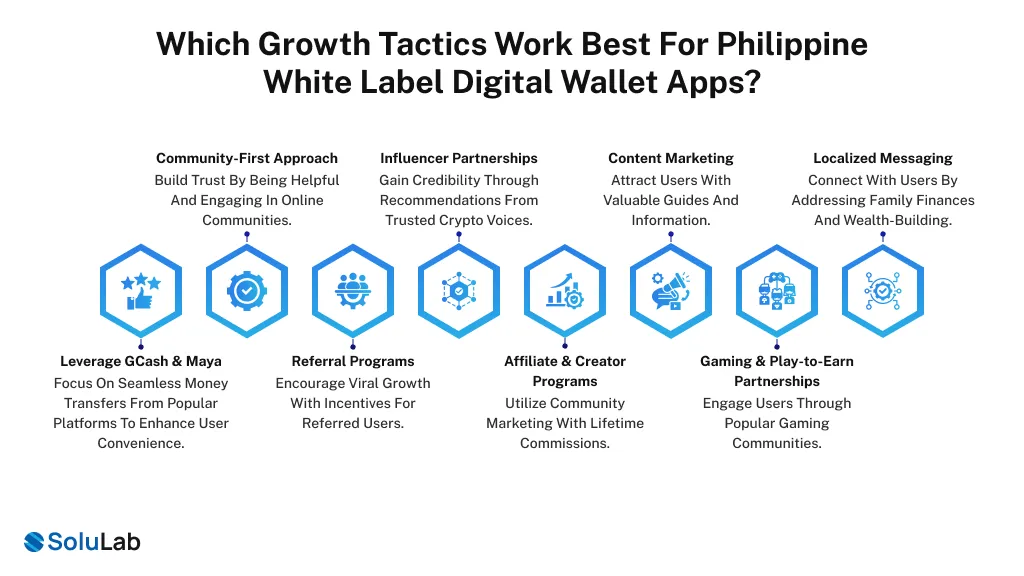
1. Leverage GCash & Maya
- Don’t try to replace them.
- Make moving money from GCash or Maya into your wallet seamless.
- Users just want convenience, not extra steps.
2. Community-First Approach
- People hang out on Telegram, Reddit, and Facebook.
- Spend your first month being genuinely helpful – answer questions, share tips, but don’t spam.
- Communities sniff out fake hype immediately.
3. Referral Programs (Viral Growth)
- $5–$20 credits or tokens per referred user who completes KYC works really well.
- Most transactions are $100–$500, so even $10 incentives pay for themselves fast.
- Telegram and TikTok outperform Instagram and Facebook for crypto audiences here.
4. Influencer Partnerships (Targeted)
- Pick 3–5 credible crypto voices with real Philippines followers.
- Let them use the wallet, review it honestly, and give small affiliate commissions.
- One genuine recommendation beats hundreds of ads.
5. Affiliate & Creator Programs
- Offer 15–25% lifetime commissions.
- Your community markets for you.
- Even 500 active affiliates referring 10 users/month = 5,000 new users, nearly free, you pay only for real conversions.
6. Content Marketing (Long-Term Wins)
- Create guides Filipinos actually search for: Sending crypto to relatives abroad, Staking rewards explained, and Tax-efficient crypto.
- A single post ranking for a crypto wallet Philippines can bring 100+ quality sign-ups/month without paid ads.
7. Gaming & Play-to-Earn Partnerships
- These communities are huge.
- Let them cash out into your wallet and take a small fee.
- It’s natural growth; users are already engaged.
8. Localized Messaging –
- speak to family finances, remittance ease, and simple wealth-building.
- Test your copy with real users before campaigns.
Now Track These Metrics:
- CAC: Total spend ÷ new users. Aim <$5 (referrals help).
- KYC Conversion: Signups → verified. Target >50%.
- 30-Day Retention: Users are still active 30 days later. Target >40%.
- Monetization Rate: Active users generating revenue. Target >30% (swaps, staking, premiums).
Hit these numbers, and your wallet starts making real sense, then scale hard.
Conclusion
The white-label crypto wallet opportunity is already here. Adoption is real, regulation is clearing up, and demand is still underserved. A lean team with a smart white-label solution can go from concept to 50,000+ users in just a few months with $30K–$50K upfront, and its success is about building trust, compliance, and retention through product depth.
If you’re ready to enter this market, start by validating which revenue streams, like swaps, staking, premiums, and fiat ramps, actually click with your users. Then pick a White-Label Crypto Wallet Development Company like SoluLab, which is experienced in Philippine regulations, can easily map your BSP and SEC approvals early, and start building your community before launch. The appetite is already proven, but what’s missing is infrastructure people can trust. That’s the space to win.
FAQs
With over 3 years of experience, I specialize in breaking down complex Web3 and crypto concepts into clear, actionable content. From deep-dive technical explainers to project documentation, I help brands educate and engage their audience through well-researched, developer-friendly writing.