By 2026, the medical credentialing software market has crossed $1.3 billion, and it’s heading toward $3.4 billion by 2033. But that spend isn’t about innovation, it’s about damage control. Slow onboarding, manual verification, fragmented records, and repeated data exposure have quietly turned credentialing into a financial and compliance risk that healthcare systems can no longer ignore.
Most platforms claim to be digital, yet they still rely on centralized databases and PDF-style credentials that are easy to forge and hard to audit. As hospitals expand remote hiring, cross-border licensing, and digital-first care models, these systems break down under regulatory pressure. The process may look modern, but the risk profile hasn’t changed at all.
That’s why zero-knowledge proofs combined with blockchain are becoming the new baseline. ZK-powered credential systems let hospitals, insurers, and regulators verify qualifications or eligibility without ever exposing raw personal or medical data.
Enterprises and national health bodies are moving fast here, because in 2026, privacy-first credentialing is a minimum standard, and anything less is already behind. Let’s understand in depth in this article.
Key Takeaways
- The problem: Medical credentialing still takes up to 120 days per provider, driving up costs and slowing onboarding. Data lives across hospitals, boards, and CVOs, while PDF-based certificates remain easy to forge and hard to verify securely.
- The solution: A ZK-powered medical credential system that allows hospitals, insurers, and regulators to verify credentials, while doctors and patients can prove qualifications or eligibility—without exposing sensitive personal or medical data.
- What SoluLab can do: SoluLab helps you with designing and building zero-knowledge medical identity systems, from ZK-proof architecture to full implementation, tailored to regional compliance frameworks like HIPAA, GDPR, and India’s DPDPA.
Why Medical Credential Verification Is Broken in Today’s Digital Healthcare Systems?
In 2024–2025, the global medical credentialing services and credentialing software market grew at double‑digit rates, driven by:
- Regulatory pressure (CMS, NCQA, TJC, EU‑level directives).
- Telehealth expansion, which forces hospitals to credential providers across states and even countries.
- Insurance fraud and directory inaccuracies, where nearly half of provider locations in payer directories had at least one error in a CMS audit.
Yet, the process is still shockingly manual for many organizations:
- Hospitals verify doctor credentials digitally using forms, emails, phone calls, and manual cross‑checks with state boards and licensing bodies.
- Medical credential verification using blockchain technology is emerging, but most implementations are still experimental or limited to single‑chain pilots.
- Digital medical certificates are often just signed PDFs or simple web‑based documents, which can be shared, copied, or altered without strong cryptographic proof of origin.
From a business perspective, this means:
- High time‑to‑onboard for new doctors and staff.
- Compliance risk whenever audits hit.
- Reputation risk if incorrect or fake credentials slip through.
That’s where ZK‑proof healthcare identity comes in.
What Is a ZK-Powered Medical Credential Verification System in Healthcare?
Think of it as a privacy‑first medical credential system that guarantees:
- Authenticity – the credential is real and issued by a trusted authority.
- Verifiability – any hospital, insurer, or regulator can instantly confirm it.
- Confidentiality – the verifier learns only what it needs to know, not everything about the doctor or patient.
Technically, a ZK‑powered medical credential verification system typically:
- Uses Zero‑Knowledge Proof System for Health Data Exchange to let entities prove statements like this doctor is licensed in State X, and their license is active, or this patient has a valid sick leave certificate without exposing the full medical record.
- Stores cryptographic commitments or hashes on a permissioned blockchain, so the proof can be audited and cannot be altered. Keeps the actual medical data off‑chain (in encrypted storage or on the patient’s own wallet), reducing the blast radius of any breach.
- Compared to traditional “blockchain‑only” medical credentialing, a ZK‑based identity verification system adds privacy by design, not just tamper‑proofing.
Core Technologies Enabling Zero-Knowledge Medical Credential Verification
To build a ZK‑powered medical credential system, you need at least three layers:
1. Zero‑Knowledge Proof (ZKP) Layer
- Protocols like zk‑SNARKs or zk‑STARKs generate compact proofs that credentials are valid without revealing the underlying data.
- Circuits encode rules (e.g., “license must be issued by this board, valid from date X to Y, and not suspended”).
Benefits include:
- Reduced visible data exposure, which directly supports zero‑knowledge identity verification in healthcare.
- Compatibility with HIPAA‑ and GDPR‑style privacy rules, since only the proof of validity is shared, not raw data.
2. Blockchain Layer
A blockchain medical credential verification process usually runs on a permissioned ledger (e.g., Hyperledger, Ethereum‑based private networks) to track:
- Issuance and revocation of credentials.
- Timestamps and audit trails for each verification event.
Smart contracts encode:
- Medical credential verification using blockchain rules.
- Access control for hospitals, insurers, and regulators.
3. Off‑Chain & Identity Layer
Patient and doctor identities are usually handled via decentralized identity wallets (eID‑style or DID‑based) that tie to:
- National ID numbers.
- Medical licenses.
- Employment and insurance records.
This lets you build privacy‑first medical credential systems where the user controls what is shared and when. From a business‑strategy angle, this stack lets you:
- Hire a ZK‑proof development team to build the core ZKP logic, while your internal team focuses on integration with EHRs and HR systems.
- Work with a blockchain development company to handle chain‑selection, consensus, and long‑term governance.
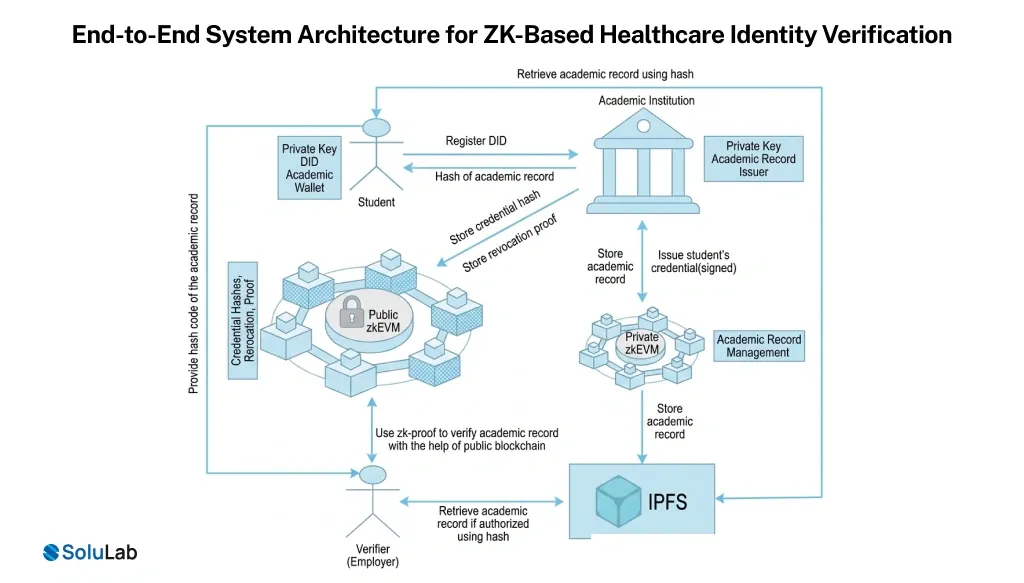
End-to-End System Architecture for ZK-Based Healthcare Identity Verification
1. Credential Issuance
- A medical board or hospital HR issues a credential (license, employment letter, training certificate).
- The credential is signed cryptographically, and its hash is stored on the blockchain.
- A ZK‑circuit is configured to encode the verification rules (e.g., “license active, not expired or suspended”).
2. Identity Binding
- The doctor or patient links their digital identity wallet to the credential.
- The system supports ZK‑healthcare identity solution logic, including Anonymous verification and Multi‑jurisdictional compliance (e.g., a doctor working in multiple states).
3. Verification Requests
- A hospital or insurer receives a request (e.g., new doctor onboarding, ambulance service licensing, or telehealth registration).
- The system generates a ZK‑proof application that proves the credential is valid, and it should not expose sensitive details (full medical record, exact license number, etc.)
4. On‑Chain Audit Trail
Blockchain in the healthcare sector records:
- When a credential was issued.
- When it was verified.
- When it was revoked.
This supports medical credential verification using blockchain and regulatory audits.
5. User‑Controlled Sharing
Patients and doctors can selectively disclose:
- Just their license status.
- Or a subset of medical data (e.g., vaccination status, age, gender) required for a specific service.
If you want to build a ZK‑identity system for healthcare providers, you can start with a single use case like doctor onboarding or telehealth licensing and then expand it to other workflows.
How ZK Proofs Secure Medical Credentials Without Exposing Patient Data?
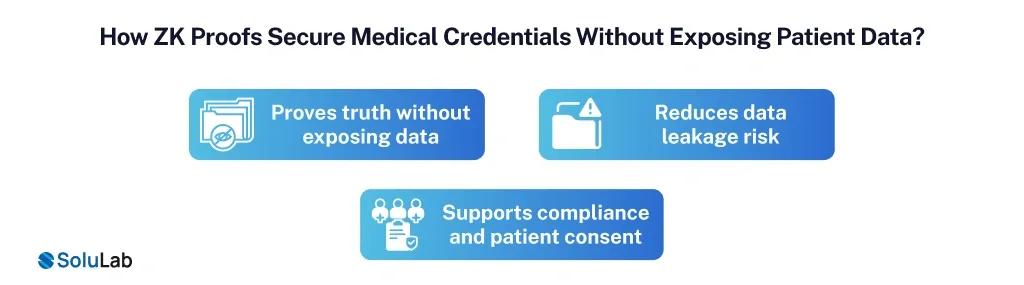
A ZK‑proof healthcare identity system does three things:
1. Proves truth without exposing data
- ZKPs let a hospital prove that a doctor’s license is valid, or that a patient has a valid sick‑leave certificate, without exposing the full license or medical record.
- This directly supports how ZK technology protects patient data: it reduces the data surface that any single party can see.
2. Reduces data leakage risk
- Traditional systems store full credentials on internal servers or third‑party platforms.
- In a ZK‑based identity verification model, the sensitive data stays off‑chain or in the user’s wallet, and only the proof is shared.
3. Supports compliance and patient consent
- Many privacy frameworks (HIPAA, GDPR, India’s DPDPA) require minimization: only collect and expose what is necessary.
- Zero‑knowledge identity verification healthcare aligns with this principle by design, making it easier to justify during audits.
If you are trying to understand ZK‑proof vs blockchain for healthcare identity, think:
- Blockchain is the tamper‑proof ledger and audit trail.
- Zero‑knowledge proofs are the encryption layer that keeps the data hidden while still allowing verification.
Combining both gives you a ZK‑healthcare identity solution that’s both secure and privacy‑respected.
How Hospitals Secure Medical Certificates and Meet Regulatory Compliance Digitally?
When you build a ZK‑powered medical credential system, you can’t just be “tech‑first”; you have to be compliance‑first.
Key angles include:
1. HIPAA / GDPR / DPDPA alignment: ZK‑based systems support data minimization and pseudonymization, which are core to modern privacy laws.
2. Licensing and accreditation bodies (e.g., medical councils, CMS, NCQA): These bodies expect clear audit trails and real‑time verification, which a blockchain medical credential verification process naturally provides.
3. Cross‑border credentialing: For multinational hospital groups or telehealth platforms, ZK‑proof applications in medical licensing let you verify cross‑border qualifications without exposing sensitive national ID or medical history.
A Zk-powered blockchain app development company should help you:
- Document data flow maps and ZK‑proof architectures for regulators.
- Design revocation workflows and audit‑ready logging.
What It Takes to Build Secure Medical Credential Verification Using ZK Proofs?
From a founder lens, here’s what you should expect if you decide to build a ZK‑based medical credential system with a blockchain consulting company:
Timeline
1. Pilot (8–12 weeks):
- Focus on one use case: doctor onboarding, medical license verification, or digital medical certificate issuance.
- Integrate with one or two existing systems (HR, EHR, or telehealth).
2. Phase 2 (3–6 months):
- Expand to more credential types and partners (insurers, labs, pharmacies).
- Add multi‑tenant support and multi‑jurisdictional compliance.’
Cost drivers
- ZK‑proof developer effort – Specialists in zk‑SNARKs/zk‑STARKs, cryptography, and blockchain integration are expensive but necessary.
- Blockchain infrastructure – Permissioned chain, nodes, smart‑contract auditing, and ongoing maintenance.
- Identity and compliance engineering – DIDs, consent flows, and regulatory documentation. Engineering effort
You can hire blockchain developers for healthcare on a contract basis or through a ZK‑tech development company that bundles design, implementation, and long‑term support.
Your internal team can focus on:
- Business logic.
- UX for hospitals and patients.
- Integration with existing EMR, HR, and insurance systems.
Where ZK Proofs Are Already Powering Privacy-First Healthcare Identity?
1. Digital Medical Certificate Verification
Platforms like MyMedicalCertificate.in and PingMeDoc already issue digital medical certificates online, but they rely on central repositories and email‑based verification. A ZK‑powered system can:
- Let a patient prove their certificate is valid without exposing the full medical history.
- Let employers verify fitness‑for‑duty certificates cryptographically.
2. Medical Licensing & Credentialing
A blockchain medical credentialing system with ZK‑proofs can reduce credentialing time from months to days, as shown in emerging pilots.
This is where ZK‑proof applications in medical licensing shine:
- Boards can issue and revoke licenses on‑chain.
- Hospitals can verify them instantly, without long‑running manual checks.
How to Build Privacy-First Medical Credential Systems with ZK Proofs with SoluLab?
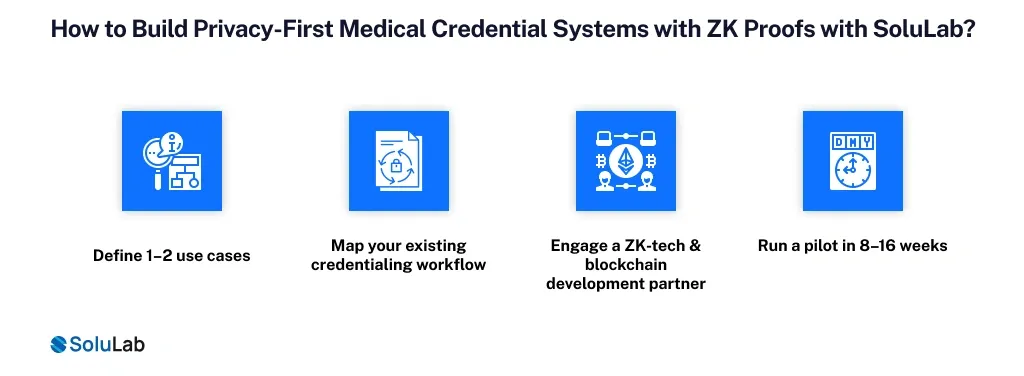
If you’re sitting at the executive table and wondering, how do we actually get started with a ZK‑powered medical credential system?, here’s a practical path:
1. Define 1–2 use cases
- Onboarding doctors across multiple hospitals.
- Automated telehealth licensing.
- Digital medical certificate verification for employers or insurers.
2. Map your existing credentialing workflow
- Identify every manual step hospitals use today to verify doctor credentials digitally.
- Note where data is stored, who has access, and where fraud or duplication has occurred.
3. Engage a ZK‑tech & blockchain development partner
A ZK‑tech development company can help you:
- Design a Zero‑Knowledge Proof System for Health Data Exchange for your context.
- Build a privacy‑first medical credential system that proves compliance from day one.
- Help you hire ZK‑proof developers for healthcare or embed them into your team.
4. Run a pilot in 8–16 weeks
Focus on a single hospital group, insurer, or state‑level board.
Measure:
- Reduction in time‑to‑verify.
- Reduction in fraud or manual errors. UX feedback from doctors and admins.
At this stage, you’re not selling a full national rollout; you’re proving to your board that ZK‑based healthcare identity verification can be a real‑world, revenue‑protective play, not just a buzzword.
Conclusion
Medical credentialing is no longer a back‑office problem. It’s a risk, cost, and trust issue that sits at the intersection of regulation (HIPAA, GDPR, DPDPA, regional boards) and Technology (blockchain, ZK‑proofs, identity wallets). Human workflows (doctors, admins, insurers, patients).
By combining a blockchain development company’s infrastructure expertise, like SoluLab, with ZK‑proof healthcare identity design, you can speed up credentialing without sacrificing security, protect patient and doctor privacy by default, and turn compliance into a competitive advantage.
The question for executives is not Should we explore ZK‑powered medical credential systems? But how quickly can we test this in a controlled, high‑impact pilot?
FAQs
Bhavya is driving growth through data-backed demand generation for AI and Web3 solutions. With 9+ years in digital marketing, he has spearheaded initiatives that led to a 40% increase in qualified inbound leads. Bhavya shares insights on marketing ROI and scaling a digital presence via AI workflows. He is open to connecting with startups and enterprise teams to help them overcome their challenges.