


Gaming picked up a strange new idea a few years back: play-to-earn. Games you play for fun, except the hours also pay out. That shift has been pulling the industry sideways ever since, and blockchain is the thing making it possible. So let’s walk through what P2E actually is, what the chain contributes, and where the whole model still creaks.

Play-to-Earn Games: A New Paradigm
Play-to-earn, usually shortened to P2E, breaks an old assumption. In a normal video game you pour in hours and skill, and what you get back is entertainment. Full stop. P2E games hand you in-game assets that carry value outside the game too. You can sell them. Trade them. Post them as collateral. That is the whole difference, and it is a big one.
Three things define the category: you own your assets rather than rent them, the supply of those assets is enforced on-chain, and nobody has to trust an operator’s word about any of it. Players in P2E games get the immersive part and the income part at the same time. For some of them, the income part is not pocket money.
Read Blog Post: Top 25 Blockchain-Based Gaming Companies
Think about how far this has travelled from Pong and Space Invaders. Those early games were entertainment and nothing more, with zero value once you switched the machine off. Then esports arrived and gave a small number of very good players a real paycheck through tournaments and sponsorship deals.
But the bigger change came from inside the games themselves. Virtual economies. World of Warcraft put currency and player-to-player trading into a mainstream title, and people noticed fairly quickly that there was money sitting in those virtual worlds if you knew where to look.
The phrase “play-to-earn” is newer than the idea behind it. Its roots go back to the early 2010s, when blockchain was still mostly a Bitcoin story and a handful of developers started asking what it would do for games. CryptoKitties and Decentraland were the early proof that assets and ownership could live on a chain instead of a company’s database.
Then came Axie Infinity in 2018, and the model stopped being theoretical. Players owned, bred and traded digital creatures called Axies, and the cryptocurrency they earned doing it was spendable in the real world. Axie’s run convinced a lot of developers, and a lot of players, that the economics here were worth taking seriously. Most of what followed followed from that.
Understanding Blockchain Technology
Quick refresher on the machinery underneath. A blockchain is a distributed ledger: transactions get recorded across a network of computers rather than one company’s server. It is built to be transparent, tamper-resistant, secure and decentralized. Every record, or block, points back at the one before it, which is where the chain part comes from.
Strip the blockchain out and a P2E game is just a normal game with a token bolted on. The chain is what makes player ownership real instead of promised, because the studio or publisher is no longer the sole custodian of your sword. And since the ledger is public, anyone can check the transaction history and verify that a rare item really is rare. Trust stops being a marketing claim and becomes something you can query.
Benefits of Blockchain in Gaming
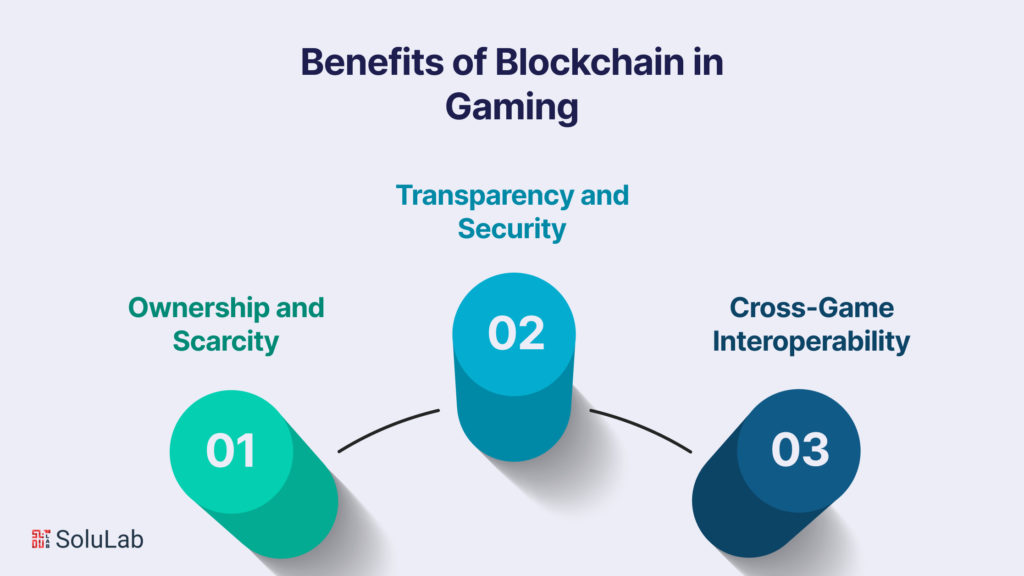
So what does the chain actually buy you, practically speaking? A few things, and they are the reason the P2E model got off the ground at all:
Ownership and Scarcity
Every gamer knows the sting. You sink months and real money into a collection, the servers go dark, and all of it evaporates because it only ever lived on somebody else’s hardware. Assets in a P2E game sit on the blockchain instead, and that record outlives the studio. You can sell them, swap them, or put them up as collateral in decentralized finance (DeFi) applications.
Scarcity is the other half. The chain caps how many of a given item can exist, the way the physical world caps how many first-edition cards were ever printed. Players can see the number. That visible ceiling is exactly what makes a rare item feel rare, and worth paying for.
Transparency and Security
The ledger is open, so every transaction lands somewhere anyone can go and read it. That alone squeezes out a lot of the duping, item-forging and quiet backend edits that plague closed game economies. And because confirmed blockchain transactions cannot be rewritten after the fact, a player’s holdings are not at the mercy of a rollback or a rogue admin account.
Cross-Game Interoperability
Here is the part that genuinely breaks the old rules: assets you earn in one blockchain game can travel into another. Grind out an armour set in one title, carry it into a game built by a completely different studio. Developers get to build on top of item libraries they did not have to create, and players stop starting from zero every time they try something new.
Notable Blockchain Gaming Projects
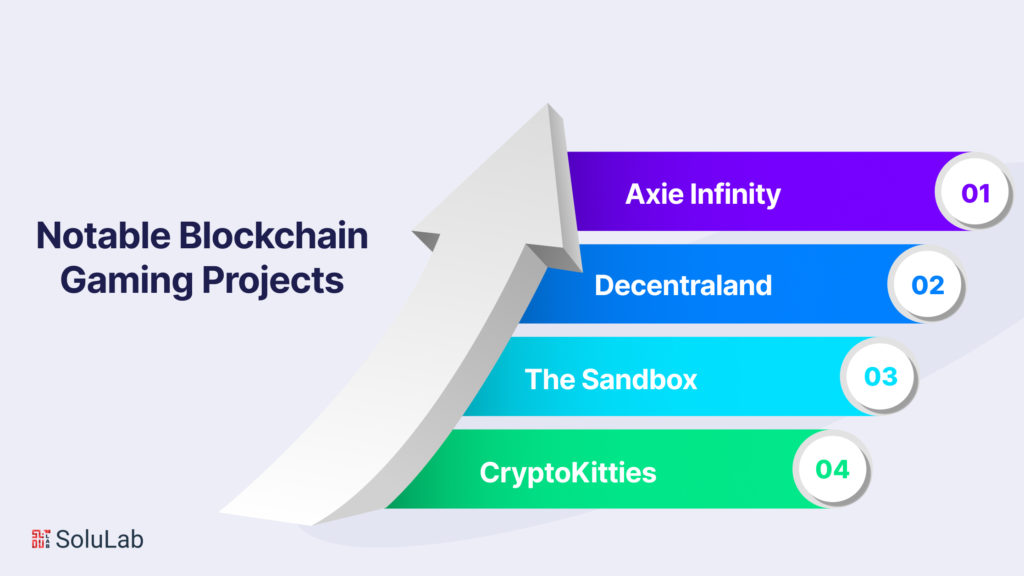
A handful of games and platforms did the interesting work with blockchain technology early on. Worth knowing these four:
Axie Infinity
Already mentioned, but it earns the repeat. You collect, breed and battle fantasy creatures called Axies, and each one is NFTs (non-fungible tokens) you can list on a marketplace. Axie grew fast, and players were pulling in cryptocurrency for the things they did in-game.
Decentraland
Decentraland runs on Ethereum and sells you land. Actual parcels, which you can buy, sell and build on, with the deed and every transfer recorded on-chain. It is one of the clearest working sketches of what people mean by a metaverse: virtual worlds wired together rather than walled off.
- The Sandbox
The Sandbox flips the creator relationship. Players build the experiences and the assets, own what they build as NFTs on the blockchain, and sell them through the marketplace. The studio supplies the tools; everything else comes from the people playing.
CryptoKitties
The original, more or less. CryptoKitties gave people collectible digital cats they could breed and trade, each one an NFT and each one unique. Simple idea, and it introduced a lot of people to on-chain ownership before anyone had a name for the category.
Economic and Social Impact
The money side is what makes people sit up. A traditional game takes your time and your cash and gives you fun in return, which is a fine trade but a one-way one. P2E lets skill convert into income, which is a different arrangement entirely.
That matters most where conventional jobs are thin on the ground. In places dealing with real economic pressure, these games have become a route to financial independence that did not exist before. Some players cover their own living costs through a virtual world. Some cover a household’s.
The Philippines is the case people cite. High cost of living, scarce work, and a lot of players who turned to Axie Infinity for a serious slice of their income. They breed and battle Axies, earn cryptocurrency for it, and convert that into money they can spend at the shop.
Redefining the Gaming Experience
Playing one of these feels different, and not only because of the payout. Your hours and your skill turn into something you can hold onto after you log off, which changes how a session lands.
You are still there for the game, but you also have skin in it. Every move, every bit of strategy, every call you make feeds into what you take home. That tends to sharpen attention. Players think harder about decisions when the decisions have a price tag attached.
It also builds unusually tight communities. People trade tips, argue about strategy, swap stories about good runs and bad ones, and generally teach each other, because helping a teammate get better has an obvious return. The social layer of gaming has rarely been this loud.
Social and Cultural Implications
The ripples go past gaming. P2E created an income source that did not exist a decade ago, and in doing so it smudged the line between work and leisure that most people grew up with.
Read Also: Top 10 Real World Applications of Blockchain Technology
Tell some families you make money playing games and you will get a raised eyebrow, or a lecture. That reaction is real, and in plenty of cultures it is still the default. It is also softening. Once people in a community can point to someone who built genuine financial stability this way, the argument about whether it counts as a career largely settles itself.
These player communities also ignore borders. Someone in one country ends up guiding a newcomer three time zones away, purely because they play the same game and want the same things out of it. Small thing on paper. Not so small in practice, and it points toward a kind of cooperation that is hard to arrange any other way.
Challenges and Concerns
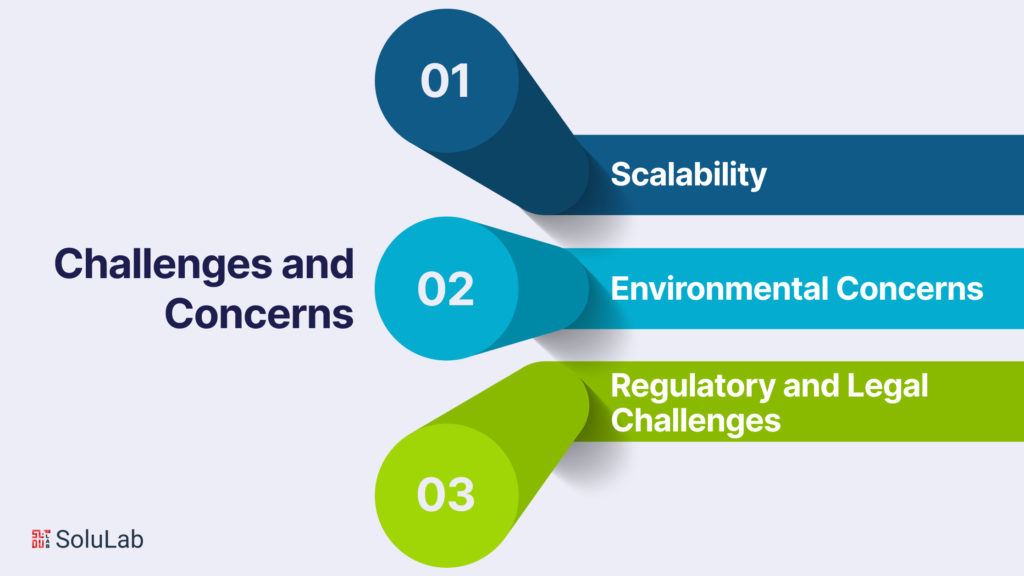
Scalability
None of this comes free, and scalability is the first bill. Plenty of blockchain networks simply cannot process transactions fast enough, or in the volume a busy game generates. The result is gameplay that stutters or stalls while the network catches up, which is a fast way to lose players. Layer-2 scaling is the main line of attack here, and teams are actively shipping against the problem.
Environmental Concerns
Then there is energy. Networks built on proof-of-work, Bitcoin and Ethereum among them, burn a lot of it by design, and the carbon question that follows is a fair one to ask. The answer the industry has landed on is a change of consensus mechanism: several projects have moved, or are moving, to proof-of-stake, which does the same job for a fraction of the power.
Regulatory and Legal Challenges
And the rules are still being written. Every country treats cryptocurrencies and virtual assets a little differently, which leaves developers guessing about compliance and players guessing about tax. In practice this is where studios get stuck, well before the game design is the problem. The industry is early in sorting it out, and P2E does not get a long-term future until it does.
Play-to-Earn and the Future of Gaming
The growth of play-to-earn games has been hard to miss. Axie proved the model could work at scale, metaverse projects kept the attention coming, and the flow of new players and new investors has not let up. NFTs pulled out of blockchain games still end up in the headlines on a regular basis.
Market figures point the same way, with the global blockchain gaming market projected to keep climbing over the next few years. [SOURCE NEEDED] Newcomers want to find out what P2E can do for them, and the studios building these games are fighting harder for their attention every quarter.
Technological Innovations
Tech is moving underneath all of this too. Developers keep pushing on what a virtual world can be and what gameplay can do inside one. Augmented and virtual reality are the next obvious pairing with blockchain gaming, and that combination is close enough now to plan around.
Artificial intelligence and predictive algorithms are already being wired into these worlds, making environments that react to you rather than replay the same script. Your choices ripple further. Play the same game twice and the second run is not the same game.
Predictions and Speculations
Forecasting any industry is a mug’s game, but four threads look worth watching:
1. The Metaverse Revolution: An actual connected network of virtual worlds, not a pitch deck version of one. If it arrives, players roam, interact and earn across many worlds instead of being locked inside a single title.
2. Mainstream Adoption: The wallets and onboarding flows keep getting easier, and at some point the friction drops low enough for ordinary players. Expect traditional studios to start bolting blockchain features onto games they already ship.
3. Regulatory Clarity: Governments and regulators are expected to publish clearer guidance for blockchain gaming, which would settle the open legal questions and give both players and investors firmer ground to stand on.
4. Diverse Revenue Streams: Earnings need not stop at battling and breeding. NFT-based virtual real estate, streaming, sponsored placements inside the world itself: each one is another way for a player to get paid.
Conclusion
What play-to-earn really changes is who keeps the value. Hours spent in a game now produce something the player owns, and the blockchain is what makes that ownership stick: real title to the asset, enforced scarcity, a public record, transactions that cannot be quietly undone.
The model is still young and still moving. Watch the scalability work and the regulatory guidance, because those two will decide how far it goes.
SoluLab offers comprehensive blockchain game development services, enabling the creation of immersive gaming experiences using blockchain technology. Our expert blockchain developers specialize in decentralized application development across various blockchain protocols, including Ethereum, Polygon, Binance, Hyperledger, Solana, Polkadot, and more. Whether the plan is a blockchain game or a decentralized app behind it, we have built both. Contact SoluLab today to explore the endless possibilities of blockchain gaming.
FAQs
Shipra Garg is a tech-focused content strategist and copywriter specializing in Web3, blockchain, and artificial intelligence. She has worked with startups and enterprise teams to craft high-conversion content that bridges deep tech with business impact. Her work translates complex innovations into clear, credible, and engaging narratives that drive growth and build trust in emerging tech markets.
![What Is Blockchain Technology? A Simple Beginner’s Guide [2026]](https://www.solulab.com/wp-content/uploads/2025/12/What-Is-Blockchain-Technology.webp)