Your identity used to mean a stack of physical documents and a password you reused everywhere. Blockchain digital identity changes that: it verifies who you are securely, privately, and consistently across services. By 2026, over 5.2 million digital ID wallets are expected, a real sign that conventional IDs are giving way to smarter, decentralized alternatives.
With digital identity verification in blockchain, you get full ownership of your data. You share only what’s needed, exactly when it’s needed. This isn’t just about convenience. It’s about trust and transparency in every digital interaction.
In this piece, we’ll dig into the real benefits of blockchain digital identification: stronger privacy, faster cross-border access, and more. Let’s get into it.
What is Blockchain Digital Identity, and Why is it Essential?
Before we get into new use cases for identity management in blockchain, it helps to understand why digital identity matters in the first place. Why does the use of blockchain technology in digital identification even come up? The idea of digital identity has grown so broad that most people assume it’s just the personal information they’ve made public online. You’d be wrong if you think your digital identity stops at your social media profiles, email address, and home address.
Digital identity captures both your real-world self and your online one. Photos, purchase decisions, browsing habits, bank account information, all of it feeds into who you are digitally. The catch: it looks different depending on where you’re standing. Banking systems, social networks, telecom providers, each one sees a slightly different slice of you.
That relevance is exactly what answers the question, “What is digital identity management in blockchain?” Faster customer onboarding without sacrificing accuracy. Fraud and money laundering prevention, since the two are tightly linked. Government services that run the same way for everyone instead of varying office to office, thanks to better digital identity management.
Social transformation projects and welfare initiatives that actually deliver economic benefits to different communities need this kind of infrastructure too, which is exactly why blockchain and identity management matter together. Singapore’s Smart Nation plan is a good real-world example: its National Digital Identification, or NDI, system secures how citizens interact with e-government services.
Issues With the Current Identity Management System
Digital identity still has a real problem. Paper-based records, birth certificates sitting in a town hall basement, get lost, stolen, or forged. Going digital helps: less bureaucracy, faster business processes, better interoperability between departments and organizations. But centralize that identity data in one institution and you’ve just built a bigger target for hackers. Since 2017, companies have lost almost 600 million pieces of personally identifiable data, including addresses and credit card details.
Most current digital identity management solutions still need real modernization. Sure, digitization means identity portability and verification are possible anywhere, anytime. But being digital alone isn’t enough; identity needs to be secure and private too. A comparison between Multi-Chain vs. Cross-Chain solutions matters here, since both approaches handle data sharing and verification differently across multiple blockchain networks. Plenty of sectors are running into real limits with current digital identity management techniques, which is exactly why demand keeps growing for more advanced, decentralized solutions.
Government
Departments and government service levels need to talk to each other, and when they can’t, bureaucracy piles up. Processes take longer. Costs climb.
Healthcare
Most people on the planet still can’t access quality healthcare. Part of the reason: hospitals, clinics, insurers, doctors, and pharmacies don’t talk to each other. That disconnect means weaker care, longer waits, and frustrated patients.
Related: AI Agents in Healthcare
Education
An estimated 200,000 fake academic degrees get sold in the United States every year. Because verifying these credentials is hard, unqualified candidates slip through, and that damages the reputation of both the institutions and the companies that hire them.
Read Our Blog: Role of AI in Education Industry
Banking
Password-based logins are a weak link. They make access to bank accounts less secure than it should be.
Businesses in General
Protecting client and employee data isn’t optional. It’s a liability question. A breach can mean GDPR penalties, as British Airways found out the hard way, or just a loss of customer trust that hurts the brand long after the headlines fade.
How Blockchain Digital Identity Acts As A Problem Solver?
Blockchain technology is proving itself as a real answer to identity problems worldwide. Blockchain for digital identity is changing how individuals and businesses manage and verify identity, through a framework that’s decentralized, secure, and actually controlled by the user.
- Eradicates Centralized Vulnerabilities: Conventional identification methods rely on central databases, exactly the kind of target cybercriminals go after. Blockchain and digital identity spread that data across a secure network instead, cutting down single points of failure.
- Helps Users to Manage Their Data: Blockchain puts control of personal data access back in users’ hands, instead of leaving it with third parties who own the identifying information. That means real confidentiality and the ability to share selectively.
- Provides Data Integrity: Every ID record kept on a blockchain is time-stamped and resistant to tampering. Once verified, it can’t change without consensus, which keeps trust high.
- Facilitates Cross-Border Verification: Decentralized systems make identity verification work the same way across institutions and borders alike, useful for global travel, finance, and digital services.
- Increases Access to Legal Identification: Millions of people without formal documentation can now build a digital identity on the blockchain, closing part of the worldwide identity gap.
How Does Blockchain for Digital Identity Verification Work?
To really understand the benefits of blockchain-based identification systems, you need to see what’s happening underneath. Cryptographic techniques, key management, and decentralized consensus come together to keep digital identification secure, private, and tamper-resistant.
- Immutable Records Using Hashing
Blockchain protects identification information with cryptographic hashes, unique digital fingerprints for each data entry. Add a user’s information to the network and it turns into a fixed hash. Change that data even slightly and the hash changes too, making tampering obvious right away. That’s what makes digital identity verification in blockchain reliable and hard to manipulate.
- Secure Access Utilizing Public-Private Key Pairs
Everyone gets a distinct pair of keys: a public key that works like a digital address, and a private key used for access authorization. Only someone holding the right private key can reach the identity data, which keeps verification safe and firmly user-governed.
- Decentralized Trust via Consensus
Blockchain networks use consensus techniques such as Proof of Stake or Proof of Authority to authenticate new entries. Submit identification credentials, and many separate nodes verify them independently. No central authority needed, and the integrity of identification data holds across the whole network.
- Privacy by Design
Blockchain systems support selective disclosure, letting people reveal only particular pieces of their identity. Less data exposure, more privacy, easier adherence to data protection rules.
- Global Interoperability
Unlike isolated conventional identity systems, blockchain IDs travel with you. People can authenticate their credentials across several platforms and jurisdictions without repeating the same manual steps, speeding up everything from onboarding to KYC.
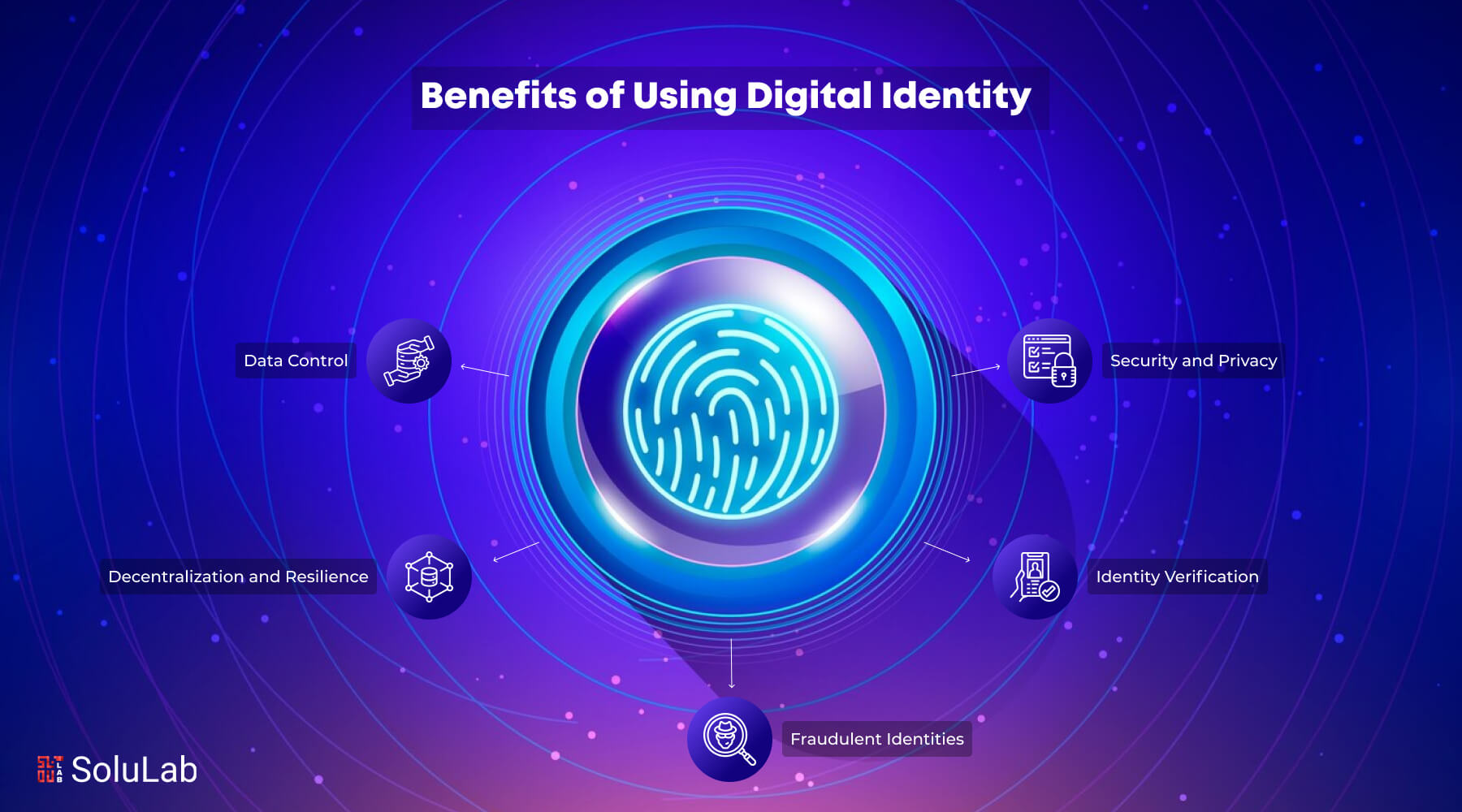
Benefits of Using Digital Identity With Blockchain
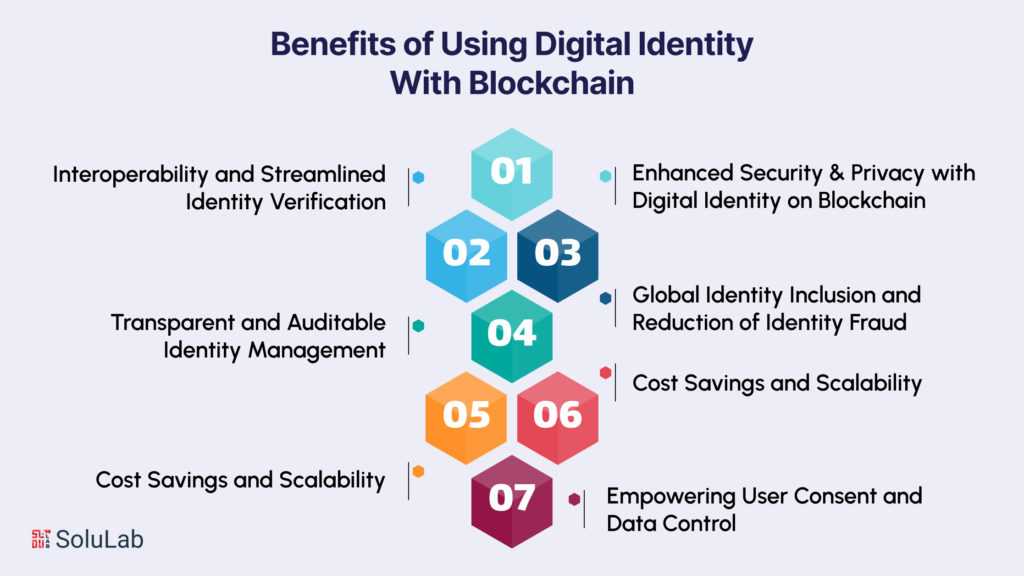
Bitcoin’s arrival in 2008 brought blockchain technology with it: an efficient, transparent, decentralized system spread across a network of computers, built with help from a blockchain development company. Ever wondered what it would feel like to fully control your own personal data and decide how it’s used? That’s not hypothetical anymore. Managing and protecting your online identity is a reality now, thanks to blockchain services. It’s already reshaped finance, banking, healthcare, and insurance, and it’s about to do the same for digital identity management.
Here’s what blockchain actually brings to identity management:
- User-Owned Identity
Blockchain digital identity means you’re not dependent on a centralized entity to issue or manage your personal credentials. You decide when, where, and who gets your information. That’s real data ownership.
- Tamper-Proof Verification
Identity data recorded on the blockchain doesn’t change. Once it’s in, it stays in, unless everyone involved agrees to modify or remove it. That alone makes identity fraud, document tampering, and impersonation a lot harder to pull off.
- Faster and Frictionless Access
Blockchain-based IDs speed up verification everywhere: bank onboarding, age checks for digital services, applications for public benefits, all without the usual paperwork delays.
- Selective Disclosure for Privacy
Users can share only the data that verification actually requires, proving you’re old enough without handing over your full birthdate, for instance, which boosts privacy and cuts down data leakage risk.
- Cross-Platform and Borderless Use
Digital identity on blockchain travels with you. It works across applications, platforms, and countries without a hitch, which matters a lot for travelers, expatriates, and international professionals who need their credentials recognized everywhere.
DO YOU KNOW?
The global blockchain market was valued at $3 billion in 2020. It’s projected to reach a staggering $39.7 billion by 2025.
- Cost Savings for Institutions
Organizations benefit too: lower compliance costs, fewer middlemen, and verification processes automated through smart contracts.
- Built-in Compliance Support
Blockchain identifiers can be structured to meet KYC/AML rules, GDPR, and other international standards, which makes audits easier and improves regulatory transparency.
How Blockchain Works in Online Verifiable Identity?
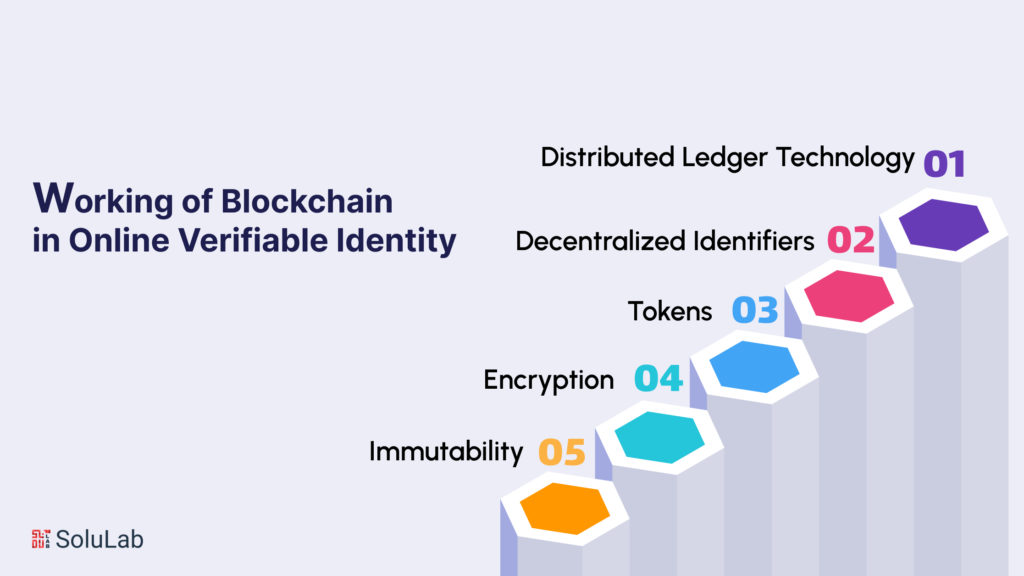
Blockchain technology can genuinely change online verifiable identity, offering a secure, transparent, decentralized platform for managing digital identities. Here’s how it actually works, step by step:
Decentralized Identifiers
Blockchain-based identification systems use decentralized identifiers (DIDs) to validate and securely share identities with verified parties. These cryptographic keys manage digital identities openly, efficiently, and tamper-proof, which means you no longer need a stack of separate identity papers.
Distributed Ledger Technology
Every part of a blockchain does real work. DLT, or distributed ledger technology, is the piece that provides security and openness. Think of it as a database that can’t be broken into, tracking every transaction and every update to identification data.
Tokens
Tokens represent identity in digital form. You can authenticate who you are using a token without handing over all your personal information. None of this works, though, without the blockchain’s ability to encrypt and retain data immutably.
Encryption
As a registered user, you’re the only one with access to the data kept on your block. It stays untouched unless you add to it yourself. That alone deters identity thieves and keeps your personal information safe.
Immutability
One defining trait of blockchain technology is immutability, where finished transactions get time-stamped, cryptographically signed, and added to the ledger in sequence. Nobody can change or distort the records kept on the blockchain without the consent of everyone involved.
DIDs and the other components working together are what make blockchain systems effective here. Together, they strengthen blockchain ecosystem’s safety and confidentiality.
Conclusion
Identification is heading toward decentralization, full stop. That means individuals own their data outright, while verification stays fast, safe, and hard to break. Blockchain-based digital identification is the bridge from outdated, centralized systems to dynamic, user-centric frameworks built for a global, digital-first world. It’s quietly building smarter identity infrastructure for the future: safer onboarding, real-time verification, and privacy-first sharing, all of it.
SoluLab builds scalable, secure identification systems tailored to different sectors. As a reputable blockchain development company, we’ve helped international clients deploy custom blockchain ecosystems that strengthen identity management and regulatory compliance. Morpheus Network is one example, a blockchain-based SaaS platform transforming the logistics sector through blockchain technology, IoT, and real-time communication technologies working together.
Ready to see what blockchain could do for your identity systems or business infrastructure? Let’s collaborate and build something worth shipping.
FAQs
Shipra Garg is a tech-focused content strategist and copywriter specializing in Web3, blockchain, and artificial intelligence. She has worked with startups and enterprise teams to craft high-conversion content that bridges deep tech with business impact. Her work translates complex innovations into clear, credible, and engaging narratives that drive growth and build trust in emerging tech markets.