


D2C Brands
Personalised recommendations, product content at scale and support agents that protect margin as order volume grows.

AI solutions for ecommerce use machine learning and large language models to personalise search and recommendations, answer customers, forecast demand, write product content and price competitively. SoluLab builds these into your existing store, OMS and CRM, starting with a use-case workshop that ranks where AI will pay back first.













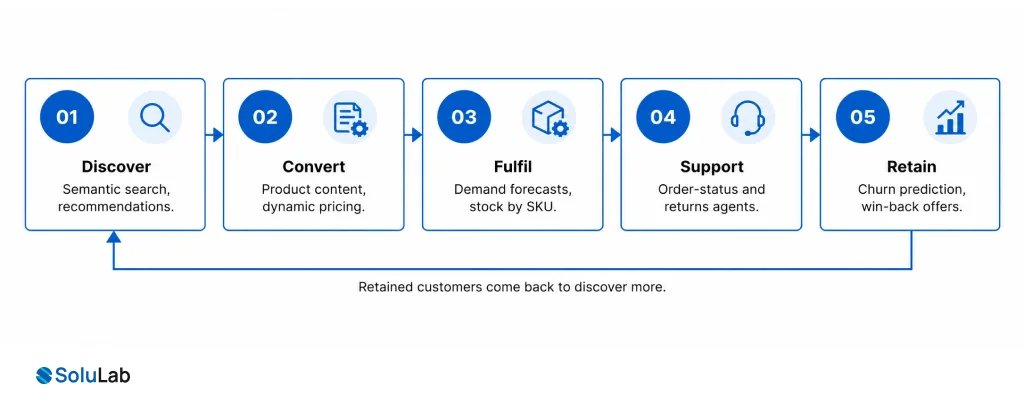
Ecommerce businesses use AI across the whole customer journey: search and recommendations to help shoppers find products, generated content to fill catalogues, support agents to answer order and return questions, demand forecasting to keep stock right, and churn prediction to win customers back. The best first use case is the one with the most repeated manual work.
Most stores already have the data. Product catalogues, order histories, support tickets and campaign results are all AI training material. What's usually missing is the plumbing that connects them to a model and puts the answer where staff or shoppers act on it. That plumbing is what our AI development services team builds.
SoluLab builds AI search and recommendations, customer support agents, product content generation, demand forecasting and inventory optimisation, visual AI for listings, dynamic pricing and AI marketing automation for ecommerce. Each solution connects to Shopify, Magento, BigCommerce, Salesforce Commerce Cloud or a custom store through APIs.

Semantic search that understands "black work shoes under $100" and recommendations based on browsing and purchase history. Built on vector search and tuned to your catalogue, synonyms and margin rules.

Agents that answer where-is-my-order, returns and sizing questions from live order data and hand complex cases to staff. We build them on our enterprise AI chatbot platform, the same pattern that cut One Wallet's ticket load by 72%.

Titles, descriptions, attributes and alt text generated from supplier data and your style guide, then approved by your team. Our guide to generative AI in ecommerce covers where generated content lifts conversion.

ML models that predict demand by SKU and location from sales, promotions and seasonality, so you reorder before stock-outs. It's the approach behind Mizar, our supply chain forecasting system.
Image tagging, background clean-up, duplicate detection and condition grading from photos. Our Collection Grading model grades collectible coins at 95% accuracy in seconds.

Pricing models that react to competitor prices, stock levels and demand while staying inside the margin and brand rules you set.
Agents that build carts, compare products, flag fraud or reconcile orders across systems. Our AI agents in retail and ecommerce guide shows where agents beat rule-based automation.

Campaign setup, audience segmentation and reporting across Google and Meta Ads, as delivered on CyberHulk with 70% faster campaign execution.

We build AI for D2C brands, multi-brand retailers, B2B ecommerce, online marketplaces and subscription businesses. The use cases differ: D2C brands lead with personalisation and content, marketplaces with search, trust and grading, B2B sellers with quoting and reordering, and subscription businesses with churn prediction.
Personalised recommendations, product content at scale and support agents that protect margin as order volume grows.
Catalogue enrichment across thousands of SKUs, semantic search and demand forecasting by store and region.
AI quoting, reorder prediction and assistants that answer spec and availability questions from your ERP.

Seller onboarding checks, listing quality scoring, fraud detection and image-based grading, as in Collection Grading.

Churn prediction, retention offers and support agents that handle pauses, swaps and billing questions.
SoluLab's AI work maps directly to ecommerce: CyberHulk's AI marketing platform delivered 70% faster campaigns and 2.5x ROI, One Wallet's AI support agent cut ticket load by 72%, Collection Grading's vision model grades collectibles at 95% accuracy, and Mizar forecasts demand across SKUs.
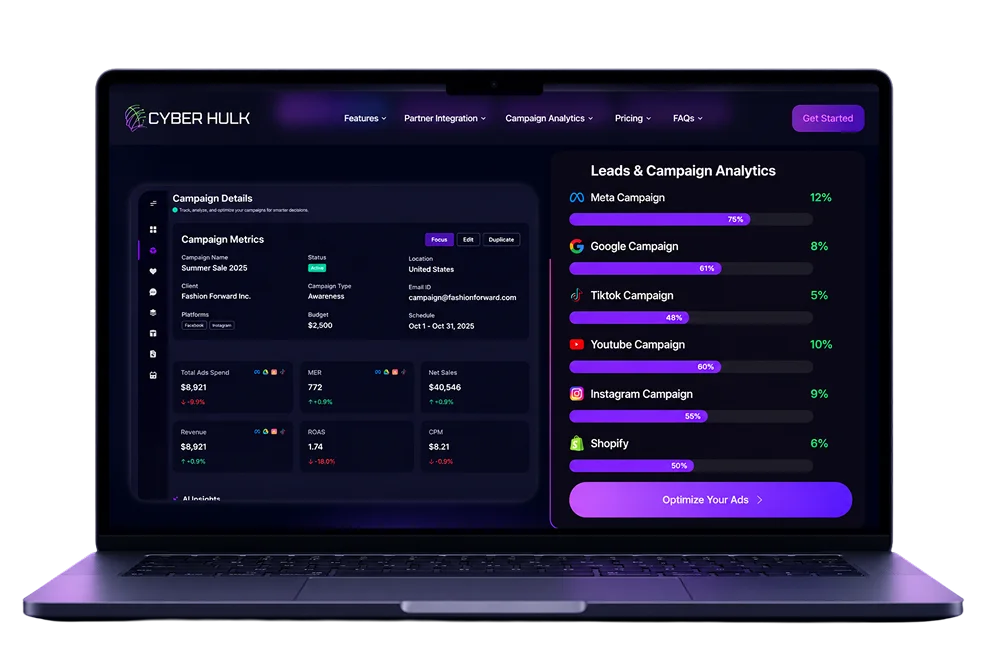
The client wanted ads, SEO, lead generation and reporting run from one platform. We built AI campaign setup, automated reporting and integrations with Google Ads, Meta Ads and ecommerce APIs.
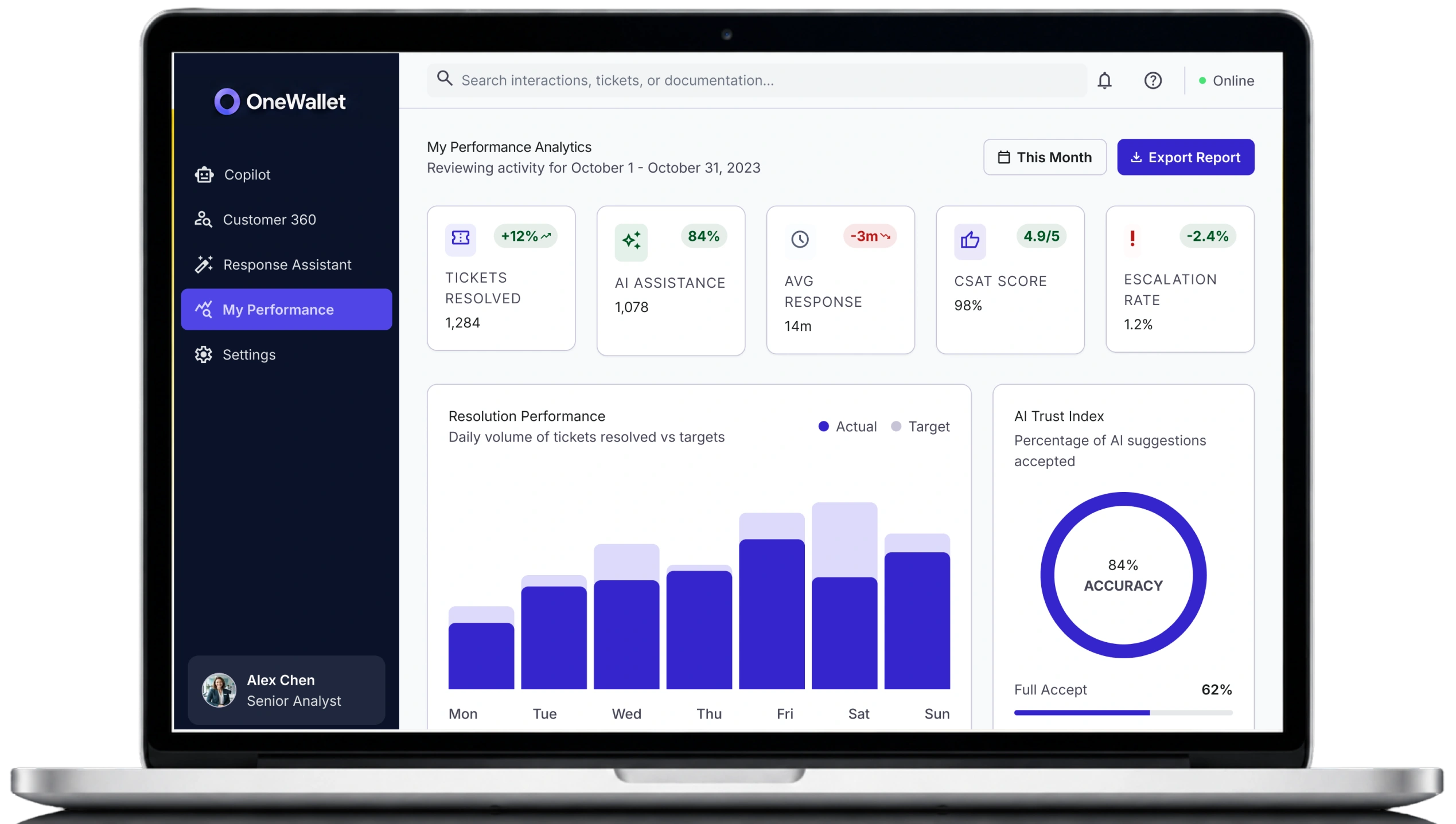
A payments platform with 1.8M+ users faced 60K+ support requests a month. We built an AI agent that answers transfer and payment questions from live data, the same pattern as order-status and refund support.

Collectors waited weeks for manual coin grading. We built a deep learning model that grades coins from high-definition photos and returns results in seconds through an upload dashboard.
We run ecommerce AI projects in five steps: use-case workshop, data audit, pilot, measured rollout and ongoing optimisation. A pilot on one use case, such as support or search, typically takes 4 to 8 weeks and is measured against your own baseline before wider rollout.

We map your journey, data and systems and rank AI use cases by return and effort.

Catalogue, order, ticket and campaign data checked for quality, gaps, and personal data.

One use case live on real traffic, such as support or search.

Conversion, ticket deflection or forecast accuracy compared with your baseline.

Monthly tuning, new use cases from the workshop list and cost reporting.
With SoluLab, an ecommerce AI use-case workshop typically costs $10,000 to $25,000, a pilot or proof of concept $15,000 to $50,000 over 4 to 8 weeks, and a first production deployment $35,000 to $70,000 over 3 to 6 months. Model and hosting fees continue after launch.
| Engagement | Typical cost | Timeline |
|---|---|---|
| Use-case workshop | $10,000 to $25,000 | 1 to 2 weeks |
| Pilot or proof of concept | $15,000 to $50,000 | 4 to 8 weeks |
| First production deployment | $35,000 to $70,000 | 3 to 6 months |
| Enterprise AI programme | $30,000 to $100,000+ | Ongoing |
Cost rises with the number of systems connected, catalogue size and how much custom model training is needed. Off-the-shelf models with good retrieval cover most support and search use cases.

We build ecommerce AI with GPT, Claude and open models for language tasks, TensorFlow and PyTorch for forecasting and vision, vector search such as Pinecone or pgvector for semantic search, and APIs into Shopify, Magento, BigCommerce, Salesforce Commerce Cloud, Klaviyo and Google and Meta Ads.
 GPT
 Claude
 Llama
 Mistral
 TensorFlow
 PyTorch
 Keras
 Pinecone
 pgvector
 Elasticsearch
 Shopify
 Magento
 BigCommerce
 Salesforce Commerce Cloud
 Custom stores
 Google Ads
 Meta Ads
 Klaviyo
 HubSpot
Salesforce
 AWS
 Azure
 Google Cloud
We protect shopper data by masking personal and payment details before they reach any model, keeping card data out of AI systems entirely, logging every AI decision and honouring consent preferences. Builds align with GDPR, CCPA, and PCI DSS scope rules, and the EU AI Act where a use case falls in scope.
No card data in AI systems, so your PCI DSS scope doesn't grow.
PII masking before prompts reach a model, as in our One Wallet build.
Consent-aware personalisation that respects GDPR and CCPA opt-outs.
Human approval for refunds, price changes and generated content above set limits.
Audit logs of every AI answer and action.
Ecommerce teams choose SoluLab because we start with the use case that pays back first, build into the platforms you already run and measure results against your own baseline. We've shipped AI support agents, marketing automation, demand forecasting and visual grading in production, and our prices are published.
The workshop ranks options by return before any build.

Shopify, Magento, BigCommerce, Salesforce Commerce Cloud or custom.

Support agents, marketing automation, forecasting and visual AI.

With masking, consent rules and no card data in AI.

Against your conversion, deflection or forecast baseline.
Code, prompts, models and data.

"Rajat has spent more than 14 years building platforms used by millions of people. A former principal software architect at Citrix, he heads SoluLab's 50+ member technical organisation and reviews every ecommerce AI build for data handling, platform fit and running cost."
SoluLab helped us bring AI directly into the banking experience. From customer onboarding and account assistance to money transfers and card requests, the AI chatbot and voice agents gave customers a much faster way to complete everyday banking tasks. The solution helped us reduce onboarding time while taking significant pressure off our support teams.

CEO, Amanbank
SoluLab successfully delivered the AI automation system we needed for our FinTech platform. Their team understood how to translate complex business workflows into practical AI agents and worked closely with us throughout development. The result was a much more streamlined approach to automating tasks that previously required significant manual effort.

Co-Founder, FinTech Platform
Working with the SoluLab team completely changed how we handle marketing. CyberHulk turned from a simple idea into a powerful AI-driven marketing platform that runs our entire process. Everything works smoothly, and it feels like having a 24/7 AI marketing team that constantly drives growth, improves conversions, and saves time.

CEO, CyberHulk
SoluLab didn't approach AI as a feature; it became part of the product experience. Their team helped translate our vision into an AI-powered platform that feels intelligent while remaining intuitive for users. The combination of technical execution and genuine understanding of wellness made a meaningful difference.

Founder, Mendle
AI solutions for ecommerce are machine learning and language-model systems built into an online store's search, content, support, inventory, pricing and marketing. They personalise what shoppers see, answer customer questions, forecast demand and automate repetitive work, using the store's own catalogue, order and customer data.
Start where your team repeats the most manual work. Common first projects are a support agent for order-status and returns questions, semantic search with recommendations, generated product descriptions, and demand forecasting. A use-case workshop ranks these by expected return and effort for your store and data.
The best support agents are grounded in your live order, shipping and returns data, hand complex cases to a person with full context, and follow your refund and tone rules. Off-the-shelf bots work for FAQs; custom agents connected to your OMS handle order-specific questions reliably.
With SoluLab, a use-case workshop typically costs $10,000 to $25,000, a pilot $15,000 to $50,000 over 4 to 8 weeks, and a first production deployment $35,000 to $70,000 over 3 to 6 months. Model and hosting fees continue after launch and grow with traffic.
A pilot on one use case, such as a support agent or AI search, usually goes live in 4 to 8 weeks. A first production deployment across several systems takes 3 to 6 months, depending mostly on data quality and how many platforms need connecting.
Yes. We connect AI to Shopify, Magento (Adobe Commerce), BigCommerce, Salesforce Commerce Cloud and custom stores through their APIs and webhooks. Most use cases, including search, support and content, run alongside your platform without replatforming or changing your checkout or fulfilment flow.
Yes. AI can generate titles, descriptions, attributes and alt text from supplier data, images and your style guide, at the scale of thousands of SKUs. We keep a review step so your team approves content before it goes live, and track conversion by product.
ML models learn from sales history, promotions, seasonality, location and market data to predict demand by SKU, often catching patterns spreadsheets miss. Better forecasts reduce stock-outs and overstock, and feed automatic reorder suggestions to your buying or inventory team every week.
It can be, with the right design. We mask personal details before they reach any model, keep card data out of AI systems so PCI DSS scope doesn't grow, respect GDPR and CCPA consent choices, and log every AI answer and action for audit.
Less than most teams expect. Support agents and AI search work from your existing catalogue, help content and order data. Demand forecasting needs roughly a year or more of sales history to capture seasonality, and the data audit in our process confirms what's usable.
Yes. SoluLab builds AI search, support agents, product content generation, demand forecasting, visual AI and marketing automation for D2C brands, retailers, B2B sellers and marketplaces. Every project starts with a use-case workshop that ranks where AI will pay back first.