Key Takeaways
- AI in RevOps connects sales, marketing, and customer success data into one system so forecasts, lead scoring, and reporting run on real numbers instead of guesswork.
- A working AI RevOps framework has four layers: data infrastructure, automation and agents, analytics and forecasting, and governance.
- Bad CRM data alone costs the average B2B company well over $10 million a year, which is why data hygiene sits at the center of any revops strategy.
- AI agents can save reps close to 5 hours a week, but only teams with a routing and coaching workflow actually convert that time into pipeline.
- Rolling out RevOps automation works best in phases: audit, connect, automate, then govern, rather than a single big-bang deployment.
AI in RevOps means using machine learning and automation to unify sales, marketing, and customer success data so revenue teams can forecast, score leads, and report on performance without manual spreadsheet work.
Gartner projects that 75% of high-growth companies will operate under a RevOps model, and the firm has also found that AI tools now save sales reps close to five hours a week. That time only turns into revenue when the underlying data and workflows are built correctly.
Most companies aren’t short on AI consulting solutions and tools. They’re short on a framework that connects those tools into one accurate, automated system. This guide breaks down what AI revenue operations actually looks like in practice, the framework behind it, and how to build a strategy that sticks.

What Is AI in RevOps?
What is AI in RevOps, in plain terms? It’s the use of machine learning, natural language processing, and workflow automation across the three revenue-generating functions: sales, marketing, and customer success.
Traditional RevOps already tries to align these teams around shared metrics and processes. AI RevOps adds a layer of intelligence on top of that alignment, so systems can predict outcomes, flag risks, and take action without a human triggering every step.
In a traditional setup, a sales rep manually updates a CRM field, a marketing analyst pulls a report at the end of the month, and a customer success manager reacts to churn after it’s already visible in the numbers.
The system enriches account data automatically, flags a deal at risk two to three weeks before a human would notice, and routes a churn signal to a CSM the moment usage drops.
This isn’t about replacing the RevOps function. It’s about giving RevOps leaders a system that catches what spreadsheets and static dashboards miss. The strategic decisions, like what “good” pipeline health looks like or how to structure territories, still require human judgment. The querying, monitoring, and repetitive analysis get automated instead.
How AI Works in the RevOps Ecosystem
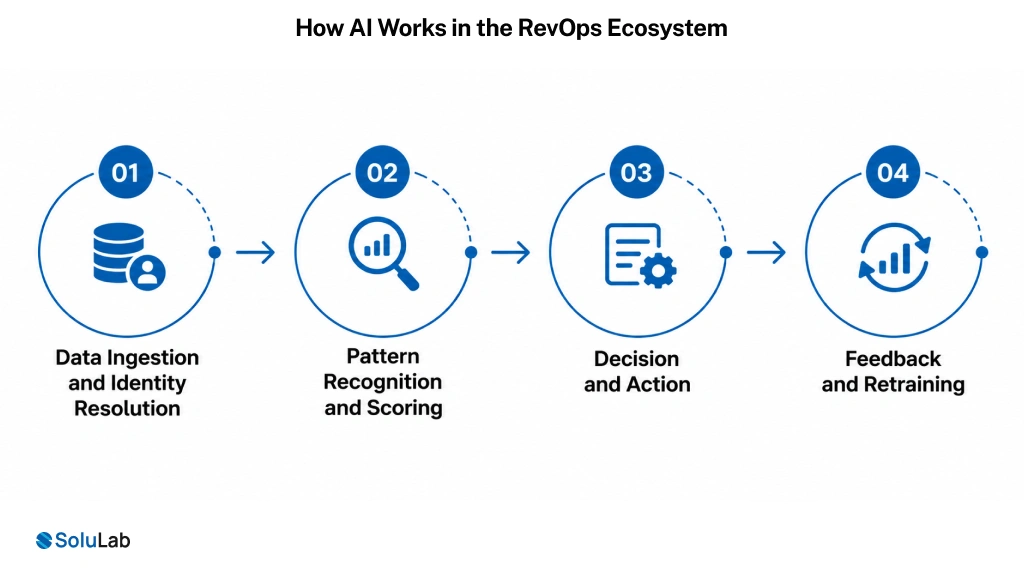
It helps to picture RevOps as a nervous system rather than a stack of software. Data is the signal, artificial intelligence is what interprets the signal, and the automated action is the reflex. Strip away the and the mechanics are actually pretty simple to follow.
1. Data Ingestion and Identity Resolution
Every touchpoint- a form fill, a support ticket, a call transcript, a usage event in the product- gets pulled into a central layer and matched to the right account and contact. This is unglamorous plumbing work, but nothing downstream functions without it.
We’ve seen teams jump straight to a forecasting model and wonder why the output looks wrong, only to find three different “ABC Corp” records feeding it conflicting numbers.
2. Pattern Recognition and Scoring
Once the data is clean and unified, machine learning models look for patterns a person would take weeks to spot manually: which deal characteristics correlate with a closed-won outcome, which usage drop-offs precede a churned account, which lead sources actually convert versus which ones just look busy in a dashboard. The model scores new records against those patterns continuously, not once a quarter.
3. Decision and Action
This is where agents come in. Instead of surfacing a score and waiting for a human to act, the system can route a hot lead to the right rep, trigger a renewal outreach sequence, or flag a deal for manager review, within the guardrails a RevOps leader has set. The action still respects approval thresholds. A $500 discount might auto-approve; a $50,000 one still routes to a person.
4. Feedback and Retraining
The loop closes when outcomes feed back into the model. Did the flagged deal actually close? Did the churn-risk account actually churn? That outcome data retrains the model over time, so accuracy tends to improve the longer the system runs, provided someone is actually watching for drift instead of assuming the model is right forever.
What makes this different from the automation RevOps teams have used for a decade is step two. Rule-based automation can trigger an action (“if field X changes, send email Y”), but it can’t recognize a pattern nobody explicitly programmed it to look for. That’s the real shift AI brings to the ecosystem, not faster execution of the same old rules, but the ability to notice something new.
Why RevOps Teams Are Turning to AI Now
The shift isn’t hype-driven. It’s a response to three converging pressures: data volume, forecasting accuracy demands, and tighter operating budgets.
1. Forecasting Has Been Broken for Years
Only a small fraction of sales organizations hit 90% forecast accuracy under traditional methods, and most sales operations leaders report real difficulty producing numbers they can trust. Rep optimism, sandbagging, and inconsistent stage definitions all distort the pipeline before it ever reaches a board deck.
Machine learning models that analyze historical win rates, deal velocity, and engagement signals close much of that gap because they aren’t subject to the same bias.
2. Bad Data Is an Expensive Problem
CRM records decay fast. Contacts change jobs, companies get acquired, and phone numbers go stale, at a rate of roughly 30% a year if nobody actively manages the database. Independent research on CRM data quality puts the average cost of bad data at somewhere between $13 million and $15 million a year for a typical B2B company, once you count wasted ad spend, lost deals, and rep hours burned chasing outdated contacts. AI-based enrichment and deduplication tools catch a large share of that decay before it snowballs.
3. The Economics of Growth Have Changed
Capital-conscious planning has replaced growth-at-any-cost. RevOps teams are now judged on efficiency metrics as much as top-line growth, which means every automated workflow needs to show a measurable return.
Gartner’s own research found that while AI tools save sellers meaningful time, a large share of sales organizations fail to reinvest those hours into pipeline-building activity. Time saved without a plan for that time is just idle capacity, not ROI.
The AI RevOps Framework: How the Pieces Fit Together
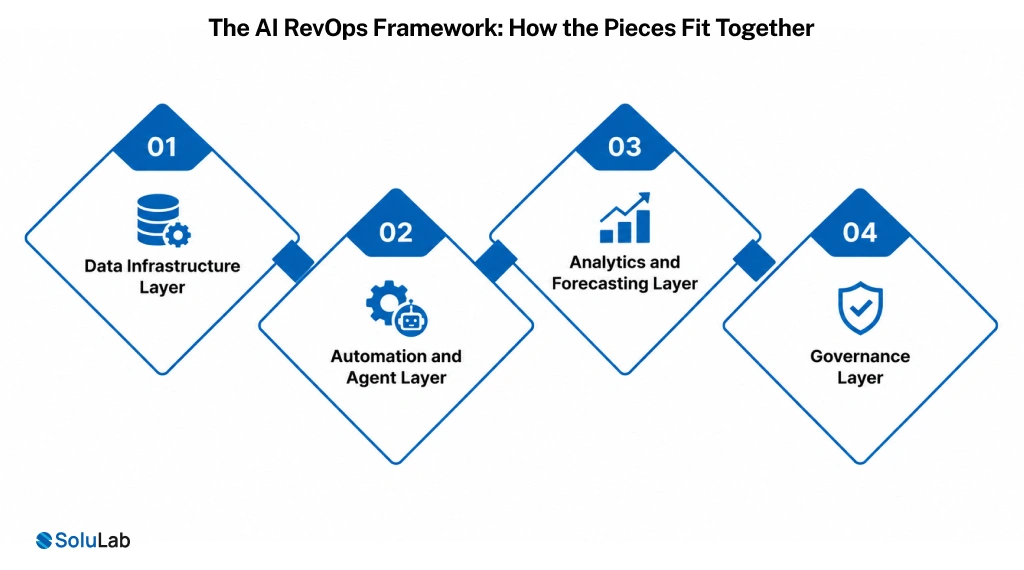
A working AI RevOps framework isn’t a single tool. It’s four connected layers, and skipping any one of them is usually why an AI RevOps implementation stalls.
1. Data Infrastructure Layer
This is the foundation: a unified data model that resolves identity across your CRM, marketing automation platform, billing system, and support desk. Without this layer, every AI model downstream is learning from fragmented or duplicated records.
2. Automation and Agent Layer
This layer handles the repetitive work: lead routing, account enrichment, meeting-prep summaries, and follow-up sequencing. RevOps AI agents sit here, observing signals and executing predefined actions instead of waiting for a person to trigger them.
3. Analytics and Forecasting Layer
This is where predictive models generate deal-level, pipeline-level, and capacity-level forecasts. It also includes conversational analytics, letting a non-technical stakeholder ask a plain-language question and get an answer pulled directly from live data.
4. Governance Layer
Every automated decision needs an audit trail. This layer defines who approves what, which data sources are trusted, and how model outputs get reviewed before they influence a comp plan or a pricing decision.
Teams that build all four layers together, even at a small scale, report stronger returns than teams that spread AI across many disconnected workflows. Default’s research on RevOps AI adoption found that organizations running one or two focused automation workflows outperform those juggling seven or more, largely because focus keeps the governance and data layers manageable.
Core Benefits of AI in RevOps
The benefits of AI RevOps show up in three places: accuracy, speed, and the quality of decisions leadership can make with confidence.
1. Sharper Forecasting
AI models trained on historical CRM data typically improve forecast accuracy by a meaningful margin over rep-based estimates, because they strip out the emotional bias that creeps into manual predictions. A model doesn’t feel pressure to hit a number; it reports what the data actually supports.
2. Faster Deal Cycles
Automated lead scoring and account enrichment mean reps spend less time on research and more time in actual conversations. Deals move through the pipeline faster when the handoff between SDR, AE, and CSM happens without manual data entry at each stage.
3. Earlier Risk Detection
AI-based deal inspection flags stalled or at-risk deals well before a human manager would catch the pattern in a pipeline review. The same logic applies to churn: usage-based signals can flag a renewal at risk weeks ahead of the contract date.
4. Lower Operational Drag
Every hour a rep spends manually updating a CRM field is an hour not spent selling. Automating that data entry, even partially, compounds across a large sales team into real capacity.
5. Better Cross-Functional Alignment
When sales, marketing, and customer success work off the same AI-generated dashboard instead of three separate reports, disagreements about “whose numbers are right” mostly disappear. That alone removes a significant source of internal friction in growing companies.
Real-World Use Cases of AI in RevOps
The theory only means something once you see where teams are actually applying it. Here are the AI use cases that show up most often in production, not in a vendor slide deck.
1. Lead Scoring and Routing
Instead of scoring leads on two or three static fields, AI models weigh dozens of signals, firmographic fit, engagement recency, content downloaded, even the seniority implied by an email domain, and route the highest-fit leads to the reps most likely to close them. One mid-market SaaS team we’ve seen reference in industry case studies cut lead response time from hours to under five minutes just by automating this handoff.
2. Deal Risk and Pipeline Inspection
AI-based deal inspection tools flag deals that look healthy on paper but show warning signs underneath: no multi-threading, a champion who’s gone quiet, or a stage duration far longer than similar won deals. Sales managers use this to prioritize coaching conversations instead of reviewing every deal in the pipeline at the same depth.
3. Churn Prediction and Renewal Protection
Customer success teams feed product usage data, support ticket volume, and NPS responses into a model that scores renewal risk weeks before the contract date. A CSM gets a nudge to intervene while there’s still time to save the account, not a report explaining why it already churned.
4. Automated Account Enrichment
Before a rep ever opens a new lead, an AI agent has already pulled firmographic data, recent funding news, tech stack information, and relevant contacts from multiple sources. This alone removes one of the most time-consuming, least strategic parts of a rep’s day.
5. Conversational Revenue Analytics
Instead of waiting on a RevOps analyst to build a custom report, a sales VP can ask a plain-language question, “Which segment had the biggest quarter-over-quarter drop in win rate,” and get an answer pulled from live CRM data in seconds. This use case alone is driving a lot of the current interest in AI RevOps, simply because it removes a bottleneck that used to sit with one or two overworked analysts.
6. Pricing and Discount Governance
AI models can flag when a proposed discount falls outside historical norms for a given deal size or segment, giving finance and sales leadership visibility before a bad precedent gets set, rather than catching it during a quarterly margin review.
7. Post-Call Summaries and CRM Updates
Call intelligence tools now generate summaries, extract action items, and update CRM fields automatically after a sales or CS call. Reps spend less time on admin, and the data that used to live only in someone’s memory actually makes it into the system of record.
Not every company needs all seven on day one. Most of the successful rollouts we’ve come across start with just one, usually lead scoring or churn prediction, and expand from there once the team trusts the output.
AI RevOps Tools and Tech Stack You Need
Building the right RevOps tech stack matters more than picking a single flagship tool. Most effective stacks include the following categories, layered on top of a core CRM.
- Data unification and identity resolution — tools that merge and clean records across systems so every downstream model works from a single source of truth.
- Revenue intelligence platforms — software that analyzes calls, emails, and deal activity to surface risk and opportunity signals automatically.
- Forecasting engines — purpose-built ML models that generate deal-level, pipeline-level, and capacity forecasts, usually plugged directly into the CRM.
- Workflow and agent orchestration — the layer that lets AI agents actually take action, not just recommend one, across routing, enrichment, and follow-ups.
- Conversational analytics — natural-language interfaces that let a marketing manager or CS lead ask a data question without writing a query.
- Governance and monitoring tools — dashboards that track model accuracy and flag drift, so a forecasting model trained on last year’s market doesn’t quietly go stale.
The mistake most teams make is buying tools in this order and only later asking whether they connect. A better approach: map the workflow first, then choose revops solutions that plug into the data layer you already have, rather than forcing a rebuild around a new platform.
Building an AI Revenue Operations Strategy
An effective AI revenue operations strategy rarely starts with AI integration. It starts with a clear picture of where the current process breaks down. Here’s a practical sequence that holds up across company sizes.
- Audit the current data and process. Map every handoff between marketing, sales, and customer success, and identify where data gets duplicated, lost, or manually re-entered.
- Fix the data foundation first. Deduplicate records, standardize field definitions, and set up ongoing enrichment before layering any predictive analytics model on top. A model built on dirty data just automates bad decisions faster.
- Pick one or two high-impact workflows. Lead scoring and forecasting are common starting points because the ROI is easy to measure and the risk of a mistake is low.
- Pilot with a defined success metric. Decide in advance what “working” looks like, whether that’s a percentage improvement in forecast accuracy or a reduction in manual data entry hours.
- Build the governance layer alongside the pilot, not after it. Define who reviews model outputs and how often accuracy gets checked.
- Scale to adjacent workflows only once the first one is stable and the team trusts the output.
- Reinvest recovered time deliberately. Time saved by automation needs a destination, whether that’s more selling hours or deeper account research, or it just evaporates.
This kind of phased revops strategy also makes budget approval easier, since each step produces a measurable result before asking for the next round of investment.
AI Agents in RevOps: Where Automation Is Headed
RevOps AI agents mark a real shift from the AI tools most teams adopted a few years ago. Earlier generative AI tools mostly generated recommendations that a human still had to act on. Agents are different: they observe a signal, make a decision within defined guardrails, and execute the action themselves.
A few examples already running in production environments:
- Account enrichment agents that pull data from multiple providers and public sources to build a complete account profile before a rep ever opens the record.
- Sales qualification agents that research a company, assess buying intent, answer basic prospect questions, and hand off only qualified opportunities to a human seller.
- Customer success agents that generate pre-call briefs, summarize post-call notes, and score renewal risk based on product usage, all without manual input.
- CRM hygiene agents that flag or correct stale records automatically, keeping the data foundation clean without a quarterly cleanup project.
Gartner’s own research is a useful reality check here: it expects that more than 40% of agentic AI projects will be scrapped by the end of 2027 due to unclear business value or weak risk controls.
RevOps AI implementation works best when a team evaluates what an agent can actually do today, tested against real data and real approval workflows, rather than what a vendor promises for a future release.
Common Challenges and Risks in RevOps Automation
No automation rollout is risk-free, and a credible strategy accounts for the downside as much as the upside.
Data Quality Debt
Most CRM users report that less than half of their organization’s data is complete and accurate. Feeding an AI model unreliable inputs doesn’t just produce a bad forecast; it erodes trust in the whole system once leadership catches the first obvious error.
Over-Automation Without Oversight
Handing a workflow entirely to an agent without a review step can cause small errors to compound quickly, especially in pricing or compensation-adjacent processes where mistakes carry real financial consequences.
Change Management Resistance
Sales reps who’ve hit quota with a manual process for years are often skeptical of a system that reroutes their leads or reprioritizes their pipeline. Rollouts succeed faster when reps see the agent removing tedious work, not second-guessing their judgment.
Vendor Overpromising
Many platforms market “AI-powered solutions” with features that are closer to basic rule-based automation. Testing a vendor against a real workflow, with your own data, before signing a contract avoids a costly mismatch between the pitch and the product.
Balancing these risks against the upside is exactly why a phased rollout, backed by clear governance, tends to outperform a single sweeping automation project.

Conclusion
AI in RevOps isn’t a single tool purchase. It’s a shift in how sales, marketing, and customer success data gets unified, automated, and governed so the numbers leadership sees are numbers they can actually act on.
The companies pulling ahead in 2026 aren’t necessarily the ones with the most AI tools. They’re the ones that fixed their data foundation first, automated one workflow at a time, and built governance in from day one.
If your team is weighing where to start, or already has an AI RevOps pilot that isn’t delivering the ROI you expected, SoluLab, an AI development company that has built agentic workflows and data infrastructure for revenue teams across industries, can help map the right sequence for your business.
FAQs
Neha is a curious content writer with a knack for breaking down complex technologies into meaningful, reader-friendly insights. With experience in blockchain, digital assets, and enterprise tech, she focuses on creating content that informs, connects, and supports strategic decision-making.