
AI is reshaping industry everywhere, and Australia sits right in the middle of that shift. The hard part isn’t the technology. It’s that plenty of Australian businesses, and plenty of the people writing the rules, still can’t say out loud how they plan to adopt or govern it. Without that clarity, projects stall, budgets get spent twice, and the gains in efficiency, sharper decisions, and new revenue never show up.
Then add ethics, data privacy, and the very real question of what happens to people’s jobs. That’s usually the point where a leadership team goes quiet and the pilot quietly dies. It doesn’t have to go that way. Read the direction of travel, pick the opportunities that actually fit your operation, and AI stops being a threat and starts being ordinary infrastructure.
The Current State of AI in Australia
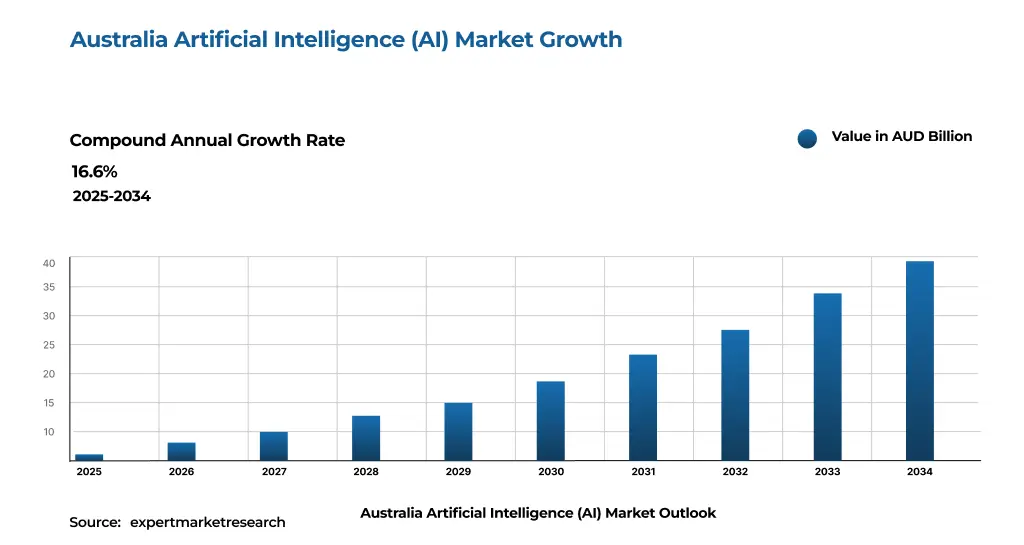
Start with the number. Australia’s AI market was worth AUD 9.41 billion in 2024, and forecasts put growth at a CAGR of 16.6%, landing near AUD 43.71 billion by 2034. Here is what the picture looks like right now:
1. Australia’s AI Action Plan
The AI Action Plan landed in 2021. Its stated ambition is to make Australia a global leader in building and using trusted, secure, and responsible AI. Productivity, jobs, problems worth solving, industry that actually changes shape: those are the four things it keeps coming back to. It also sits underneath the wider Digital Economy Strategy, which sets the target of Australia being a leading digital economy and society by 2030.
2. National Framework for AI Assurance in Government
June 2024 was the turning point here. Federal, state, and territory governments signed up to a single national framework covering safe and responsible AI use inside government itself. It spells out the principles and the working practices for AI assurance, and it now forms one of the load-bearing pieces of how AI gets governed across the public sector.
3. Investment in AI by Federal and State Governments
- Federal Investment: AU$39.9 million, committed over five years, aimed squarely at building AI policy and capability. The stated payoff is national productivity and economic growth.
- National AI Capability Plan: Announced in December 2024. The goal is more money flowing into Australian AI capability, with government and industry pulling in the same direction on productivity and growth.
Read Also: AI in Australian Fintech Industry
How Businesses Are Adopting AI in Australia?
Across the country, AI is doing unglamorous work: shortening response times, sharpening calls that used to be guesswork, taking the grind out of back-office tasks. Automation on one side, data insight on the other. Nothing exotic. Just useful.
- Customer Experience Automation: Chatbots and virtual assistants answer at 2am the same way they answer at 2pm. They field the repeat questions, walk users through a process, and personalise the interaction enough that support gets faster without getting colder.
- Data-Driven Decision Making: Your data already has patterns in it. AI tools surface them, so you can forecast demand, price with more nerve, and stop arguing about what the numbers “probably” say.
- Operational Efficiency: Finance, logistics, operations. Every one of them carries repetitive work that automation handles without complaint, which gives your team back hours and pulls operating costs down.
- Fraud Detection and Security: Transactions get watched as they happen, and anything odd gets flagged immediately. Banking, fintech, and eCommerce feel this one hardest, because that is where the losses land.
- Predictive Maintenance: Equipment tells you it is about to fail, long before it does. AI reads that signal in the data, so you fix things on a schedule instead of during an outage. Mining and energy operators know exactly what an unplanned stop costs.
Industries Benefiting From AI Integration In Australia: Real-World Examples
Sector by sector, here is where the AI use cases in Australia are actually showing up, with companies you can go and look at:
Healthcare
Diagnostics, patient care, the running of the hospital itself. Take Harrison.ai, out of Melbourne, which builds AI tools that back up clinicians reading medical scans. Faster reads, fewer missed findings, better outcomes for the person on the table.
Agriculture
Crop monitoring, precision spraying, yield prediction: Australian farms have taken to all three. AgriWebb’s farm management software leans on AI, including generative AI solutions, to help producers keep track of livestock, stretch their inputs further, and decide from data rather than from habit.
Finance and Insurance
Fraud detection, risk assessment, and customer service are the three big uses here. Commonwealth Bank runs AI over transactions hunting for anything suspicious, and puts chatbots on the front line of customer support. The result is a cheaper operation carrying less risk.
Retail and eCommerce
Woolworths is the obvious local example, using AI to forecast demand, keep inventory honest, and tailor what shoppers see. The algorithms chew through customer data to recommend products and to keep the supply chain and logistics moving, which shows up in both satisfaction scores and margin.
Mining and Energy
Predictive maintenance, safety monitoring, squeezing more out of each shift. BHP puts AI-powered analytics behind mineral exploration and automated haulage, which cuts cost and, more to the point, keeps people out of the parts of a mine site that hurt them.

How to Start AI Adoption in Your Business?
Where do you actually begin? Small, and with a goal you can measure. That is how enterprise AI development turns into something that survives past the demo.
1. Identify processes that can benefit from automation: Sit with your own workflow for a week and watch what repeats. The same form, the same lookup, the same copy-paste. Those are the tasks bleeding hours and inviting errors, and they are the ones automation fixes first.
2. Analyze available business data: You are already sitting on it. Customer behaviour, seasonal swings, the churn you noticed but never quantified. Clean it up and AI can find the pattern you have been half-guessing at.
3. Choose the right AI technologies and tools: The market is crowded. Some tools are built for marketing, others for operations, and a fair few are built for a company that isn’t yours. Pick for fit, and pick something your team will open on a Monday morning without a training course.
4. Develop scalable AI models: Begin with narrow AI solutions for businesses. Put them in front of real users, watch what breaks, and only widen the scope once the results hold up. In practice, this is where teams get stuck, because scaling a model that nobody trusts yet just multiplies the problem.
5. Integrate AI into existing systems: An AI tool sitting on its own island is a demo, not a system. Wire it into the CRM, the analytics stack, the support desk. Done properly, nobody has to rip anything out.
Top AI-Based Opportunities for Businesses in Australia
Running a business here? These are the openings worth a serious look. AI is already rewriting how operations run, how customers get treated, and how decisions get made, and the gap between the firms using it well and the ones talking about it is widening. Retail, finance, agriculture: it does not much matter which one you are in.
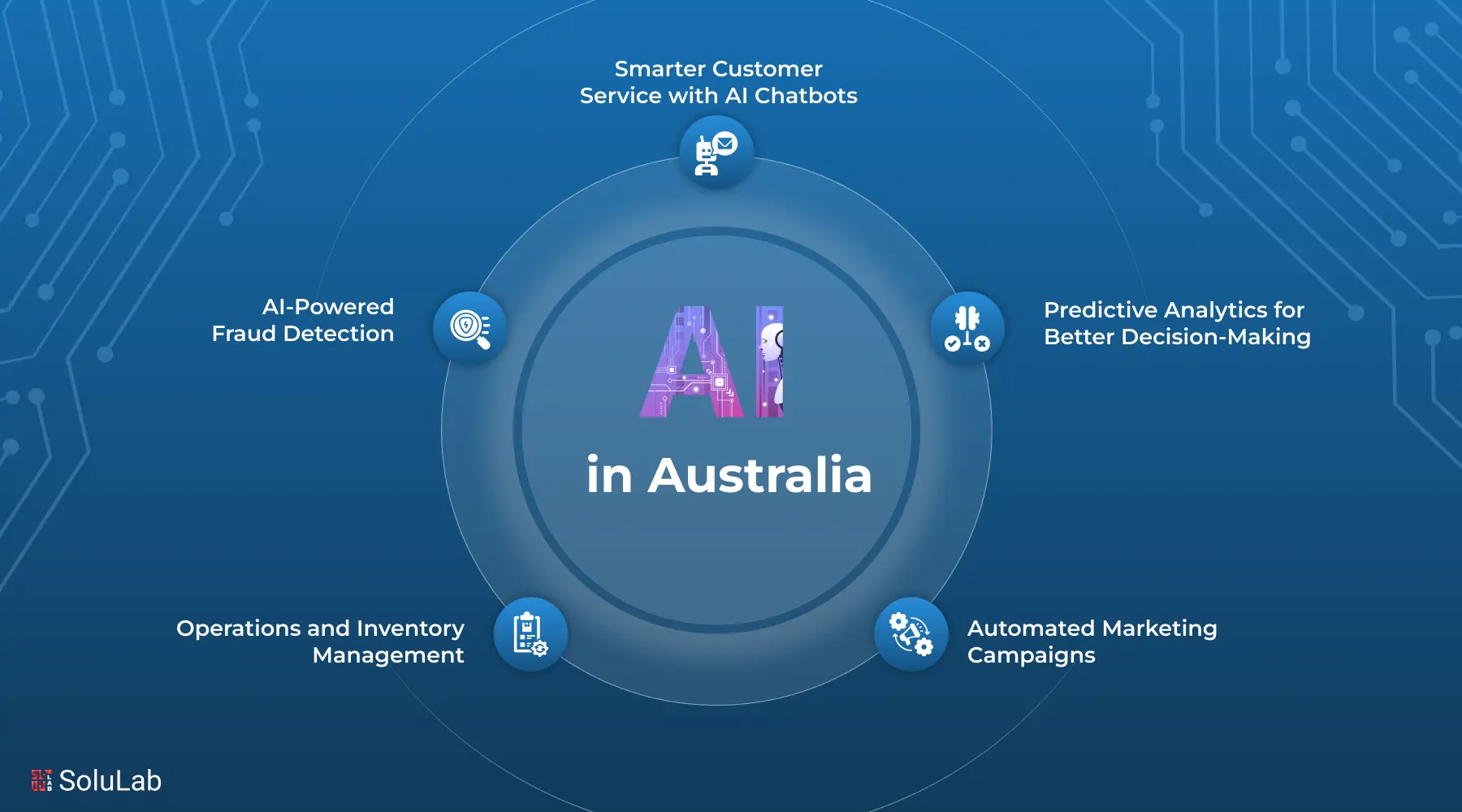
1. Smarter Customer Service with AI Chatbots: Round-the-clock support without hiring an AI developer. AI chatbots take the FAQs off your queue, walk customers through the process, and will upsell when the moment is right. Fast, consistent, and cheaper than the alternative.
2. Predictive Analytics for Better Decision-Making: What will your customers buy next month? When does your sales curve spike? AI tools and solutions read the patterns already sitting in your data, which beats deciding on instinct and hoping.
3. Automated Marketing Campaigns: ChatGPT, Jasper, and the rest of that crowd can draft emails, ads, and social copy cut for each audience segment. You get the hours back, and engagement usually goes up rather than down.
Read Also: AI Copilot for Sales and Marketing
4. Operations and Inventory Management: AI can tighten the supply chain: forecast what stock you actually need, stop the over-ordering reflex, and cut waste. Retail and manufacturing get the obvious win. So do food businesses, where waste is the whole margin.
5. AI-Powered Fraud Detection: Finance and eCommerce first, though nobody is exempt. generative AI technology in Australia now flags dubious transactions in real time, which protects your books and your customers in the same move.
The Future of AI in Australia
The technology is ready to reorganise whole industries and add real weight to the economy. As AI adoption in Australia keeps moving, the country’s bets are on innovation, ethical use, and getting workers ready before the change arrives rather than after.
The pieces to watch:
- Economic Impact: Projections put the productivity and efficiency gain across Australia’s economy at $315 billion by 2028.
- Smart Cities: Transport, energy, and public safety are the three that stand to improve for everyone living in a city.
- Workforce Transformation: Retraining is what gets workers ready to work alongside AI instead of around it.
- Health Improvements: Sharper diagnosis, better-targeted treatment, and medicine tailored to the individual.
- Sustainability: Smarter resource management and progress in renewables are both part of the climate fight.
Adopt it with some judgement and some strategy, and Australia gets to set the pace on the technology while building something more inclusive and more sustainable than what it replaces.
How SoluLab helps you adopt AI solutions for your Businesses?
Most businesses are not short on data. They are short on data that talks to itself. It sits in separate systems, owned by separate teams, describing the same operation in different vocabularies. The right technology, machine learning development services among them, pulls those fragments into one view that actually changes what you decide and how the business performs.
Our Technology Stack
- Python and R for medical analytics
- Tensor Flow and PyTorch AI models
- Natural language processing for records
- Cloud infrastructure for secure processing
- EHR system integration frameworks
- Data encryption and privacy protection
Example Use Case
A MedTech company came to a SoluLab team with a familiar problem: patient data scattered across several healthcare systems, none of which agreed with each other. We built a clinical decision support platform to read all of it. It hooked into the EHR systems already in place, so clinicians saw one consolidated view of a patient while the patient was still in front of them.
Advanced AI models and machine learning algorithms did the heavy lifting. What came out of it:
- 35% reduction in diagnostic errors
- 30% reduction in patient waiting times
- 25% improvement in treatment accuracy
- 60% faster documentation drafting
It also surfaces guideline-based treatment recommendations and writes the clinical documentation itself, which is the part clinicians mention first. Less paperwork, more accurate diagnosis, a workflow with fewer dead ends in it. Fewer medical errors follow from that, and so do better outcomes for patients.
Conclusion
From hospital wards to haul trucks, Australian operations are already running on smarter tooling and daily automation, and the decisions coming out the other end are better for it.
Firms using AI integration services move faster and waste less. The ones that started early are compounding that lead right now. But none of it works on enthusiasm alone: you need technology you can rely on and people who have done the adoption before, because experienced AI specialists are what keep the risk from landing on you.
That is the gap a good partner fills, turning an idea on a whiteboard into a system your team uses on Tuesday. If you are ready to grow, look at what AI can take off your plate. SoluLab, an AI development company, can automate the manual workflows eating your week so your team gets back to the work that actually moves the business. Book a free discovery call!
FAQs
Neha is a curious content writer with a knack for breaking down complex technologies into meaningful, reader-friendly insights. With experience in blockchain, digital assets, and enterprise tech, she focuses on creating content that informs, connects, and supports strategic decision-making.