Key Takeaways
- AI governance stalls when it starts with a 40-page policy. Three artifacts get you moving in weeks: policy intake, risk tiering, and a model registry.
- Policy intake is one short form every use case passes before build: purpose, data used, who it affects, whether a human decides.
- Risk tiering sorts submissions into low, medium, and high, so only the high tier gets heavy review and governance stops being a bottleneck.
- A model registry lists what’s actually running: model, version, owner, data sources, approval date, evaluation results. Without it, no one can answer who signed off.
- Map your tiers to the EU AI Act, ISO/IEC 42001, or the NIST AI RMF instead of inventing a scheme, and give every registered model a named owner or it goes stale within a quarter.
AI governance quick wins are three artifacts you can ship in weeks, not quarters: a use-case intake form that catches new AI projects early, a risk-tiering rubric that sorts them by impact, and a model registry that tracks every deployed model. Stand these up first, then write the full policy once you see what you actually have.
Most enterprise AI governance stalls because teams start with a committee and a 40-page policy nobody reads. The faster path is to build the plumbing first. SoluLab builds these governance artifacts into delivery for clients through our enterprise AI development services, so risk controls ship with the model instead of chasing it. This guide gives you the three quick wins, a risk-tiering table, a registry schema, a 30-day plan, and a reusable seven-template toolkit you can adapt today.
What are the AI governance quick wins: policy intake, risk tiering, and a registry?
The AI governance quick wins are a policy intake form, a risk-tiering rubric, and a model registry. Together they answer three questions every risk owner needs: what AI are we building, how dangerous is it, and what is actually running in production. You can stand up all three in about a month without a full policy or a standing committee.
They beat a long policy cycle for a simple reason. A policy describes rules; these three artifacts create the data those rules depend on. You cannot enforce a risk threshold if you do not know which projects exist. You cannot audit a model you never registered. Intake, tiering, and a registry give you visibility on day one, and visibility is the thing that actually reduces risk.
Here is the order that works:
- Intake form first. It is the cheapest to build and the highest return. Every new AI idea flows through one door.
- Risk-tiering rubric second. Once intake feeds you projects, you sort them so effort matches impact.
- Model registry third. As tiered projects reach production, the registry becomes your single source of truth for what is deployed.
None of this replaces a formal governance program. It buys you a working baseline while the bigger program takes shape, and it produces the evidence you will need for frameworks like the NIST AI Risk Management Framework and ISO/IEC 42001.
What is an AI use-case policy intake form and what fields does it need?
An AI use-case intake form is the front door for every AI project in your organization. Before anyone spends budget or touches production data, they fill out a short structured request. It converts shadow AI, the models built quietly in a corner, into visible, reviewable work. This single form is the highest-return governance quick win because it moves risk decisions to the start of a project instead of the end.
Keep it short enough that people actually complete it. Ten to fifteen fields is usually the right size. The required fields are:
- Use-case owner: the named person accountable, not a team or a queue.
- Business purpose: what decision or task the AI supports, in one sentence.
- Data used: the datasets involved, including any personal, financial, or health data.
- Affected users: who the output touches (internal staff, customers, the public).
- Decision autonomy: does the AI advise a human, or act without review.
- Model type: built in-house, fine-tuned, or a third-party API such as an OpenAI or Anthropic model.
- External vendors: any providers processing your data.
- Known risk factors: bias, safety, privacy, or regulatory exposure the requester already sees.
- Requested go-live date: so review effort can be planned, not rushed.
The payoff is early routing. A well-designed intake form pushes each project straight into the right tier, which is the next quick win. It also creates a timestamped record of who asked for what and when, which is exactly the kind of documentation that governance auditors and the EU AI Act expect for higher-risk systems.
How do you build an AI risk-tiering rubric?
You build an AI risk-tiering rubric by defining a small set of named tiers, writing plain criteria that assign a project to one, and attaching the controls, approval owner, and review cadence each tier requires. Four tiers work for most enterprises: prohibited, high, medium, and low. This mirrors the four-level structure the EU AI Act uses, where systems are sorted into unacceptable, high, limited, and minimal risk categories, with obligations scaling to the level (EU AI Act summary).
The rubric turns risk from a debate into a lookup. A reviewer reads the intake form, checks the criteria, and lands on a tier. That tier tells everyone what happens next.
| Tier | Example use cases | Controls required | Approval owner | Review cadence |
|---|---|---|---|---|
| Prohibited | Social scoring, manipulative or exploitative systems, use cases banned by law or policy | None; the project does not proceed | Legal and executive sponsor | Not applicable |
| High | Credit or hiring decisions, medical guidance, safety-critical automation, anything touching regulated or sensitive data | Human review, bias and safety testing, red-teaming, documented audit trail, monitoring in production | Governance lead plus domain owner | Quarterly, plus on model change |
| Medium | Internal decision support, customer-facing content generation, moderate-impact automation with human oversight | Lightweight review, output logging, monitoring, defined rollback | Domain owner | Semi-annual |
| Low | Internal productivity tools, drafting aids, low-stakes classification with no personal data | Self-service approval from intake, basic logging | Team lead | Annual or on major change |
The EU AI Act flatly prohibits an “unacceptable risk” category that includes practices such as social scoring and certain manipulative systems, which is why the top tier here means the project stops (EU AI Act summary). For the high tier, the Act sets obligations under Article 6 and Annex III that map closely to the controls above (Article 6, EU AI Act). Exact clause-to-control mappings for your jurisdiction should be confirmed with counsel.
The design principle is proportional friction. A low-risk drafting tool should sail through. A high-risk credit model should not. When friction matches impact, teams stop treating governance as a tax and start treating it as a fast lane for the safe stuff.
What is an AI model registry and what should it track?
An AI model registry is a single catalog of every AI model your organization has deployed or is preparing to deploy, with the metadata needed to evaluate, approve, and govern each one. It is the production counterpart to intake: intake captures what you plan to build, and the registry records what actually runs. A model registry manages model versions along with metrics, lineage, and lifecycle records that teams use to promote and govern models (Snowflake: what is a model registry).
Without a registry, nobody can answer basic questions during an incident: which version is live, who owns it, what data trained it, when it was last reviewed. A minimal registry is just a well-structured table. Start with these fields:
| Field | What it records | Why it matters |
|---|---|---|
| Model name and ID | Unique identifier for the model | Lets everyone refer to the same thing |
| Version | Semantic version of the deployed model | Ties incidents to a specific build |
| Owner | Accountable person or team | Someone to call when it breaks |
| Purpose | The business use case it serves | Links back to the intake record |
| Data lineage | Training and input data sources | Supports audits and bias reviews |
| Risk tier | Tier from the rubric above | Drives required controls |
| Approval status | Draft, approved, deprecated | Blocks unapproved models from production |
| Monitoring status | Active monitoring on or off | Flags drift and performance decay |
| Last reviewed | Date of last governance review | Enforces the review cadence |
Model versioning tracks every artifact that defines a model, including weights, training data, and code, so you can reproduce and roll back a build (Atlan: AI model versioning best practices). You do not need a heavy platform to begin. A shared spreadsheet or a simple database table works for the first 20 models. Once counts grow, tools such as MLflow, SageMaker Model Registry, or a data catalog automate the same fields. SoluLab wires registry and monitoring into delivery through our AI deployment services so models do not reach production untracked.
The registry closes the loop. Intake opens a project, tiering sizes its risk, and the registry proves the controls are actually in place on the running model.
How do these quick wins map to NIST AI RMF, ISO/IEC 42001, and the EU AI Act?
These quick wins map cleanly to the major frameworks because they produce the documentation and oversight those frameworks require. Intake, tiering, and a registry are not a workaround for compliance; they are the raw material compliance is built from. Here is how each artifact lines up.
The NIST AI Risk Management Framework is organized around four functions: Govern, Map, Measure, and Manage (NIST AI RMF, AIRC). Your intake form supports Map, because it identifies and contextualizes each AI use case. The risk-tiering rubric supports Measure, because it assesses and categorizes risk. The registry and its review cadence support Manage, because they track and act on risk over time. The whole system, with named owners and clear routing, supports Govern, which NIST describes as the roles, responsibilities, and lines of communication for AI risk (AI RMF Core, NIST). The framework is voluntary and designed to fold trustworthiness into AI systems, so early adoption of these artifacts is a low-cost way to align (NIST AI RMF).
ISO/IEC 42001:2023 specifies requirements for establishing, implementing, maintaining, and continually improving an AI management system (ISO/IEC 42001). The plan-do-check-act rhythm of that standard is exactly what intake (plan), tiered controls (do), monitoring and review (check), and registry updates (act) give you. ISO frames 42001 as a systematic approach to governing and managing AI technologies (ISO: AI management systems).
The EU AI Act sorts systems by risk and scales obligations to the tier, which is why your risk-tiering rubric is the artifact that connects most directly to it (Article 6, EU AI Act). Match your tiers to the Act’s categories and your controls to its high-risk obligations, and the rubric doubles as a compliance mapping.
What does a 30-day AI governance quick-start plan look like?
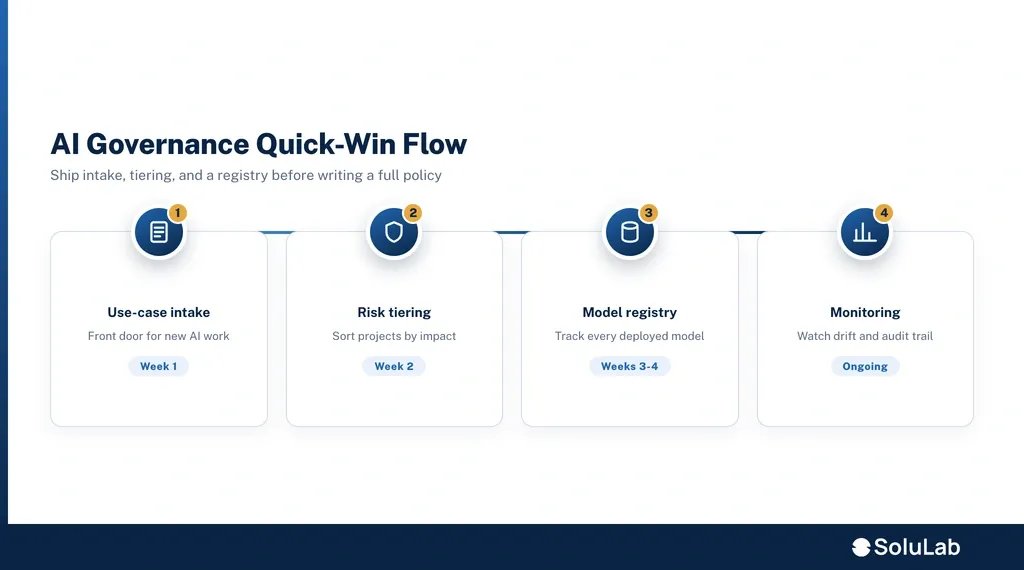
A 30-day AI governance quick-start plan sequences the three artifacts across four weeks so each one feeds the next. Week 1 stands up intake, week 2 builds the tiering rubric, weeks 3 and 4 launch the registry and run your first backlog pass. The durations below are a realistic starting template; adjust to your team’s size and calendar
Week 1
Ship the intake form. Build the form with the fields listed above in whatever tool you already have, such as a form builder or ticketing system. Announce one intake channel. Name the person who reviews new requests.
Week 2
Write the risk-tiering rubric. Define your tiers, criteria, controls, and approval owners. Test the rubric against five real projects from intake to check that tiers feel right. Adjust criteria where the results surprise you.
Week 3
Stand up the model registry. Create the registry table with the schema above. Populate it with models already in production, which is usually the hardest and most revealing step.
Week 4
Run a backlog pass and set cadence. Route every existing project through intake retroactively, tier each one, and set the review dates. Publish a one-page summary of what you found to your sponsor.
By day 30 you have a working front door, a shared risk language, and an honest inventory of what is running. That is more than most organizations achieve in six months of committee work. Get a governance-ready delivery model in place with SoluLab’s enterprise AI development team if you want the artifacts built into your pipeline rather than bolted on.
What are the 7 AI governance templates you can download and adapt?
The seven AI governance templates are reusable starting artifacts that cover the full quick-win cycle plus the controls high-risk projects need. Each one is a standalone document you copy, rename, and adapt to your organization. Together they give a small team the same coverage a large governance function builds over months.
- Use-case intake form. The field set from the intake section, ready to drop into a form builder or ticket template.
- Risk-tiering rubric. The four-tier table with criteria, controls, approval owners, and review cadence.
- Model registry schema. The field list for your registry table, usable as a spreadsheet or database definition.
- Responsibility matrix. A RACI-style grid assigning accountable, responsible, consulted, and informed roles across the model lifecycle.
- Guardrails definition sheet. Per-tier rules for what a system may and may not do, including input filters, output limits, and escalation triggers.
- Red-team scenario starter. A short library of adversarial prompts and misuse cases to test high-tier systems before launch.
- Audit-trail template. A log format capturing approvals, changes, incidents, and reviews for each registered model.
Treat these as living documents. Version them, keep them next to your registry, and update the rubric and guardrails as regulation and your own risk appetite change. If you want them pre-filled for your stack and integrated with your delivery workflow, our team can adapt the set during onboarding
How do you avoid governance slowing down delivery?
You avoid governance slowing delivery by tying friction to risk, not to process for its own sake. The whole point of tiering is that most projects are low risk and should move fast. When 80 percent of requests clear a self-service low-risk path, engineers stop seeing governance as a blocker and reserve deep review for the genuinely dangerous 20 percent.
Three practices keep it lightweight:
- Self-service intake with auto-approval. Low-tier projects approve from the form itself, with no meeting. Only medium and high tiers escalate to a human review.
- Tier-based friction. A drafting assistant should never face the same scrutiny as a credit model. Publish the tier rules so teams can predict their path before they submit.
- Time-boxed reviews. Give high-tier reviews a fixed turnaround, such as a set number of business days, so governance is a scheduled step, not an open-ended wait
The failure mode to avoid is a single committee reviewing everything. That queue is where velocity dies. Distribute approval authority by tier, keep the low path frictionless, and governance becomes the reason safe projects ship faster, because nobody is waiting for a sign-off they never needed. Buyer objections about cost, ownership, and regulator readiness are best answered with your own rollout data
When do quick wins need to graduate into a full governance program?
Quick wins need to graduate into a full governance program when scale, regulation, or risk cross a threshold the three artifacts cannot hold alone. Intake, tiering, and a registry are a strong baseline, but they are not a substitute for dedicated ownership once AI becomes core to how the business runs.
Watch for these triggers:
- Volume: more AI projects than one part-time reviewer can tier and track.
- Regulated data or sectors: finance, healthcare, or any use that falls under EU AI Act high-risk obligations, where documentation and testing requirements are formal (Article 6, EU AI Act).
- High-risk systems in production: autonomous decisions, safety-critical automation, or public-facing models where an incident carries real harm.
- Audit or certification goals: pursuing ISO/IEC 42001 certification or contractual attestations that need a managed system, not ad hoc artifacts (ISO/IEC 42001).
Graduating means adding a named governance owner, a formal management system aligned to a framework, continuous monitoring, and periodic external review. The quick wins do not get thrown away; they become the operational core of the larger program. SoluLab helps teams take that step, moving from three starter artifacts to an operationalized program built on the same foundation.
FAQs
Chintan leads SoluLab's highest-level AI consulting conversations, assessing whether a client's business problem actually justifies an AI investment before any solutioning begins.