
Recent industry estimates indicate that family offices allocate close to 60-70 percent of their overall budgets to activities, compliance, reporting, and administration management, but not investments.
Even more surprising? Research indicates that 30-40% of such operational expenses are avoidable inefficiency in the form of manual procedures, disjointed data systems, and excessive dependence on outside advisors. The operating models that were previously considered inexpensive and sustainable are not always maintained as portfolios become more complicated in terms of geographies, asset classes, and regulatory conditions.
However, AI development solutions are being used in family offices to automate reporting and compliance, improve portfolio management and vendor management, as well as streamline workflows, minimise human error, and run leaner without compromising control. Continue reading this blog to know more about reducing family office operational costs.
Key Takeaways
- The Problem: The family offices face the challenge of high costs of operations because of manual procedures, disjointed data systems, compliance factors, and the use of large advisory teams.
- The Solution: AI provides a competitive edge by simplifying operations, enhancing data quality, and providing other real-time insights, which will lessen the administrative burden and streamline resource allocation to allow family offices to reduce operational expenses.
- How SoluLab Helps: SoluLab develops specialized AI that fits wealth management and family offices– intelligent automation solutions and sophisticated analytics systems that generate efficiencies, lower expenses, and improve long-term management.
What Are Family Offices and Their Biggest Challenges?
Family offices are private wealth management entities that serve ultra-high-net-worth families, overseeing investments, tax strategy, estate planning, philanthropy, governance, and legacy planning under a centralized structure.
- Data Entry & Reconciliation: The manual consolidation of data across custodians, banks, private equity, and real estate systems leads to errors, delays, duplication, and limited real-time visibility into consolidated portfolio performance.
- Reporting & Compliance: Generating accurate, audit-ready financial, tax, and regulatory reports across multiple jurisdictions is time-intensive, highly complex, and vulnerable to inconsistencies without standardized systems and automation.
- Risk Management: Monitoring market, liquidity, operational, and concentration risks across diversified global portfolios is challenging without integrated analytics, scenario modeling, and timely exposure tracking.
- Client Service: Meeting rising expectations for transparency, customized reporting, and rapid responses requires scalable systems; manual workflows limit personalization and proactive communication.
- Investment Research: Sourcing, evaluating, and tracking public and private investment opportunities demands extensive due diligence, data analysis, and ongoing monitoring, straining lean internal investment teams.

Why Operational Costs Matter for Family Offices?
Operational costs make or break the success of family offices, with high expenses directly affecting returns, efficiency, and long-term sustainability, especially when they run into millions annually and vary with scale and services.
1. Costs as a Percentage of AUM Matter: Family offices typically spend 0.5%–1.5% of Assets Under Management (AUM) annually on operational costs alone — meaning a $500 M office could spend $2.5M–$7.5M each year. This metric helps families gauge whether costs are proportionate to wealth managed.
2. Absolute Dollar Costs Are High: Surveys show median annual operating costs ranging from $0.4M (smaller offices) to $4.2M+ (larger ones). For billion-dollar offices, that can exceed $7M in internal expenses annually. These figures highlight why even wealthy families must monitor efficiency.
3. Scale Reduces Cost Ratios: Smaller offices (e.g., $150–250 M AUM) face ~61 basis points costs, while larger ones (> $1 B) operate at ~20 bps of AUM. Economies of scale significantly lower the relative burden.
4. Staffing Is the Biggest Line Item: Internal staff often account for 60–70% of total costs, with salaries and benefits dominating the budget. Talent retention is expensive but essential to keep performance high.
5. Operational Inefficiency Has Hidden Costs: Manual processes, like spreadsheet-based reporting, can cost a mid-sized office $225,000–$450,000+ annually in wasted time and errors. Upgrading tech can dramatically cut these hidden losses.
6. Cost Discipline Preserves Wealth: Without cost control, family offices risk draining capital that could otherwise be invested for long-term growth — especially if expenses grow faster than returns. Effective budgeting and cost oversight are, therefore, strategic necessities.
Step‑by‑Step Guide to Implementing AI in Your Family Office
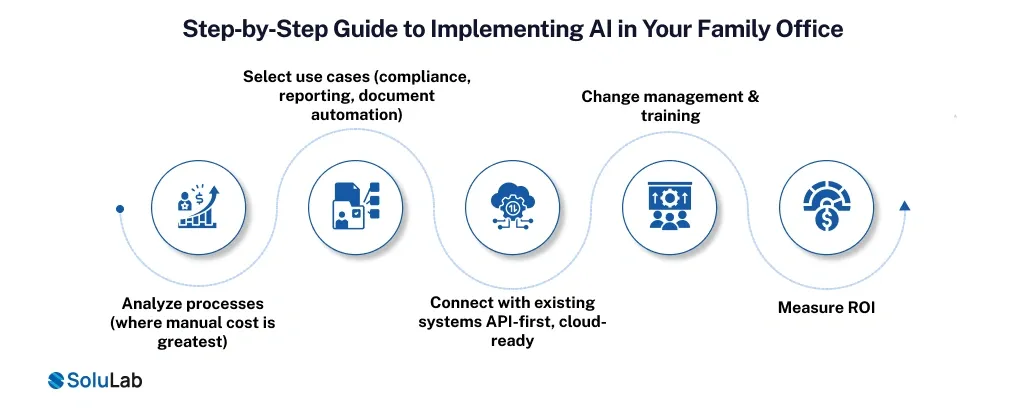
Family offices are turning to AI integration solutions as a way to decrease the amount of manual effort, making decisions that are more accurate and more effective, but effective implementation must come on a step-by-step basis and according to the strategic priorities and quantifiable goals.
1. Analyze processes (where manual cost is greatest): Begin with the daily audit of operations that include reporting, document review, reconciliation, and checking compliance. Determine redundant items that are time-consuming, which are eating up human bandwidth. This baseline analysis explains the areas where AI in family office operations can provide instant efficiency and cost-reduction.
2. Select use cases (compliance, reporting, document automation): Give priority to high-impact use cases such as automated document processing, regulatory monitoring, risk flagging, and real-time reporting dashboards. Pay attention to such areas, where accuracy and speed are key. The use of AI compliance in family offices will help to mitigate regulatory risk and human error significantly.
3. Connect with existing systems API-first, cloud-ready: Make sure that AI models are integrated with portfolio management systems, CRM-based solutions, accounting, and custodial data feeds. A cloud-ready, API-first architecture will make scaling, data security, and easier interoperability possible without impacting the legacy infrastructure.
4. Change management & training: Without alignment of people, technology adoption fails. Train management and leadership on the possibilities and constraints of AI and governance frameworks. Introduce best practices in family offices by setting policies that govern the use of data, its management, and responsibility in a structured manner using AI.
5. Measure ROI: Measure success, which includes less processing time, less compliance costs, fewer reporting errors,s and less time to make decisions. Ongoingly monitor the performance against benchmarks to ensure a valid value creation and the optimization of the AI models to provide long-term strategic benefits.
7 Ways AI Is Reducing Family Office Operational Costs
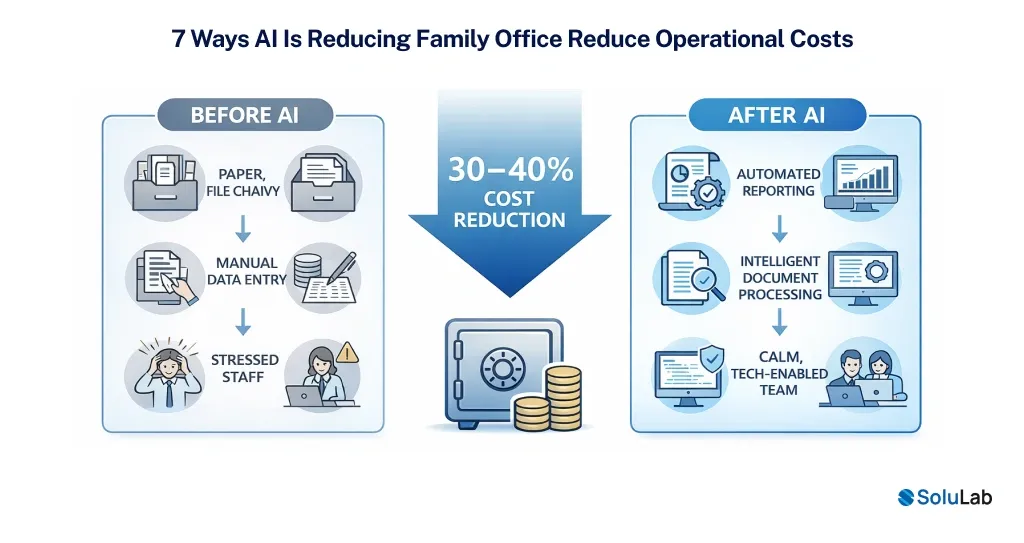
Family offices are facing the pressure of lowering their operational costs while dealing with complex investments, compliance, and reporting requirements. Artificial Intelligence is becoming one of the most potent tools that can be used to automate processes, reduce errors, and make decisions more efficiently.
1. Smart Transaction Matching and Reconciliation
AI can match transactions between various bank accounts, custodians, and other parties and minimize the manual reconciliation efforts. Machine learning models can detect anomalies in real time, enhance accuracy, speed up month-end closings, and reduce the number of employees and other costs associated with audits.
2. Unusual Activity Detection and Fraud Prevention
Transactions and behavioral patterns are monitored on a continuous basis by AI systems in detecting unusual activities in real-time. Family offices mitigate risk of fraud, curb financial leakage, or avoid expensive compliance fines by flagging suspicious transfers, duplicating payments, or unusual access.
3. Data Extraction and Document Processing Automation
AI reads the data in contracts, invoices, statements, and tax documents and extracts the data automatically using OCR and natural language processing. This saves on administration effort, human errors are minimized, the reporting cycle is accelerated, and costs on outsourcing or back-office processing are reduced.
4. Multi-Entity Forecasting anPredictiveve Cash Flow
The AI-driven forecasting models examine past transactions, market, and liquidity trends in order to forecast the cash flow requirements in the future. This aids family offices to maximize the use of capital, avoid shortages in liquidity, and unnecessary borrowings or cash holdings.
5. Natural Language Reporting & Conversational Insights
AI translates complicated financial information into easy-to-interpret narrative reports to principals and other stakeholders. The use of conversational AI tools enables the decision-maker to communicate in a straightforward language, which limits the reliance of an analyst and wastes time on creating tailored performance reports.
6. Chatbots and Virtual Assistants for routine support
Chatbots are AI-powered to process basic internal requests, such as a summary of portfolios, compliance reports, or cost approvals. This will cut down on administration overhead, enhance response rates, and liberate the high-value employees to concentrate on strategic investment and advisory services.
7. Artificial Intelligence-Based Compliance and Risk Surveillance.
AI keeps a constant check on regulatory changes, exposure limits, and risk assessment of the portfolio in real time. The automated alerts and risk scoring minimize the process of conducting compliance reviews, reduce legal liability, and ensure that family offices eliminate expensive regulatory violations.

Conclusion
Family offices are no longer able to be limited to the traditional processes. They can achieve quantifiable efficiency and long-term benefits by combining automation and predictive analytics with smart monitoring.
Reducing manual workload to making the risk management and compliance accuracy resilient, AI changes cost centers into a value generator. The actual gain is not only in the reduction of expenses, but a smarter, more agile operation.
AI-based family office solutions are no longer optional but necessary. In simple terms, AI in family offices is transforming the understanding of how a modern wealth management firm attains scalability, control, and sustainable cost reduction.
SoluLab, an AI development company, can help you reduce your family office operational costs through smart automation and AI solutions. Book a free discovery call today!
FAQs
With over 3 years of experience, I specialize in breaking down complex Web3 and crypto concepts into clear, actionable content. From deep-dive technical explainers to project documentation, I help brands educate and engage their audience through well-researched, developer-friendly writing.