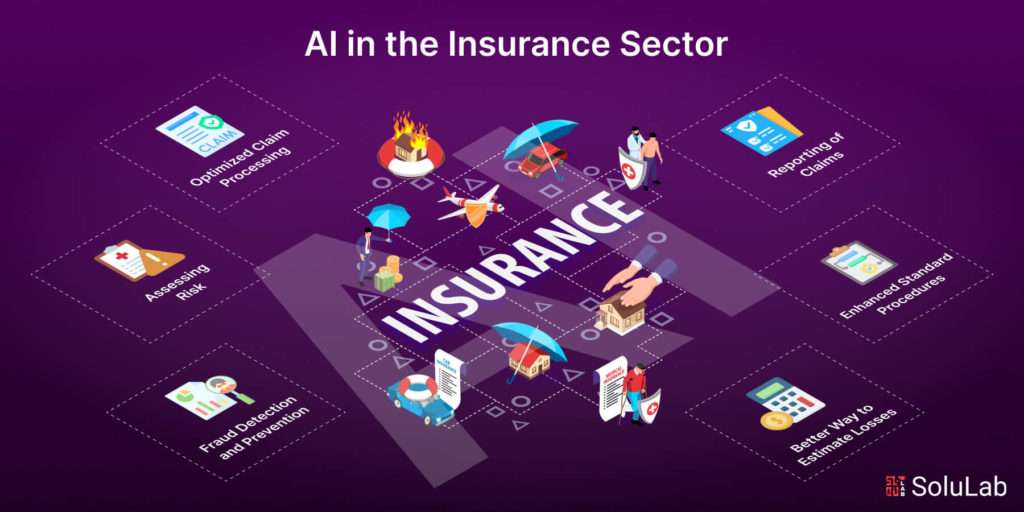
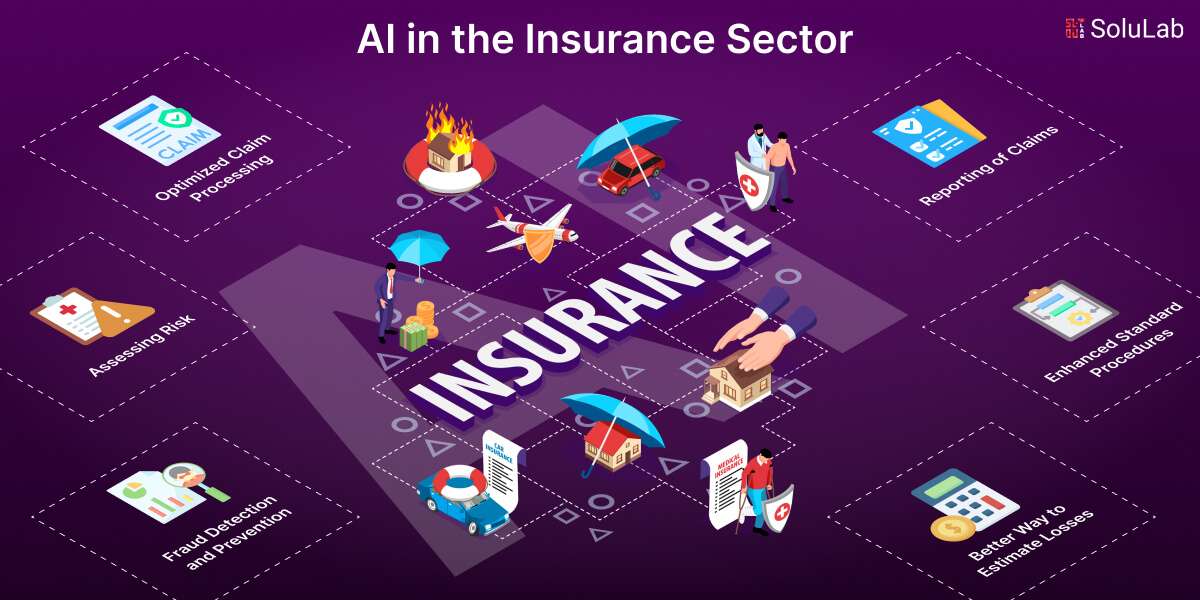
Insurance has always run on data. Customer records, claim histories, actuarial tables, decades of paperwork sitting in systems nobody wants to touch, and insurers are now pointing artificial intelligence (AI) at all of it to cut down the manual work and give customers a less painful experience. Artificial intelligence did not skip this industry. AI life insurance changed how risk gets judged, how policies get underwritten, and how the older rituals of the business actually run. The effect has been big enough that insurers on every continent are rebuilding their methods around it.
Forbes reports a 60% gain in operational efficiency across the insurance industry, a 99.99% rise in claims accuracy, and a 95% improvement in customer satisfaction. The market number is just as loud: AI in the insurance business is projected to hit USD 35.77 billion by 2030, at a CAGR of 33.06%.
Claims processing, fraud detection, underwriting. AI tooling has made all three simpler for insurers, and that list keeps growing. So this blog gets into the function and use of AI in insurance: the advantages, the real use cases, the impact, and where the trend lines are pointing.
Understanding the Need for AI in Insurance
Think about what buying insurance used to mean. Stacks of forms, meetings that ate an afternoon, claims that asked for documents you did not know you needed, and then months of waiting for someone to decide.
Artificial intelligence in insurance brought automation into that picture, and trust started coming back with it. Companies now run AI solutions for insurance to grow the book, strip out risk and fraud, and automate the core operations that were quietly draining budget.
AI in health insurance matters here too. It tightens operations and lets insurers price premiums against a much deeper read of the data instead of a broad category. Underwriting gets shorter, fewer hands touch each file, and applicants can connect with health insurance carriers directly rather than through three intermediaries.
Read Blog: Generative AI in Healthcare
The short version: AI insurance pays off on both sides of the contract. Here’s how.
- AI in the insurance sector sharpens risk analysis, catches fraud, and takes human slips out of the equation.
- AI in insurance makes customer service better and faster, and it does the same for claims processing.
- Underwriting improves once AI handles the repetitive judgment calls and fewer people have to intervene.
- With AI and ML in insurance, underwriters measure risk more precisely, which means premium pricing can actually be personal.
- And AI in the insurance sector shortens the path between an applicant and an insurer, cutting the steps in between.
How Does Artificial Intelligence Add Value to the Insurance Sector?
To stay relevant, insurers have to fold in the newer technologies: metaverse, blockchain, artificial intelligence, robotic process automation, whatever fits the problem. So look at where those tools actually touch an insurance process that today is slow and exhausting for everyone involved. But value only counts when the implementation of Gen AI in insurance industry produces something you can measure. A few places it does:
- Optimized Claim Processing
Claims processing is genuinely hard work. An agent has to read through several policies, understand the fine print in each, and then work out what the customer is actually owed. AI for insurance takes over the mechanical half of that job, which cuts both the errors and the clock time on a claim.
Bring in AI, RPA, and IoT together and the operational gain compounds. Insurers suddenly have a pipeline into smart home assistants, fitness trackers, healthcare wearables, a whole spread of connected devices. AI and Insurance working in tandem means data arrives on its own, insurers stay close to policyholders instead of hearing from them once a year, and the insight that feeds underwriting and claim management is far richer. Risk drops as a result.
- Assessing Risk
Underwriting leaned almost entirely on the applicant filling out standard forms by hand. People lie. People also just get things wrong, and either way the risk assessment that comes out the other end is off.
Research on the advantages of AI in insurance, underwriting especially, points to three things it can do:
- Model a future market with 83% accuracy.
- Reduce processing time in underwriting by 10-fold.
- Boost case acceptance by 25%.
- Fraud Detection and Prevention
Roughly $1 trillion in premiums flows into the insurance sector every year. At that size, fraud is not a rounding error. Non-health insurance fraud is expected to cost more than $40 billion annually, and households pay for it: $400 to $700 extra on premiums.
Gen AI in insurance is rewriting how fraud gets caught. Push enough data through it and the odd patterns surface, insurers get flagged in real time rather than after the payout clears. Less risk, smaller losses, and operations that hold up under scrutiny. The policyholder benefits too, because false claims are what push everyone’s rate up.
- Reporting of Claims
For claim filing, AI can take the first notification of loss with almost no human touch. From there the system allocates, routes, reports, and prioritizes the claim on its own.
People report incidents at 2am, from a phone, on the side of a road. Chatbots handle that intake without complaint and move the claim along. Build Chatbots with AI then pushes the information onward to whatever needs to process it next.
- Investigation and Management of Insurance Claims
Paired with the right applications, AI and ML in insurance automate the hunt for fraudulent activity across the whole chain: data collection, claims processing, authorizations, permits, payment tracking, recovery tracking. Every step, monitored. That is where the time and money come back.
Artificial Intelligence in insurance processes can run and improve a wide spread of functions.
- Enhanced Standard Procedures
Customer service in insurance looks nothing like it did a decade ago, and artificial intelligence is the reason. As noted above, a chatbot is the cheapest way to open a process and hand the information to whoever needs it next, with no person in the loop. Quick, simple, and hard to get wrong.
AI chatbots also upsell and cross-sell, reading a customer’s purchase history and profile before they suggest anything. Automate the repetitive layer and operations scale without a matching headcount jump, while the humans you already have move to work that deserves them.
- Better Way to Estimate Losses
Damage assessment has gotten much easier, thanks to machine learning, deep learning, and optical character recognition (OCR). Upload a photo of the damaged object. That is roughly the whole workflow now, and the extent of the damage comes back fast.
The same technologies also forecast losses before they land and offer advice worth acting on.
Use Cases of AI in Insurance
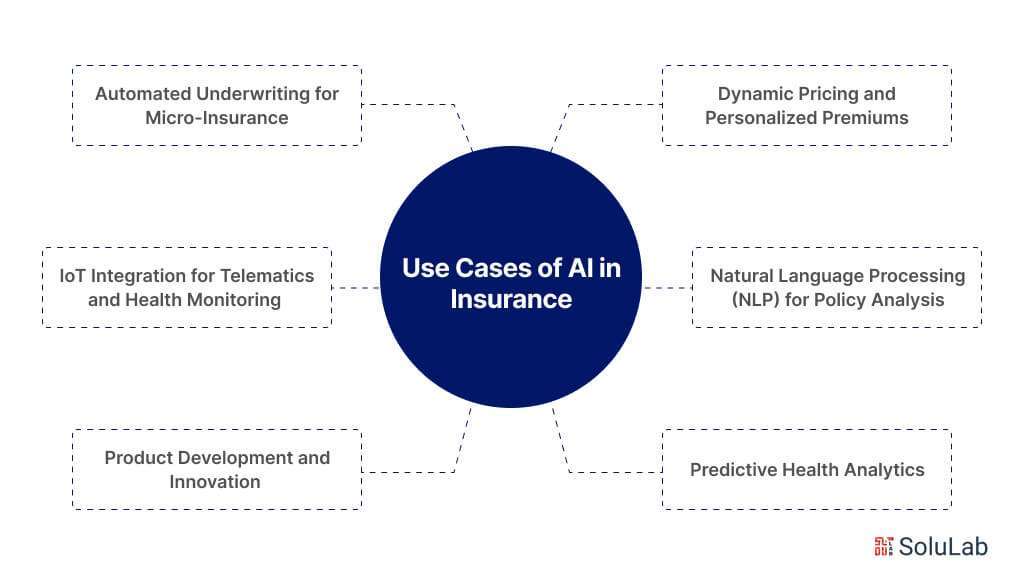
The list of AI use cases in insurance is long, and it stretches across the whole business. Risk management, underwriting, customer service, product design. Each one gets faster, cheaper, or more accurate, and the customer usually notices.
Some of the AI in insurance use cases:
Customer Segmentation and Targeted Marketing: AI analytics pull apart the customer base along demographic, behavioral, and psychographic lines. Insurers then aim campaigns and products at the segment that will actually respond, and engagement and conversion both move.
- Dynamic Pricing and Personalized Premiums: Algorithms read individual risk factors and behavioral data, then move the premium in real time. Drive carefully, pay less. That is the incentive, and it pushes policyholders to reduce their own risk rather than wait for a claim.
- Automated Underwriting for Micro-Insurance: Small, low-premium policies never justified manual underwriting. AI models handle that assessment cheaply, which is what makes micro-insurance viable for low-income customers. Insurers reach people they previously could not serve, and the numbers still work.
- Natural Language Processing (NLP) for Policy Analysis: NLP tools read dense policy documents and pull out what matters: coverage limits, exclusions, terms. Underwriting and claims teams get the details in seconds instead of an afternoon, and they decide on better information.
Read Also: Top 10 Applications of Natural Language Processing
- IoT Integration for Telematics and Health Monitoring: Telematics in cars, wearables on wrists. Insurers use both to see what policyholders are actually doing and how their health is trending, in real time. That feeds risk assessment, pricing, and reward programs, and it nudges people toward safer driving and better habits.
- Product Development and Innovation: AI surfaces market trends, shifting customer preferences, and risks that did not exist last year. Insurers build new products against that signal instead of guesswork, which is how a crowded market stays interesting.
- Predictive Health Analytics: AI in health insurance reads wearable data, electronic health records, and other sources, looking for the patterns that precede a health risk or a chronic condition. Catch it early and the insurer can step in with a health management program or preventive care instead of paying for the crisis later. Better outcomes for the person, lower cost for everyone.
Top Trends and Innovations Driven by AI Changing the Insurance Industry
Adopting these technologies is not free. The insurance business has a steep learning curve ahead of it, and the people holding the policies will feel the changes as much as the companies writing them. A few of the trends worth watching:
- High Personalization
Plans can now be built around one person rather than a category, because AI can hold that much detail. Feed a system data on lifestyle, behavior, and stated preferences and it will assemble a personalized insurance solutions. In a market this competitive, that level of tailoring is what keeps existing customers and wins new ones.
- Explosion of Data from Networked Devices
Connected devices multiplied, and data creation went up with them. IoT sensors and smart devices are collecting and transmitting at a volume nobody planned for. That is an opportunity and a headache at once, because storing it, reading it, and deciding on it are three separate problems. Companies that handle the flood well stay competitive. The rest drown in it.
- Extended Reality
Extended reality is where virtual reality goes next. The insured object no longer has to physically be somewhere for someone to look at it. File the claim, and AI runs a virtual examination instead. If the safety features of the car are already known, quoting a better rate gets much easier.
- Data Accuracy
In AI, data is king. The whole exercise is gathering data from many sources and making sense of it. But the business decisions are only as good as the inputs, and reliable, exact data is what separates a useful model from an expensive one. Get that right and insurers can head off risk and fraud before either one costs them anything.
Factors Driving Implementation of AI in Insurance Industry
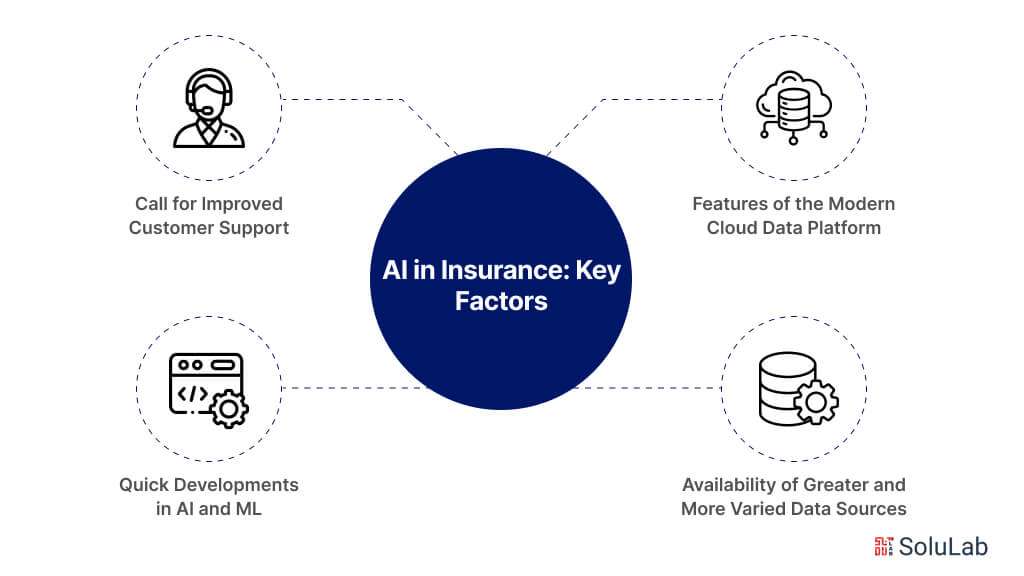
Market share and profitability are both climbing for insurers who deployed AI. So why now? A handful of forces pushed the industry over the line at roughly the same time.
- Quick Developments in Artificial Intelligence and Machine Learning
Machine learning and AI moved fast, and every jump opened another way to pull value out of data an insurer already owned. Take large language modeling (LLM), a subfield of artificial intelligence built to read document data intelligently. With LLMs, claims move faster and fraudulent ones get flagged with better accuracy. Generative AI is the other example: it stitches together functions, data, and tools, then reasons its way to an answer. Early days still. The potential for insurance is hard to overstate.
- Availability of Greater and More Varied Data Sources
There is simply more raw material now. The count and variety of data sources jumped, and third-party information turned into something insurers cannot ignore: consumer credit, marketing files, social posts, shopping behavior, criminal records, prior claims, weather. Each one feeds something. Marketing gets sharper, risk models get closer to reality, underwriting and claims handling both improve.
- Call for Improved Customer Support
Customers stopped accepting business-hours support. Chatbots and virtual assistants now give them individual answers at any hour, which is a different standard than the industry held five years ago. Behind those front-line systems sits natural language processing (NLP), the branch of artificial intelligence that lets machines understand and respond to written and spoken language. It absorbs the basic questions around the clock, and human agents get to spend their time on the messy cases that need a person.
- Features of the Modern Cloud Data Platform
Cloud data platforms like Snowflake made storing and processing huge volumes both practical and affordable. Structured, semi-structured, unstructured: it all lands in the same place, so insurers can train and refine AI models on data sets they previously kept in separate silos. Compute scales elastically, which is what keeps AI and ML workloads from becoming a capacity planning exercise.
Final Words
AI has reshaped insurance operations, customer experience, and risk strategy, and the change runs deeper than a tooling upgrade. Underwriting got shorter. Fraud detection got sharper. Customer service got personal. Insurers who keep pushing on AI will find more efficiency and more competitive room in a business that is now thoroughly digital. But the ethics do not take care of themselves. Transparency, fairness, and accountability in how these systems are used are what earn trust, and without them the risks come back in a different form.
Deployment is where most insurance teams get stuck, which is why working with experienced AI development companies such as SoluLab tends to shorten the path. SoluLab builds around the specific business problem rather than shipping a generic product: chatbots and virtual assistants for client interaction, pricing model optimization, claims processing automation, whatever the gap actually is. SoluLab is a trustworthy AI development company pushing the insurance industry’s transformation forward with modern artificial intelligence (AI) solutions, and the focus stays on innovation and on customers who come back. Get in touch and tell us where your AI journey is stalling.
FAQs
Shipra Garg is a tech-focused content strategist and copywriter specializing in Web3, blockchain, and artificial intelligence. She has worked with startups and enterprise teams to craft high-conversion content that bridges deep tech with business impact. Her work translates complex innovations into clear, credible, and engaging narratives that drive growth and build trust in emerging tech markets.