An Initial Coin Offering, ICO for short, is how crypto companies raise money without going anywhere near a bank. A team mints a new token and sells it to investors for a set window of time. Sound familiar? It’s roughly what Coinbase did with its own IPO: sell a stake in the company, take the cash, and put it toward new projects and working capital. People often use “ICO” to describe both the event and the token itself, since the two get talked about interchangeably. In practice, the mechanics are simple. Creators fix a supply of tokens, set a price, and sell until the round closes or the target gets hit.
Types of ICOs
ICOs generally split into two camps:
1. Private ICOs:
- Participation is capped. Only a hand-picked group of investors gets in.
- Minimum buy-ins run high, so it’s mostly big institutions and wealthy individuals writing the checks.
- Companies pick this route when they need serious capital fast and already know which high-value investors to approach.
2. Public ICOs:
- Anyone can join. That’s the whole point.
- Regulatory scrutiny has actually pushed a lot of companies back toward the private route.
- Entry amounts stay low, which pulls in a much wider crowd.
- The strategy here is volume: raise money from as many contributors as possible.
Working of ICO
Running an ICO isn’t something you wing. It demands real technical grounding in the blockchain underneath it. Strip away the jargon and the goal is simple: raise capital from investors. But before a single token gets sold, the organizer has to settle on a structure. Three show up again and again:
1. Static Supply and Static Price: Token count and price are both locked in from the start.
2. Static Supply and Dynamic Price: Supply stays fixed, but the price moves depending on how much money flows in during the sale.
3. Dynamic Supply and Static Price: Price is locked, and supply expands or contracts based on how much gets raised.
The Following Are The Steps Explaining The Working Of ICO:
1. Investment Targets:
- Before launch, a company sets a value on its currency and starts hunting for people who want a piece of it.
- Once the audience is clear, marketing materials get built around exactly what that audience wants to see.
2. Token Creation:
- With the audience mapped out, token creation begins.
- These aren’t cryptocurrencies in the traditional sense. They’re tradable tokens, a different animal.
- Holding one doesn’t make you a shareholder. It gives you a stake in how well the company does, which isn’t quite the same thing.
- Most teams build tokens on existing blockchain platforms rather than write blockchain code from scratch.
3. Promotion Campaign:
- Next comes promotion, campaigns built to get the ICO in front of potential buyers.
- Most of this happens online, partly because plenty of platforms flat out ban ICO ads.
- Even so, there’s no shortage of platforms still willing to run the campaigns.
4. Initial Offering:
- Tokens go out to investors across multiple funding rounds, not all at once.
- The company puts the raised funds toward new products or services. Investors, in turn, use their tokens to actually access what got built.
It starts with infrastructure: the blockchain gets set up, protocols and rules get written down. Then the team states, plainly, why this ICO exists. Before launch, there’s a final check to make sure nothing breaks the moment the sale opens. From there, the creators list on an exchange, the same place investors go to find active and upcoming ICOs. It’s an IPO listing, essentially, minus most of the paperwork.
ICO vs IPO
Buy into an IPO and you get voting rights proportional to your shares, real influence over how the company gets run. That said, do your homework first. No project’s success is guaranteed, no matter how polished the prospectus looks. IPOs sit under government regulation, and only established companies with stable bank accounts, clean business records, and proper legal paperwork can raise one at all. Lawyers and banks are involved at every step.
ICOs flip that script. A finished product isn’t required, which is exactly why the risk runs higher. Some do ship working, testable products, and that’s worth weighing before you commit anything. But there’s no regulator standing over an ICO, which is part of why developers can vanish with the funds, the classic “rug pull” scam. Any startup, any new entity, any two people with an idea can launch one. No legal format required. Where IPOs run on lawyers and banks, ICOs run on programmers and the internet.
IPO
- Opening a dedicated bank account is part of the process, for security.
- It’s the traditional route for private companies raising funds under government oversight.
- Strict rules apply, set by whichever regulatory body governs that country.
- What you get is a share, actual ownership rights, not just a promise.
- Expect a long wait. Due diligence alone can drag on for months.
ICO
- To join one, you just need an exchange account or a wallet. That’s it.
- Regulation is light, transparency ranges from low to moderate, security tokens being the exception.
- What gets issued is usually a utility token, unless the offering treats security tokens as equity instead.
- Utility tokens can go out fast. Security tokens take longer, regulatory requirements see to that.
Related: ICO Vs IPO: What’s the Difference?
How to Create ICO?

Here’s what actually goes into building one:
1. Whitepaper:
- Think of it as the technical backbone: what the coin does, and why it’s not just another copy of something else.
- A solid one covers marketing plans, the problem being solved, unique features, development fees, developer wallet addresses, and where the project is headed long term.
2. Marketing:
- This part is genuinely hard now, thanks to years of influencer scams and rug pulls poisoning the well.
- The job is getting investors to actually understand what the coin does, then turning that understanding into funding.
- Common tactics: targeted ads on crypto platforms, showing up in the right communities, and yes, influencer partnerships, the carefully chosen kind.
3. Selling on Platforms:
- A platform handles the pre-sale collection and then distributes coins back to investors.
- Investors trust a neutral third party more than they trust the coin’s own developers. Fair enough.
- It just makes launch simpler, end to end.
ICO Regulations
Growing the crypto market’s capitalization means the ICO space needs real rules, not just guidelines nobody follows. The Russian Association of Crypto-Currency and Blockchain, RACB, has already moved to set uniform standards for companies running ICOs. The bigger problem right now is that no consistent standard exists industry-wide, and there’s no institution clearly defining what role cryptocurrencies actually play in the broader economy. Governments will likely close that gap eventually, building conditions that encourage innovation, diversify how businesses grow, and open up new income streams.
Advantages of ICO
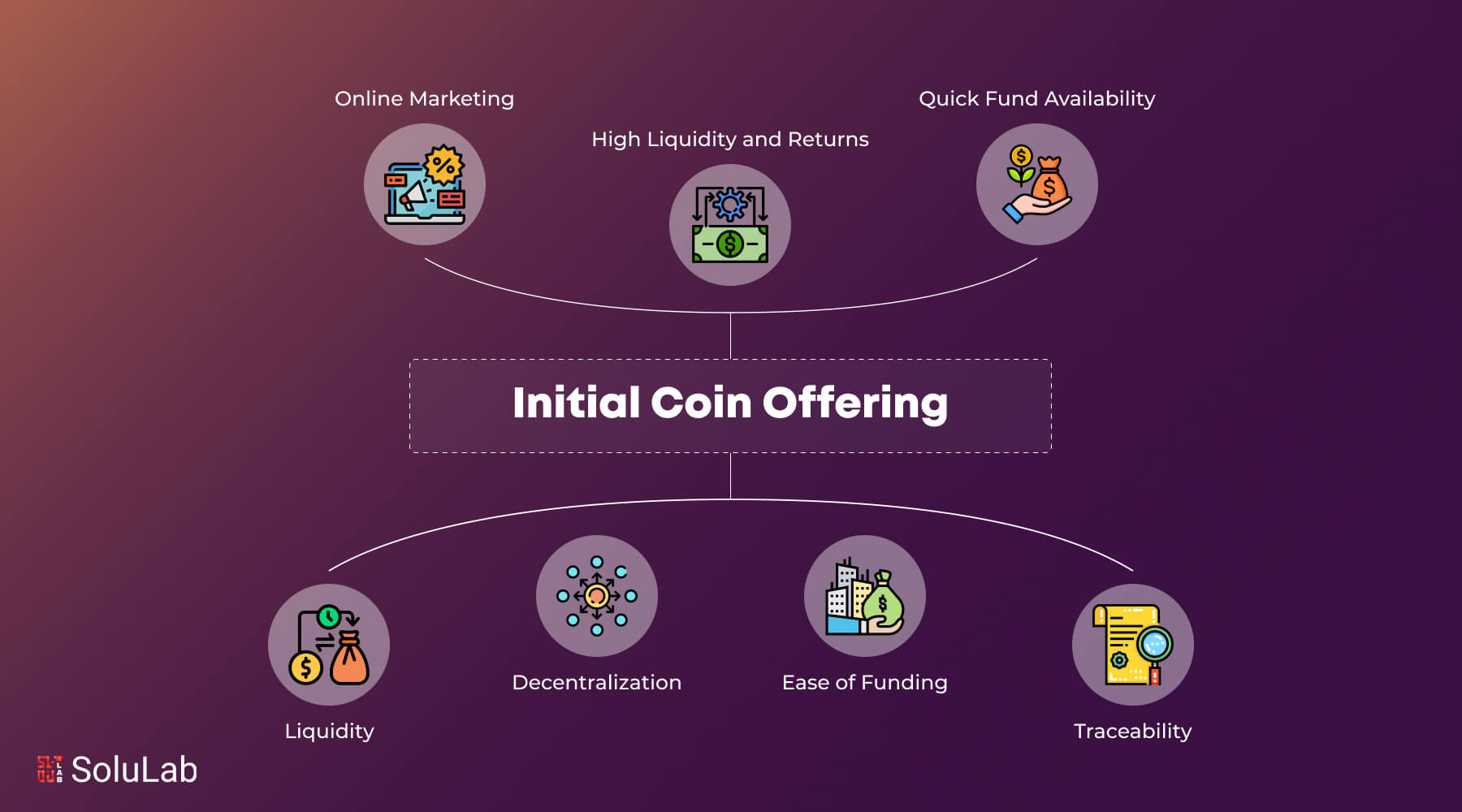
- Liquidity: Money is the usual bottleneck for anyone trying to invest. ICOs hand investors real liquidity, sidestepping a lot of the restrictions traditional funding routes impose.
- Decentralization: Most ICOs let you transfer funds the moment you decide to buy, so anyone can jump in whenever they want. Getting in early has a real payoff too: you pay less and skip the premiums latecomers get stuck with.
- Ease of Funding: Fundraising doesn’t get much simpler than this. Anyone, anywhere, can take part, which means projects get the capital they need without jumping through the usual hoops.
- Online Marketing: Everything happens online, so the reach is wide by default. Buyers find out about an ICO through the project’s website, forums, and whatever platforms the community lives on.
- Positive Impact: Decentralized apps live or die by user count, and the ICO model pushes their development forward. Launch a public ICO for decentralized applications, and you’re directly encouraging adoption and growth.
- Quick Fund Availability: Skip the paperwork, get the funds fast. That speed matters most in the early stage, when a company is still building basic infrastructure and can’t afford to wait months for capital.
- Traceability: Every transaction happens online and leaves a trail, which means investors can actually dig in and verify things. Roadmaps for the months and year ahead stay visible too, nothing hidden.
- High Liquidity: Buying and selling tokens is easy, no physical exchange required since everything’s digital. Investors can watch their positions closely, in real time if they want.
- High Returns: Some ICOs start cheap and climb from there, which is exactly the kind of upside that draws investors in the first place.
Disadvantages Of ICO
Here’s the flip side, the concerns nobody puts in the pitch deck:
1. Due Diligence:
- There’s no formal audit process most of the time.
- Problems buried in a whitepaper can stay hidden until real money is already on the line.
- Some projects even bury a clause where you agree upfront that the whole thing might just get abandoned.
2. Volatility:
- Prices can swing hard, within seconds, not days.
- That volatility is a real risk. It can hit a whole portfolio, not just one position.
- So many ICOs compete for attention that price swings become genuinely unpredictable, more so than most other investments.
3. Unlawful Activity:
- There’s growing worry that ICOs could be used to fund criminal or even terrorist activity.
- Hash functions hide who’s actually involved, which makes that kind of misuse easier to pull off.
4. Conflict of Interest:
- Founders often risk none of their own money, which sets up a conflict of interest from day one.
- Handing founders tokens with no lock-up period just misaligns everyone’s incentives.
5. ICO Scams:
- Most investors go in expecting fast, outsized returns.
- Sure, some legitimate ICOs have delivered. But that success blinds a lot of people to the scams sitting right next to them, and the losses that follow.
- Scammers exploit exactly what makes ICOs appealing: minimal paperwork, easy fundraising, and investors who haven’t done their homework.
6. Lack of Clarity:
- How profits from an ICO get treated legally still varies wildly by jurisdiction, and clarity is rare.
- Tax treatment is murky too. Accountants disagree, which tells you something.
Read Also: Build MiCA-Compliant Neo Banks in Europe
Examples
- Ethereum: Launched in 2014 and raised $18 million in 42 days, at $0.31 a token. It’s still the most valuable cryptocurrency around, and it gave developers the technology to build distributed applications through smart contracts.
- Tezos: Raised $232 million in its ICO in July 2017, an enormous sum. Then came the delays. Distribution kept slipping, and the project never quite delivered on what it promised.
- EOS: Launched in 2017 at $0.925 a token and pulled in $185 million in just five days. It pitches itself as an Ethereum alternative.
- NEO: Came into being between 2015 and 2016 at $0.032 a token. Returns were substantial that year, helped along by confidence and backing from some high-profile names.
What To Consider Before Investing In An ICO?
Protecting your money here starts with slowing down before you assess any ICO. A few factors worth checking before you risk a cent:
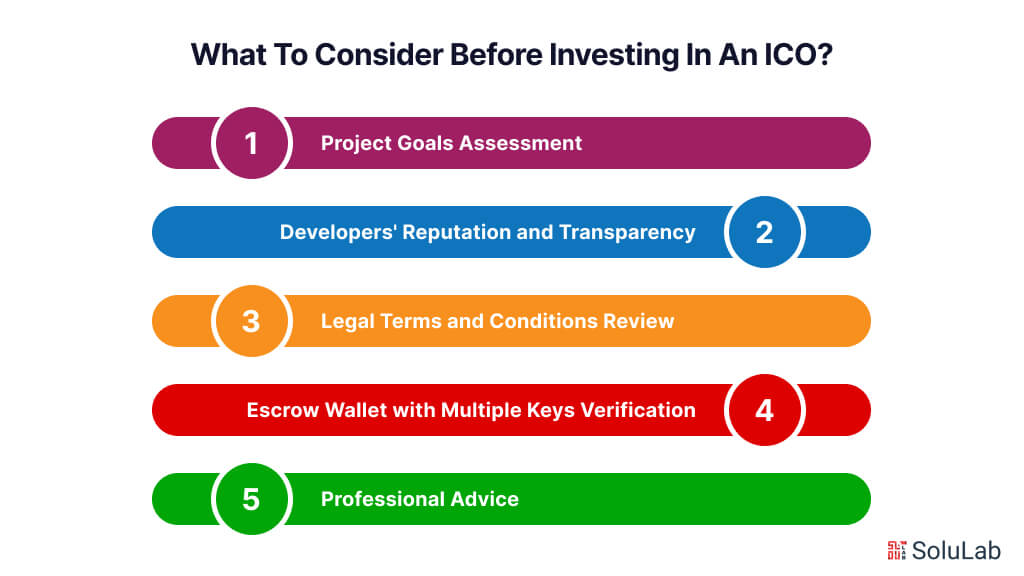
1. Project Goals Assessment:
- Look hard at the goals. Are they actually realistic, or just ambitious on paper?
- Watch for promises and timelines that sound too good. That’s usually over-ambition talking.
- A legitimate project has clear, practical goals that actually match what its team and resources can deliver.
2. Developers’ Reputation and Transparency:
- Dig into the developers behind the project. Do they have a track record in crypto, or is this their first attempt?
- Check how transparent they’ve been historically. Reputation tells you a lot here.
- Red flags worth hunting for: past failures, questionable dealings, anything that smells off.
3. Legal Terms and Conditions Review:
- Read the legal terms closely. Are they clear? Complete? Actually compliant?
- Pay special attention to how distribution, refunds, and dispute resolution are handled.
- A lawyer’s opinion isn’t overkill here. It’s how you find out what you’re actually agreeing to.
4. Escrow Wallet with Multiple Keys Verification:
- Confirm the raised funds sit in a multi-key escrow wallet, not a single wallet one person controls.
- That structure keeps any single party from controlling the funds outright, which cuts the odds of misappropriation or outright fraud.
- Ideally, a reputable third-party custodian manages that wallet, not the founders themselves.
5. Professional Advice:
- Bring in people who actually know this space: financial advisors, analysts who specialize in ICOs specifically.
- They can size up the project’s potential, flag the risks you might miss, and help you decide with your eyes open.
None of this eliminates risk. It just lowers it. The crypto market stays volatile no matter how promising a project looks on paper, so the smart move is research first, caution always, and never invest money you can’t afford to lose.
The Difference Between Coin And Token
People use “coin” and “token” interchangeably, but they’re not the same thing. Coins, Bitcoin, Ether, Ripple, Litecoin, run on their own dedicated blockchain networks and serve a specific job: a store of value, a medium of exchange, that kind of thing. Tokens don’t build their own blockchain. They ride on top of one that already exists. Every project defines its tokens a little differently, which is exactly why the ERC20 standard on Ethereum exists, to give some of them a common shape. The core difference comes down to infrastructure: coins own their chain, tokens borrow one. And usually, coins and tokens get listed on separate cryptocurrency exchanges. Get this distinction wrong, and pretty much everything else about crypto gets confusing fast.

Conclusion
So where does that leave you? If you started out asking “what is an Initial Coin Offering,” you now know it’s more than one thing: a fundraising mechanic, a regulatory gray zone, and, for the right project, a genuine growth engine. ICO vs IPO, how to actually build one, the different types on offer, all of it matters once real money is on the table. And with so many listings competing for attention, the real skill is telling which projects are worth your time. ICO development shapes whether these ventures succeed or quietly fade out. Companies like SoluLab work in this space every day, offering guidance and practical solutions for teams planning their own coin offering. Worth exploring our ICO listing if you want to stay on top of what’s actually happening in this market.
FAQs
Bhavya is driving growth through data-backed demand generation for AI and Web3 solutions. With 9+ years in digital marketing, he has spearheaded initiatives that led to a 40% increase in qualified inbound leads. Bhavya shares insights on marketing ROI and scaling a digital presence via AI workflows. He is open to connecting with startups and enterprise teams to help them overcome their challenges.